

Dr Forest
Dr Forest's Montmorillonite Clay Minerals | Organic Soil Conditioner
Dr Forest's Montmorillonite Clay Minerals | Organic Soil Conditioner
Couldn't load pickup availability
Montmorillonite clay minerals — the soil's nutrient battery: holds nutrients, holds water, builds structure
Sandy soils drain too fast. Peat-free composts leach nutrients with every watering. Coir holds almost nothing. The fundamental problem in all of these growing media is the same: they have almost no cation exchange capacity (CEC) — the soil's ability to hold positively charged nutrient ions on its surfaces and release them to plant roots on demand. Without CEC, nutrients pass straight through. You apply fertiliser and the next watering washes it away. You water, and an hour later the pot is dry. The soil cannot hold onto anything.
Montmorillonite clay is the solution. It has the highest cation exchange capacity of any naturally occurring mineral. A single gram has an internal surface area of approximately 800 square metres — an enormous negatively charged surface that captures and holds positively charged nutrient ions (calcium, magnesium, potassium, ammonium, iron, manganese) against leaching. When plant roots release hydrogen ions during normal nutrient uptake, the clay exchanges its stored nutrients in return — a self-regulating, slow-release mechanism built into the soil matrix itself. This is what makes the world's most productive agricultural soils work: they contain clay. Adding it to clay-poor media transforms them from inert sponges into nutrient-retaining growing systems.
Derived from natural bentonite clay deposits, this montmorillonite is unprocessed, chemical-free, and rich in essential micro-elements. Its unique plate-like crystalline structure swells on contact with water — absorbing moisture between the mineral layers and releasing it gradually as the soil dries. This dual function — nutrient retention and water regulation — makes montmorillonite the single most effective structural amendment for light, sandy, and peat-free growing media.
What montmorillonite clay is used for
- Transforming sandy soils and peat-free composts into nutrient-retaining media — the ultra-high CEC holds calcium, magnesium, potassium, ammonium, and iron on the clay surfaces instead of letting them leach away with every watering or rainfall event
- Increasing water-holding capacity in free-draining soils and container media — montmorillonite swells as it absorbs water between its mineral layers, then releases that water gradually as the surrounding soil dries; this buffers the wet-dry cycle that stresses plants in sandy soils and containers
- Improving fertiliser efficiency — stopping nutrients from washing through — when you add fertiliser to a low-CEC medium, much of it leaches out before roots can absorb it; montmorillonite captures those nutrients and holds them in the root zone, reducing waste and extending the effective duration of every application
- Building clay-humus complexes for long-term soil fertility — montmorillonite binds with humic substances to form extremely stable organo-mineral complexes that persist in soil for decades; these complexes are the foundation of long-term fertility in the world's most productive agricultural soils
- Coir and peat-free media conditioning — coir and many peat-free composts have virtually no mineral content and negligible CEC; adding montmorillonite provides the nutrient-holding framework that these media lack entirely
- Composting aid — controlling odour and accelerating decomposition — montmorillonite binds ammonium ions that would otherwise volatilise as ammonia (the source of compost odour), retaining the nitrogen in the compost; it also provides mineral surfaces that micro-organisms colonise, accelerating decomposition
- Lawn soil improvement in sandy areas — broadcast across sandy lawns to improve water retention and reduce the frequency of watering needed during dry spells
- Providing essential micro-elements — montmorillonite naturally contains calcium, magnesium, iron, and other micro-elements that are released slowly as the clay participates in cation exchange
Montmorillonite clay vs the Mineral Mix — when to use which
Montmorillonite Clay Minerals (this product)
- Pure clay mineral — the standalone CEC builder
- Use when you want to add CEC and water retention to a soil mix without the other components in the Mineral Mix
- Ideal for living soil builders who formulate their own blends and want control over each ingredient individually
- Excellent composting aid — bind ammonia, reduce odour, accelerate decomposition
- The right choice when CEC building and water retention are the specific goals
Dr Forest Mineral Mix
- Six-ingredient blend that includes montmorillonite alongside volcanic rock dust, gypsum, sea-shell meal, and humic acid
- Provides CEC + trace elements + calcium + silica + humic acid in a single product
- The easier choice for gardeners who want one product that addresses multiple dimensions of soil mineral health
- Already contains montmorillonite — no need to add extra unless your medium is extremely sandy or CEC-poor
- The right choice for general-purpose soil conditioning and remineralisation
The science of montmorillonite: 800 m² in a gram, and why that changes everything in the soil
The plate-like structure — how montmorillonite works
Montmorillonite is a 2:1 phyllosilicate clay mineral — meaning each particle consists of an aluminium octahedral sheet sandwiched between two silica tetrahedral sheets. These three-layer "sandwiches" stack on top of each other with a gap between them called the interlayer space. This is where the magic happens. Water molecules and nutrient cations enter the interlayer space, causing the clay to swell. The interior surfaces of every interlayer space are negatively charged — attracting and holding positively charged nutrient ions (Ca²⁺, Mg²⁺, K⁺, NH₄⁺, Fe²⁺/³⁺, Mn²⁺) with electrostatic force.
The total surface area — external faces plus every interlayer space — gives montmorillonite approximately 800 square metres of reactive surface per gram. For comparison, kaolinite clay (the type found in most garden "clay soils") has a surface area of only 10–30 m²/g. This 30-to-80-fold difference in surface area is why montmorillonite has such dramatically higher CEC, water-holding capacity, and nutrient retention than other clay types.
Why CEC is the most important soil property most gardeners have never heard of
- Cation exchange capacity (CEC) is the soil's ability to hold positively charged nutrient ions on its surfaces and release them to plant roots on demand
- Calcium (Ca²⁺), magnesium (Mg²⁺), potassium (K⁺), ammonium (NH₄⁺), iron (Fe²⁺/³⁺), and manganese (Mn²⁺) are all cations — they are ALL held by CEC
- A soil with low CEC loses these nutrients every time it rains or you water — the nutrients simply wash through
- Sandy soils: CEC of 1–5 meq/100g. Peat-free compost: typically 5–15. Coir: 2–8. These cannot hold nutrients
- Montmorillonite: CEC of 80–120 meq/100g — the highest of any natural mineral
- Adding even a small percentage of montmorillonite to a low-CEC medium can multiply its nutrient-holding capacity several times over
- This is why you can apply fertiliser to sandy soil and see no response — the nutrients leach out before roots can absorb them; montmorillonite stops this
Clay-humus complexes — the long game
- When montmorillonite clay meets humic substances in the soil, they bind together to form organo-mineral complexes of extraordinary stability
- These clay-humus complexes resist decomposition for decades to centuries — they are the physical foundation of long-term soil fertility
- The complexes have even higher CEC than either component alone — the negative charges of both clay and humic acid combine
- They improve soil aggregate stability, creating the crumb structure that gives good soil its tilth, aeration, and drainage
- They provide physical habitat for beneficial soil micro-organisms — the surfaces and pores of the complexes are colonised by bacteria and fungi
- The world's most productive agricultural soils (the Chernozems of Ukraine, the Mollisols of the American prairies) are defined by their clay-humus complex content
- Adding montmorillonite clay and humic acid together (or using Dr Forest Mineral Mix, which contains both) begins building these complexes immediately
Five mechanisms of action
Cation Exchange — the Nutrient Battery
Montmorillonite's negatively charged surfaces attract and hold positively charged nutrient cations. When a plant root releases hydrogen ions (H⁺) into the soil solution — the normal process of active nutrient uptake — the hydrogen displaces a stored nutrient cation from the clay surface, which is then absorbed by the root. The clay is "recharged" every time you apply fertiliser, and "discharged" every time the plant feeds. This is why CEC is the soil's nutrient battery — and why montmorillonite, with its 80–120 meq/100g, is the most powerful natural battery material available.
Water Absorption & Buffered Release
Water molecules enter the interlayer spaces between montmorillonite's plate-like sheets, causing the mineral to swell to several times its dry volume. This absorbed water is held against gravity and released gradually as the surrounding soil dries — providing a moisture buffer that reduces the severity of the wet-dry cycle. In containers, this means longer intervals between waterings. In sandy garden soil, it means less drought stress during dry spells. The swelling is reversible and repeats with every wetting-drying cycle, indefinitely.
Fertiliser Efficiency Multiplier
In a low-CEC medium (sand, coir, peat-free compost), a significant proportion of applied fertiliser leaches out with the next watering before roots can absorb it. Montmorillonite intercepts those nutrients and holds them in the root zone. This means less fertiliser is wasted, each application lasts longer, and the effective cost of fertilising is reduced. Research consistently shows that adding clay to sandy soils increases nitrogen recovery efficiency by 20–40% — the same amount of fertiliser produces more growth because less is lost to leaching.
Ammonia Binding in Compost
During composting, microbial decomposition of protein-rich materials releases ammonium (NH₄⁺). In the absence of binding sites, ammonium converts to ammonia gas (NH₃) and volatilises — the source of the strong smell from poorly managed compost, and a direct loss of nitrogen from the finished product. Montmorillonite's CEC captures ammonium ions before they can volatilise, retaining the nitrogen in the compost as a plant-available nutrient. Compost made with montmorillonite is measurably higher in nitrogen and significantly less odorous during production.
Microbial Habitat & Stimulation
The enormous surface area of montmorillonite provides physical habitat for beneficial soil bacteria and fungi. Micro-organisms colonise the external and interlayer surfaces, using the mineral nutrients held on the clay as cofactors for their enzyme systems. Research has shown that montmorillonite-amended soils have higher microbial biomass, greater enzyme activity, and faster organic matter turnover than unamended controls. The clay does not just hold nutrients — it actively supports the biological community that cycles them.
Scientific References
- Bohn, H.L. et al. (2001). Soil Chemistry (3rd ed.). Wiley. [Cation exchange, clay mineralogy, montmorillonite structure]
- Bronick, C.J. & Lal, R. (2005). Soil structure and management: a review. Geoderma, 124(1–2), 3–22.
- Schulze, D.G. (2005). Clay minerals. In: Encyclopedia of Soils in the Environment. Elsevier, 246–254.
- Sposito, G. (2008). The Chemistry of Soils (2nd ed.). Oxford University Press. [Surface chemistry of phyllosilicate clays]
- Canellas, L.P. & Olivares, F.L. (2014). Physiological responses to humic substances as plant growth promoter. Chemical and Biological Technologies in Agriculture, 1(1), 3. [Clay-humus complex formation]
How to use montmorillonite clay: application rates for soil, containers, compost & lawns
Unlike fertilisers and biological amendments that are consumed and need regular replacement, montmorillonite clay is a mineral that does not degrade. Once mixed into soil or growing media, it remains there permanently — continuing to hold nutrients, absorb water, and support soil structure indefinitely. Each application is a permanent improvement to the growing medium. You are not feeding the soil; you are physically upgrading its capacity to function.
Application rates
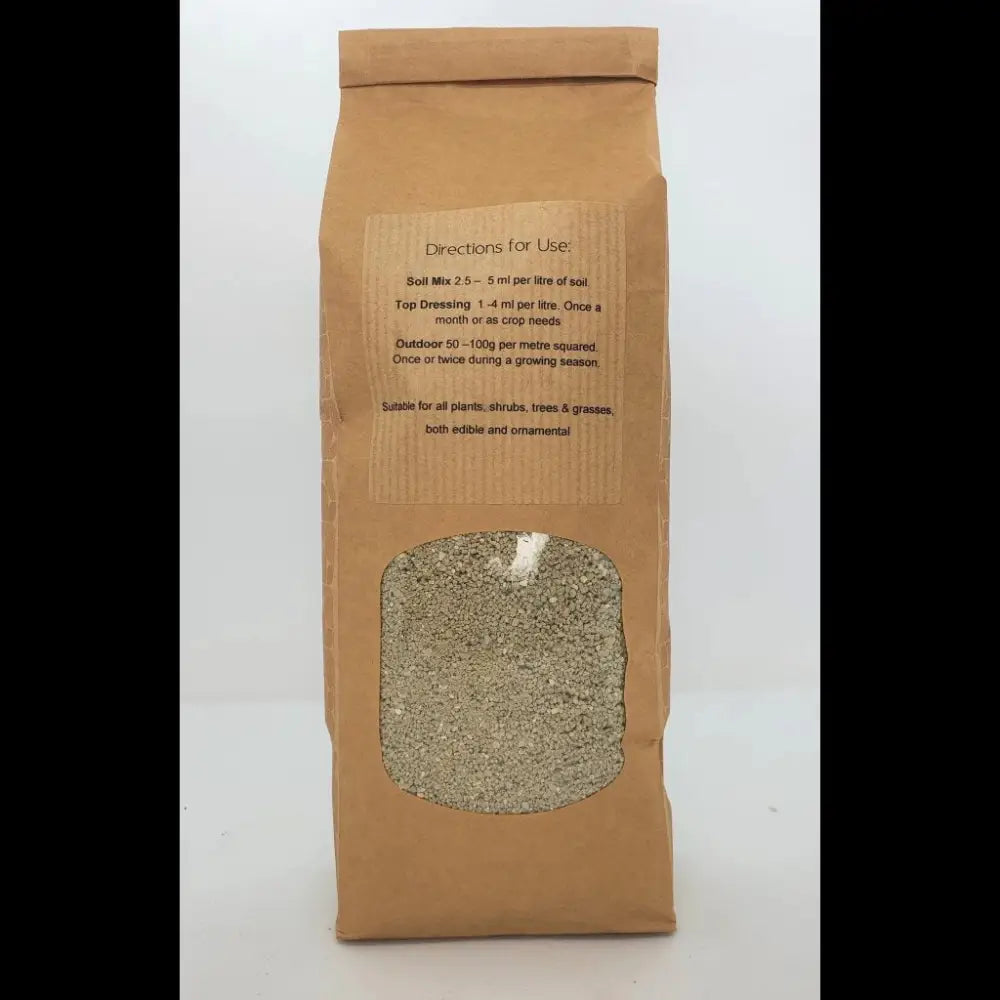
Soil mix — potting and container media
Mix thoroughly into potting compost, peat-free media, coir, or living soil blends before planting. Even at the lower rate (2.5 ml/L), the CEC improvement is significant — the 800 m²/g surface area means a small amount of clay contributes an enormous number of exchange sites. Use the higher rate (5 ml/L) for very sandy or coir-based media with minimal native CEC. Do not exceed 5 ml/L in container mixes — too much clay can impede drainage in confined volumes.
Top dressing — containers, pots and raised beds
Sprinkle over the soil surface and water in well. The clay particles work into the soil profile over successive waterings. Top dressing is useful for existing plantings where you cannot remix the soil — the clay incorporates gradually from the surface down. Use the lower rate for maintenance on media that already contain some clay; the higher rate for very free-draining media that are losing nutrients rapidly.
Outdoor beds, borders and vegetable plots
Scatter over the soil surface and fork or rake into the top 10–15 cm. Water in well. Use the higher rate (300–500g/m²) for sandy and free-draining soils that are losing nutrients and drying out rapidly. Use the lower rate (100–200g/m²) as annual maintenance on soils that have been previously amended. The effect is cumulative and permanent — each application adds to the CEC reservoir that remains in the soil indefinitely.
Composting aid
Sprinkle montmorillonite between layers of compost material, particularly when adding high-nitrogen materials (grass clippings, kitchen waste, manure) that tend to produce ammonia. The clay captures ammonium ions before they volatilise, retaining nitrogen in the compost and significantly reducing odour. The finished compost will have higher nitrogen content and a richer mineral profile than compost made without clay.
Lawn improvement — sandy soils
Broadcast over the lawn after scarifying or aerating — the clay particles need to reach the root zone, so application to recently aerated turf is far more effective than scattering on a dense, matted surface. Water in thoroughly. Repeat annually for 2–3 years to build a meaningful clay content in the root zone. Once established, the clay is permanent and continues working indefinitely without further application.
Coir and peat-free media conditioning
Coir has a CEC of approximately 2–8 meq/100g — far too low to hold nutrients effectively. Adding montmorillonite at 3–5 ml/L raises the effective CEC of the medium by several fold, transforming coir from an inert sponge into a nutrient-retaining growing system. Mix thoroughly before planting. Combine with Dr Forest Sea Shell Meal or Gypsum for calcium, and Volcanic Rock Dust for trace elements — coir needs all three to function as a complete growing medium.
Step-by-step application
- Measure the correct amount. For soil mixes: 2.5–5 ml per litre. For beds: 100–500g per m². For compost: a few handfuls per layer. A tablespoon is approximately 12–15g of clay.
- Mix or scatter evenly. For soil building, mix thoroughly into the growing medium. For beds, scatter and fork in. For top dressing, sprinkle and water in. Even distribution is important — clay clumps will create localised drainage problems.
- Water in well. Water activates the swelling mechanism and begins integrating the clay into the soil matrix.
- Do not overdo it in containers. Too much clay in a confined volume can impede drainage. Stick to 2.5–5 ml/L for containers. In open ground, drainage is less of a concern and higher rates are safe.
- Store sealed and dry. Montmorillonite is hygroscopic — it will absorb moisture from the air and clump if stored open. If clumped, break apart and use as normal — the quality is unaffected. Indefinite shelf life.
Every time you water a pot of sandy compost or coir, some of the nutrients you applied wash out the bottom. This is leaching, and in low-CEC media it can waste 30–50% of applied fertiliser. Montmorillonite intercepts those nutrients and holds them in the root zone until the plant is ready to absorb them. The result: each fertiliser application lasts longer, less is wasted, and you need to feed less frequently. The clay pays for itself by reducing the amount of fertiliser required to achieve the same level of plant growth.
Montmorillonite builds CEC — but it does not supply trace elements or NPK nutrition. Combine with Dr Forest Volcanic Rock Dust for trace mineral supply and Humic Acid for clay-humus complex formation — these three together create the mineral foundation of a high-performance living soil. For a single product that includes montmorillonite alongside volcanic rock, gypsum, sea-shell meal, and humic acid, use the Dr Forest Mineral Mix instead. Add a balanced fertiliser — Veg 4-4-4, Bloom 2-8-4, or All-Purpose 6-6-6 — for NPK nutrition, and Grow-Kashi for the biology that populates the clay surfaces.
Frequently asked questions about montmorillonite clay
Share