Dr Forest
Organic Bloom Fertiliser UK | 2-4-8 NPK | High Potash
Organic Bloom Fertiliser UK | 2-4-8 NPK | High Potash
Couldn't load pickup availability
Bloom fertiliser 2-4-8 — premium organic plant food for finishing, ripening and aroma
Bloom 2-4-8 is a high-potassium organic bloom fertiliser — a natural bloom booster built for sugar transport, terpene production and the finishing weeks of flower. The ratio is potassium-dominant — 8% K₂O drives sucrose loading from leaves into developing flowers and fruit, sharpens aroma compound production, and supports stem strength under heavy bud and fruit loads. Phosphorus sits at 4% to maintain flower set without front-loading P after early bloom, and reduced nitrogen at 2% prevents the leaf stretch that thins flowers and softens finishing weight. Sulphur runs above 7% — the highest in the bloom range — to feed the cysteine, methionine and sulphur-volatile pathways that anchor terpene biosynthesis. Twenty organic and mineral inputs deliver this in one handcrafted granular blend.
This is a living-soil flower fertiliser. Nutrients release through microbial activity, not chemical solubility — the same biology that produces the secondary metabolites responsible for flavour, aroma and resin in the finished crop. Bloom 2-4-8 is the higher-potassium partner to Bloom 2-8-4 — use as a standalone bloom feed for K-favouring growers, or switch from 2-8-4 to 2-4-8 in the final three to four weeks for a sharpened harvest. Handcrafted in small batches in Stockport.
What Bloom 2-4-8 is used for
- Late-flower finishing — the primary finishing feed for growers running Bloom 2-8-4 through early-to-mid flower; switch to 2-4-8 in the final three to four weeks for sugar load, aroma sharpness and finishing weight.
- High-potassium standalone bloom feed — for growers who favour potassium-dominant nutrition through the whole flowering cycle. Top dress when flowers form and continue through harvest.
- Fruit ripening and sugar accumulation — potassium drives sucrose loading from leaves into developing fruit. Ideal for tomatoes, peppers, soft fruit and fruit trees in the ripening window.
- Terpene and aroma production — elevated sulphur (~7% SO₃) supports the mevalonic acid pathway; chloride-free potassium preserves flavour and volatile compound development.
- Heavy bud and fruit loads — potassium supports stem rigidity, water flow and the cell-wall strength that holds finishing weight without collapse. Silica meal in the blend adds structural support.
- Living soil and no-dig beds — feeds the soil food web; fermented bio-char, humic and fulvic acid, seaweed and a microbial inoculant maintain biology through the finishing window.
- Stage feeding for serious growers — the finishing piece in a Veg 4-4-4 → Bloom 2-8-4 → Bloom 2-4-8 programme. See the transition steps in the How to Use tab.
Organic high-potash bloom feed vs synthetic K booster
Dr Forest Bloom 2-4-8 (Dry Amendment)
- 20 organic inputs — multiple sources per nutrient, even release over weeks
- Feeds through microbial breakdown — secondary metabolites drive flavour and aroma
- Potassium 8%, sulphur ~7% — the highest S in the bloom range, anchors terpene biosynthesis
- 0% chloride — chloride salts suppress flavour compound accumulation; SOP preserves it
- Calcium ~6% from gypsum, rock phosphate and Phosphorous Meal — still strong cell-wall support
- No flush needed — biology self-regulates nutrient draw-down before harvest
- Reuse your substrate — top dress and grow again
Typical Liquid Synthetic K Booster
- One or two mineral salt inputs — single source per nutrient, rapid depletion
- No microbial activity — no secondary metabolite production
- Often potassium chloride (KCl) — chloride suppresses terpene formation and damages soil biology
- Usually zero calcium, limited or no trace minerals
- Salt accumulation damages roots and kills beneficial microbes
- Requires extended flush before harvest to remove salt residues
- Substrate is spent after one cycle — dispose and replace
Which bloom fertiliser is right for you?
We make three bloom fertilisers, each built from the same organic inputs in different proportions. Bloom 2-8-4 is our bestseller — high phosphorus, moderate potassium, ideal as a standalone bloom feed or for early-to-mid flower. Bloom 2-4-8 shifts the balance toward potassium — for growers who favour higher K in the mid-to-late flowering phase for sugar transport and ripening, or as a finishing-stage swap from 2-8-4 in the final three to four weeks. Bloom 2-8-10 delivers high P and high K together — for heavy-feeding varieties or growers who want maximum phosphorus and potassium throughout. Many growers use a single bloom all the way through; others run 2-8-4 into early flower then switch to 2-4-8 for the finishing weeks. Both work — pick the ratio that matches how you grow.
Why Bloom 2-4-8 costs more than our Premium range
If you are running separate veg and bloom fertilisers — or splitting bloom across early and finishing stages — you are already growing for maximum results. We built Bloom 2-4-8 for that approach, and we loaded it with the expensive ingredients that drive results, which is why it costs more than our Premium range (Tomato, Rose & Flower, Fruit & Veg, Strawberry). Compared to those blends, Bloom 2-4-8 contains 2.5× the humic and fulvic acid and double the Scottish seaweed. Veg and Bloom also include diastatic malted barley and the Amino Acid Powder we sell as a standalone — neither of which is in any of our other fertilisers. The Premium range is excellent for one-product growers. Bloom 2-4-8 is for growers who want the very best at each stage.
Every batch is blended by hand in our Stockport unit and made with organic ingredients throughout, with British sources used wherever we can find them — including Scottish seaweed. No slaughterhouse waste, no synthetic chemistry.
What's inside: 20 organic inputs, weighted toward potassium and sulphur
Bloom 2-4-8 carries the same premium ingredient set as our Veg 4-4-4 and Bloom 2-8-4, blended in different proportions to deliver a potassium-dominant bloom ratio. Phosphorus inputs are reduced (P drops from 8% in 2-8-4 to 4%), sulphate of potash inclusion is roughly doubled to lift K from 4% to 8%, and the elevated SOP loading pushes total sulphur to around 7% — the highest in the bloom range. Multiple sources stack at each nutrient — three for phosphorus, three for potassium, three for calcium, four for sulphur — so the plant draws steadily from a deep nutrient bench through the entire finishing cycle.
Nitrogen Extract
British-produced plant protein concentrate at 12% N — included at a deliberately reduced rate for the bloom stage. Provides background nitrogen to support leaf function and the early flower stretch without driving the soft, airy growth that excess N produces during finishing. Releases gradually through microbial mineralisation.
Phosphorous Meal
A calcined plant meal at roughly 15% P₂O₅ and 9% CaO — included at a reduced rate vs Bloom 2-8-4 to deliver the moderate 4% P target. The phosphorus is citric acid soluble, which means plant roots can unlock it on demand through their own organic acid exudates. Sufficient P for sustained flower set and seed development through the finishing weeks, without front-loading the heavy P demand that defines early bloom.
Amino Acid Powder
A high-grade plant-derived free amino acid concentrate at 12% N — the same Amino Acid Powder we sell as a standalone product on the website. Free amino acids are absorbed by plant roots in pre-formed nitrogen units, bypassing the energy-intensive nitrate-to-amino-acid conversion that takes place inside the plant. Particularly useful during finishing, when carbon budgets are tight and every unit of metabolic energy spent on nitrogen assimilation is energy not spent on flower and aroma compound production.
Alfalfa Meal
Cold-milled lucerne containing triacontanol — a natural long-chain alcohol that increases photosynthetic efficiency. Photosynthesis is the limiting resource during finishing; every additional percentage point translates into more sugars available for loading into flowers and fruit. Alfalfa breaks down quickly in moist soil, releasing background N and K plus growth-promoting compounds across the first three weeks of application.
Sulphate of Potash
The workhorse of Bloom 2-4-8 — K₂SO₄ at 50% K₂O and 45% SO₃, included at roughly double the rate vs Bloom 2-8-4 to deliver the high-K target. Chloride-free, which matters more here than anywhere else in the range: chloride salts suppress flavour compound accumulation and damage soil biology, and they are the standard K source in cheap synthetic boosters. Potassium regulates stomatal opening and the long-distance transport of sucrose from leaves to flowers and fruit. Sulphur is a precursor for the sulphur-containing volatile compounds that anchor aroma.
Micronised Rock Phosphate
Ultra-finely milled apatite mineral at 31% P and 49% Ca — included at a reduced rate vs Bloom 2-8-4 in line with the lower P target. Provides a slow-release phosphorus reserve that continues feeding flowers long after faster sources are depleted. Micronisation increases the surface area exposed to soil acids and root exudates, lifting availability well above coarse rock phosphate. The high calcium content underpins the total Ca budget in the finished blend.
Gypsum
Calcium sulphate dihydrate (CaSO₄·2H₂O) at 23% Ca and 17% S. Soluble calcium without the pH lift of limestone — important for established living soil that already sits in the right pH band. Calcium loads cell walls during the rapid expansion and weight gain of finishing flowers and fruit; the sulphate fraction supports cysteine and methionine synthesis, both essential for terpene precursor production.
Kieserite
Magnesium sulphate monohydrate at roughly 25% Mg and 50% S. Soluble magnesium pairs neatly with the calcium load — magnesium sits at the centre of every chlorophyll molecule, and chlorophyll is the engine that powers continued sugar production through finishing. The high sulphate contribution adds to the blend's elevated S budget for amino acid and terpene biosynthesis.
Diastatic Malted Barley
A nutrient cycling activator unique to our Veg and Bloom blends. Germinated barley containing active amylase and protease enzymes that break down starches and proteins in the soil into plant-available sugars and amino acids. Accelerates the microbial cycling that releases secondary metabolites responsible for flavour and aroma. Not in any of our other fertilisers.
Fermented Bio-Char
Pyrolysed carbon with internal surface area approaching 300 m² per gram, pre-charged with microbial communities through fermentation. Especially valuable in a high-K blend like Bloom 2-4-8: bio-char's negatively charged surfaces hold positively charged potassium ions and release them gradually to plant roots, protecting against the leaching losses that plague high-K applications. Lehmann et al. (2011) showed K retention increases of 18–35% under leaching conditions.
Organic Humic & Fulvic Acid
Humic acid lifts cation exchange capacity, builds aggregate structure and stimulates root growth. Fulvic acid is a low-molecular-weight chelator that binds micronutrients into plant-available complexes and shuttles them across cell membranes — vital during finishing when micronutrient demand for enzyme cofactors peaks. Bloom 2-4-8 carries this at 2.5%, around 2.5× the level in our Premium range.
Scottish Seaweed (Ascophyllum nodosum)
Cold-water Ascophyllum hand-harvested from the Scottish Atlantic coast. Contains cytokinins, auxins, gibberellins, alginic acid, laminarin and over 60 trace elements. During finishing the cytokinin activity delays leaf senescence, keeping the canopy photosynthetically active longer to power continued sugar loading. The whole-plant powder runs at 4% — double the level in our Premium range — and pairs with the concentrated seaweed extract further down the list for a fast-acting plus slow-release biostimulant pairing.
Rapeseed Meal
Medium-speed nitrogen source from cold-pressed oilseed rape. Contributes background N, a small phosphorus fraction and modest sulphur from the residual sulphur compounds in the seed. The slow protein breakdown extends the nitrogen tail across the application window without spiking levels at any single point — important during finishing when nitrogen excess softens flowers and delays ripening.
Mealworm Frass
Insect castings rich in nitrogen, phosphorus, potassium and chitin. Chitin triggers the plant's systemic defence response through a well-documented elicitor pathway — particularly valuable during finishing, when pest pressure tends to rise and the crop is at its most valuable. Frass also contributes a biological potassium fraction and a steady NPK trickle through microbial mineralisation.
Clay Minerals
High cation exchange capacity (CEC) clay minerals that hold positively charged nutrient ions — including potassium — and release them gradually to plant roots. Critical in a high-K blend: without CEC capacity, applied potassium is prone to leaching, especially in coco coir and sandy soils. Clay acts as a buffer, holding K through demand spikes and protecting against the deficiency swings that come from heavy waterings.
Effective Microorganisms
A blend of beneficial soil bacteria and yeast cultures introduced as a dormant powder. Once activated by water, the inoculant boosts the breakdown of organic matter, supports the production of plant-available nutrients and contributes to a more diverse rhizosphere community. Particularly useful when amending used substrate between cycles.
Herbal Mixture
A proprietary blend of dried herbs and botanical material contributing trace plant compounds, plant-derived growth factors and additional carbon forms for soil biology to work on. Broadens the range of organic substrates available to the microbial community, supporting the metabolic diversity that drives quality compound production through the finishing window.
Volcanic Rock Dust
Volcanic basalt ground to a fine powder, carrying over 60 trace elements — iron, manganese, zinc, copper, boron, molybdenum, cobalt, selenium. Trace elements are critical during finishing: boron supports pollen tube growth in late flower, zinc regulates auxin synthesis, manganese supports photosynthesis, iron underpins chlorophyll production. Released slowly over several years, building the trace mineral reserve in the substrate.
Silica Meal
Plant-available silicon — the structural nutrient that strengthens cell walls and increases stem rigidity. Especially valuable in a high-K finishing blend: heavy flowers and ripening fruit are mostly water, and that weight has to be supported by the stem. Silica-fed plants produce thicker stems capable of holding finishing loads without staking. Silicon also improves resistance to heat stress and fungal penetration, both elevated risks during the dense humid canopy conditions of late flower.
Seaweed Extract
A concentrated seaweed extract sitting alongside the standalone Scottish Seaweed powder — two forms of the same seaweed family, working at different speeds. The extract is fast-acting: cytokinins, auxins and gibberellins released within days of watering in, supporting flower maintenance and reducing senescence in the finishing weeks. The whole-plant powder releases slowly over the cycle. Two seaweed sources working together give a steady biostimulant signal from application through to harvest.
How to use Bloom 2-4-8: application rates, transition guide and feeding programme
Bloom 2-4-8 is a granular dry amendment. Sprinkle it on the soil surface as a top dress and water it in. No pH pens, no EC meters, no mixing reservoirs. The biology does the work. Bulk density approximately 1 g/ml — useful for converting between grams and millilitres on the kitchen scales.
Application rates
Top dressing — finishing-stage feed
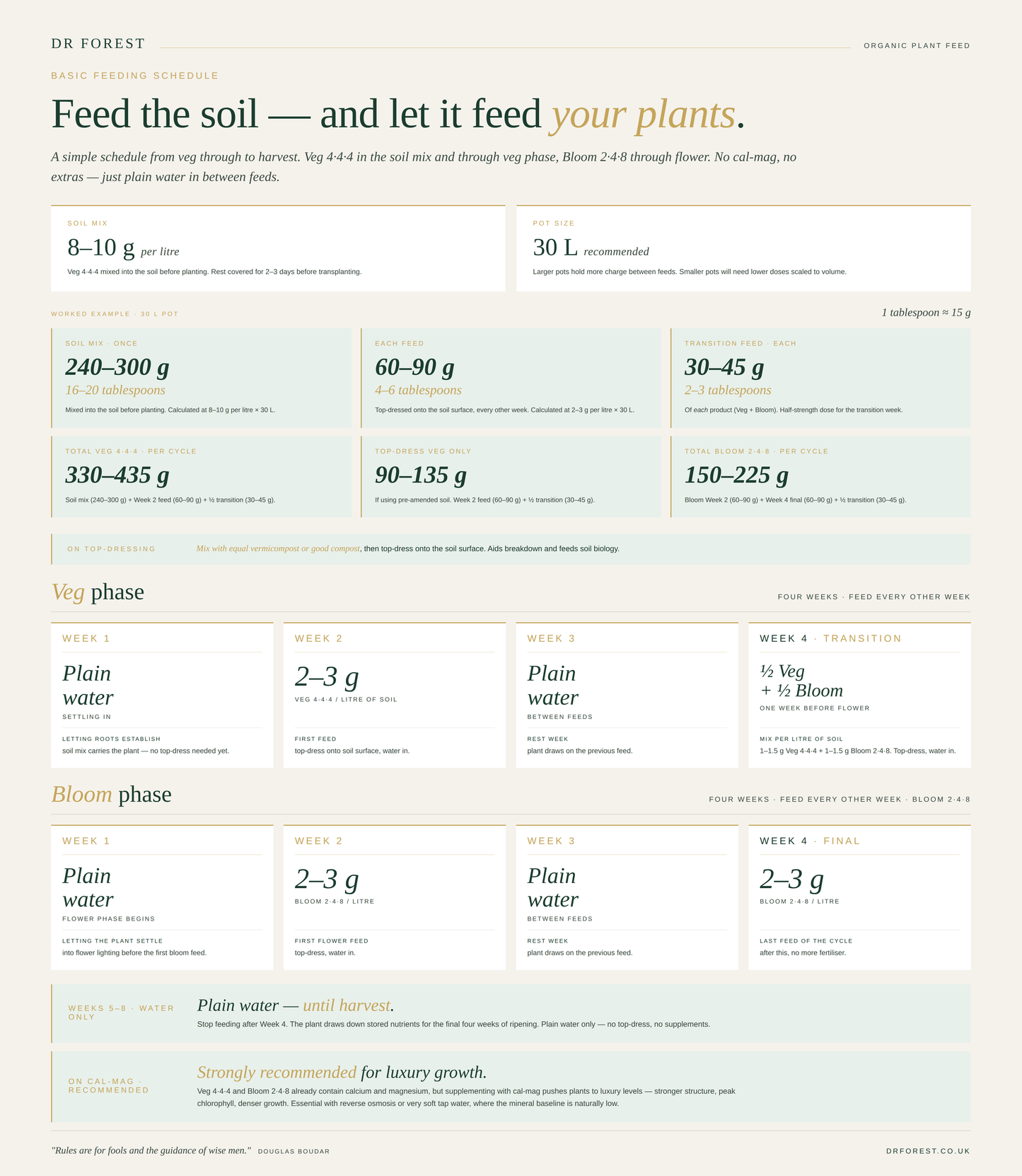
Sprinkle evenly on the soil surface around the base of the plant. Water thoroughly to begin microbial breakdown. For a standard 20-litre pot, that is roughly 3–7 tablespoons per top dress. Start at 2–3 ml per litre for early-to-mid use; work up to 4–5 ml per litre for the finishing weeks of heavy fruit/flower loads. Use our fertiliser calculator for exact quantities.
Outdoor beds — fruiting and finishing crops
Scatter evenly and rake lightly into the top 5–10 cm of soil. Water deeply after application. Use 100–200 g for light-to-moderate feeders and established beds. Use 200–300 g for heavy fruit loads — indeterminate tomatoes, peppers, large fruit trees during finishing. Outdoor beds hold nutrients longer than containers — the larger soil volume and deeper biology mean a 4–6 week cycle gives steady nutrition without accumulation risk.
Coco coir and soilless substrates
Coco coir and other soilless substrates are biologically inert — unlike soil, they contain no microbial life to break down organic matter. Add worm castings or quality compost at 20–30% of the mix to introduce the biology that makes dry amendments work. Pre-buffer with cal-mag solution before amending, or use a pre-buffered coco — unbuffered coir locks out calcium and magnesium through cation exchange. Use the upper end of the dosage range and top dress more frequently than in soil. Do not water to heavy run-off — run-off flushes dry amendments out of the root zone and is especially costly with high-K blends, since potassium is highly mobile. Water thoroughly but stop before significant drainage.
Cal-mag — recommended for luxury-level results
Bloom 2-4-8 carries enough calcium and magnesium for most growers — around 6% CaO and 1% MgO from gypsum, kieserite, micronised rock phosphate and volcanic rock dust. Calcium sits slightly lower than Bloom 2-8-4 (which has 8% CaO) because the phosphorus sources that carry calcium are reduced in this ratio. For luxury-level results — heavy crops, container growing under high light, or growers chasing maximum yields and flower density — supplement with Dr Forest Cal-Mag at 10% of your Bloom 2-4-8 rate. Apply 10 g of Bloom, add 1 g of Cal-Mag alongside it. Match the intervals to your bloom top dress. The supplement lifts calcium and magnesium from adequate into optimal, which is where the gains in cell wall integrity, terpene production and finishing weight sit.
Transitioning into Bloom 2-4-8
Bloom 2-4-8 can be used two ways — as a standalone bloom feed through the whole flowering cycle, or as a finishing-stage swap from Bloom 2-8-4 in the final weeks. Both transitions are below.
Path A — Bloom 2-4-8 as a standalone bloom feed (Veg → 2-4-8)
- Identify the transition point. For protected growing on a 12/12 light cycle, this is the cycle switch. For autoflowering varieties, the trigger is the first pre-flowers. For outdoor plants, transition when you see the first flower buds forming.
- First bloom top dress — 50:50 Veg and Bloom 2-4-8. Combine equal parts Veg 4-4-4 and Bloom 2-4-8. The plant still needs nitrogen for the early flower stretch but is also starting to demand more potassium. The 50:50 mix bridges the transition smoothly.
- Second top dress onwards — full Bloom 2-4-8. Once the stretch is complete and flowers are actively developing, switch to straight Bloom 2-4-8 at 2–5 ml per litre every 2–4 weeks.
- Carry through peak flower and finishing. Maintain Bloom top dressing through mid and late flower. The dual-speed release ensures sustained potassium and sulphur without depletion windows.
- Stop feeding 2–3 weeks before harvest. Organic growing does not need a synthetic-style flush. Stop top dressing and let the plant draw down remaining nutrients from the substrate. The biology self-regulates — there are no harsh chemical residues to clear.
Path B — Bloom 2-4-8 as a finishing swap (Veg → 2-8-4 → 2-4-8)
- Run Veg 4-4-4 through the vegetative phase until flowers initiate.
- First bloom top dress — 50:50 Veg and Bloom 2-8-4. Bridge the veg-to-bloom transition with high-phosphorus 2-8-4.
- Second top dress onwards — full Bloom 2-8-4. Top dress every 2–4 weeks through early-to-mid flower as flower buds differentiate and set. The high-P phase typically runs four to six weeks.
- Switch to Bloom 2-4-8 in the final 3–4 weeks. Once flowers are formed and the plant has moved into sugar-loading and ripening, swap to the high-K finisher. Top dress at 2–5 ml per litre once at the switch, and again two weeks later if the cycle is long enough.
- Stop feeding 2–3 weeks before harvest. Same as Path A — let the substrate run down naturally.
Use dechlorinated water. Chlorine and chloramine kill the beneficial soil microbes that break down organic matter and deliver nutrients to the plant. Stand tap water for 24 hours, run it through a carbon filter or add a dechlorinator. This single step makes the biggest difference to how well organic dry amendments perform.
Watering practice for dry amendments
Organic growing asks for a different watering approach to synthetic feeds. Water thoroughly but not to heavy run-off — wet the entire root zone, but excessive drainage flushes dissolved nutrients and microbial by-products out of the substrate. This matters more with high-K blends because potassium is one of the most mobile cations in soil. In soil, water until you see the first drops of drainage and stop. In coco coir and other soilless media this matters even more — heavy run-off washes dry amendments straight through. Let the top layer dry slightly between waterings to maintain oxygen in the root zone and encourage healthy microbial activity.
What to watch for during finishing
Signs you need to feed more
Potassium deficiency during finishing shows as classic leaf-edge scorch (necrotic brown margins, working inward), small loose flowers, and crops that lack the flavour intensity they should have. Top dress at the higher end of the range (4–5 ml per litre) and tighten the interval to every 2 weeks. In coco, feed more frequently than in soil — K leaches readily.
Signs you are overfeeding
High potassium can antagonise calcium and magnesium uptake — if you see interveinal yellowing on younger leaves (Mg deficiency) or blossom-end rot (Ca uptake issue), back off the rate. Stretch the interval to every 3–4 weeks and add Dr Forest Cal-Mag to rebalance. Overfeeding K also delays the natural slow-down that signals the plant is ready to finish.
Use Dr Forest Cal-Mag through the grow to lift calcium and magnesium from adequate into optimal — especially important alongside high-K blends like 2-4-8 where K can antagonise Ca and Mg uptake. Apply Amino Acid Powder as a watered-in or foliar boost during the early flower weeks — pre-formed nitrogen units skip the metabolic cost of nitrate conversion. Add Seaweed Powder as a fortnightly foliar to maintain biostimulant activity through finishing. Top up with Dr Forest Mineral Mix for trace mineral diversity in long fruiting seasons. See our feeding schedule for the full programme, or our measurement converter to switch between grams, ml and tablespoons.
Mix in a well-ventilated area. Wear a dust mask when handling the dry powder. Wash hands after use. Keep out of reach of children and pets. Store sealed in a cool, dry place.
Growing guide — getting the most out of finishing
Bloom 2-4-8 works across every kind of flowering and fruiting plant where potassium drives the finishing result — but the rate, frequency and timing vary depending on what you are growing. This is a working guide to which plants benefit most, what to adjust for each type, how protected and outdoor growing differ, and what to watch for through the UK season.
Which plants benefit most from a high-potash finishing feed
Heavy-fruiting vegetables
Tomatoes, peppers, chillies, courgettes, cucumbers, aubergines, squashes, melons. These crops shift from leaf-building to fruit-set in a clear window, but the big late-season demand is for potassium — to drive sucrose loading and ripen the fruit. Use 2-4-8 from the first ripening fruit onwards, or switch from 2-8-4 in mid-summer once the fruit is sized up.
Soft fruit ripening
Strawberries, raspberries, blackberries, blueberries, grapes. Apply at flowering, then again as the first fruit begins to colour. For strawberries, work into the soil before mulching with straw. The high-K finish drives Brix (sugar concentration) in the ripened fruit — taste-test crops respond particularly well.
Fruit trees in the finishing window
Apples, pears, plums, cherries, citrus, figs. Apply once at petal-fall (use 2-8-4) and again at fruit-set or colour break (use 2-4-8). For trees, apply to the drip line rather than the trunk. The high-K finish improves Brix, firmness and storage life. Avoid late nitrogen on stone fruit — it softens the harvest and shortens storage.
Flowering ornamentals at finishing
Roses, dahlias, sweet peas, sunflowers, fuchsias. The high-K supports stem strength under heavy flower loads, deepens flower colour and extends the bloom period. Use as a single feed before peak display for cut flowers; alternate with 2-8-4 for repeat-flowering shrubs.
Feeding adjustments by plant type
Heavy-fruiting tomatoes, peppers, indeterminate vines
Long fruiting seasons strip potassium faster than the average bedding plant. These crops will not stop demanding K until you cut them down. Top dress on the higher end of the range and keep the interval tight from the first ripening fruit onwards. Pair with foliar seaweed every fortnight for biostimulant activity through the harvest.
Soft fruit at ripening
Strawberries, raspberries and blueberries respond strongly to a high-K feed at colour break — sugar concentration lifts measurably. For container-grown strawberries and blueberries, drop to 3 ml per litre and apply at the same two intervals.
Roses and repeat-flowering ornamentals
Alternate Bloom 2-8-4 (after the first flush, when phosphorus drives flower bud differentiation) and Bloom 2-4-8 (after subsequent flushes, when potassium supports stem strength and flower colour intensity). Final dose by mid-August so the plant can harden off before winter.
Container-grown fruiting plants
Containers hold a finite reserve, so a small soil volume runs out of K quickly under heavy fruit. Top dress every three weeks from first ripening fruit. For hanging baskets and patio pots through midsummer, this often means weekly to fortnightly when paired with a foliar seaweed.
Protected vs outdoor growing
Protected growing (greenhouse, polytunnel, tent)
- Higher photosynthesis rates — plants demand more K per week through finishing
- Use upper end of the dose range, tighter intervals (every 2–3 weeks)
- Watch humidity through late flower — silica supports cell wall integrity against fungal pressure
- Air circulation matters more than rate increases for finished quality
- Use dechlorinated water; soil biology has to do all the cycling work
Outdoor open beds and borders
- Native soil biology supports nutrient cycling — feed less aggressively
- Use lower end of the dose range, longer intervals (every 4–6 weeks)
- Mulch over the top dress with compost or leaf mould to protect biology from sun
- Heavy rain leaches K faster than other nutrients — top dress after, not before, a forecast downpour
- For sandy free-draining soils, increase frequency rather than rate
Watering through finishing
Through bud and fruit formation
Keep soil consistently moist but not soggy. Microbial activity that breaks down a fresh top dress needs water but also oxygen — waterlogged soil shuts down both. Water in the morning so the surface dries before evening.
Mid-finishing, fruit swell
Plant water demand peaks here — heavy fruit is mostly water. Allow the top inch to dry between waterings to keep oxygen in the root zone. Long deep waterings beat frequent shallow ones, and they reduce the K leaching that hurts a high-K programme.
Late finishing and ripening
Pull back slightly. A small water deficit in the last fortnight concentrates sugars and improves flavour in fruiting crops. Do not stress the plant — wilting damages yield — but do not pour water on if it doesn't need it.
UK seasonal timeline for high-potash feeding
| Month | What to do |
|---|---|
| March | Hold off. Soil below 10°C means dormant microbes — no nutrient cycling yet. Top dress beds with Veg 4-4-4 if amending for spring sowing. |
| April | Bud-break for apples, pears and roses — start with 2-8-4 here, not 2-4-8 (early flower needs phosphorus first). Strawberries flowering under cloches. |
| May | Outdoor strawberries flowering. Greenhouse tomatoes and peppers begin bloom feeding as the first truss flowers open — start on 2-8-4. |
| June | Strawberries at colour break — switch to 2-4-8. First soft fruit picking. Roses after the first flush — 2-4-8 supports stem strength for the second flush. |
| July | Peak high-K window. Tomatoes ripening — 2-4-8 every 2–3 weeks. Soft fruit at full ripening. Outdoor beds settle to every 4 weeks. Watch for blossom-end rot in hot dry spells — water consistency matters more than feed. |
| August | Final rose dose by mid-month (2-4-8 supports the last flush). Outdoor tomatoes still cropping. Apples and pears reaching size — feed at the drip line. |
| September | Final feeds for chillies, peppers and outdoor tomatoes still ripening on. Stop feeding ornamentals so they can harden off for winter. |
| October | Late apple and pear varieties still drawing nutrients — final 2-4-8 dose at the drip line. Stop feeding everything else. |
| Nov–Feb | Hold off. Mulch over beds with leaf mould or garden compost. Resume bloom feeding when soil warms above 10°C — usually April. |
Common problems through finishing
Leaf-edge scorch (potassium deficiency)
Classic K deficiency symptom — necrotic brown margins on older leaves, working inward. If you see it on a 2-4-8 programme, the cause is usually leaching (heavy watering, sandy substrate, or high run-off in coco). Tighten the interval to every 2 weeks and check watering practice. In severe cases, foliar potassium gives a faster response than soil applications.
Blossom-end rot despite high calcium
Potassium and calcium compete at the root surface — high-K feeding can sometimes block Ca uptake even when soil Ca is adequate. Water consistently (most common cause), mulch heavily, and add Dr Forest Cal-Mag at 10% of your Bloom 2-4-8 rate to rebalance. If the issue persists, drop back to 2-8-4 for a top dress or two — the higher Ca and lower K relieves the antagonism.
Slow ripening or soft, bland fruit
If switching from a high-N feed straight into late flower and seeing slow ripening, residual N is suppressing the natural finishing process. Hold off any further N supplementation and apply Bloom 2-4-8 at the higher end of the range. The low 2% N in the blend won't add to the problem.
Interveinal yellowing on younger leaves (Mg deficiency)
K, Ca and Mg all compete at the root surface — when K is dominant, Mg can be the first to suffer. Add Dr Forest Cal-Mag at 10% of your Bloom rate to rebalance. Foliar Epsom salt (10 g/L) gives a fast response if the deficiency is severe.
Stems collapsing under fruit weight
Silica meal in the blend supports stem strength, but light limitation produces thin etiolated growth that no fertiliser can fully fix. Stake heavy crops early. For repeat grows, increase silica supplementation through veg as well as bloom.
Soft, lightweight flowers at harvest
Soft, airy flowers usually trace back to feeding too aggressively into late flower or running a higher-N product through the finishing weeks. Drop bloom feeding 2–3 weeks before harvest. For very heavy feeders, finish on Bloom 2-4-8 from the start — the higher K ratio sharpens the final fortnight.
The science behind Bloom 2-4-8: why potassium-dominant organic nutrition drives finishing quality
Why 2-4-8 is the correct ratio for finishing
Potassium is the most-demanded nutrient in fruit and flower tissue by mass, and demand peaks during the finishing weeks when sugars are being loaded into developing tissue. A potassium-dominant ratio delivers what the plant is actively pulling at the highest rate. Reduced phosphorus at 4% still supports flower set and seed development but avoids the front-loaded P demand that defines the early bloom phase. The elevated sulphur — derived primarily from sulphate of potash, with kieserite and gypsum reinforcing — supports the cysteine and methionine biosynthesis that drives terpene and volatile compound production, the chemistry of flavour and aroma at harvest. Nitrogen stays low at 2% to prevent the soft, airy finishing weight that comes from over-nitrogenated late flower.
Multi-source phosphorus at a moderate target
Phosphorous Meal contributes citric-acid-soluble phosphorus at roughly 15% P₂O₅, included at a reduced rate vs Bloom 2-8-4 to deliver the 4% P target. Plant roots unlock it on demand through their own organic acid exudates — when phosphorus is needed for late flower bud differentiation or seed development, citrate and malate secretion dissolves the meal directly in the rhizosphere. Micronised rock phosphate contributes slow-release P at 31% with significant calcium — also at reduced inclusion. The Amino Acid Powder and broader organic fraction add a smaller biological P contribution that microbes mineralise over weeks. Three sources, three release mechanisms — enough P to maintain flower function without the heavy front-loading 2-8-4 provides.
Potassium: the workhorse — chloride-free, driving sugar and terpene production
Sulphate of potash is the dominant ingredient of Bloom 2-4-8 — included at roughly double the rate vs 2-8-4 to deliver the 8% K₂O target. K₂SO₄ at 50% K₂O is chloride-free, which is critical for finishing quality: chloride salts depress flavour compound accumulation and damage soil biology over repeated cycles. Potassium during the finishing weeks is the bottleneck nutrient — it activates over 60 enzymes, regulates stomatal opening, and drives the long-distance transport of sucrose, organic acids and secondary metabolites from photosynthetic leaves into developing flowers and fruit. Higher potassium availability correlates directly with terpene concentration, Brix, flavour intensity and finished weight. The base blend and volcanic rock dust contribute additional K through slower release pathways, and fermented bio-char holds applied K against leaching losses.
Sulphur: the terpene precursor, at the highest level in the range
Bloom 2-4-8 carries sulphur from four sources — sulphate of potash, kieserite, gypsum and rapeseed meal — for a total SO₃ contribution above 7%, the highest in the bloom range. The elevated S loading is a deliberate consequence of the doubled SOP inclusion, and it is one of the main reasons 2-4-8 finishes harder on aroma than 2-8-4. Sulphur is a structural component of methionine and cysteine, and a precursor for the sulphur-containing volatile compounds that define aroma intensity in finishing crops. It is also required for the synthesis of coenzyme A, which drives the mevalonic acid pathway — the primary biosynthetic route for terpenoid production in plants.
Calcium and magnesium at finishing
The blend carries calcium from three sources — gypsum (23% Ca), micronised rock phosphate (49% Ca) and Phosphorous Meal (9% CaO) — landing close to 6% total CaO, slightly lower than Bloom 2-8-4 (around 8%) because the phosphorus-carrying inputs are reduced in this ratio. Still plenty for sustained cell-wall function through finishing. Magnesium comes from kieserite (~25% Mg) plus smaller contributions from the organic fraction. For luxury-level results — heavy crops, container growing under high light, or growers pushing for maximum density and finishing weight — supplement with Dr Forest Cal-Mag at 10% of your Bloom rate to lift these structural nutrients from adequate into optimal. This matters more on a high-K programme because K antagonises Ca and Mg uptake at the root surface; rebalancing keeps the structural nutrients available even under heavy potassium loading.
— Wang et al., 2023 (7,859 data pairs)
Dual-speed release: fast organic plus slow mineral
Fast-release fraction (days to weeks)
- Amino Acid Powder — immediately bioavailable nitrogen as free amino acids
- Alfalfa meal — rapid N, K and triacontanol
- Mealworm frass — medium-speed NPK and chitin elicitor
- Rapeseed meal — medium-speed nitrogen and sulphur
- Sulphate of potash — immediate K and S, the dominant fast K source
- Gypsum and kieserite — soluble Ca, Mg, S within days
- Phosphorous Meal — citric soluble P, released on demand
- Diastatic malted barley — enzymes accelerating nutrient cycling
Slow-release fraction (weeks to months)
- Nitrogen Extract — sustained background nitrogen at 12% N
- Micronised rock phosphate — slow P plus calcium reserve
- Volcanic rock dust — trace element release over years
- Clay minerals — CEC buffering and K storage against leaching
- Fermented bio-char — permanent microbial habitat and K-holding capacity
- Humic and fulvic acids — long-term soil structural improvement
- Effective microorganisms — ongoing biological turnover
Why organic dry amendments produce better finished crops
The quality difference between organically and synthetically grown crops is measurable and repeatable, and it is explained by biochemistry rather than ideology. Peer-reviewed research shows that organic nutrient management produces higher secondary metabolite concentration, better flavour compound profiles and healthier soil biology — all of which compound over repeated cycles.
Microbial cycling produces the secondary metabolites that define quality
When soil microbes mineralise organic matter, they produce enzymes, organic acids, amino acids and volatile compounds as by-products. Many of these secondary metabolites are absorbed by plant roots and contribute directly to terpene biosynthesis, flavour intensity and aroma complexity. Synthetic feeds bypass this biology — the nutrients arrive, but the metabolic by-products that drive quality are absent.
All 21 starch and sucrose metabolism genes upregulated under organic
Li et al. (2024) found that all 21 starch and sucrose metabolism genes were upregulated under organic fertilisation. Higher sugar content translates directly to improved flavour, aroma and resin production — and in a high-K programme like 2-4-8, the gene-level upregulation compounds with the elevated potassium that actively transports those sugars into the finishing crop.
Organic management reduces tissue nitrate accumulation
Cardarelli et al. (2023) reported that organic fertilisation reduces tissue nitrate concentrations by 27–50% compared to synthetic nitrogen sources. Lower tissue nitrate means cleaner, smoother material with reduced harshness — a quality parameter that matters to growers producing high-value crops for consumption.
Combined organic-mineral inputs maximise quality
Wang et al. (2023) synthesised 7,859 data pairs and concluded that combined organic-mineral fertilisation produces the highest crop quality outcomes of any fertiliser strategy. Bloom 2-4-8 is precisely this — organic nitrogen sources (alfalfa, frass, rapeseed, amino acids) combined with mineral nutrient carriers (sulphate of potash, gypsum, kieserite, rock phosphate, volcanic rock dust).
Organic inputs increase soil organic carbon and biology
Ferro et al. (2022) demonstrated that organic fertiliser management increases soil organic carbon by 12.9% compared to mineral-only inputs. In living soil systems, soil carbon feeds the microbial communities that produce the metabolites driving crop quality — a compounding benefit that grows with each cycle.
Enzyme activity increases under organic management
Liu et al. (2021) measured urease activity +38.3%, β-glucosidase activity +122.4%, and yield increases of 15–20% under organic fertiliser management. These enzymes are the machinery of nutrient cycling — more enzyme activity means faster, more complete mineralisation of organic inputs and greater secondary metabolite production.
Balanced NPK preserves actinobacterial diversity
Shen et al. (2024) showed that unbalanced fertilisation causes 23–31% loss of actinobacterial diversity in soil. Actinobacteria produce antifungal compounds critical for disease suppression during the dense, humid conditions of late flower. Bloom 2-4-8 maintains the microbial diversity that protects the crop through its most valuable stage.
Organic systems increase biomass while maintaining biodiversity
Xu et al. (2024) analysed 537 experiments and reported that organic fertilisation increased plant biomass by 56% while maintaining biodiversity. Inorganic fertilisation achieved 42% biomass increase but at the cost of soil biodiversity loss. In living soil systems, biodiversity is the mechanism of quality production.
Scientific References
- Li, J. et al. (2024). Organic fertilisation upregulates starch and sucrose metabolism genes. Nature Scientific Reports, 14.
- Cardarelli, M. et al. (2023). Organic vs. mineral fertilisation: effects on nitrate accumulation in crops. Agronomy, 13.
- Wang, M. et al. (2023). Combined organic-mineral fertilisation and crop quality — 7,859 data pairs meta-analysis. Field Crops Research.
- Ferro, N.D. et al. (2022). Soil organic carbon dynamics under organic vs. mineral fertilisation. Agriculture, Ecosystems & Environment, 326, 107786.
- Liu, Y. et al. (2021). Organic fertilisation increases soil enzyme activities and crop yield. Science of the Total Environment, 779, 146422.
- Shen, W. et al. (2024). Unbalanced fertilisation and actinobacterial diversity loss. Applied Soil Ecology.
- Xu, H. et al. (2024). Organic fertilisation boosts plant biomass while maintaining biodiversity. Nature Communications, 15.
- Nardi, S. et al. (2009). Humic substances and soil biology. Soil Biology & Biochemistry, 41, 2164–2175.
- Lehmann, J. et al. (2011). Bio-char effects on soil biota. Soil Biology & Biochemistry, 43, 1812–1836.
- Shukla, P.S. et al. (2019). Ascophyllum nodosum-based biostimulants. Frontiers in Plant Science, 10, 655.
- Khan, W. et al. (2009). Seaweed extracts as biostimulants. J. Plant Growth Regul., 28, 386–399.
- Epstein, E. (1999). Silicon. Annual Review of Plant Physiology and Plant Molecular Biology, 50, 641–664.
- Taiz, L. & Zeiger, E. (2010). Plant Physiology, 5th ed. Sinauer Associates. Chapter 5: Mineral Nutrition.
- Marschner, P. (2012). Marschner's Mineral Nutrition of Higher Plants, 3rd ed. Academic Press.
- Rothamsted Research. Park Grass Experiment (1856–present). Long-term organic vs. mineral fertiliser field trials.
Frequently asked questions about Bloom 2-4-8
Share