

Dr Forest
Organic Mineral Mix | Micro-Nutrient Soil Conditioner | Trace Element Blend | UK
Organic Mineral Mix | Micro-Nutrient Soil Conditioner | Trace Element Blend | UK
Couldn't load pickup availability
Organic mineral mix — volcanic rock, clay minerals, gypsum, sea-shell meal & humic acid for complete soil remineralisation
NPK fertilisers feed the plant. This mineral mix feeds the soil. Most fertiliser programmes supply nitrogen, phosphorus, and potassium — and nothing else. But plants need far more than three elements to grow well. Calcium for cell walls. Magnesium for chlorophyll. Silica for stem strength and pest resistance. Iron, manganese, zinc, copper, and boron for enzyme function. These are the minerals that determine whether your crops are merely alive or genuinely thriving — and they are the minerals most commonly missing from standard fertiliser programmes, bagged potting compost, and depleted garden soils.
Dr Forest's Mineral Mix is a six-ingredient blend designed to address every dimension of soil mineral health simultaneously. Micronised volcanic basalt rock dust and volcanic rock granules supply the broadest spectrum of trace elements available from any single geological source — the same minerals that make volcanic soils the most fertile on Earth. Bentonite and montmorillonite clay minerals increase the soil's cation exchange capacity (CEC) — its ability to hold and release nutrients rather than losing them to leaching. Micronised gypsum delivers calcium and sulphur without altering pH. Sea-shell meal provides slow-release calcium and trace minerals from a marine source. And humic and fulvic acid tie the entire system together — chelating minerals into plant-available forms and stimulating the soil biology that drives nutrient cycling.
The result is a soil conditioner that does not simply add nutrients — it rebuilds the soil's capacity to hold, cycle, and deliver nutrients over the long term. This is the difference between feeding a plant and building a soil that feeds itself.
What the mineral mix is used for
- Remineralising depleted garden soil, beds and borders — years of cropping, rainfall leaching, and NPK-only feeding strip trace minerals from the soil; this blend restores the full mineral spectrum in a single application
- Building potting soil and growing media — bagged compost and peat-free mixes are often mineral-poor; mixing in mineral mix at the soil-build stage creates a growing medium with the trace element and CEC foundation that organic growing depends on
- Improving flavour, sugar content and nutrition in fruit and vegetables — trace minerals are directly involved in the synthesis of sugars, organic acids, vitamins, and aromatic compounds that determine flavour; mineral-rich soil produces measurably more flavourful crops
- Increasing cation exchange capacity (CEC) in sandy and peat-free soils — bentonite and montmorillonite clay dramatically increase the soil's ability to hold positively charged nutrient ions (calcium, magnesium, potassium, iron) and prevent them from leaching away
- Calcium and magnesium supply without altering pH — micronised gypsum delivers calcium and sulphur at a neutral pH; sea-shell meal provides slower-release calcium; both avoid the pH increase that lime produces
- Silica supply for stem strength and pest resistance — volcanic basalt is rich in silica, which is deposited in plant cell walls to create a physical barrier against piercing-sucking insects (aphids, spider mites) and fungal penetration
- Container and raised bed soil conditioning — confined growing media lose mineral reserves faster than open ground; regular mineral mix applications maintain the trace element and CEC levels that sustain healthy plant growth in containers
- Lawn soil improvement — broadcast across lawns to improve root-zone mineral balance, soil structure, and drought tolerance; the clay minerals and gypsum improve water retention in sandy lawn soils
Why a blend rather than a single mineral?
Dr Forest Mineral Mix (this product)
- Six complementary mineral sources — each addresses a different dimension of soil health
- Volcanic rock provides the broadest trace element spectrum; clay builds CEC; gypsum delivers calcium without pH change; sea-shell provides marine calcium; humic acid chelates and activates
- Both micronised (fast-acting) and granular (slow-release) fractions in the same blend
- Supplies calcium, magnesium, silica, iron, manganese, zinc, copper, boron, and dozens of other trace elements simultaneously
- Improves soil physical structure, water retention, and aeration alongside mineral supply
- A single product replaces multiple separate amendments
Single-Mineral Amendments (rock dust, lime, gypsum alone)
- Each addresses one aspect of soil health — but leaves the others unaddressed
- Rock dust alone does not build CEC or deliver calcium efficiently
- Lime supplies calcium but raises pH — inappropriate for neutral or alkaline soils
- Gypsum alone delivers calcium and sulphur but no trace elements or CEC improvement
- Multiple separate products are needed to achieve what the mineral mix does in one
- More complex to dose, apply, and manage for the home gardener
The science of soil mineralisation: why trace elements, CEC, and soil structure determine crop quality
The minerals your NPK fertiliser does not supply
Nitrogen, phosphorus, and potassium are the three nutrients plants consume in the largest quantities — which is why they are the three numbers on every fertiliser bag. But they are not the only nutrients plants need. Calcium is required for every cell wall. Magnesium is the central atom in every chlorophyll molecule. Sulphur is essential for protein synthesis. Iron, manganese, zinc, copper, boron, and molybdenum are all enzyme cofactors without which critical metabolic processes simply stop. These elements are needed in small amounts — but when any one of them is deficient, the plant's performance is limited just as severely as if nitrogen were missing.
UK garden soils are frequently deficient in one or more trace elements. Decades of NPK-only fertilisation, combined with continuous cropping and the natural leaching effect of British rainfall, have progressively stripped many soils of their mineral reserves. Bagged potting composts and peat-free growing media are often even more mineral-poor — they may contain adequate organic matter but very little mineral content. The mineral mix is designed to address this across every dimension simultaneously: trace element supply, CEC building, calcium and magnesium delivery, silica supply, and biological activation — all in a single, blended product.
Why trace minerals improve flavour
- Sugar synthesis depends on manganese and zinc as enzyme cofactors — deficiency directly reduces sweetness
- Organic acid production (the sharp, complex flavour notes in tomatoes and berries) requires iron-dependent enzymes
- Aromatic volatile compounds — the smells and flavours that make herbs, roses, and fruit distinctive — are synthesised by copper and manganese-dependent pathways
- Vitamin C production (an important flavour and nutrition marker) requires iron, copper, and manganese
- Mineral-rich soils consistently produce crops with higher Brix readings (sugar content) and more complex flavour profiles
- This is why volcanic soils — the most mineral-rich on Earth — produce the world's best wine, coffee, and horticultural crops
Why CEC matters — the soil's nutrient-holding capacity
- Cation exchange capacity (CEC) is the soil's ability to hold positively charged nutrient ions on its surfaces
- Calcium (Ca²⁺), magnesium (Mg²⁺), potassium (K⁺), iron (Fe²⁺/³⁺), and manganese (Mn²⁺) are all held by CEC
- Soils with low CEC lose these nutrients to leaching every time it rains — you apply fertiliser and the rain washes it through
- Sandy soils and peat-free composts have naturally low CEC — they cannot hold nutrients
- Bentonite and montmorillonite clays have extremely high CEC — adding them to soil dramatically increases its nutrient-holding power
- Humic acid also increases CEC by providing additional negatively charged exchange sites on organic molecules
Six ingredients — six functions
Micronised Volcanic Basalt Rock Dust
Basalt is a volcanic ignite rock that contains the broadest spectrum of mineral elements of any common rock type — silica, calcium, magnesium, iron, manganese, zinc, copper, boron, molybdenum, cobalt, and dozens of others. Micronising it to a fine powder dramatically increases the reactive surface area, making these minerals available to soil biology and plant roots within weeks rather than the years required by coarse rock dust. Basalt is the geological material that creates the fertile volcanic soils renowned worldwide for producing exceptional crops.
Volcanic Rock Granules
The same basalt source in a coarser granular form. While the micronised fraction delivers fast-acting mineral availability, the granules provide a slow-release reservoir that continues weathering and releasing trace elements over months and years. The combination of micronised and granular fractions in the same blend gives both immediate and sustained mineral supply — the fast fraction prevents acute deficiency, the slow fraction builds long-term soil mineral reserves.
Bentonite & Montmorillonite Clay Minerals
These are swelling clays with an extraordinarily high cation exchange capacity (CEC). One gram of montmorillonite has a surface area of approximately 800 square metres — an enormous negatively charged surface that holds positively charged nutrient ions (calcium, magnesium, potassium, iron, manganese) and prevents them from leaching. Adding these clays to sandy soil, peat-free compost, or coir-based media can increase the CEC by several fold, transforming a soil that loses nutrients with every watering into one that holds and recycles them.
Micronised Gypsum
Calcium sulphate ground to a fine particle size for rapid availability. Delivers calcium — the most abundant mineral nutrient in plant tissue — and sulphur — the fourth major crop nutrient — without altering soil pH. Unlike lime, gypsum is pH-neutral and can be used safely on soils of any pH. The calcium supports cell wall construction, fruit firmness, and disease resistance. The sulphur supports protein synthesis and is particularly important for brassicas, alliums, and flavour development in all crops.
Sea-Shell Meal
Ground marine shells provide a slow-release calcium source alongside a suite of marine trace minerals. The calcium in sea-shell meal releases over a longer timeframe than the gypsum — weeks to months rather than days — providing a sustained calcium supply that complements the faster gypsum fraction. The marine origin also contributes trace elements (strontium, boron, iodine) that are rarely found in terrestrial mineral sources.
Humic & Fulvic Acid with Mineral Micro-Nutrients
Humic acid increases CEC by providing additional negatively charged exchange sites on organic molecules — complementing the clay minerals. Fulvic acid chelates mineral nutrients into plant-available complexes and increases root cell membrane permeability, improving the rate at which nutrients are absorbed. Together they are the activators that make every other mineral in the blend more effective — chelating them, holding them in the root zone, and facilitating their transport into the plant. The additional mineral micro-nutrients in this fraction supply a concentrated dose of the trace elements most commonly deficient in UK soils.
Scientific References
- Marschner, H. (2012). Mineral Nutrition of Higher Plants (3rd ed.). Academic Press. [Trace element nutrition and deficiency]
- Bohn, H.L. et al. (2001). Soil Chemistry (3rd ed.). Wiley. [CEC, clay mineralogy, and nutrient retention]
- Gillman, G.P. (1980). The effect of crushed basalt scoria on the cation exchange properties of a highly weathered soil. Soil Science Society of America Journal, 44(3), 465–468.
- Canellas, L.P. & Olivares, F.L. (2014). Physiological responses to humic substances. Chemical and Biological Technologies in Agriculture, 1(1), 3.
- Epstein, E. (1999). Silicon. Annual Review of Plant Physiology and Plant Molecular Biology, 50, 641–664. [Silica in plant defence]
- Bronick, C.J. & Lal, R. (2005). Soil structure and management: a review. Geoderma, 124(1–2), 3–22.
How to use the mineral mix: application rates for soil, containers, lawns & all plants
The mineral mix does not supply significant nitrogen, phosphorus, or potassium. It supplies the trace elements, calcium, magnesium, silica, and CEC-building minerals that NPK fertilisers do not contain. Use it alongside a Dr Forest fertiliser programme — the fertiliser provides the macronutrients, the mineral mix provides everything else. Together they create a mineral-complete growing environment. Neither alone is sufficient.
Application rates
Soil mix — building potting media and growing mixes
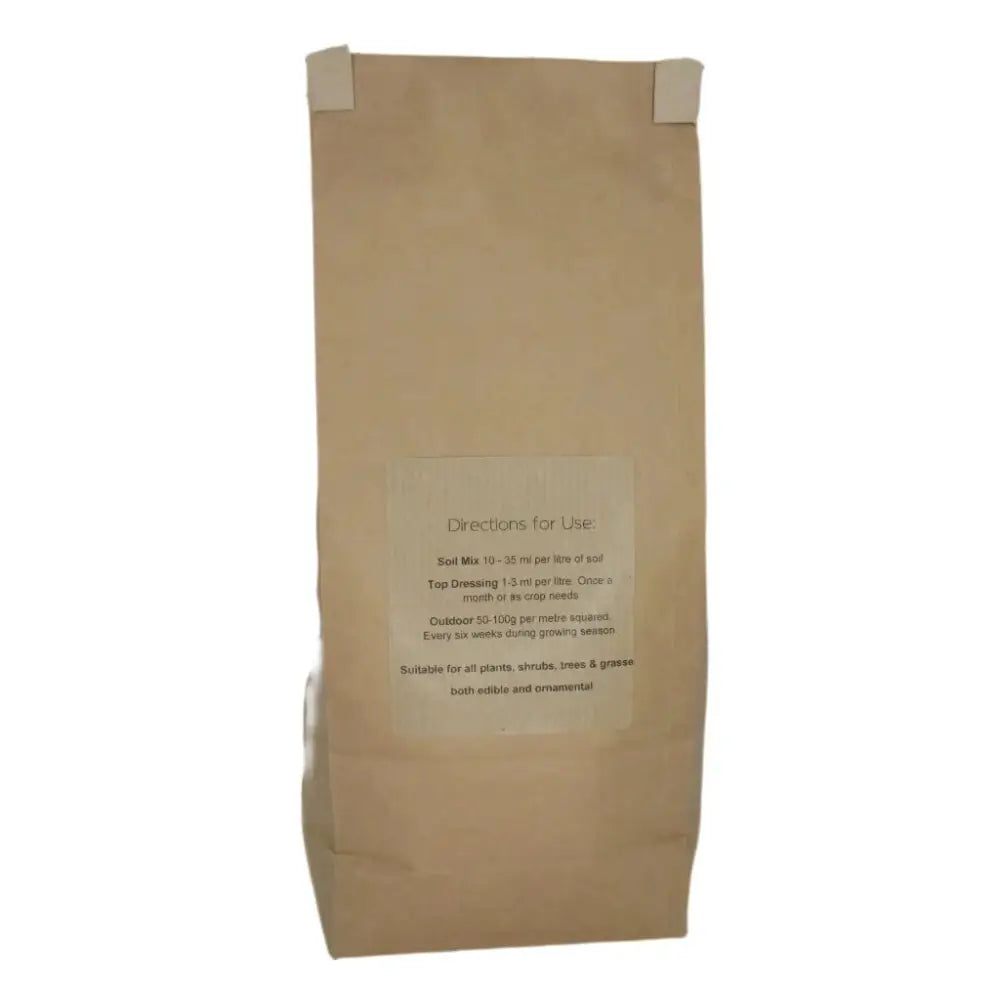
Add to potting compost, peat-free media, coir, or home-made soil blends before planting. Mix thoroughly to distribute the mineral components evenly. Use the lower rate (10 ml/L) for mineral-rich composts and the higher rate (35 ml/L) for mineral-poor media such as pure coir or peat-free compost. This is the most important application — building minerals into the growing medium from the outset is far more effective than trying to add them later.
Top dressing — containers, pots and raised beds
Sprinkle evenly over the soil surface in pots, containers, and raised beds. Water in well. The micronised fractions begin releasing minerals immediately; the granular fractions and clay minerals incorporate gradually over successive waterings. Particularly important for plants that have been in the same container soil for several months — the minerals replenish what cropping and watering have depleted.
Outdoor beds, borders and vegetable plots
Scatter over the soil surface and fork or rake lightly into the top few centimetres. Water in well. Apply alongside your regular NPK fertiliser programme. Use the higher rate (150g/m²) for the first application on soils that have never received a mineral amendment, and the lower rate (50g/m²) for maintenance on soils that have been previously mineralised.
Lawn soil conditioning
Broadcast evenly across the lawn and water in well. The fine micronised fractions settle between grass blades; the clay minerals and gypsum improve root-zone water retention and mineral balance. Combine with Nitrogen Meal and Scottish Seaweed Meal for a complete organic lawn remineralisation programme.
New planting — trees, shrubs, roses and hedging
Mix into the backfill soil when planting. The clay minerals improve water retention around new roots; the gypsum and sea-shell meal provide immediately available calcium for cell wall construction in developing roots; the volcanic rock supplies the trace elements needed for establishment growth.
Coco coir amendment
Coir has virtually no mineral content and very low CEC. The mineral mix is particularly important in coir-based systems — the bentonite clay provides the CEC that coir lacks, the gypsum supplies calcium that coir does not contain, and the volcanic rock delivers the full trace element spectrum. Use the higher rate for pure coir; reduce if blending coir with compost or soil.
Step-by-step application
- Measure the correct amount. For soil mixes: 10–35 ml per litre. For outdoor beds: 50–150g per m². For top dressing: 1–3 ml per litre. A tablespoon is approximately 15–17g of mineral mix.
- Mix into soil or scatter on the surface. For soil building, mix thoroughly into the growing medium. For beds and lawns, scatter evenly and fork or rake in lightly. For top dressing, sprinkle around the base of plants.
- Water in well. Moisture activates the micronised fractions and begins incorporating the clay minerals into the soil matrix.
- Repeat at the recommended interval. The mineral mix provides both fast-acting and slow-release mineral supply, but it is not permanent — repeat every 4–8 weeks for containers, every 6 weeks for outdoor beds.
- Store dry. Keep in a sealed bag in a cool, dry place. The clay minerals are hygroscopic and will absorb moisture if exposed to damp air.
The complex flavours that make home-grown tomatoes, strawberries, herbs, and vegetables taste better than anything from a supermarket are produced by enzyme systems that require trace minerals as cofactors. Sugar synthesis, organic acid production, aromatic volatile generation, and vitamin C production all depend on iron, manganese, zinc, copper, and boron. When these minerals are deficient — which they frequently are in garden soils and potting media — the plant produces less sugar, fewer aromatics, and simpler flavour profiles. Remineralising the soil with this blend directly addresses the mineral deficiencies that limit flavour development.
The mineral mix is the foundation layer for any Dr Forest growing programme. Use alongside Veg 4-4-4 or Bloom 2-8-4 for complete NPK + mineral nutrition. Combine with Mycorrhizal Fungi at planting — the trace minerals in the mix support fungal establishment and function. Add Grow-Kashi to inoculate the soil with the biology that processes the minerals into plant-available forms. For container growing, the mineral mix + fertiliser + Grow-Kashi is the three-part system that creates a complete living soil in a pot.
Frequently asked questions about the mineral mix
Share