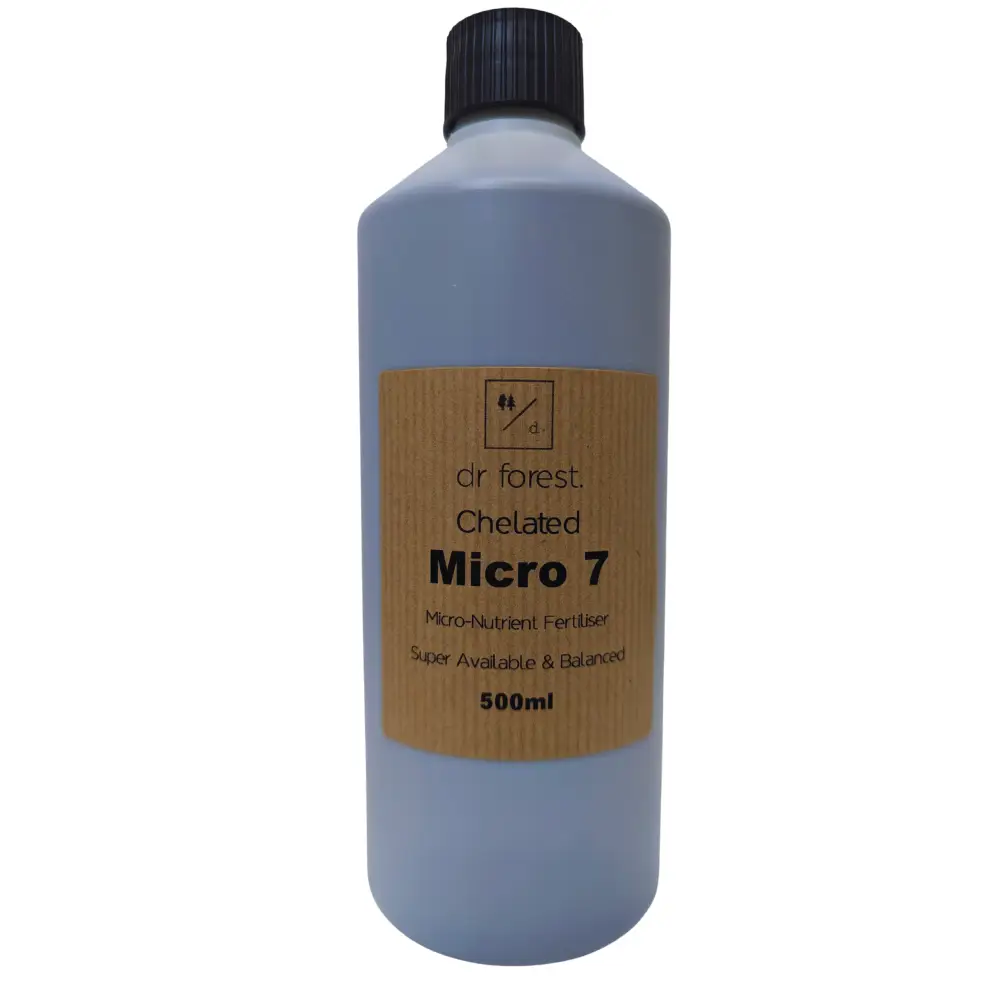
Dr Forest
Liquid Micro-Nutrient Fertiliser UK | 7 Chelated Elements
Liquid Micro-Nutrient Fertiliser UK | 7 Chelated Elements
Couldn't load pickup availability
Micro-7 — seven chelated trace elements with fulvic acid & saponins
Most micronutrient products deliver isolated elements in simple salt form — they correct one deficiency but risk triggering another through antagonistic interactions between trace elements. Micro-7 takes a different approach. It delivers all seven essential trace elements — copper, iron, manganese, molybdenum, boron, zinc, and cobalt — in a single chelated liquid, preventing the cascade of secondary deficiencies that single-element corrections often cause.
The chelating agent is biodegradable — it breaks down naturally in soil, unlike synthetic EDTA which persists indefinitely. But while active, it does something most chelates cannot: it continues to sequester and convert dormant soil ions into plant-available forms beyond the original dose. Combined with fulvic acid for enhanced uptake and natural saponins for improved leaf wetting, this is a complete trace element management system in a single bottle.
Micronutrient composition
| Element | Content (% w/v) |
|---|---|
| Zinc (Zn) | 0.75% |
| Manganese (Mn) | 0.65% |
| Iron (Fe) | 0.60% |
| Copper (Cu) | 0.23% |
| Boron (B) | 0.16% |
| Molybdenum (Mo) | 0.02% |
| Cobalt (Co) | 0.01% |
Also contains fulvic acid, natural saponins, and carbohydrate-based microbial promotants.
What Micro-7 is used for
- Complete trace element coverage — all seven essential micronutrients in one application, eliminating the need to diagnose and treat individual deficiencies separately
- Correcting clustered deficiencies — modern soils are rarely short of just one element; the balanced seven-element formula prevents fixing one shortage from triggering another
- Foliar spray for rapid correction — biodegradable chelation and saponin-enhanced leaf wetting deliver micronutrients through the cuticle faster than inorganic sprays
- Soil sequestering beyond the initial dose — the chelating agent continues to mobilise locked-up soil ions into plant-available forms after application, extending efficacy between doses
- Fruit quality, colour, and shelf life — zinc for fruit set, boron for sugar transport, iron and manganese for chlorophyll; adequate micronutrients produce measurably better produce
- Nitrogen fixation in legumes — molybdenum and cobalt are essential co-factors for the nitrogen-fixing bacteria in legume root nodules
- Soil biology stimulation — fulvic acid and carbohydrate-based promotants feed beneficial rhizosphere microorganisms alongside delivering minerals
Why a balanced chelated blend instead of individual supplements?
Chelated 7-Element Blend — Micro-7
- All seven trace elements balanced in one product
- Balanced formula prevents antagonistic cascade effects
- Biodegradable chelate — breaks down naturally, unlike EDTA
- Sequestering action mobilises dormant soil ions beyond the initial dose
- Fulvic acid and saponins enhance absorption and soil biology
- One product, one dilution rate, one application
Individual Element Supplements
- Requires diagnosing which specific element is deficient
- Correcting one deficiency can trigger another (e.g. excess Zn locks up Fe)
- Multiple products, multiple dilution rates, more complexity
- Typically inorganic salts or synthetic EDTA chelates — no biological benefit
- No sequestering action — provides only what is in the bottle
Every Dr Forest product is made by hand in small batches at our workshop in Stockport, Greater Manchester. We source ingredients for quality, not cost.
The science of chelated trace element management
Why seven elements together
Trace element deficiencies rarely occur in isolation. Soils depleted of zinc are typically also low in manganese. Iron availability drops whenever pH rises. Boron leaches in sandy soils alongside molybdenum. Treating one deficiency without addressing the others frequently triggers secondary imbalances — zinc supplementation can lock up iron, phosphorus excess suppresses zinc, and so on. The only reliable approach is balanced supplementation of the full suite to prevent antagonistic cascade effects.
Biodegradable Chelation
Conventional synthetic chelates like EDTA and DTPA are effective at maintaining mineral solubility but are not biodegradable — they persist in soil indefinitely and can mobilise heavy metals from contaminated ground. Micro-7 uses a biodegradable natural chelating system that performs the same solubility-maintenance function but breaks down naturally in the soil environment. While active, the chelate wraps each mineral ion in a neutral organic molecule that resists soil lock-up and passes through root and leaf cell membranes efficiently.
Soil Sequestering Action
Most chelated fertilisers deliver only what is in the bottle — once the chelated ions are absorbed, the effect is over. Micro-7's chelating system has a documented sequestering capacity that continues operating in soil beyond the original dose. It complexes and converts dormant soil-bound ions into plant-available forms, effectively unlocking micronutrients that are already present in the soil but immobilised by pH, clay, or competing cations. This extends the practical efficacy of each application well beyond the mineral content of the product itself.
The Seven Elements — Roles in Plant Function
Iron: Chlorophyll synthesis, electron transport. Zinc: Auxin production, leaf size, fruit set. Manganese: Photosystem II (water-splitting), enzyme activation. Copper: Lignin synthesis, cell wall strength, disease resistance. Boron: Pollen viability, sugar transport, cell wall structure. Molybdenum: Nitrate reductase — essential for nitrogen metabolism. Cobalt: Required by nitrogen-fixing bacteria in legume root nodules. Together, these seven elements underpin every major metabolic pathway from photosynthesis to reproduction.
Antagonistic Prevention
The classic problem with single-element corrections: applying zinc to a zinc-deficient soil can suppress iron uptake, converting a zinc problem into an iron problem. By supplying all seven trace elements simultaneously in balanced ratios, Micro-7 maintains nutritional balance rather than creating a moving target of cascading deficiencies.
Fulvic Acid & Natural Saponins
Fulvic acid is a low-molecular-weight organic acid that chelates minerals, increases cell membrane permeability, and feeds beneficial soil microorganisms. Natural saponins act as biosurfactants — they reduce the surface tension of foliar spray droplets, improving leaf wetting and cuticle penetration. Combined, these biostimulant components improve both the absorption efficiency and the biological impact of each application, turning a mineral supplement into a soil health tool.
Carbohydrate-Based Microbial Promotant
The formulation includes carbohydrate compounds that serve as a food source for rhizosphere microorganisms. Applied as a soil drench, Micro-7 does not just deliver minerals — it stimulates the biological workforce that drives natural nutrient cycling. Increased microbial activity improves the mineralisation of organic matter, the solubilisation of locked-up minerals, and the production of plant growth-promoting substances in the root zone.
Scientific References
- Marschner, P. (2012). Marschner's Mineral Nutrition of Higher Plants. 3rd ed. Academic Press.
- Nardi, S. et al. (2009). Physiological effects of humic substances on higher plants. Soil Biol. Biochem., 41, 215–229.
- Mengel, K. & Kirkby, E.A. (2001). Principles of Plant Nutrition. 5th ed. Kluwer Academic.
- Halpern, M. et al. (2015). The use of biostimulants for enhancing nutrient uptake. Advances in Agronomy, 130, 141–174.
How to use Micro-7: application rates & guide
Micro-7 is a concentrated chelated micronutrient blend. More is not better. Excessive application of trace elements — particularly boron and copper — can cause phytotoxicity. Follow the rates below and do not apply more than 6 times per year without a demonstrated trace element requirement from soil or tissue testing.
Application rates — professional & commercial
Foliar spray — vegetables
Apply every 2 weeks or as required. Target pre-flower, flowering, fruit set, and fruit fill stages. Ensure thorough coverage of all foliage. Where higher water volumes are needed for canopy penetration, do not exceed the maximum product rate per hectare.
Foliar spray — orchards & vineyards
Apply every 2–4 weeks or as required. Time applications to pre-flower, flowering, and fruit fill stages for maximum impact on fruit quality, set, and shelf life.
Foliar spray — ornamentals & turf
Apply every 2–4 weeks or as required. Improves colour intensity, disease resistance, and overall plant vigour in managed landscapes and sports turf.
Broadacre crops
Adjust water volume depending on canopy closure. Apply at key growth stages — tillering, stem extension, pre-flower, and grain fill for cereals; pre-flower and pod fill for legumes.
Fertigation & soil amelioration
Use the higher rate for soil amelioration where multiple trace element deficiencies have been identified through soil testing. Use the lower rate for maintenance fertigation through drip systems. Maintain minimum 1:3 dilution ratio (product to water).
Spot spraying — individual plants & small areas
For targeted foliar application to individual plants or small problem areas. Apply as a fine mist to both leaf surfaces. Ideal for addressing visible deficiency symptoms on specific plants without treating the entire crop.
Application rates — home garden
Foliar spray & soil drench — standard rate
Shake or stir well before use. Dilute 7.5 ml of Micro-7 into a 9-litre watering can of water. For foliar spraying, apply as a fine mist to both leaf surfaces in early morning or late evening. For soil drenching, apply the diluted solution evenly over the root zone at 1 litre per square metre. This rate can be used for both foliar and soil application.
Application frequency
Apply at key growth stages: pre-flowering, flowering, fruit set, and fruit fill. Most garden crops benefit from 3–4 applications per season. Leafy vegetables and high-demand fruiting crops may warrant up to 6 applications. Do not exceed 6 applications per year without soil or tissue test confirmation of ongoing deficiency.
Best timing
Micronutrient demand peaks during reproductive stages — flowering, pollination, fruit set, and fruit development. Apply the first dose as flower buds begin forming and repeat at each subsequent stage for maximum benefit. Early-season applications support vegetative establishment; late-season applications improve fruit quality and storage life.
Step-by-step preparation
- Shake the bottle well. The product contains suspended components that settle during storage. Shake vigorously for 15–20 seconds before measuring.
- Measure 7.5 ml. Use a measuring syringe or graduated cap. For a 9-litre watering can, 7.5 ml is the standard dose.
- Add to water and stir. Add the measured product to the watering can and stir briefly. The chelated nutrients dissolve readily.
- Apply as foliar spray or soil drench. For foliar, use a sprayer targeting both leaf surfaces. For soil drench, pour evenly at 1 litre of diluted solution per m². Maintain agitation during sprayer use.
- Spray in cool conditions. Apply in early morning or late evening. Temperature below 30°C, low wind, and high humidity give the best foliar absorption. Avoid full sun — the solution dries too fast.
Chelated metals can irritate skin and eyes. Wear gloves, eye protection, and long sleeves when mixing and applying. Wash hands and exposed skin thoroughly after use. Keep out of reach of children and pets.
Micro-7 provides trace elements only — it does not replace macronutrient (NPK) feeding. Use alongside Dr Forest crop-specific fertilisers (Tomato, Rose & Flower, Fruit & Veg, All-Purpose 6-6-6) for complete nutrition. Pair with Seaweed Powder for additional biostimulant activity. Avoid tank-mixing with concentrated calcium or phosphate solutions — perform a jar test before combining with any new product.
Frequently asked questions about Micro-7
Share