Humic & Fulvic Acid
Fulvic Acid Powder | 70% Fulvic | Plant Biostimulant
70% fulvic acid to help roots take up nutrients.
from £6.49
Free UK Delivery on Orders Over £40


Dr Forest
Couldn't load pickup availability
Dr Forest customers rate us 4.89/5 · 3,250+ reviews across Shopify, Amazon, Google and eBay
Humic acid flakes are a refined, fully water-soluble extract of premium leonardite — the highest-quality source of humic substances known, formed over geological timescales from the oxidation of ancient plant-rich lignite deposits. At 70% humic acid content, these flakes are the active concentrate that decades of agronomic research has built application protocols around.
Humic acid is not a fertiliser in the conventional sense. It supplies no primary nutrients directly. What it does is transform the environment in which nutrients operate: it raises the cation exchange capacity of the soil so minerals are held and released to roots rather than leached away, it directly stimulates bacterial and fungal biomass in the rhizosphere, and it carries auxin-like activity that drives root cell elongation within days of application. These are cumulative gains that compound across growing seasons.
The flake format dissolves to complete clarity within minutes of mixing — no sediment, no residue, no insoluble fraction. That solubility is what makes the flakes usable across every application method peer-reviewed research has shown to work: foliar spray, soil drench, seed soak, and compost tea. Handcrafted in Stockport, made with organic ingredients, no animal by-products.
Humic substances are the end product of plant and microbial decomposition, formed over geological timescales through progressive oxidation and polymerisation of organic matter. They are large, dark, carbon-rich molecules with a structure dominated by carboxyl (-COOH) and hydroxyl (-OH) functional groups. These functional groups are the source of humic acid's properties: they carry negative charge, which enables cation exchange; they chelate metal ions, which makes micronutrients plant-available; and they bind to mineral and organic particles, which stabilises soil aggregates.
Leonardite from premium deposits contains some of the highest concentrations of humic substances found anywhere in nature — far higher than the 1–5% humic content of even good garden topsoil, and significantly higher than lower-grade sources such as standard lignite, peat, or vermicompost. The use of leonardite humates in agriculture is backed by over 50 years of agronomic research across dozens of crops and soil types, summarised most recently in the Rose et al. (2014) meta-analysis and the Canellas et al. (2015) biostimulant review.
CEC (cation exchange capacity) measures how many positively charged nutrient ions a soil or amendment can hold and exchange with plant roots. Sandy soils typically have a CEC of 2–5 meq/100g. Good clay soils reach 20–40 meq/100g. Leonardite humic acid has a CEC of 450 meq/100g — roughly 10–200× the CEC of the soil it is added to. Even small quantities dramatically increase the capacity of a growing medium to hold calcium, magnesium, potassium, ammonium, and trace elements that would otherwise leach through with watering. For containers, raised beds, and peat-free media — where intense watering removes nutrients quickly — this is one of the most valuable properties of any soil amendment.
Humic acid molecules bridge mineral particles and organic matter into stable macro-aggregates, creating pore spaces that improve drainage in clay soils and moisture retention in sandy soils. In clay soils, aggregation opens the structure and reduces compaction. In sandy soils, humic coatings on sand grains increase water-holding capacity considerably (Stevenson, 1994).
Humic acid functional groups carry a strong negative charge that binds positively charged nutrient cations — calcium, magnesium, potassium, ammonium, iron, manganese, zinc — on exchange sites. This slows leaching, stabilises nitrogen, and creates a reservoir of plant-available nutrients that release progressively as roots demand them. For peat-free compost and container growing, this is transformative.
Phosphorus in most soils is rapidly locked up by binding with calcium, iron, and aluminium. Humic acid competes for these cation binding sites and forms soluble humate-metal complexes, releasing previously fixed phosphorus back into plant-available form. The Ma et al. (2024) meta-analysis reports an average crop yield gain of 12% and nitrogen use efficiency gain of 27% when humic acid is applied alongside conventional fertilisers.
Humic substances directly stimulate bacterial and fungal biomass in the rhizosphere. Nardi et al. (2009) demonstrated increases of 30–60% in bacterial biomass and 25–40% in mycorrhizal colonisation following humic acid application. The carbon structure acts as a slow-release food source that supports the microbial engine of nutrient cycling.
Humic acid carries auxin-like activity that directly stimulates root cell elongation and lateral root initiation. Visible root mass improvements typically appear within 2–3 weeks of regular application, with particularly strong responses at transplanting. Canellas et al. (2015) reviewed 40 years of research confirming consistent root hormone-like effects across dozens of crop species.
Humic acid binds tightly to aluminium, lead, cadmium, and other potentially toxic cations, reducing their bioavailability. In acidic soils where aluminium toxicity limits root growth, humic acid provides an immediate detoxification effect alongside its other benefits — one reason it is routinely used in remediation programmes on degraded land (Piccolo, 2002).
The humic acid literature is unusually consistent across crops and soil types. Yildirim (2007) reported significant yield, fruit weight, and ascorbic acid improvements in tomato at 20 ml/L foliar applications, with Karakurt et al. (2009) confirming the same window for pepper. Eshghi and Garazhian (2015) identified 600–900 mg/L foliar and 300–450 mg/L drench as optimal windows for strawberry. Kadhim and Hamza (2021) showed that pre-sowing maize seed soak at 1 ml/L for 18 hours raised emergence rate and seedling vigour significantly. The mechanisms differ slightly by crop and method, but the direction of the effect is stable: humic acid applied at agronomic rates improves root mass, nutrient uptake efficiency, and final yield.
Weigh the flakes against the rate in the relevant card below, add to the volume of water required, and stir. They dissolve completely within 2–5 minutes in warm water and within 10 minutes in cold. There is no sediment, no settling step, and no residue to manage. The solution will be very dark but completely clear. Apply on the same day you mix it — extended storage allows microbial activity to develop in the bucket.
The solution stains porous surfaces — paving, concrete, grout, light-coloured clothing, and timber. Work over soil or grass. Rinse spills on hard surfaces immediately.
Foliar application delivers humic acid directly to leaf tissue, where the auxin-like response is fastest. Yildirim (2007) found 20 ml/L of commercial liquid humate sprayed at 10-day intervals optimum for tomato, with Karakurt et al. (2009) confirming the same window for pepper. Eshghi and Garazhian (2015) identified 600–900 mg/L (active humic acid) as the strawberry sweet spot, with declining returns above 1000 mg/L. Commercial protocols summarised by Alsultana suggest 0.1–0.3% active concentration depending on crop sensitivity. Concentrations expressed below are for 70% humic acid flakes.
Spray both leaf surfaces to runoff in early morning or late evening. Yildirim (2007) recorded the highest yield, fruit weight, and ascorbic acid content at this concentration window across two seasons of greenhouse tomato trials, with sprays at 10-day intervals from three weeks after planting.
Eshghi and Garazhian (2015) identified 600 mg/L as the lower bound and 900 mg/L as the upper bound of the optimum foliar window for strawberry. Both produced the highest dry shoot and root mass, with significant improvements in fruit ascorbic acid and total soluble solids over control.
Leafy crops respond at gentler concentrations and benefit from more frequent, lighter applications. Stay at the lower end of the rate range — higher concentrations risk leaf marking on thin-leaved crops.
Foliar application supports flower colour and stem vigour, particularly on roses growing in alkaline soils where iron uptake is restricted. For stressed plants, combine with the soil drench programme below.
The Ma et al. (2024) meta-analysis of humic acid across cereal trials confirms the strongest response at 100–200 kg N/ha programmes, with cash crops and upland cereals out-responding paddy rice. For lawns, deliver via knapsack sprayer at standard turf coverage rates.
Drench delivers humic acid into the active root zone where it builds CEC, stimulates microbial biomass, and provides the auxin-like signal that drives lateral root development. Eshghi and Garazhian (2015) optimised strawberry drenches at 300–450 mg/L active humic acid every 14 days. The literature consensus is for monthly application at moderate strength, stepped up to 14-day intervals on stressed plants or alkaline soils.
Apply to moist soil around the root zone. Skip applications when soil is dry or plants are heat-stressed — wait for the soil to be moist first.
This matches the Eshghi and Garazhian (2015) optimal soil treatment for cultivar Paros strawberry: significant gains in fruit number, total yield, and ascorbic acid against control. The 14-day interval was the trial schedule.
Shaygan (2024) demonstrated that 1000 mg/L drenches every 15 days for two months on rose under alkaline stress lifted total protein, proline, and antioxidant activity above control, with sugar content peaking at 500 mg/L. The higher rate is the stress-management option — drop back to 500 mg/L (0.7 g flakes per litre) once vigour returns.
Apply directly into the planting hole before setting the root ball. Auxin-like root stimulation typically appears within 48–72 hours, with significant reductions in transplant shock and faster establishment recorded in the Canellas et al. (2015) review.
Peat-free media is naturally low in humic substances. Regular drenches replenish humic content, raise CEC of the growing medium so it holds nutrients more like a peat-based mix, and extend compost working life. Particularly valuable in season-long container crops.
Pre-sowing seed treatment with humic acid is one of the best-evidenced uses of the material. Kadhim and Hamza (2021) recommend maize seeds soaked at 1 ml/L of commercial humate for 18 hours before spring sowing — significant gains in emergence percentage, seedling root length, and seedling vigour. Killi (2004) confirmed 16-hour soak as optimal for cotton in potassium humate solution. Across cereals, legumes, and vegetables, the literature points to dilute concentrations and longer soak times rather than concentrated short dips.
Soak seeds at room temperature in a shallow dish. Sow immediately afterwards — do not redry. Faster germination and stronger first true leaves are the typical response.
This matches the Kadhim and Hamza (2021) protocol for spring maize on cultivars Baghdad3, 5018 and Sumer. Drain seeds briefly before sowing — do not redry. The longer soak time reflects cereal seed coat permeability.
Azhar (2026) evaluated faba bean (cultivar Barcino) seed treatments at 100–300 mg/L active humic acid, with response peaking in the middle of that range for germination index and seedling vigour. Do not exceed 12 hours — legume seeds split with prolonged soaking.
Small seeds need the lightest treatment. A 2–4 hour soak in the dilute solution lifts germination uniformity without risk of inhibition.
Hartwigsen and Evans (2000) demonstrated significant root development gains in marigold and geranium from pre-sowing humate seed soak. Adjust soak time to seed size — small seeds 4 hours, larger seeds up to 12.
Humic acid added during compost tea brewing serves two purposes: it binds chlorine and chloramine in mains water (protecting the microbial population in the tea), and it acts as a food source that documented research shows stimulates fungal biomass during the brew. Crophealth research used 30 ml of liquid humic extract per 15 L of standard recipe — broadly equivalent to a few grams of these flakes scaled to brew volume.
Dissolve the flakes into the water first and let the brewer run for 5–10 minutes — this binds chlorine in mains water before the microbial inoculant arrives. Then add compost, kelp, fish hydrolysate, or whichever other ingredients your recipe uses. Brew at 18–24°C for 18–24 hours and apply within 4 hours of switching off the air pump.
For aerated bucket-scale brews or steeped (non-aerated) compost extracts. Same protocol — dissolve, wait briefly, then add compost.
Add the dissolved flakes to the reservoir after the main nutrient solution is mixed. Compatible with all liquid nutrient programmes. Because the flakes are fully soluble, emitters will not clog at these rates.
Humic acid enhances uptake efficiency of every mineral in the feed. Always add the dissolved flakes to the already-diluted feed, not to undiluted concentrate, to avoid precipitation.
Pair with Fulvic Acid Powder in every liquid feed for complete humic-plus-fulvic coverage — humic works in the soil, fulvic works inside the plant. Stack with Seaweed Powder for biostimulant compounding: seaweed delivers cytokinins and auxins, humic improves uptake and soil biology. Fully compatible with all Dr Forest crop-specific fertilisers as a general efficiency booster.

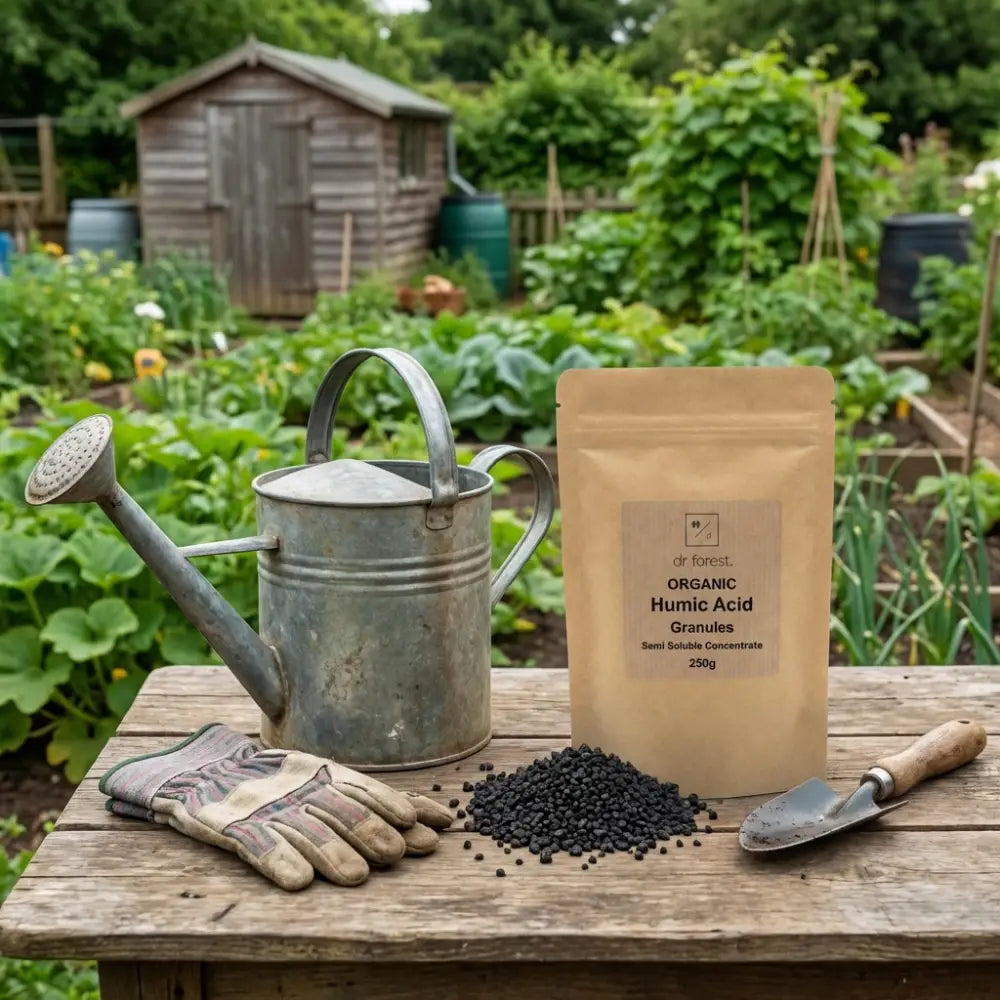

70% fulvic acid to help roots take up nutrients.
from £6.49

Helps water and feed soak in evenly, with less run-off.
from £14.00

Concentrated seaweed biostimulant for steady, resilient growth.
from £12.99