Fertiliser
Organic Bloom Fertiliser 2-8-4 | High Phosphorus
High-phosphorus 2-8-4 for flowering and fruiting.
from £10.99
Free UK Delivery on Orders Over £40


Dr Forest
Couldn't load pickup availability
Dr Forest customers rate us 4.89/5 · 3,250+ reviews across Shopify, Amazon, Google and eBay
Veg 4-4-4 is a multi-input dry amendment formulated for the vegetative stage of plant growth. It delivers balanced nitrogen, phosphorus, and potassium alongside calcium, magnesium, silica, trace minerals, humic and fulvic acids, fermented biochar, and natural growth promoters from Scottish seaweed and diastatic malted barley. Sixteen individual ingredients — each selected for a specific agronomic function — are blended in small batches to provide steady, sustained nutrition without the salt accumulation or nutrient spikes of synthetic liquid feeds.
This is a living soil fertiliser. The nutrients are released through microbial breakdown, which means the soil biology does the work — converting organic matter into plant-available forms at the rate the plant demands. The result is thicker stems, tighter internodes, vigorous lateral branching, and deep green foliage without the stretched, soft growth that excess soluble nitrogen produces. Use it as a soil mix amendment, a top dress during the grow cycle, or worked into outdoor beds.
If you are running separate veg and bloom fertilisers rather than one product all the way through, you are already growing for maximum results. We built Veg 4-4-4 for that mindset — and we loaded it with the expensive ingredients that drive results, which is why it costs more than our Premium range (Tomato, Rose & Flower, Fruit & Veg, Strawberry). Compared to those blends, Veg 4-4-4 contains 2.5× the humic acid and double the Scottish seaweed. Veg and Bloom also include diastatic malted barley — a powerful nutrient cycling activator that is not in any of our other fertilisers. Our Premium range is excellent — crop-tuned NPK ratios designed for a single product to carry the entire grow from planting to harvest. But if you are splitting stages, you expect the best at each stage, and that is exactly what Veg 4-4-4 delivers.
Every batch of Veg 4-4-4 is blended by hand in our Stockport unit using British ingredients where possible — including Scottish seaweed and Yorkshire polyhalite. No slaughterhouse waste. No synthetic chemistry. Organic ingredients throughout.
Every ingredient in Veg 4-4-4 is selected for a specific agronomic function. This is not a two-input NPK blend padded with fillers — it is a multi-source formula where each component contributes either a primary nutrient, a secondary nutrient, a trace element profile, or a biological function. The result is a fertiliser that behaves more like a living soil amendment than a simple plant food.
The primary nitrogen source — a British-produced concentrated plant extract delivering 12% nitrogen without ammonia or urea. Unlike synthetic nitrogen salts, this is a true organic nitrogen that feeds through microbial mineralisation, providing a steady, sustained release as soil biology breaks down the organic matrix. No ammonia volatilisation risk. No salt loading. No EC spikes.
British-produced primary phosphorus source delivering 15% phosphorus and 9% calcium from heat-treated plant material. The phosphorus is citric acid soluble — meaning plant roots can make it available on demand through their own root exudates. When the plant needs phosphorus, it secretes organic acids into the rhizosphere that dissolve the meal and release P directly into the root zone. This is biology-driven nutrient delivery at its most efficient — no waste, no excess, no lock-out. Phosphorus is the central component of ATP, the energy molecule that drives root development, cell division, and reproductive growth.
Insect frass is the castings of mealworm larvae — rich in nitrogen (3–4%), phosphorus, potassium, and chitin. Chitin triggers the plant's systemic defence response, upregulating chitinase enzymes that provide natural pest and pathogen resistance. Frass also introduces beneficial microbial communities to the root zone.
Contains triacontanol — a natural growth hormone that stimulates cell division and increases the rate of photosynthesis. Also provides nitrogen, potassium, and a suite of amino acids. Alfalfa breaks down relatively quickly, providing an early-release nitrogen boost while slower sources are still being mineralised.
A medium-speed nitrogen source from cold-pressed rapeseed. Provides nitrogen alongside small contributions of phosphorus and sulphur. The protein content feeds bacterial populations in the rhizosphere, accelerating the nutrient cycling that makes organic growing work.
The primary potassium source. Sulphate of potash (K₂SO₄) provides potassium and sulphur in a chloride-free, plant-available form. Potassium regulates water transport, enzyme activation, and stomatal function. Sulphur is essential for amino acid synthesis and terpene production — directly influencing aroma and flavour intensity.
A 260-million-year-old evaporite mineral mined from beneath the North Yorkshire Moors. Delivers four nutrients in a single granule: 14% potassium, 17% calcium, 6% magnesium, and 19% sulphur. All four are released gradually over 8–12 weeks as the mineral dissolves — providing a slow-release calcium and magnesium supply that most organic fertilisers lack entirely.
Ultra-finely milled apatite mineral delivering 31% phosphorus and 46% calcium. Micronisation massively increases the surface area exposed to soil acids and microbial activity, accelerating phosphorus availability compared to coarse rock phosphate. Also contributes significant long-release calcium.
Volcanic basalt ground to a fine powder, containing over 60 trace elements including iron, manganese, zinc, copper, boron, molybdenum, cobalt, and selenium. Remineralises depleted soils, buffers pH, and provides the full trace element spectrum that intensive growing depletes. Also contributes silica, calcium, and magnesium.
High cation exchange capacity (CEC) clay minerals that act as nutrient banks in the soil. Clay particles hold positively charged nutrient ions — calcium, magnesium, potassium, ammonium — and release them gradually to plant roots via exchange reactions. Prevents nutrient leaching and buffers against pH swings, particularly important in container substrates.
Biochar is pyrolysed carbon with an enormous internal surface area — up to 300 m² per gram — that provides permanent habitat for beneficial soil microorganisms. Fermentation pre-charges the biochar with microbial communities and nutrients, so it is biologically active from the moment it enters the soil. Research shows biochar increases potassium retention by 18–35% under leaching conditions (Lehmann et al., 2011).
Cold-water harvested from the Scottish Atlantic coast. Contains cytokinins, auxins, gibberellins, alginic acid, laminarin, mannitol, and over 60 trace elements. Acts as a biostimulant — priming the plant's own growth and defence systems. Seaweed application has been shown to increase yield by an average of 15% across crops in peer-reviewed meta-analyses.
A powerful nutrient cycling activator exclusive to our Veg and Bloom fertilisers. Germinated barley containing active amylase and protease enzymes that break down starches and proteins in the soil into plant-available sugars and amino acids — accelerating the microbial nutrient cycling that makes organic growing work. Also contains natural auxins and gibberellins produced during germination. Not found in any of our other blends — this is one of the reasons Veg and Bloom cost more than our Premium range.
Humic acid increases cation exchange capacity, improves soil structure, and stimulates root growth. Fulvic acid is a low-molecular-weight chelator that binds micronutrients into plant-available complexes and transports them across cell membranes. Research shows humic substances increase bacterial biomass by 30–60% and mycorrhizal colonisation by 25–40% (Nardi et al., 2009).
Provides plant-available silicon — the structural nutrient that strengthens cell walls, increases stem rigidity, and improves resistance to physical stress. Silicon-fed plants produce thicker stems capable of supporting heavier canopies and are more resistant to heat stress, drought, and fungal penetration. Critical for indoor growing where structural support is limited.
A proprietary blend of dried herbs that contributes trace compounds, plant-based growth factors, and additional microbial food sources. Acts as a diversifier — broadening the range of organic carbon forms available to soil biology and supporting a wider spectrum of beneficial microbial species in the rhizosphere.
Veg 4-4-4 is a granular dry amendment. Sprinkle it on the soil surface as a top dress, or mix it into your substrate before planting. Water in and let the biology do the work. No pH pens, no EC meters, no mixing reservoirs. This is organic growing at its simplest.
Mix thoroughly into soil or coco-based substrate before transplanting. Use the lower end for light feeders and autoflowers, the upper end for heavy feeders and photoperiod plants in larger containers. For a standard 20-litre pot, that is 7–13 tablespoons. Allow 7–14 days for biology to activate before planting if possible. Use our measurement converter to switch between grams, ml, and tablespoons.
Sprinkle evenly on the soil surface around the base of the plant. Water thoroughly to begin microbial breakdown. For a standard 20-litre pot, that is 3–7 tablespoons per top dress. Start at 2–3 ml per litre and increase to 4–5 ml for large, vigorous plants in heavy veg. Use our fertiliser calculator to work out exactly how much you need for your grow.
Scatter evenly and work lightly into the top 5–10 cm of soil. Water deeply after application. Use 100–200g for light-to-moderate feeders and established beds. Use 200–300g for heavy feeders and new plantings where soil needs building. Outdoor beds hold nutrients longer than containers — the larger soil volume, deeper biology, and natural buffering capacity mean a 4–6 week cycle delivers steady nutrition without the accumulation risk of more frequent applications.
After harvest, remove old root mass and break up the substrate. Mix in fresh Veg 4-4-4 at the standard soil mix rate. Add a handful of fresh worm castings or compost if available. Water thoroughly and allow 10–14 days for microbial activity to re-establish before replanting.
Coco is biologically inert — unlike soil, it contains no microbial life to break down organic matter. We recommend adding worm castings or quality compost at 20–30% of the mix to introduce the biology that makes dry amendments work. Use pre-buffered coco or buffer with cal-mag solution before amending — unbuffered coco locks out calcium and magnesium through cation exchange. Use the upper end of the dosage range and top dress more frequently than in soil. Do not water to heavy runoff — unlike synthetic coco growing, heavy runoff flushes your dry amendments out of the root zone. Water thoroughly but stop before significant drainage.
We recommend using our Dr Forest Cal-Mag alongside Veg 4-4-4. We packed so many premium ingredients into this formula — biochar, humic acid, seaweed, malted barley — that there is limited room for the quantities of calcium and magnesium that fast-growing plants demand. Veg 4-4-4 contains calcium and magnesium from polyhalite, rock phosphate, and basalt, but supplementing with cal-mag ensures your plants never run short of these critical structural nutrients. This is especially important in coco substrates, soft water areas, and with heavy-feeding varieties.
Use dechlorinated water — chlorine and chloramine kill the beneficial soil microbes that break down organic matter and deliver nutrients to the plant. Leave tap water to stand for 24 hours, use a carbon filter, or add a dechlorinator. This single step makes the biggest difference to how well organic dry amendments perform.
Organic growing requires a different watering approach to synthetic feeds. Water thoroughly but not to heavy runoff — you want the entire root zone moist, but excessive drainage flushes dissolved nutrients and microbial by-products out of the substrate. In soil, water until you see the first drops of drainage and stop. In coco, this is even more critical — heavy runoff washes dry amendments straight through. Allow the top layer to dry slightly between waterings to maintain oxygen in the root zone and encourage healthy microbial activity.
Lower leaves lightening from dark green to lime green or yellow is the earliest sign of nitrogen depletion. Top dress at the higher end of the range (4–5 ml per litre) and increase frequency to every 2 weeks. If the plant is in a small pot relative to its size, consider transplanting into a larger container with freshly amended substrate.
Very dark green leaves with downward curling tips indicate nitrogen excess. Reduce the amount per top dress, stretch the interval to every 3–4 weeks, or skip an application entirely. Organic dry amendments are forgiving — the biology self-regulates to a degree — but overloading the substrate will produce soft, stretched growth with poor structure.
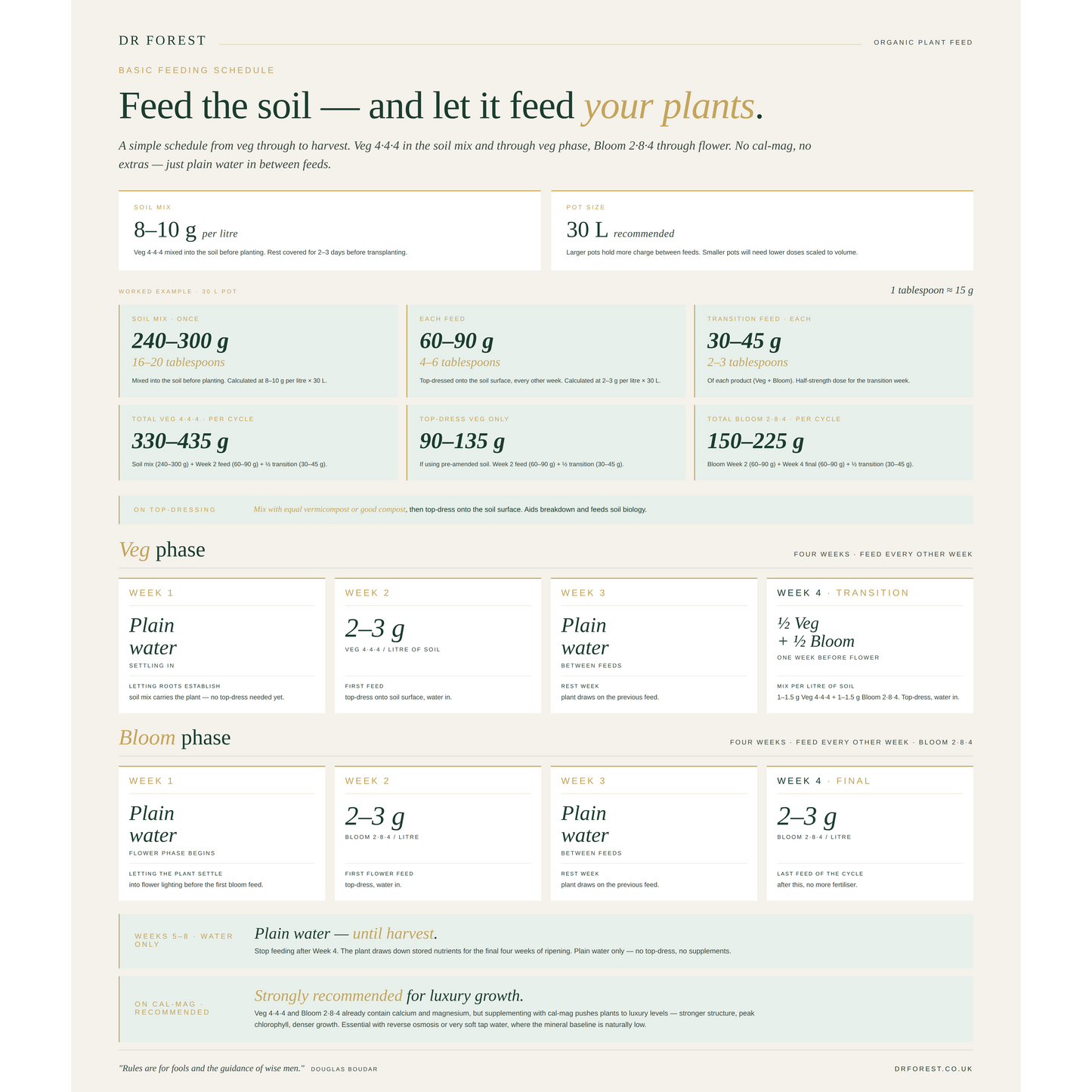
For the first top dress after flipping to flower (or when autoflowers show pre-flowers), use half Veg 4-4-4 and half Bloom 2-8-4. This bridges the transition period when the plant still needs some nitrogen for stretch growth but is beginning to demand more phosphorus and potassium for flower development.
Use Dr Forest Cal-Mag throughout the grow to supplement calcium and magnesium — recommended with all Veg and Bloom feeds. Add Dr Forest Mineral Mix to your substrate for extra calcium, trace minerals, and clay CEC. Use Seaweed Powder as a fortnightly foliar or drench to boost growth hormones. Apply Humic Acid Granules as a soil conditioner to maximise nutrient retention. See our feeding schedule for the full programme.
Mix in a well-ventilated area. Wear a dust mask when handling dry powder. Wash hands after use. Keep out of reach of children and pets. Store sealed in a cool, dry place.
A balanced NPK ratio provides equal parts nitrogen, phosphorus, and potassium — the three macronutrients most rapidly depleted during active vegetative growth. High-nitrogen formulas (such as 10-2-2 or 7-1-3) force rapid top growth at the expense of root development, structural integrity, and future flower production. A 4-4-4 ratio supports proportional development — strong roots, thick stems, and a robust vascular system that will support heavy yields during the reproductive phase.
Nitrogen in Veg 4-4-4 comes from five separate organic sources: nitrogen plant extract, mealworm frass, alfalfa meal, rapeseed meal, and seaweed. Each source has a different carbon-to-nitrogen ratio and a different mineralisation speed. Alfalfa breaks down within days to weeks. Frass and rapeseed meal release over weeks to months. The nitrogen plant extract provides the highest concentration at 12% N with a sustained background release. The combined effect is a staggered nitrogen supply curve — no spike, no crash, no deficiency window.
This is fundamentally different from a synthetic liquid feed where all nitrogen arrives as a single soluble salt. Soluble nitrogen spikes tissue concentrations, promotes soft, stretched growth, and flushes rapidly through the substrate — requiring constant reapplication and creating salt accumulation.
Phosphorous plant meal provides citric acid soluble phosphorus — 15% P that plant roots can unlock on demand through their own root exudates. When the plant needs phosphorus, it secretes organic acids that dissolve the meal directly in the rhizosphere. Micronised rock phosphate contributes slow-release phosphorus alongside significant calcium. Mealworm frass adds a biological phosphorus fraction that soil microbes mineralise over weeks. Three sources, three release mechanisms — ensuring phosphorus is available throughout the entire vegetative stage without over-supply or lock-out.
Sulphate of potash delivers immediately available potassium with zero chloride — chloride toxicity is one of the most common causes of leaf-tip burn in container growing. Polyhalite adds slow-release potassium alongside calcium, magnesium, and sulphur. Basalt rockdust contributes trace potassium as part of its 60+ element mineral spectrum. No muriate of potash. No potassium chloride.
Most liquid synthetic feeds contain zero calcium. This is the single largest nutritional gap in conventional indoor feeding programmes. Calcium is the most abundant mineral in plant tissue, essential for cell wall integrity, root tip growth, and disease resistance. Magnesium is the central atom of chlorophyll and drives photosynthetic efficiency.
Veg 4-4-4 delivers calcium from three sources — polyhalite (17% Ca), micronised rock phosphate (46% Ca), and basalt rockdust. Magnesium comes from polyhalite (6% Mg) and basalt. These provide a baseline supply that most liquid feeds lack entirely. However, we packed so many premium biostimulant and nutrient-cycling ingredients into this formula that there is limited space for the full calcium and magnesium load that fast-growing plants demand. We recommend supplementing with Dr Forest Cal-Mag throughout the grow to ensure these critical structural nutrients are never the limiting factor.
The shift from bottled liquid feeds to dry organic amendments is driven by measurable, repeatable outcomes — not ideology. Peer-reviewed research consistently shows that organic nutrient management produces healthier plants, better soil biology, enhanced secondary metabolite production, and more sustainable growing systems.
When soil microbes mineralise organic matter, they produce enzymes, organic acids, amino acids, and volatile compounds as by-products. Many of these secondary metabolites are absorbed by plant roots and contribute directly to flavour, aroma, and terpene production in the finished crop. Synthetic feeds bypass this biology entirely — the nutrients are available, but the metabolic by-products are absent.
Ferro et al. (2022) demonstrated that organic fertiliser management increases soil organic carbon by 12.9% compared to mineral-only inputs. Organic carbon is the foundation of soil health — it feeds microbial communities, improves water holding capacity, increases CEC, and creates the porous structure that roots need to explore the substrate efficiently.
Xu et al. (2024) analysed 537 experiments across global crop systems and reported that organic fertilisation increased plant biomass by 56% while maintaining biodiversity. Inorganic fertilisation achieved 42% biomass increase but at the cost of soil biodiversity loss. In living soil systems, biodiversity is the mechanism of nutrient delivery.
Wang et al. (2023) synthesised 7,859 data pairs and concluded that combined organic-mineral fertilisation produces the highest crop quality outcomes of any fertiliser strategy. Veg 4-4-4 is precisely this — a blend of organic nitrogen sources (alfalfa, frass, rapeseed) with mineral nutrient carriers (polyhalite, rock phosphate, basalt, SOP).
Cardarelli et al. (2023) reported that organic fertilisation reduces tissue nitrate concentrations by 27–50% compared to synthetic nitrogen sources. Lower tissue nitrate means cleaner, smoother-burning material with reduced harshness — a quality parameter that matters to growers producing high-value crops.
Liu et al. (2021) measured urease activity +38.3%, β-glucosidase activity +122.4%, and yield increases of 15–20% under organic fertiliser management compared to unfertilised controls. These enzymes are the machinery of nutrient cycling — more enzyme activity means faster, more complete mineralisation of organic inputs.
Li et al. (2024) found that all 21 starch and sucrose metabolism genes were upregulated under organic fertilisation. Higher sugar content translates directly to improved flavour, aroma, and overall crop quality. These are the biochemical pathways responsible for the quality difference between organically and synthetically grown produce.
Shen et al. (2024) showed that unbalanced fertilisation causes 23–31% loss of actinobacterial diversity in soil. Actinobacteria are critical for nutrient mineralisation, disease suppression, and the production of antifungal and antibacterial compounds in the rhizosphere. A balanced 4-4-4 ratio avoids the microbial disruption caused by high-N single-nutrient formulas.


40% of buyers here also chose Organic Bloom Fertiliser 2-8-4

High-phosphorus 2-8-4 for flowering and fruiting.
from £10.99

High-potash 2-4-8 for firmer fruit and flowers.
from £10.99

Veg and bloom together, matched to your stage.
from £20.00