Fertiliser
Organic Veg Fertiliser 4-4-4 | Leafy Growth
Balanced 4-4-4 for strong leafy growth.
from £10.99
Free UK Delivery on Orders Over £40


Dr Forest
Couldn't load pickup availability
Dr Forest customers rate us 4.89/5 · 3,250+ reviews across Shopify, Amazon, Google and eBay
Mycorrhizal fungi powder is a root inoculant — living fungal spores you apply at planting so the fungi colonise the roots and extend them out through the soil. Once colonised, the plant trades a little sugar for a vast secondary network of fungal threads that pull in phosphorus, water and trace minerals from soil the roots cannot reach on their own. Dr Forest's is an 18-species blend of 9 endomycorrhizal and 9 ectomycorrhizal fungi, milled to a fine powder so the spores sit in direct contact with the feeder roots, which is where colonisation actually begins.
Modern growing strips this partnership out. Bagged compost is sterilised, peat-free mixes start with no native fungi, and pot-raised nursery stock is grown on high-phosphate feeds and fungicides that suppress colonisation. Take that plant out of its pot and into the garden and it has no fungal partner. That is why new trees stall in their first seasons, transplants sulk, and roses planted where roses grew before fall into replant disorder. Inoculating at the moment of planting puts the partner back.
A root inoculant for gardeners who would rather not reach for bone meal, fish blood and bone, or other slaughterhouse by-products when they plant. Mycorrhizal fungi do the establishment job those products are bought for, improving root reach and phosphorus uptake, with no animal inputs. Pair it with a light, low-phosphate organic feed rather than a high-phosphate one.
Most UK inoculants are single-species or built on a handful of strains. Different fungi partner with different plants and thrive in different soils, so a wider blend colonises more of what you actually grow. This powder carries 9 endomycorrhizal species (for the 80–90% of garden, vegetable, fruit and flower plants that form arbuscular associations) and 9 ectomycorrhizal species for the many trees and shrubs that need the other type. One pouch covers a mixed garden rather than a single crop.
Several of the endo species were reclassified out of the old genus Glomus, so spec sheets and rival products may list either name — the familiar Glomus name is shown in brackets where it differs.
Handcrafted in small batches in Stockport. Plant-based, with no animal by-products — Dr Forest.
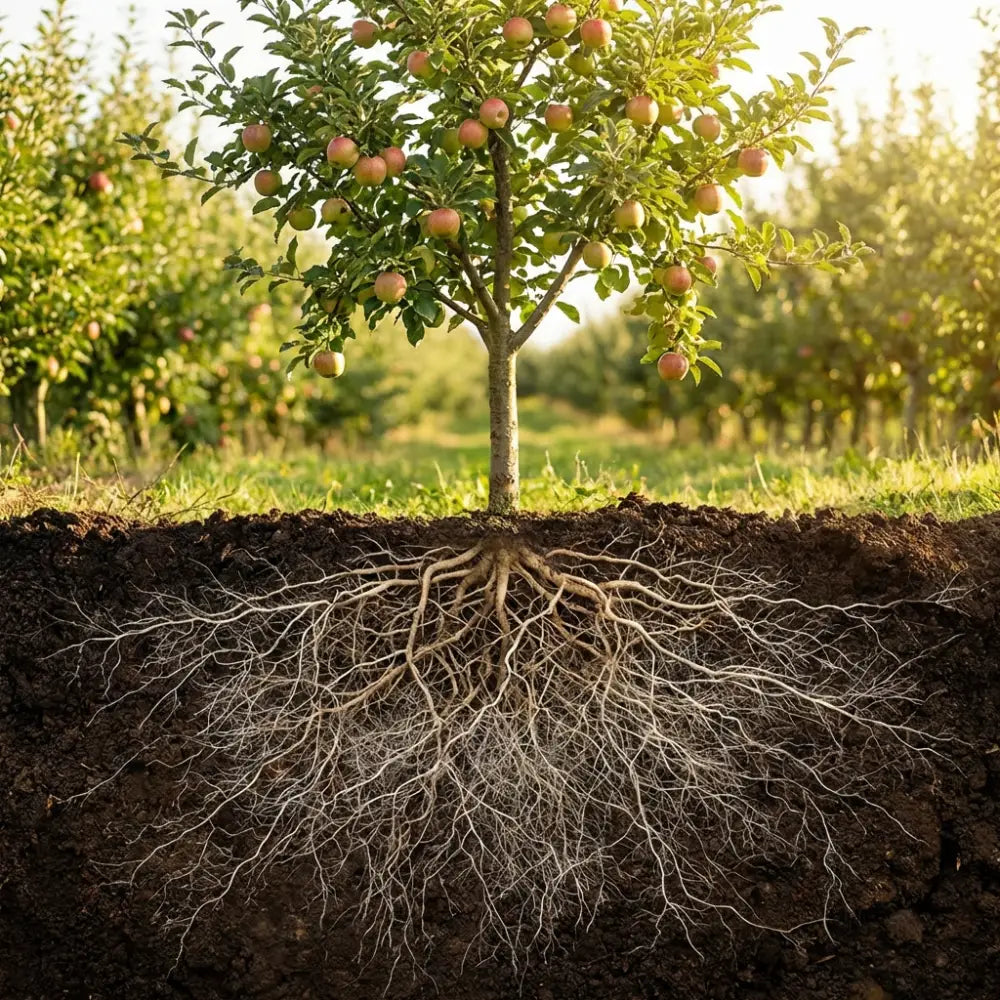
Mycorrhizae are not a fertiliser. They are a symbiosis around 450 million years old, in which fungi colonise plant roots and grow a network of ultra-fine threads (hyphae) out into the surrounding soil. The plant supplies sugars from photosynthesis; the fungi return phosphorus, water, nitrogen and trace elements gathered from a soil volume many times larger than the roots could explore alone. Phosphorus is the headline benefit, because it barely moves in soil: roots quickly strip the zone immediately around them, and hyphae bridge the gap to the phosphorus beyond.
Independent testing has repeatedly found that many shop-bought mycorrhizal products contain too few living spores to do anything. A 2025 meta-analysis of 302 trials reported that fewer than 12% of commercial inoculants produced both viable colonisation and a measurable growth benefit, and that around 84% failed to produce meaningful root colonisation at all (Koziol et al., 2025). Species counts and propagule claims mean nothing if the spores are dead on arrival. Dr Forest buys this inoculant in small batches with fresh stock arriving every month, so the spores leave here fresh rather than after a year on a warehouse shelf, and every pouch carries an honest 9–12 month use-by because viability falls over time. Store it cool and dry, and use it inside that window for the best colonisation.
Fungal hyphae are far finer than root hairs and grow out through pores roots cannot enter, extending the plant's effective reach several-fold. This is what lets a colonised plant draw water and immobile nutrients from soil its own roots never touch: the foundation of every other benefit below.
Endomycorrhizae form arbuscules inside root cells — branched structures that hand phosphorus directly to the plant. Because phosphate ions diffuse so slowly through soil, a plant's own uptake is limited to a thin depletion zone around each root; the fungal network reaches well past it. Smith & Read (2008) document this as the central nutritional role of the symbiosis.
Arbuscular fungi exude glomalin, a sticky glycoprotein that binds soil particles into stable aggregates. The result is better porosity, aeration and water-holding — improvements that outlast the growing season and feed back into healthier rooting (Rillig, 2004).
Colonised plants hold leaf water potential and keep photosynthesising for longer under drought, and tolerate salinity and heavy-metal stress better. Reviews of abiotic-stress trials attribute this to improved water capture through the hyphal network and to changes in the plant's own stress physiology (Begum et al., 2019).
Endomycorrhizae (arbuscular, AMF) grow inside root cells and partner with most garden, vegetable, fruit and flower plants. Ectomycorrhizae sheath the root surface in a fungal mantle and partner with many trees and shrubs — birch, beech, oak, pine. Carrying both types, across a wide species range, is why one product works across a mixed planting (van der Heijden et al., 1998, on why fungal diversity raises plant productivity).
Around 10–20% of plants form no functional association and gain nothing from inoculation: the brassica family, beets and spinach, and ericaceous plants such as blueberries, rhododendrons and heathers (which use a different, ericoid partnership). On these, save the powder for something that will use it.
On crops that do partner, the gains are well documented. A 2023 field study on citrus reported heavier, sweeter fruit with higher vitamin C after arbuscular inoculation, alongside improved soil phosphorus availability (Zhou et al., 2023). Field trials on tomato have shown higher fruit fresh weight and markedly higher lycopene, the antioxidant pigment behind the red colour, in mycorrhizal plants than in uninoculated controls (Aguilera et al., 2022). The pattern across the literature is consistent: better phosphorus nutrition, better stress tolerance, better fruit quality, provided the spores were alive to begin with.
The single thing that matters is getting live spores onto the feeder roots at planting. A light, even coating in direct contact with the roots colonises far better than a heavier dose scattered nearby or raked into the surface. You can apply more without harm, since the fungi self-regulate colonisation to the plant's needs, but more powder is no substitute for good contact.
Apply directly to the roots — dusting or drenching the root ball itself ensures maximum contact with the feeder roots and far better colonisation than adding it only to the hole or backfill.
Lightly moisten the base of the cutting and dip it straight into the powder before planting.
Mix with the seed before sowing, or dust lightly into the seed drill so spores sit alongside the germinating roots.
Mycorrhizae establish even in poor soil, but perform best when planted into ground rich in organic matter. If you feed, use a light dose of a slow-release, low-phosphate organic feed — high phosphate signals the plant it doesn't need a fungal partner and suppresses colonisation. Once established, mycorrhizal plants need far less feeding. Most herbicides and insecticides that are safe for the plant don't interfere; if a fungicide is unavoidable, check compatibility first.
Follow up a few days after planting with Dr Forest seaweed powder as a transplant biostimulant to support early root recovery, and feed established plants with the matching crop feed (Tomato, Rose & Flower, or the Veg & Bloom range) once the partnership has taken hold. Browse the full range over on the Dr Forest shop, and read more in our guide to mycorrhizal fungi on the blog.


23% of buyers here also chose Organic Veg Fertiliser 4-4-4

Balanced 4-4-4 for strong leafy growth.
from £10.99

High-phosphorus 2-8-4 for flowering and fruiting.
from £10.99

A ready-to-use no-dig living soil base.
from £12.00