


Customer highlight
Extremely fast delivery and very well packaged. Top quality product, as expected from what I have read. I will be purchasing more Organic Nutrients for my Urban Farming supplies. What can I say top Seller, will be using again. These guys have got you covered Looking forward to seeing the results
Editorial highlight from marketplace and store reviews — separate from the full review list below.
Mycorrhizal fungi powder · 18 species
The plant you just bought left its fungal partner in the nursery
Garden-centre rose, fruit tree or tomato that sulks for a season: bagged compost was sterilised, peat-free mix started empty, and nursery stock grew on high-phosphate feeds and fungicides that keep fungal partners out. You paid for a plant with no network. That is why new trees stall, transplants sulk, and a rose dropped into last year’s rose hole looks like a “soil disease” when it is mostly missing partners in tired ground.
Dr Forest’s mycorrhizal fungi powder puts the partner back at the one moment that counts — when living feeder roots meet living spores. Eighteen species (nine endomycorrhizal for the vegetables, tomatoes, roses and most ornamentals that form arbuscular associations; nine ectomycorrhizal for the birch, beech, oak, pine and other trees that need the sheathing type), milled fine so the dust sits on the root instead of in a sand pellet two inches into the backfill. Once colonised, the plant trades a little sugar for hyphae that forage phosphorus, water and traces beyond the root-hair zone. It is not a fertiliser. It is the missing partnership modern growing strips out.
Contact is the whole product. Fresh slurry (pancake-batter consistency, preferably with dechlorinated water) or a dry dust on damp roots beats watering powder into the can or sprinkling the surface and hoping. If no living root is nearby within about a day of the fungi touching soil, treat that dose as inactive for colonisation. About 1–1.5 g per litre of root ball is the usual rate; more does no harm — the fungi self-regulate.
What this pouch is for
- Nursery stock and sterile compost with no fungal partners — inoculate at planting so the plant you bought gets a network instead of a year of sulking.
- Rose replant disorder in the old rose hole — tired rose soil plus missing partners; mycorrhizae are part of the fix, not a disinfectant. Change the pocket soil if you can.
- Granular “mycorrhiza” that is mostly carrier — fine powder on feeder roots, not grit waiting for roots to find it.
- A root inoculant at planting — establishment job gardeners often buy bone meal or fish, blood and bone for, without slaughterhouse inputs. Pair with a light, low-phosphate organic feed, not a high-P soluble that suppresses colonisation.
Most UK bags are single-species or a handful of strains in a coarse carrier. This blend carries both endo and ecto across eighteen species so one pouch covers a mixed garden — but only if the spores touch living roots. A tomato or rose uses the endo half; many trees use the ecto half. Do not tell a tomato grower the ecto species are what their roots use.
Dr Forest powder vs a typical granular inoculant
This pouch — fine powder; eighteen named species; dust or slurry onto feeder roots at planting; fresh small-batch stock with an honest 9–12 month use-by.
Typical granular bag — mostly carrier grit in the hole; spores sit away from the root; fewer species; often warehoused until viability is a guess. Surface sprinkle and watering-in look easy and underperform for the same reason: no root contact.
Liquid Seedling Fertiliser — a calcium-led root drench at planting that feeds new root without the high-phosphate hit that suppresses colonisation.
Organic Rose Feed 5-3-5 — once the rose is away; mycorrhizae are the planting step, not a substitute for a rose ratio.
Soil Smiths The Goop — bacterial inoculant in the same hole for organisms mycorrhizae do not replace; still put the powder on the root, not only in the backfill.
A light All Purpose 4-4-4 once growth resumes — not a high-phosphate soluble bloom bottle in the first weeks.
Must touch damp feeder roots at planting — not a fertiliser, not a fungicide, not a cure for a plant that has already cooked in a hot car. High-phosphate soluble feeds and fungicides suppress colonisation afterwards. Skip brassicas (cabbage family), beetroot, spinach and chard, and ericaceous plants that need ericoid fungi — on those the pouch is wasted. Independent tests have found many shop-bought inoculants short on living spores; buy fresh, store cool and dry, and use within 9–12 months. Full host matching and UK evidence sit on the guide: What are mycorrhizal fungi?
Dr Forest buys this inoculant in small batches with stock refreshed monthly, so the pouch that arrives is living spores rather than long-warehoused grit. Named after Joe’s grandfather, Dr Forrest — a GP who kept a back-garden plot for the runner beans he turned into piccalilli.
The science, short version
Mycorrhizal fungi form partnerships with plant roots and can supply phosphorus, and sometimes water and micronutrients, when soil conditions favour the symbiosis. About 80% of land plant species surveyed are mycorrhizal1.
Three findings shape how to use it:
- Phosphorus: when available phosphorus is above what the plant needs, colonisation is strongly suppressed2.
- Digging: in a field study, ploughed soil had significantly less fungal hyphae and lower root colonisation than reduced-till or no-till soil3.
- Timing: in a laboratory study, germinated spores stayed able to infect roots for up to six months without a host plant, though less well after three6. Contact soon after application is still best.
Brassicas (cabbage, kale, broccoli, radish and relatives) do not form the partnership4, so the powder does nothing for them. Full plant matching and how-to live in our guide: Mycorrhizal fungi UK — how to use for gardeners
- Wang B, Qiu Y-L (2006). Phylogenetic distribution and evolution of mycorrhizas in land plants. Mycorrhiza 16(5): 299–363. doi:10.1007/s00572-005-0033-6
- Li P, Liu J, Zhang S, Zhu Y, Yin X, Xing L, Wei D, Jin L (2025). Effects of nitrogen and phosphorus levels on arbuscular mycorrhizal symbiosis and associated bacterial communities in culture. Journal of Fungi 11(11): 757. doi:10.3390/jof11110757
- Kabir Z, O'Halloran IP, Fyles JW, Hamel C (1997). Seasonal changes of arbuscular mycorrhizal fungi as affected by tillage practices and fertilization: hyphal density and mycorrhizal root colonization. Plant and Soil 192: 285–293. doi:10.1023/A:1004205828485
- Poveda J, Hermosa R, Monte E, Nicolás C (2019). Trichoderma harzianum favours the access of arbuscular mycorrhizal fungi to non-host Brassicaceae roots and increases plant productivity. Scientific Reports 9: 11650. doi:10.1038/s41598-019-48269-z
- Koziol L, Lubin T, Bever JD (2024). An assessment of twenty-three mycorrhizal inoculants reveals limited viability of AM fungi, pathogen contamination, and negative microbial effect on crop growth for commercial products. Applied Soil Ecology 202: 105559. doi:10.1016/j.apsoil.2024.105559
- Logi C, Sbrana C, Giovannetti M (1998). Cellular events involved in survival of individual arbuscular mycorrhizal symbionts growing in the absence of the host. Applied and Environmental Microbiology 64(9): 3473–3479. doi:10.1128/AEM.64.9.3473-3479.1998
How to use this powder
- Best: fresh slurry. Mix with a little rainwater, or tap water left to stand, to a thin pancake-batter consistency. Dip bare roots or roll the root ball in it, then plant at once.
- Good: dry dust. Dust bare roots or the outside of the root ball as it goes into the hole.
- Sowing: mix with the seed or dust it lightly into the drill as you sow.
Rate: about 1–1.5 g per litre of root ball.
Put the powder on roots at planting, or where roots will grow within a few days. The sooner and closer the contact, the better. Watering it in after planting, or sprinkling it on the soil surface, leaves most of it away from the roots.
Skip brassicas: they do not form the partnership. Ericaceous plants such as blueberries and rhododendrons partner with ericoid fungi, which this blend does not contain.
On fruit trees and soft fruit
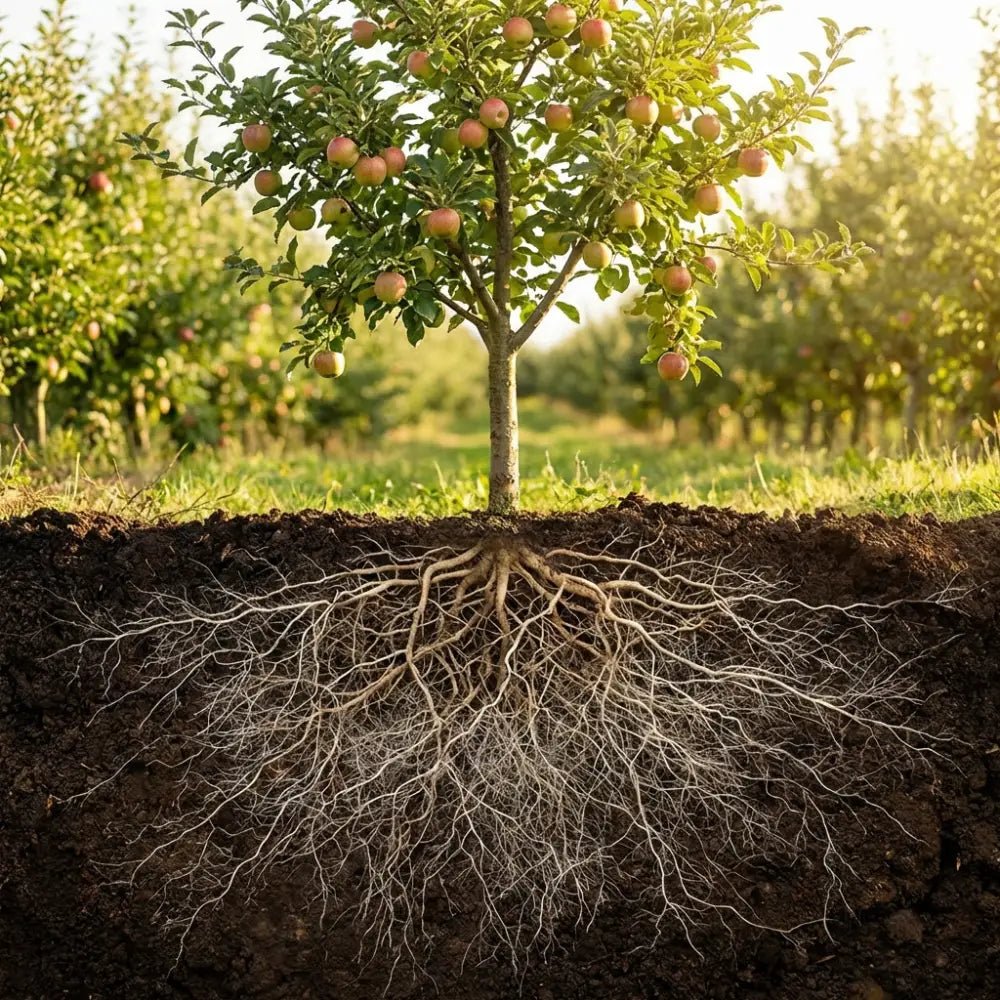
Which fruit: apples, pears, plums, cherries, figs, citrus, walnuts, almonds, grapes, strawberries, raspberries, blackberries, currants and gooseberries all partner with the arbuscular (endo) fungi in this blend.
Not for blueberries, cranberries or lingonberries. They partner with a different group, the ericoid fungi, which this blend doesn't contain.
When: only at planting, while the roots are exposed. Bare-root trees and bushes go in from November to March; pot-grown plants can go in whenever the soil is workable. The fungi have to touch living roots to work, so sprinkling the powder on the surface around established plants does very little.
How
- Bare-root trees and bushes: mix the powder into a thin slurry with water and dip the roots, or dust it straight onto damp roots. Use about 1–1.5 g per litre of root volume; a typical bare-root fruit tree takes about 5–10 g. Plant straight away and don't let the roots dry out.
- Pot-grown trees and bushes: dust the powder onto the sides and base of the root ball, or into the planting hole where it will touch the roots, at 1–1.5 g per litre of root ball.
- Strawberry runners and plugs: dip the roots in slurry; about 1–1.5 g covers 10 plants.
Getting the most from it
- Go easy on phosphate at planting. Rich phosphate feeds make roots less willing to partner, so leave rock phosphate and bone-type meals out of the same hole.
- Water well after planting, and mulch.
Honest expectations: mycorrhizal fungi are a natural part of healthy soil, and most garden soils already contain them. Independent tests have found that many commercial inoculants establish poorly, and in fertile, established garden soil the benefit is often small or hard to measure. They're most worth trying on new-build plots, disturbed ground or poor soil. Treat them as a low-cost extra at planting, not a substitute for good soil preparation, watering and feeding.
Full method and UK planting timing: Mycorrhizal fungi UK guide.
Frequently asked questions
Here. This powder is sold in 40 g, 120 g, 250 g, 500 g, 1 kg and 5 kg packs and posted to any UK address. At about 1–1.5 g per litre of root ball, a 40 g pouch covers a handful of shrubs or a tray of transplants, and the larger packs suit hedging, orchards and nursery work. Buy the size you'll use within 9–12 months rather than the cheapest per gram: the spores are living, and an old bag is a weaker bag.
At planting, whenever roots are exposed or about to grow into fresh soil. In a UK garden that usually means spring and autumn: new trees, shrubs, roses and hedging, perennials going in, bedding and veg transplants, and seed at sowing. The powder needs to touch living roots within a few days to take, so dust the root ball or dip the roots in a thin slurry rather than sprinkling it on the surface of an established bed. You don't need to re-apply to a settled plant; do it again when you plant something new or after ground has been dug over.
One that tells you what's in it and when to use it by. Look for a named species list, both endo and ecto fungi if you're planting trees and shrubs as well as veg and perennials, and a use-by date, because the spores are alive and lose viability over time. This powder has 18 species, nine of each type, and should be used within 9–12 months of purchase. Quality varies widely across brands in independent testing, so a missing date or species list is a reason to walk away. Whatever you buy, keep phosphorus light at planting.
Customers also bought
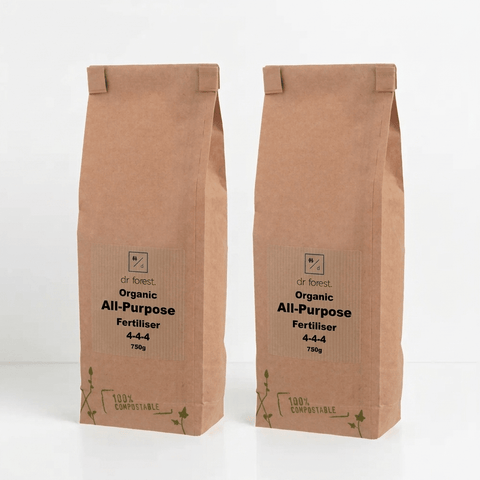
21% of buyers here also chose Organic All Purpose Fertiliser 4-4-4
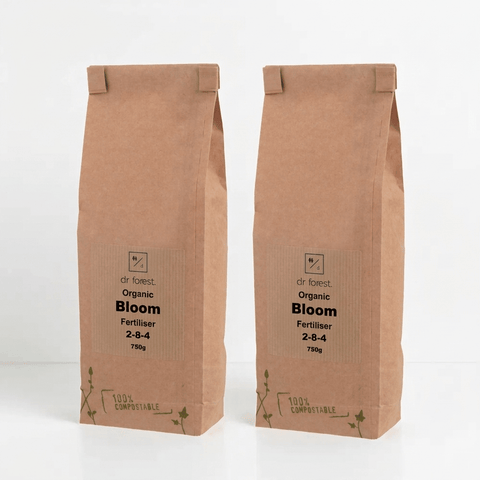
Organic Bloom Fertiliser 2-8-4 | Flower & Fruit Stage Feed
High-phosphorus 2-8-4 for flowering and fruiting.
from £12.00


