Soil Conditioner
Humic Acid Flakes | 70% Humic Acid, 100% Water Soluble | Premium Leonardite Soil Conditioner | Dr Forest
70% humic acid to improve soil structure and uptake.
from £7.49
Free UK Delivery on Orders Over £40


Dr Forest
Couldn't load pickup availability
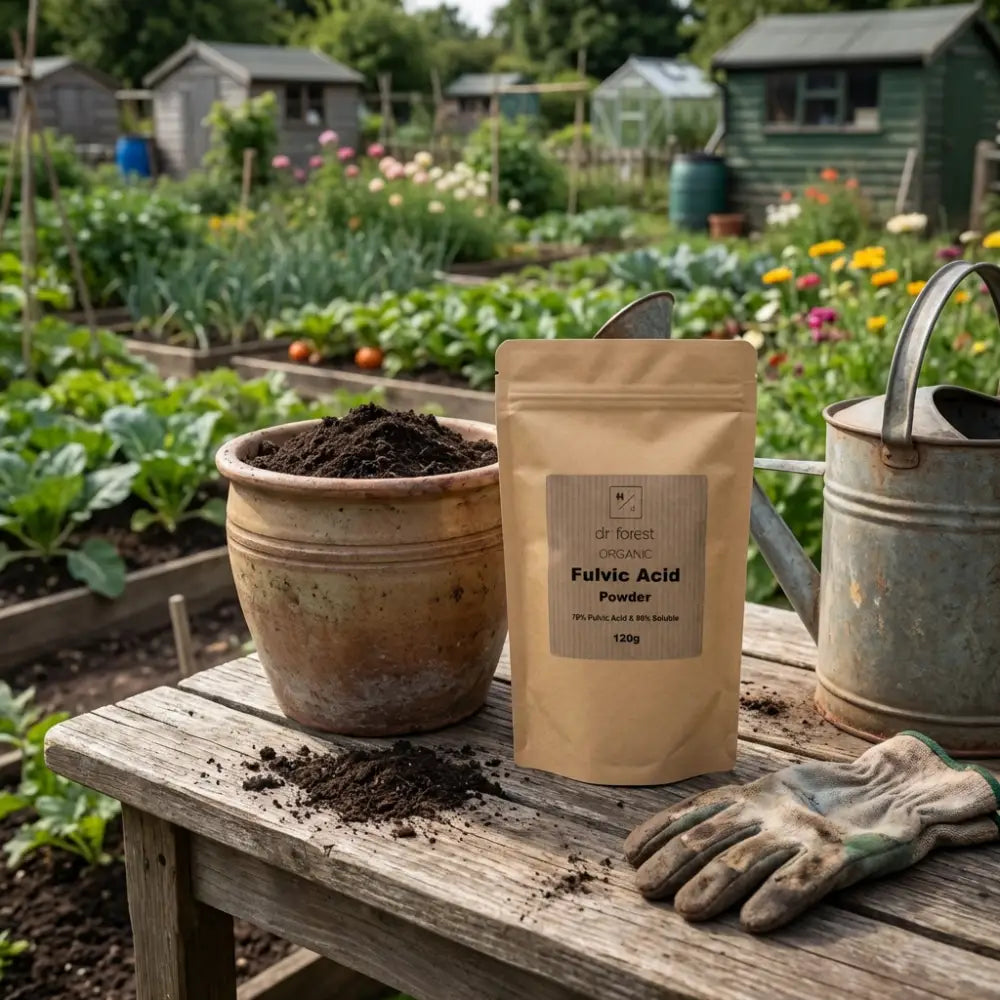
This is an organic plant biostimulant for use in the garden, allotment and protected growing setting. It is not a dietary supplement and is not formulated, tested or approved for human consumption. If you're looking for a fulvic acid supplement to take orally, this is not the product — those go through completely different food-grade processing, heavy-metal testing and human-use certification.
Fulvic acid is the smallest, most water-soluble fraction of humic substances — the carbon-rich molecules left behind when plant material has been broken down by microbes over geological timescales. The molecules are small enough (1,000 to 10,000 daltons) to pass through plant cell walls intact, which is why fulvic acid for plants works inside the leaf and root rather than only in the soil. As a biostimulant it chelates trace minerals into mobile, plant-available complexes, activates the H⁺-ATPase pump on root cell membranes, and triggers lateral root formation through auxin-like signalling. Most growers use fulvic and humic acid together — fulvic for the fast plant-side response, humic flakes for the slower soil-side build.
This powder is produced by enzymatic hydrolysis — biological enzymes at ambient temperature, gentler than the alkaline extraction used in cheaper products and preserving the heat-sensitive bioactive compounds that high-temperature processes destroy. 70% fulvic acid by mass, 99% soluble in cold water: it dissolves in seconds with no sediment, no insoluble fraction, and nothing to clog drip emitters or fine spray nozzles. Approved for organic production by OF&G (Organic Farmers & Growers). Handcrafted in Stockport.
Fulvic acid biostimulants are classed under EU regulation as substances that stimulate plant nutrition processes regardless of nutrient content, and the most useful synthesis of the evidence is the 2024 Agronomy meta-analysis by Ma and colleagues: 12% average yield increase on humic-acid amendments across 28 countries, 27% improvement in nitrogen use efficiency, and 17% increase in nitrogen uptake. Effects are biggest on soils with moderate pH and low-to-moderate organic matter — exactly the gardens where fulvic acid is most worth using.
Mechanistically, fulvic acid does three things. It carries an unusually high density of carboxyl (–COOH) and hydroxyl (–OH) groups for its size — these bind tightly to positively charged metal ions (iron, manganese, zinc, copper, calcium, magnesium) and form small chelated complexes that move freely through soil water and across plant cell membranes. Inside the plant, low-molecular-weight fragments interact with auxin signalling and trigger lateral root formation. Third — less obvious until you see the dose-response data — moderate concentrations of fulvic and humic acid prime the plant's antioxidant defences, stretching tolerance to drought and salinity. Too much suppresses the same response.
Carboxyl and hydroxyl groups bind metal cations to form small soluble complexes. The complex stays mobile in soil solution across a wide pH range, reaches root surfaces, and crosses cell membranes intact. The same mechanism also lets fulvic acid bias uptake away from sodium and chloride on saline soils — barley grain yield rose 64.7% over the salt-stressed control on saline land in Egypt, with reduced phosphorus rates and no yield loss.
Alsudays et al. 2024, BMC Plant Biology 24: 191The plasma membrane H⁺-ATPase is the proton pump that drives nutrient uptake by acidifying the root surface. Humic substances isolated from earthworm compost activated this pump in maize roots at very low concentrations (4 mg carbon per litre), enhancing root elongation and lateral root emergence. The finding has replicated across maize, Arabidopsis and rice.
Canellas et al. 2002, Plant Physiology 130(4): 1951–1957Trevisan and colleagues showed in 2010 that humic substances induce lateral root formation in Arabidopsis through the same gene-expression signature — the IAA19 gene and the DR5 auxin-response element — as a low dose of auxin itself. The flush of lateral roots and longer root hairs is what most growers notice first: a denser, fuzzier root ball within two to four weeks of starting to use fulvic acid.
Trevisan et al. 2010, Plant, Cell & Environment 33(1): 145–156Drought stress floods cells with reactive oxygen species. Plants pre-treated with fulvic acid carry higher activity of superoxide dismutase, peroxidase, catalase and ascorbate peroxidase, and lower accumulation of malondialdehyde (the cell-membrane damage marker). Drought-stressed oat retained higher relative water content and chlorophyll under the same stress as the untreated controls. The treatment has to go on before the stress arrives, not after.
Zhu et al. 2024, Frontiers in Plant Science 15: 1439747Foliar fulvic acid at 0.8 g/L on greenhouse tomatoes increased plant height, fresh and dry weight and marketable yield through more medium and large fruit. Blossom-end rot was greatly reduced at all rates and eliminated entirely at 1.6 g/L. Cracking was also reduced. The mechanism is the same as for the trace minerals: keep calcium mobile and chelated, more of it gets to the fruit on the transpiration stream.
Suh, Yoo & Suh 2014, Hort. Environ. Biotechnol. 55(6): 455–461The flavour, colour and nutritional quality of fruit comes from secondary metabolites: phenolic acids, flavonoids, carotenoids. Foliar fulvic at 1.5 g/L on mature pistachio at kernel formation raised phenolic compounds in the harvested kernel by 31.8% and flavonoid content by 24.5%. Catalase, ascorbate peroxidase and SOD activity all rose substantially. The same direction of effect shows up across the fruit and ornamental literature.
Nikoogoftar-Sedghi et al. 2024, BMC Plant Biology 24: 241Fulvic acid does not behave like a fertiliser. With nitrogen fertiliser, more gives more leaves up to the salt-damage point. With fulvic acid, the effective dose window is narrow, and going past it actively suppresses the response. The Suh tomato trial shows it cleanly: 0.8 g/L produced larger plants and more fruit; 1.6 g/L produced smaller plants and smaller fruit. Same season, same cultivar. Rice seedlings: 0.05 g/L stimulated root growth, 0.5 g/L inhibited it. Pistachio: 1.5 g/L was the optimum for phenolic content; 4.5 g/L gave smaller gains. Researchers call this hormesis. The practical rule for fulvic acid dosage is to start at the low end of the published range and only step up if a few cycles of consistent application aren't producing visible results.
Hard UK tap water carries calcium and magnesium that bind to fulvic acid before it reaches the leaf, lowering the bioactivity you paid for. Rainwater is the cleanest carrier for any fulvic acid spray. If you only have hard tap water, leave it standing 24 hours to let chlorine outgas, or pre-acidify slightly with a few drops of dilute citric acid. Mix fresh, use within 24 hours — diluted fulvic acid is a substrate for bacteria and a sprayer left for two weeks turns cloudy.
The dose-response curve is non-linear and going past the optimum reverses the effect. 0.8 g/L beats 1.6 g/L on tomatoes. Start at the low end of each range below. Step up only if a few applications haven't produced visible results — and then look at water quality, application timing and soil condition before assuming the dose was the problem.
The most-cited foliar rate in the literature. Greenhouse trials at 0.8 g/L produced larger plants, more medium and large fruit, and reduced blossom-end rot at every test rate. Spray early morning or late evening on both leaf surfaces.
Suh, Yoo & Suh 2014Lower foliar rates work best on leafy crops. The aim is steady supply rather than push.
Plant Sci Today 2025 review of 100+ studiesTwo well-timed sprays carry more weight than monthly maintenance through the flowering window.
The Damask rose trial used 1, 3 and 5 g/L; 5 g/L gave the strongest response, lifting flower number per plant by 40.5% and flower yield per hectare by 52.8%. Garden roses are less responsive than the cut-flower cultivars in the trial, but the direction of effect is consistent.
Ali et al. 2022Pistachio trials show 1.5 g/L is the optimum for phenolic and antioxidant content in the kernel. Higher rates flatten or reverse the response.
Nikoogoftar-Sedghi et al. 2024The benefit on turf shows up under stress, not on a healthy lawn already getting enough food and water. Apply 3 to 4 weeks before expected drought (May onwards in southern England, June in the north).
Zhang & Schmidt 1999Apply to moist (not dry) soil at the root zone. Pre-water if needed so the drench doesn't channel straight through.
Wet the rooting zone but don't soak straight through. For a 30 cm pot, half a litre of working solution is about right.
Roughly 5 g of powder per square metre per drench cycle. The field-scale benchmark from the saline-alkali processing tomato trial is 50 kg/ha, which peaked at 50 and declined at 75 (the dose-response curve again). The back-garden equivalent is 5 g/m². Use 1 g/L in solution rather than spreading powder dry — the chelation effect needs the fulvic in solution.
Irrigation Science 2025Auxin-like stimulation of lateral roots begins within 48–72 hours. Significantly reduces transplant shock and accelerates establishment.
Most useful on chalky beds where iron, zinc and phosphorus lock-up are recurrent issues.
Tomato seeds soaked at 80–160 mg/L (0.08–0.16 g/L) showed higher germination, longer radicles and greater seedling biomass than water-soaked controls. Seed soaking uses a far weaker solution than a foliar spray or drench, and there is no published evidence that stronger soaks do more — the dose-response work points the other way, so hold the concentration in this band and vary the soak time by seed type instead. Easy way to hit the rate: dissolve 1 g of powder in 1 litre of water to make a 1 g/L stock, then dilute about 100 ml of that stock into 900 ml of water for roughly 100 mg/L. Fine seeds (lettuce, brassicas, herbs): 4 hours. Medium seeds (tomato, pepper, beetroot): 4–6 hours. Large seeds (peas, beans, cucurbits): 6–8 hours. Hard-coated slow germinators (carrot, parsnip, parsley): up to 12 hours. Soak once, before sowing, and don't soak past 12 hours — seeds need oxygen to germinate.
Zhang et al. 202199% solubility means no residue, no blockages, no filtration step. Add the pre-dissolved concentrate to the reservoir after the main nutrient solution is mixed.
Spraying onto hot leaves at midday. The spray dries before the cuticle absorbs it. Worst case, dilute solution concentrates as it dries and leaves droplet burn marks. Apply early morning or late evening.
Mixing in hard tap water without adjusting. Calcium and magnesium in hard UK water lock up part of the fulvic before it reaches the leaf. Use rainwater, or stand tap water 24 hours and pre-acidify with a few drops of dilute citric acid.
Storing diluted solution. Diluted fulvic supports bacterial growth. Mix what you need, use it within 24 hours, pour the rest on the soil.
Treating it as a rescue product. Fulvic is a priming and uptake input. A wilting drought-stressed plant won't recover faster from a fulvic spray. The plant that won't wilt at all is the one that was sprayed three weeks earlier.
Using it on a well-fed plant in isolation. Fulvic is the carrier. If there are no nutrients in the soil for it to chelate, the chelation does nothing. Use it alongside an organic fertiliser, a compost-fed soil, or a regular liquid feed.
Fulvic acid is a carrier, not a feed — it works hardest alongside the rest of the programme. Pair with our Humic Acid Flakes as a monthly soil drench for the slower soil-side benefit; together the fulvic humic acid pairing is the most studied combination in the literature. Add the powder to any micronutrient feed where iron, zinc or manganese absorption is limiting. Tank-mix with our Liquid Seaweed for complementary biostimulant mechanisms. For long-term reading, our blog covers what fulvic acid is and eight peer-reviewed benefits in more detail.


31% of buyers here also chose Humic Acid Flakes

70% humic acid to improve soil structure and uptake.
from £7.49

Helps water and feed soak in evenly, with less run-off.
from £14.00

Fully soluble kelp for foliar or root feeding.
from £6.50