


Probiotic/Innoculant
Mycorrhizal Fungi Powder | 18 Species, Endo + Ecto
A plant-based root inoculant, 18 endo and ecto species.
from £6.99
This is a garden biostimulant for plants and soil. It is not a dietary supplement, not food grade, and not tested to supplement standards. Do not consume it. If you are looking for a seaweed or kelp supplement, this is the wrong product.
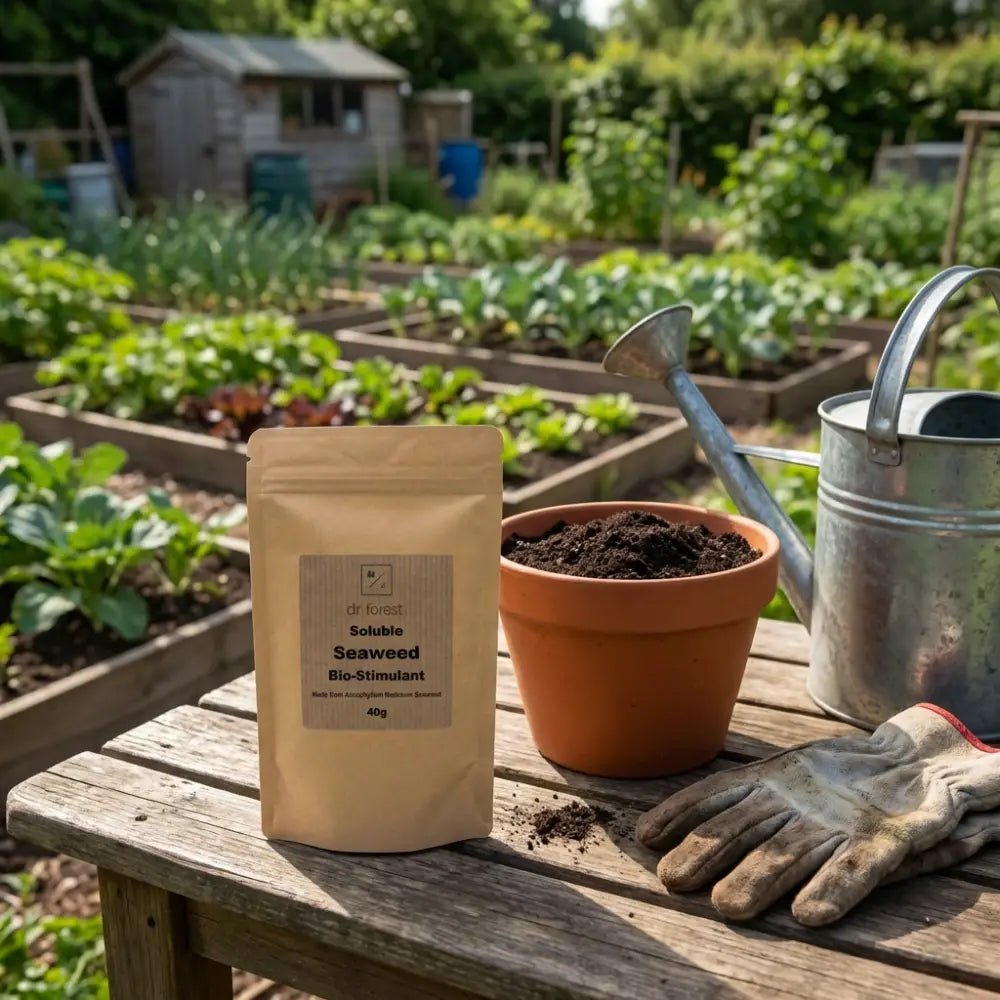
Mix a spoon of this powder into water and you have a liquid seaweed feed — seaweed fertiliser and seaweed plant food as a drench or foliar, without buying a bottle of water.
It is a biostimulant, not a weekly high-nitrogen bottle. Nitrogen and phosphorus stay low; the useful fraction is alginic acid, natural growth compounds and potash from Ascophyllum nodosum. Use it to support roots, stress tolerance and how the plant uses the feed you already give — not as the only bag in the shed.
Seaweed is a biostimulant, not a conventional fertiliser. It carries almost no nitrogen or phosphorus. What it carries instead is alginic acid, complex polysaccharides, natural growth compounds and potash, all of which act on the plant's own growth and defence machinery rather than simply feeding it. That is the difference between a plant food and a plant activator.
This is an organic seaweed extract powder made from a single ingredient, Ascophyllum nodosum, the knotted wrack of the cold North Atlantic and the most heavily researched seaweed in agricultural science. The seaweed is processed gently, without harsh chemicals or heat, so the bioactive fraction survives the manufacturing rather than being cooked or stripped out by hot alkaline extraction. The result dissolves fully in cold water in seconds, with no sediment, no straining and no blocked sprayer nozzles.
The label is unusually strong for a soluble seaweed powder: 19.38% alginic acid, 48.33% organic matter and 17.89% K₂O. That potash figure matters. Most liquid seaweed feeds deliver a fraction of a percent of potassium once diluted, so gardeners assume seaweed is a poor source of potash. In a concentrated soluble powder it is not.
Dr Forest is a small independent fertiliser business run from Stockport, Greater Manchester, founded in 2020 and named after Joe's grandfather Dr Forrest, a GP in a Lancashire mining town who kept a back-garden plot for the runner beans he turned into piccalilli.
Ascophyllum nodosum grows in the intertidal zone of the North Atlantic and is exposed twice a day to desiccation, UV, freezing, osmotic shock and wave damage. Surviving that has driven it to accumulate an unusual density of protective compounds: alginates, fucoidans, laminarin, mannitol, betaines and phenolics. Applied to land plants, several of those compounds behave as signalling molecules rather than nutrients. This is the reason A. nodosum, rather than kelp or Sargassum, dominates the peer-reviewed biostimulant literature.
Alginic acid is the fraction that does most of the soil work. It is a natural chelator, binding mineral cations into forms roots can take up, and it improves aggregate stability and water-holding capacity in both sandy and heavy ground. It is also the reason a seaweed drench behaves as a soil conditioner as well as a feed. At 19.38%, this material sits above the alginic acid content typically declared by mainstream Ascophyllum powders, which is the single most useful comparison figure when you are looking at competing seaweed products.
Seaweed accumulates potassium from seawater. At 17.89% K₂O, alongside 1.20% N and 0.89% P, this is a potash-dominant analysis. It will not replace a dedicated potash feed at garden dilution rates, but it does mean the biostimulant is doing nutritional work at the same time, which is why seaweed has always earned its place in flowering and fruiting programmes.
Ascophyllum nodosum extracts alter the plant's own hormone balance rather than simply supplying hormones. Wally et al. (2013) showed that treatment of Arabidopsis with a commercial A. nodosum extract changed cytokinin, auxin and abscisic acid biosynthesis and accumulation in plant tissue. The visible outcome is faster root establishment and a larger root surface for water and nutrient capture.
Shukla et al. (2018) demonstrated improved drought tolerance in soybean following A. nodosum application, through upregulation of stress-response genes rather than through any water-holding effect of the product itself. Betaines, mannitol and proline in the seaweed act as osmoprotectants, stabilising membranes while the plant's own stress response comes online.
Rayirath et al. (2009) found that lipophilic components of A. nodosum enhanced freezing tolerance in Arabidopsis. For a UK garden this is the most practically useful of all the stress findings, given how often a late frost is the difference between a crop and no crop on early potatoes, blossom and tender bedding.
Laminarin and fucoidan, polysaccharides specific to brown algae, act as elicitors that trigger systemic acquired resistance. The plant's defence genes are primed before infection, so the response to a fungal or bacterial attack is faster and stronger. Khan et al. (2009) review the elicitor evidence across crops.
Alginic acid chelates mineral cations in soil and lowers surface tension on the leaf, which is why tank-mixing seaweed with a foliar feed reliably improves the performance of the feed. In the soil, the polysaccharide fraction feeds bacteria and fungi and improves aggregate stability. Shukla et al. (2019) summarise the soil and rhizosphere evidence.
Seaweed biostimulant responses are concentration dependent and non-linear. The effect rises to an optimum and then falls away, and strong concentrations can inhibit the growth they promote at the correct dilution. Khan et al. (2009) note this concentration dependence across the biostimulant literature. Doubling the rate does not double the result, it usually costs you the result. Weigh the powder rather than guessing with a spoon, and treat the stress-recovery rate as a short-term measure, not a new normal.
This is a fully soluble powder, not a meal or a granule. Sprinkle the measured amount onto the water surface, stir briefly, and it is gone within seconds with no sediment. The powder is alkaline, so in hard tap water expect a slight cloudiness on standing. That is normal and does not affect performance. Use the made-up solution within 24 hours.
The standard biostimulant rate for anything in the ground or in a pot through the growing season. Apply around the root zone and water in. Compatible with all Dr Forest fertilisers.
Both leaf surfaces, fine mist, early morning or evening. Never in full sun. The alginic acid acts as a wetting agent, so you need less spray volume than you think to get full coverage.
Drench the root zone straight after any root disturbance. This is the single highest-value application in the year.
Drain and sow directly. Do not rinse. Improves germination and produces seedlings with stronger root systems.
Frost damage, heat, drought or pest attack. Drop back to the standard rate as soon as the plant is growing away again. This is a short-term rate, not a permanent one.
Deeper rooting, better drought tolerance, faster green-up. Most useful straight after scarifying, aerating or overseeding.
Add to the reservoir after the main nutrients are mixed. Fully soluble, so no filter or emitter issues, and the contribution to EC is small.
Seaweed biostimulant response is non-linear. Past the optimum the effect reverses and strong concentrations inhibit growth instead of promoting it. A stronger mix is not a stronger result. Weigh the powder, do not eyeball it, and if you have overdone it, water through with plain water and go back to the standard rate.
Pair with Fulvic Acid Powder for mineral chelation and uptake, Humic Acid Granules for long-term soil CEC, and the Dr Forest crop-specific plant foods for tomatoes, chillies, strawberries and roses, where the seaweed acts as the biostimulant layer under the nutrition.
Gardeners often search seaweed feed and seaweed plant food expecting an NPK replacement. Seaweed extract is the wrong tool for that job. A proper tomato or all-purpose fertiliser supplies the numbers; seaweed sits alongside them. For the longer explanation of forms, rates and evidence, see what seaweed fertiliser actually does.
Choosing meal vs powder? Start at the seaweed fertiliser collection.
19% of buyers here also chose Fulvic Acid Powder
A plant-based root inoculant, 18 endo and ecto species.
from £6.99
An amino-acid foliar feed for quick uptake.
from £6.00


