Skip to product information
1 of 1

Dr Forest

Wood Vinegar | Organic Plant Biostimulant

Wood Vinegar | Organic Plant Biostimulant

Regular price £14.99 GBP
Regular price Sale price £14.99 GBP
Sale Sold out
Shipping calculated at checkout.
size
Quantity
  • Free UK delivery on orders over £40
  • Handcrafted and dispatched from Stockport
  • Made with organic ingredients, no slaughterhouse by-products

Dr Forest customers rate us 4.89/5 · 3,250+ reviews across Shopify, Amazon, Google and eBay


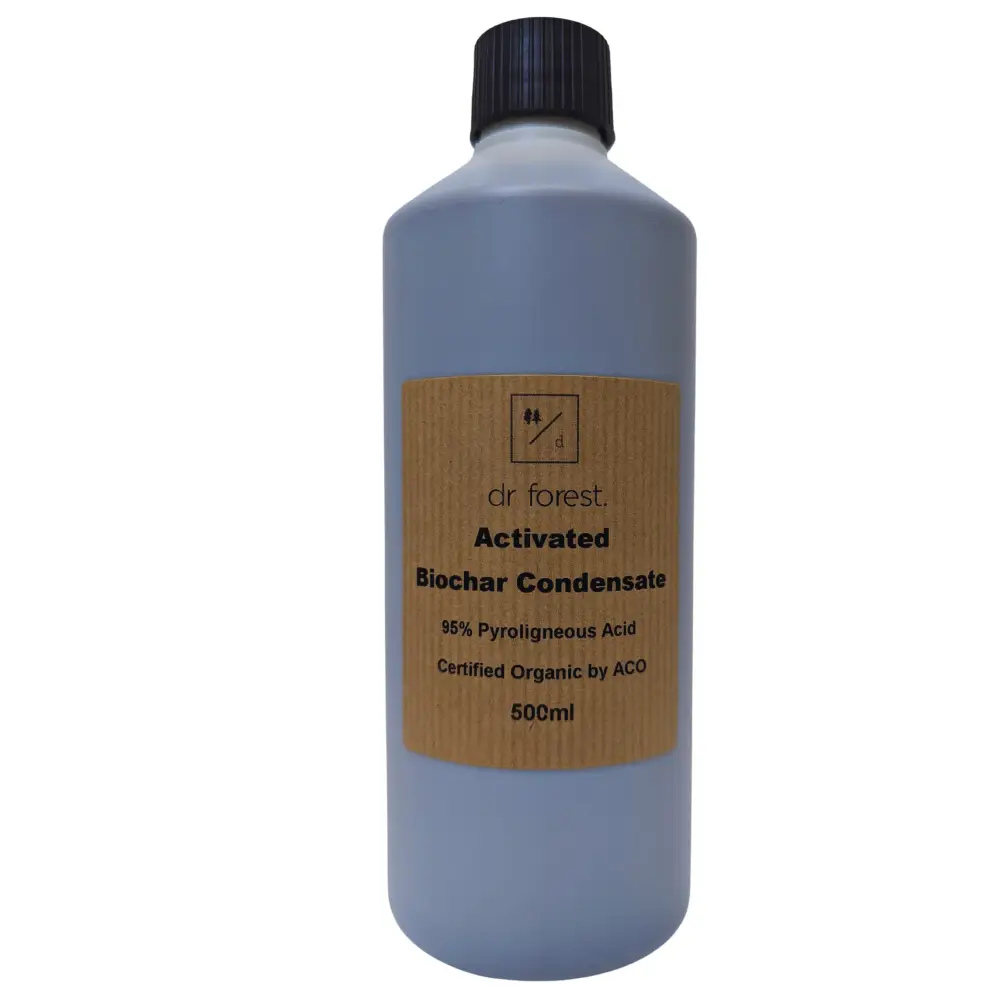
Activated biochar condensate — liquid biostimulant with wood vinegar, karrikins & 200+ bioactive compounds

99.5% Pyroligneous Acid 200+ Bioactive Compounds Contains Karrikins Biochar Nanoparticles ACO Organic Certified Foliar & Soil Use

This is not a fertiliser, not a compost tea, and not a conventional biostimulant. Activated biochar condensate is a concentrated liquid derived from plant biomass pyrolysis — the controlled heating of organic material in the absence of oxygen. The process produces biochar (solid carbon) and a liquid condensate known as wood vinegar (pyroligneous acid). This product is that condensate: 99.5% pyroligneous acid carrying biochar nanoparticles and over 200 bioactive compounds including organic acids, phenolics, and a class of signalling molecules called karrikins that were only discovered in 2004.

Karrikins are fire-derived compounds that trigger seed germination and stimulate plant growth — they are the biochemical reason that vegetation regenerates so vigorously after bushfires. In nature, karrikins are produced when plant matter burns. In this product, the pyrolysis process generates them in concentrated form. When applied to soil or foliage, karrikins signal the plant to invest in root development, biomass production, and stress tolerance — as if responding to a post-fire regeneration cue.

Alongside the karrikins, the condensate delivers a complex cocktail of organic acids that stimulate soil microbial activity, phenolic compounds that enhance plant resilience against pests and pathogens, and biochar nanoparticles that provide colloidal carbon surfaces for microbial colonisation in the root zone. The result is a single liquid product that simultaneously stimulates plant growth, feeds soil biology, enhances pest resistance, and improves fertiliser efficiency.

99.5%Pyroligneous Acid
200+Bioactive Compounds
32%Rice Yield Increase (Trial)
pH 4.5–6.5Mildly Acidic

What activated biochar condensate is used for

  • Foliar biostimulant spray — applied to leaves, the bioactive compounds are absorbed through stomata and cuticle; karrikins trigger growth signalling, phenolics prime plant defence systems, and organic acids provide a carbon source for beneficial phyllosphere micro-organisms
  • Soil drench to stimulate microbial activity — the organic acids and biochar nanoparticles in the condensate fuel rapid microbial multiplication in the root zone; enzyme activity (including phosphatase) increases, accelerating nutrient cycling and improving the availability of phosphorus and other locked-up nutrients
  • Enhancing fertiliser performance — when applied alongside organic or mineral fertilisers, the condensate increases microbial enzyme activity that breaks down organic nitrogen, phosphorus, and sulphur compounds into plant-available forms; research shows measurably higher nutrient uptake in treated plants
  • Pest and disease resistance — the phenolic compounds and organic acids in wood vinegar have natural insect-repellent and antifungal properties; research shows reduced Fusarium wilt, lower nematode pressure, and decreased insect damage in treated crops
  • Seed treatment for improved germination — karrikins are the most potent known natural germination triggers; soaking seeds in diluted condensate before sowing increases germination rate, seedling vigour, and root length
  • Compost accelerant — diluted condensate applied to compost heaps stimulates microbial activity, reduces ammonia volatilisation, and accelerates decomposition
  • Improving fruit quality, Brix and flavour — trial data shows increased sugar content (°Brix), improved fruit firmness, and enhanced overall quality in tomatoes and other crops treated with biochar condensate
  • Post-harvest dip — diluted condensate used as a post-harvest dip for fruit and vegetables extends shelf life through its mild antimicrobial action on surface-borne decay organisms

Typical analysis

Composition

  • Pyroligneous acid (wood vinegar): 99.5%
  • Organic carbon concentrate (OCC): 0.5%
  • EC (conductivity): 10–18 mS/cm
  • Specific gravity: 1.1
  • pH: 4.5–6.5
  • Contains: organic acids, phenolics, karrikins, biochar nanoparticles, and 200+ bioactive compounds
  • ACO certified organic

What makes this different from plain wood vinegar

  • This is not raw wood vinegar — it is an activated biochar condensate containing suspended biochar nanoparticles alongside the pyroligneous acid
  • The biochar nanoparticles provide colloidal carbon surfaces that soil micro-organisms colonise, creating biological hotspots in the root zone
  • The activation process concentrates the karrikin and phenolic content beyond what raw wood vinegar typically contains
  • The combination of liquid organic acids + solid nanoparticles + signalling molecules makes this a more complex and effective product than unprocessed wood vinegar

The science of pyroligneous acid: karrikins, phenolics & what 200 bioactive compounds actually do

What pyrolysis produces and why it matters

Pyrolysis is the thermal decomposition of organic material in the absence of oxygen. When plant biomass is heated under these conditions, it produces three outputs: biochar (solid carbon), syngas (combustible gases), and a liquid condensate — the pyroligneous acid or "wood vinegar" that makes up this product. The condensate is not a simple liquid. It is an extraordinarily complex mixture of over 200 identified compounds including organic acids (acetic, propionic, butyric), phenolics, alcohols, esters, ketones, aldehydes, and — critically — karrikins.

These compounds are not present in raw plant material. They are created by the pyrolysis process itself — the heat transforms the plant's cellulose, hemicellulose, and lignin into an entirely new chemistry. This is the same chemistry that occurs during bushfires, which is why karrikins (the germination-triggering compounds in wood vinegar) are named after the Aboriginal word karrik, meaning "smoke".


Six mechanisms of action

01

Karrikins — Germination & Growth Signalling

Karrikins are butenolide compounds discovered in 2004 that trigger seed germination and stimulate plant growth through a specific receptor pathway (KAI2). In nature, they are responsible for the mass germination of seeds after bushfires. Applied to garden soil or seeds, karrikins signal the plant to invest in root development, biomass production, and stress tolerance. They operate at extremely low concentrations — parts per billion — making even dilute applications biologically active. This product contains karrikins generated during the pyrolysis process, in concentrated form.

02

Phenolic Compounds — Plant Defence Priming

The phenolics in pyroligneous acid include catechol, guaiacol, syringol, and other lignin-derived compounds. When absorbed by plant tissue (through roots or foliar spray), these phenolics prime the plant's own defence systems — upregulating the production of defensive enzymes, strengthening cell walls, and increasing the synthesis of the plant's own antimicrobial compounds. Research on tomatoes shows that wood vinegar treatment reduced Fusarium wilt incidence by lowering oxidative stress markers and enhancing the plant's enzymatic antioxidant defences.

03

Organic Acids — Soil Microbial Fuel

The organic acid fraction (acetic, propionic, formic, butyric) provides an immediately available carbon and energy source for soil bacteria and fungi. A single application triggers a rapid bloom of beneficial microbial activity in the root zone. This increased microbial activity drives faster nutrient cycling — the organisms produce enzymes (phosphatase, protease, urease) that break down organic matter into plant-available nutrients. The microbial stimulation effect is the primary mechanism by which wood vinegar increases fertiliser efficiency.

04

Biochar Nanoparticles — Colloidal Carbon Habitat

Suspended in the liquid are nanoparticles of biochar — microscopic fragments of the solid carbon produced during pyrolysis. These nanoparticles have enormous surface area relative to their size and are colonised by soil micro-organisms within hours of application. They create biological hotspots in the root zone — concentrated nodes of microbial activity that accelerate nutrient cycling, produce plant growth-promoting substances, and compete with pathogenic organisms for space and resources. The nanoparticles also adsorb and slowly release nutrient ions, acting as a nano-scale CEC contribution to the soil.

05

Phosphatase Stimulation — Unlocking Phosphorus

Research consistently shows that wood vinegar application increases phosphatase enzyme activity in the soil. Phosphatase hydrolyses organic phosphate compounds into plant-available inorganic phosphate (PO₄³⁻). Since over 80% of soil phosphorus is locked in organic forms, this enzymatic release is a critical bottleneck in nutrient cycling. The condensate removes that bottleneck — not by supplying phosphorus, but by stimulating the biology that liberates it from existing soil reserves and organic amendments.

06

Ammonia Reduction & Carbon Sequestration

Applied to compost or soil, the organic acids in the condensate bind ammonium ions, reducing the volatilisation of ammonia — conserving nitrogen that would otherwise be lost to the atmosphere. The biochar nanoparticles contribute stable carbon to the soil that persists for decades to centuries, making each application a direct (if small) contribution to soil carbon sequestration. These environmental benefits complement the agronomic ones.

Scientific References — Published Trial Data

  1. Exogenous application of wood vinegar improves rice yield and quality (2024). Agronomy. [Up to 32.4% yield increase; improved photosynthesis, soluble sugar, reduced chalkiness]
  2. Effects of foliar spraying wood vinegar on rice agronomic characters and yield (2022). Chinese Agricultural Science Bulletin. [1.7–16.9% yield increase at 100×–300× dilution]
  3. Effect of the interaction between wood vinegar and biochar on tomato plants (2023). International Journal of Environmental Science and Technology. [Increased fruit yield and °Brix at 1:200 weekly foliar]
  4. Physiological and biochemical mechanisms of wood vinegar-induced stress response against tomato Fusarium wilt (2024). Plants. [Reduced Fusarium wilt; enhanced enzymatic antioxidant defences]
  5. Wood vinegar impact on growth and low-temperature tolerance of rapeseed (2022). Agronomy. [Improved biomass, photosynthesis, and cold stress tolerance]
  6. Effects of soaking seeds with wood vinegar on germination of forage species (2025). Chinese Agricultural Science Bulletin. [Increased germination, vigour index, root length at 300–500× dilution]
  7. Flematti, G.R. et al. (2004). A compound from smoke that promotes seed germination. Science, 305(5686), 977. [Discovery of karrikins]

How to use activated biochar condensate: foliar spray, soil drench, seed treatment & compost

Concentrated — always dilute before use

This is a concentrated liquid (99.5% pyroligneous acid, SG 1.1, pH 4.5–6.5). Never apply undiluted. Dilute according to the rates below before all applications. Agitate well during mixing and application — the biochar nanoparticles settle if left standing. Shake the bottle before measuring.

Application rates

Foliar spray

Rate: 5 ml per litre of water  |  Frequency: Every 3–4 weeks during active growth

Mix 5 ml of condensate per litre of water and apply as a fine foliar spray to both upper and lower leaf surfaces. Apply in the early morning or late evening to avoid rapid evaporation and maximise leaf absorption. The karrikins, phenolics, and organic acids are absorbed through stomata and cuticle, triggering growth signalling and defence priming within hours. Compatible with most organic fertiliser sprays — can be tank-mixed with Dr Forest Seaweed Powder liquid feed for a combined biostimulant and nutrient application.

Soil drench — root zone application

Rate: 5–10 ml per litre of water  |  Frequency: Every 3–4 weeks during active growth

Mix 5–10 ml per litre and apply to the root zone with a watering can. Water thoroughly before and after application to distribute the condensate through the root zone. The organic acids and biochar nanoparticles stimulate microbial activity in the rhizosphere, increasing enzyme production and nutrient cycling. Particularly effective 2–3 days after applying organic fertiliser — the condensate accelerates the biological breakdown of the fertiliser's organic nutrients.

Seed treatment

Rate: Dilute 1:100  |  Method: Soak seeds for 6–24 hours, or spray during sowing

Dilute the condensate at 1:100 in water and soak seeds before sowing. The karrikins trigger the KAI2 germination pathway, increasing germination rate and seedling vigour. Research on forage crops shows increased germination, vigour index, root length, and seedling biomass at 300–500× dilution. For direct sowing, spray the diluted solution over the seed drill before covering.

Fertigation — drip, irrigation, or liquid feed systems

Rate: 5 ml per litre of water  |  Frequency: Every 3–4 weeks

Add to irrigation water or liquid feed systems at 5 ml/L. Agitate well — the nanoparticles can settle in standing solution. Strain through a fine mesh if using with drip emitters. Fully compatible with organic liquid fertiliser programmes.

Compost accelerant

Rate: 10 ml per litre of water  |  Method: Apply during heap construction or when watering

Dilute 10 ml per litre of water and apply to compost during construction or as part of routine watering. A standard watering can (10 litres) needs 100 ml of condensate. The organic acids fuel microbial activity, accelerating decomposition. The mildly acidic pH helps maintain the optimal acid conditions for early-stage composting. The biochar nanoparticles bind ammonium, reducing ammonia volatilisation and conserving nitrogen in the finished compost.

Post-harvest dip

Rate: 5 ml per litre of water  |  Method: Brief dip or spray of harvested produce

Dilute and use as a quick dip or spray for freshly harvested fruit and vegetables. The mild antimicrobial action of the organic acids reduces surface-borne decay organisms, extending shelf life. Allow produce to air dry after dipping. Particularly useful for soft fruit (strawberries, raspberries) and salad crops.

Step-by-step foliar application

  1. Shake the bottle well. Biochar nanoparticles settle during storage. Agitate thoroughly before measuring to ensure an even suspension.
  2. Measure and dilute. Add 5 ml of condensate per litre of water. Stir or shake the spray vessel well to distribute the nanoparticles evenly.
  3. Spray in early morning or late evening. Avoid spraying in full sun — the stomata close and the liquid evaporates before absorption. Cool conditions with open stomata maximise uptake.
  4. Cover both leaf surfaces. Apply as a fine mist to upper and lower leaf surfaces. The underside of the leaf has a higher stomatal density and absorbs the solution more efficiently.
  5. Repeat every 3–4 weeks. The biostimulant effect is cumulative — regular applications maintain the karrikin signalling, phenolic defence priming, and microbial stimulation throughout the growing season.
Safety precautions

This is a concentrated acid product (pH 4.5–6.5). Avoid contact with eyes and skin. Wear gloves when handling the concentrate. Keep out of reach of children. If contact with eyes occurs, rinse immediately with plenty of water. If swallowed, seek medical advice. Once diluted to the recommended rates, the solution is safe for plants, soil, and edible crops with no withholding period.

Works well combined with…

Use as a foliar spray alongside Dr Forest Seaweed Powder for a combined biostimulant + trace mineral application. Apply as a soil drench 2–3 days after top dressing with Dr Forest granular fertilisers — the condensate accelerates the microbial breakdown of the organic nutrients. Add to Molasses-based compost tea brews for enhanced biological diversity and karrikin signalling. Combine with Humic Acid soil drenches — the humic acid chelates the minerals released by the condensate's microbial stimulation effect. Use as a seed soak before sowing alongside Mycorrhizal Fungi powder dusted into the seed drill.
Frequently asked questions about activated biochar condensate

Wood vinegar is the liquid condensate produced when plant biomass is heated in the absence of oxygen (pyrolysis). It is not vinegar in the kitchen sense — it is a complex mixture of over 200 organic compounds including organic acids, phenolics, alcohols, esters, and karrikins. It has been used in agriculture across Asia for centuries as a soil stimulant, pest deterrent, and plant growth enhancer. Modern research has confirmed and expanded our understanding of its mechanisms of action.
Karrikins are butenolide signalling molecules discovered in 2004 by Australian researchers studying post-bushfire seed germination. They are produced when plant material is burned or pyrolysed. Karrikins bind to a specific plant receptor (KAI2) and trigger germination, root development, and growth responses. They are the biochemical reason vegetation regenerates so vigorously after fire. In this product, karrikins are generated during the pyrolysis process and delivered in concentrated form. They are active at extremely low concentrations — parts per billion.
No. Biochar is the solid carbon product of pyrolysis — a charcoal-like material mixed into soil as a long-term amendment. This is the liquid condensate produced by the same pyrolysis process. It contains biochar nanoparticles suspended in the liquid, but it is primarily a liquid biostimulant (99.5% pyroligneous acid), not a solid soil amendment. Biochar and biochar condensate are complementary products — one builds long-term soil carbon structure, the other delivers immediate biostimulant and microbial activation effects.
No. It contains negligible NPK. Its value is as a biostimulant — it stimulates the plant's own growth responses, primes its defence systems, and activates the soil biology that cycles nutrients from organic matter and fertilisers into plant-available forms. Use it alongside a fertiliser programme, not instead of one. It makes fertilisers work more effectively by increasing the microbial enzyme activity that breaks organic nutrients down.
Yes. ACO certified organic with no withholding period for edible crops. Once diluted to the recommended rates (5 ml/L for foliar, 5–10 ml/L for soil), the solution is safe for all food crops. The concentrate is a mild acid (pH 4.5–6.5) — handle with gloves and avoid skin and eye contact before dilution.
Yes. Compatible with most organic fertilisers and pesticides. It can be tank-mixed with seaweed extract, humic acid, and liquid fertiliser solutions for combined applications. If mixing with a product you have not combined before, test on a small area first. Do not mix with strongly alkaline products — the acid pH of the condensate may react. The mildly acidic solution can actually improve the efficacy of some foliar sprays by lowering the spray solution pH closer to the optimal absorption range.
Yes — the biochar nanoparticles settle during storage. This is normal and does not indicate deterioration. Shake the bottle thoroughly before each use to resuspend the nanoparticles. If using in a sprayer with fine nozzles, strain through a fine mesh after diluting to prevent any larger particles from clogging the nozzle.
Store in a cool, dry place away from direct sunlight with the cap tightly sealed. The organic acid content acts as a natural preservative — the product has a shelf life of approximately 2 years when stored correctly. Do not freeze. Keep out of reach of children.
View full details
From 4,172 real Dr Forest orders

Often bought with this