




Fertiliser
Organic Amino Acid Fertiliser | Foliar Feed
An amino-acid foliar feed for quick uptake.
from £6.00
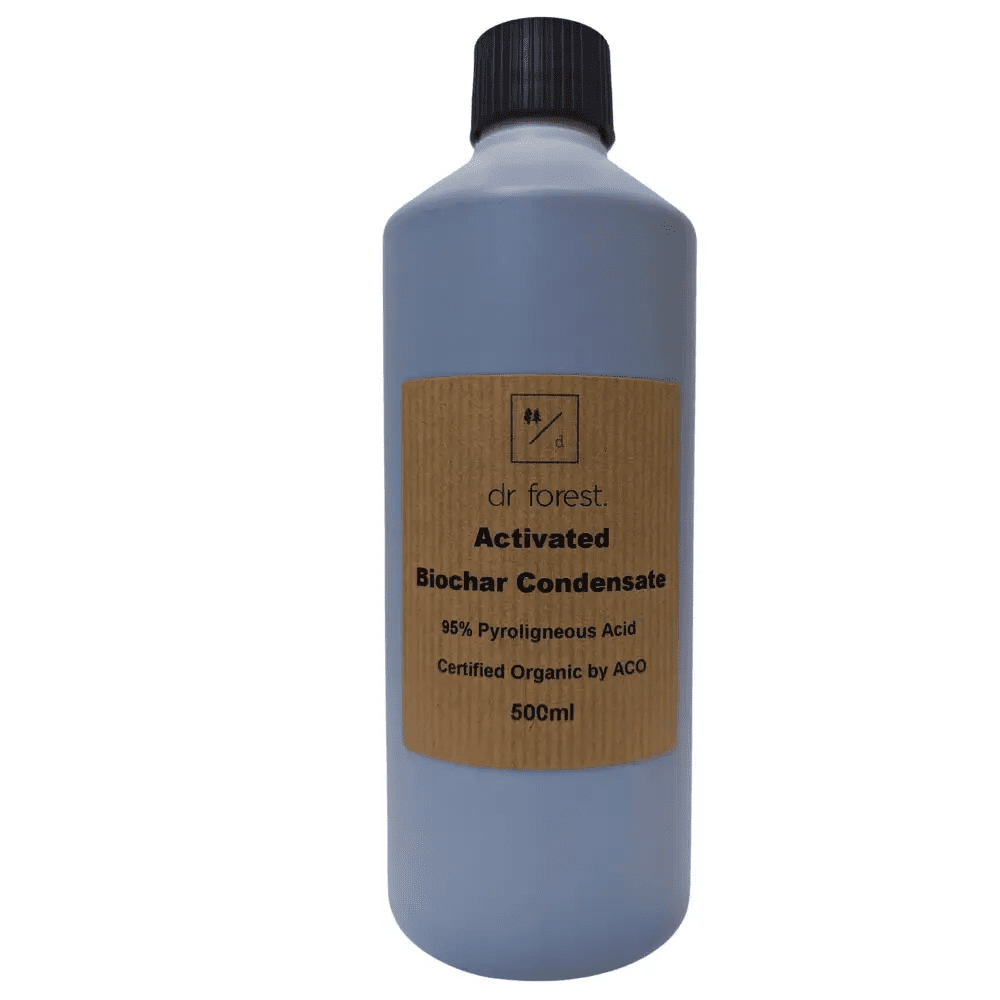
Wood vinegar concentrate (this bottle)
Home-made smoke water
Wood vinegar is the liquid that condenses out of the smoke when plant biomass is heated without oxygen to make biochar. Chemists call it pyroligneous acid, or wood acid. It is mostly water carrying more than 200 organic compounds, chiefly acetic acid and lignin-derived phenols. Diluted and applied to leaves, soil, seed or a compost heap, it works as a plant biostimulant and carries negligible NPK. The Dr Forest bottle is a 99.5% pyroligneous acid concentrate with a 0.5% organic carbon fraction, for UK gardens and allotments.
It goes a long way. At the standard 5 ml per litre foliar rate a 500 ml bottle makes 100 litres of spray, ten full 10 litre watering cans, and the 1 litre bottle makes 200 litres. The concentrate is mildly acidic (pH 4.5–6.5) and must always be diluted. It sits alongside your normal feeding and helps the soil biology turn that feed into something the plant can use.
Dr Forest is a small science-led fertiliser business in Stockport, Greater Manchester, founded in 2020. Wood vinegar is plant-derived, and it suits a no-dig or living-soil approach where the aim is to feed the soil biology. If that idea is new to you, start with What is living soil? Made by Growers. Backed by Science.
Heat plant material to a few hundred degrees with the air shut out and it breaks apart without burning. The solid left behind is biochar; the gases are cooled, and the part that condenses is pyroligneous acid, better known as wood vinegar. Theapparat et al. (2018) describe it as 80–90% water with more than 200 organic compounds in the remainder, the largest single one being acetic acid, followed by other short-chain acids and a family of lignin-derived phenols such as guaiacol and syringol.
None of those compounds is in the wood to begin with. The heat makes them from cellulose, hemicellulose and lignin, which is why wood vinegar smells of smoke. Biochar is the long-term soil carbon from that process; wood vinegar is the short-lived liquid side of it. For the seaweed side of the biostimulant story, see What is seaweed fertiliser?
| Property | Value | Note |
|---|---|---|
| Pyroligneous acid (wood vinegar) | 99.5% | Mostly water carrying organic acids, phenols, esters and ketones |
| Organic carbon concentrate | 0.5% | Fine biochar fraction, settles on standing; shake before use |
| pH | 4.5–6.5 | Mildly acidic concentrate |
| EC (conductivity) | 10–18 mS/cm | Undiluted |
| Specific gravity | 1.1 | 5 ml weighs about 5.5 g |
| NPK | Negligible | Use alongside a feed |
Leifeld and Walz (2025) found a mean pH of 3.5 in the 26 studies that reported it; this one sits one to three units higher, so it is less acidic at the same dilution. It still needs gloves neat and dilution before it goes near a plant.
Flematti et al. (2004, Science) isolated a butenolide from plant- and cellulose-derived smoke that promoted germination in a number of species at a level similar to plant-derived smoke-water; the family was later named karrikins. Kochanek et al. (2016, PLOS ONE) found karrikinolide in biochar and, at 69 ng/ml (460 nM), in the water used to scrub the gas from a slow-pyrolysis unit. That liquid took dormant seed from 0–8% germination on water to as much as 91–96%. The authors class it separately from wood vinegar, though, and how much karrikin a given wood vinegar carries is uncertain. This batch has not been assayed, so we make no karrikin claim for it.
Acetic and butyric acids are about the simplest carbon a soil microbe can eat. Yang et al. (2024, Plants) drip-applied wood vinegar to pots of saline soil growing cotton and recorded soil urease activity 96.85% higher than the untreated control at the stronger dose, with β-glucosidase activity also up. Seok and Park (2024, Environmental Science and Pollution Research) found basal soil respiration rose and soil nitrate fell where wood vinegar was added to a urea-fertilised soil. A pot trial and a laboratory study respectively, so read across to a Stockport allotment with care, but the direction is consistent.
Hur et al. (2025, Plant Physiology and Biochemistry) sprayed rice with wood vinegar at three growth stages and recorded a higher photosynthetic rate, more chlorophyll, total soluble sugars of 9.71 mg/g and a yield lift of up to 32.4%. Zhu et al. (2021, Agronomy) sprayed rapeseed twice at a 400-fold dilution and averaged 9.58% more seed yield, with leaf area index up 23.45%. The rice figure is the best of several spray timings; the rapeseed figure is a two-year average.
Leifeld and Walz (2025, Agronomy) reviewed 65 studies. Wood vinegar raised yield by an average of 21% and biomass by 25%, with the optimum at around 0.5–1%. Sprayed on leaves, yields fell above about 6%; as a drench, above about 11%. Ofoe et al. (2022, Plants) saw the same curve in tomato: a fortnightly 0.5% drench gave about 26% more fruit weight and 66% more fruits, while 2% reduced growth and yield. The Dr Forest rates of 5 ml/L (0.5%) foliar and 5–10 ml/L (0.5–1%) drench sit inside that window. Stick to them.
Liu et al. (2023, Agriculture) added bamboo vinegar, the same class of pyroligneous acid made from bamboo, to a compost of tomato residues and duck manure and cut ammonia emissions by 25%, with total nitrogen loss down by up to 7.2% in the early phase. The acids stop the heap's pH climbing, which keeps more nitrogen as ammonium instead of letting it leave as ammonia gas.
Three caveats. This batch has not been assayed for karrikins, and whether wood vinegar carries them in useful amounts is uncertain (mechanism 01). The Leifeld and Walz review found soil organic matter up a modest 9% but no significant rise in soil microbial biomass, so mechanism 02 is evidence of busier enzymes; whether there are more microbes is unproven. And the trials in that review ran for one or two growing cycles, seven months on average; we know of no controlled trial on a British allotment. We think the mechanisms transfer. We are not going to promise a percentage.
Figures describe the published literature on pyroligneous acid and are not product-specific yield guarantees.
This is a concentrated liquid (99.5% pyroligneous acid, SG 1.1, pH 4.5–6.5). Never apply undiluted. Dilute according to the rates below before all applications. Agitate well during mixing and application; the fine biochar fraction settles if left standing. Shake the bottle before measuring. A 5 ml measure is one standard teaspoon; a 10 litre watering can at 5 ml/L takes 50 ml.
Wood vinegar carries negligible NPK and works alongside a feed. The research is clear that more is not better: across 65 studies the best results came at 0.5–1%, and in a tomato trial a 2% drench reduced growth and yield. Stay at the rates below.
Mix 5 ml of concentrate per litre of water and apply as a fine foliar spray to both upper and lower leaf surfaces. Apply in the early morning or late evening to avoid rapid evaporation and maximise leaf absorption. The organic acids and phenolics are taken in through stomata and cuticle. Compatible with most organic fertiliser sprays and can be tank-mixed with Dr Forest Seaweed Powder liquid feed for a combined biostimulant and nutrient application.
Mix 5–10 ml per litre and apply to the root zone with a watering can. Water thoroughly before and after application to distribute the liquid through the root zone. The organic acids and the carbon fraction stimulate microbial activity in the rhizosphere, increasing enzyme production and nutrient cycling. Particularly effective 2–3 days after applying organic fertiliser, when the extra microbial activity speeds the biological breakdown of the fertiliser's organic nutrients.
Dilute the concentrate at 1:100 in water and soak seeds before sowing. For direct sowing, spray the diluted solution over the seed drill before covering.
Add to irrigation water or liquid feed systems at 5 ml/L. Agitate well, as the fine particles can settle in standing solution. Strain through a fine mesh if using with drip emitters. Fully compatible with organic liquid fertiliser programmes.
Dilute 10 ml per litre of water and apply to compost during construction or as part of routine watering. A standard watering can (10 litres) needs 100 ml of concentrate. The organic acids fuel microbial activity and speed decomposition. The mildly acidic pH helps maintain the acid conditions that suit early-stage composting and slows the pH rise that drives ammonia loss, conserving nitrogen in the finished compost.
This is a concentrated acidic liquid (pH 4.5–6.5). Avoid contact with eyes and skin. Wear gloves when handling the concentrate. Keep out of reach of children. If contact with eyes occurs, rinse immediately with plenty of water. If swallowed, seek medical advice. Once diluted to the recommended rates, the solution is safe for plants, soil and edible crops.
Use as a foliar spray alongside Dr Forest Seaweed Powder for a combined biostimulant and trace mineral application. Apply as a soil drench 2–3 days after top dressing with Dr Forest granular fertilisers such as All Purpose 4-4-4, so the microbial lift lands on fresh organic nutrients. Add to Molasses-based compost tea brews for a wider mix of microbial foods. Combine with Humic Acid soil drenches, where the humic acid chelates the minerals released by the extra microbial activity. Use as a seed soak before sowing alongside Mycorrhizal Fungi powder dusted into the seed drill.
Store in a cool, dry place away from direct sunlight with the cap tightly sealed. The organic acids act as a natural preservative; shelf life is approximately 2 years stored correctly. Do not freeze.
42% of buyers here also chose Brix+ Liquid Seaweed Biostimulant Booster
An amino-acid foliar feed for quick uptake.
from £6.00


