






Microbial inoculant
Wood Vinegar | Organic Plant Biostimulant
A wood-vinegar biostimulant for soil and foliar use.
from £14.99
Not sure where to start? These are our three best sellers.
 Organic All Purpose Fertiliser 4-4-4from £12.00
 Organic Bloom Fertiliser 2-8-4from £12.00
 Mycorrhizal Fungi Powderfrom £6.99
Have an account?
Log in to check out faster.
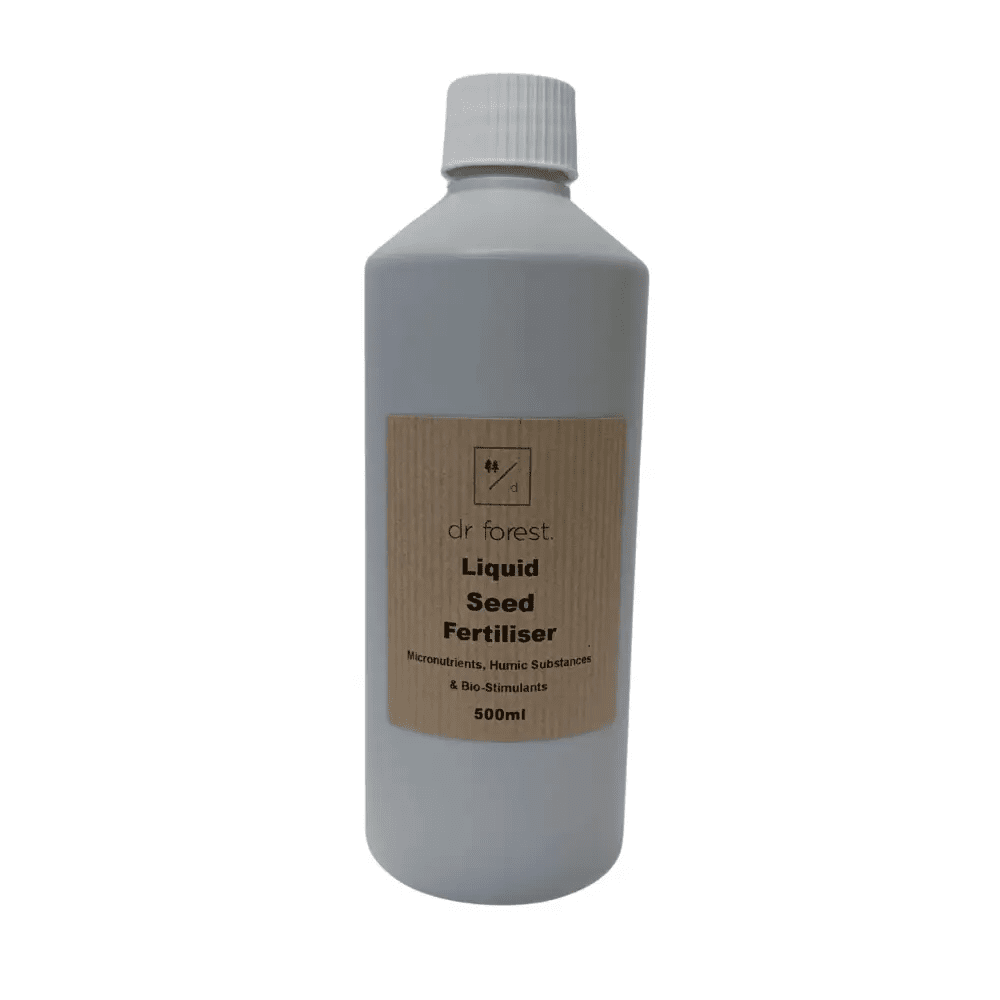
Dr Forest Liquid Seedling Fertiliser
General-purpose liquid feed, watered down
Customer highlight
Great service thanks
Editorial highlight from marketplace and store reviews — separate from the full review list below.
This liquid fertiliser for seedlings is a starter feed, built around calcium, four micronutrients and humic and fulvic acids, for the first two to four weeks of a plant's life. A germinating seed builds its first root tips and cell walls from a small store of reserves, and this feed puts calcium, zinc, manganese and molybdenum next to the new root from the start. Dr Forest makes it as a thick, calcium-rich suspension (4.13% Ca) for a seed soak before sowing or a drench straight after planting, both at 3 to 3.5 ml per litre, and for a root dip at transplanting at 10 ml per litre.
It is a low-nitrogen seedling feed on purpose. Young plants want roots before leaves, and a nitrogen-led liquid pushes the wrong end of the plant. It comes in 500 ml and 1 litre recycled plastic bottles.
Every Dr Forest product is made by hand in small batches at our workshop in Stockport, Greater Manchester, with organic ingredients where they exist. If you want the background on the humic and fulvic fraction, read Humic vs fulvic acid: the difference, and which you need. Made by Growers. Backed by Science.
A thick brown suspension (SG 1.1, pH 8 to 9) carrying calcium and sulphur as the main minerals, a background of potassium and magnesium, four micronutrients and a humic and fulvic acid fraction. Nitrogen and phosphorus are not declared in the analysis. It goes on at sowing and planting out, and a crop-specific feed takes over once the seedlings are established.
The humic acids work on the root (mechanism 04 below). The fulvic acid is a natural chelator that helps keep iron, zinc and manganese in plant-available form in the compost immediately around the seed. There is a longer explanation in What is fulvic acid?.
| Element | Content | Role in the seedling |
|---|---|---|
| Calcium (Ca) | 4.13% | Cell wall cross-linking; root tip and shoot tip growth |
| Sulphur (S) | 1.24% | Sulphur amino acids and proteins |
| Potassium (K), organic | 2,667 mg/L | Cell turgor and water regulation |
| Magnesium (Mg) | 734 mg/L | Chlorophyll core once the cotyledons green |
| Iron (Fe) | 160 mg/L | Chlorophyll synthesis; electron transport |
| Zinc (Zn) | 71 mg/L | Auxin (IAA) levels in growing shoots; part of thousands of proteins |
| Manganese (Mn) | 64 mg/L | Water-splitting in photosystem II; enzyme activation |
| Molybdenum (Mo) | 8 mg/L | Nitrate reductase cofactor |
Calcium and sulphur are declared as percentages and the remaining elements in milligrams per litre, as in the guaranteed analysis. At the 3 to 3.5 ml per litre soak and drench rate, each litre of diluted solution carries roughly 125 to 160 mg of calcium, half a milligram of iron and 0.02 to 0.03 mg of molybdenum: seedling-scale quantities, deliberately.
Farooq, Wahid and Siddique (2012, Journal of Soil Science and Plant Nutrition) reviewed the seed-treatment literature. Priming echinacea seed in a 0.1% manganese sulphate solution raised germination by 36% and field emergence by 27%, and a 0.05% zinc sulphate soak raised them by 38% and 41%. Across 48 trials in eastern India, molybdenum applied by seed priming lifted mean yield by 17 to 22% over the no-molybdenum control. Those trials used single-nutrient solutions at their own strengths; read the figures as the direction of the effect.
Paparella and colleagues (2015, Plant Cell Reports) describe priming as controlled water uptake that switches on pre-germinative metabolism, including DNA repair and antioxidant pathways, stopped before the radicle breaks through. A 6 to 12 hour soak, drained and sown straight away, works on the same principle.
Calcium cross-links the pectin in the middle lamella, the cement between new cells, and it is poorly remobilised from old tissue through the phloem (Thor, 2019, Frontiers in Plant Science). Young tissue therefore depends on a fresh supply carried up in the xylem with the transpiration stream, and young tissue does not transpire much, so the supply is thin. A germinating seed is nearly all young tissue, which is why this feed puts calcium on the seed coat and in the top layer of compost, where the first root tips grow.
A meta-analysis of published trials (Rose et al., 2014, Advances in Agronomy) put the average response to humic substances at +22% shoot dry weight and +21% root dry weight, with wide variation by source and rate. Nardi and colleagues (2002, Soil Biology and Biochemistry) reviewed evidence that the low molecular size fraction stimulates the plasma membrane H⁺-ATPase and has auxin-like activity, and noted that the increase in root growth is generally more apparent than that of the shoot. Jindo et al. (2012, Plant and Soil) found the same root and proton pump response in four-day-old maize seedlings. Canellas et al. (2015, Scientia Horticulturae) tie the bioactivity specifically to lateral root promotion and nutrient uptake.
In zinc-deficient bean, indole-3-acetic acid in the shoot tips and young leaves fell to about half the level in zinc-sufficient plants, and shoot growth was severely depressed; resupplying zinc restored both within 96 hours (Cakmak, Marschner and Bangerth, 1989, Journal of Experimental Botany). Zinc is a component of thousands of plant proteins and zinc-limited crop growth is widespread (Broadley et al., 2007, New Phytologist). Zinc also locks up in alkaline and high-phosphate soils, which is the reason for the fulvic acid alongside it.
Molybdenum is a cofactor of nitrate reductase, the enzyme that turns absorbed nitrate into something the plant can build protein from. Kaiser and colleagues (2005, Annals of Botany) describe its importance as disproportionate to the tiny amounts required, and note that the deficiency is often misdiagnosed and put down to its downstream effects, nitrogen metabolism among them. A seedling short of molybdenum can look short of nitrogen, and extra nitrate will not help while the enzyme lacks its cofactor.
Figures describe the published literature on seed treatments and humic substances at the rates used in those trials. They are not product-specific guarantees.
This is a concentrated liquid with suspended mineral particles. Shake vigorously for 15–20 seconds before measuring. When diluting, add the fertiliser to a small amount of warm water (20–30°C) and stir for at least 30 seconds before topping up to the full volume. This ensures thorough mixing and uniform application.
This is a starter fertiliser, designed for the first 2–4 weeks of a plant's life. It is not a replacement for ongoing feeding. Once seedlings are established and growing strongly, transition to a Dr Forest crop-specific fertiliser (Tomato, Rose & Flower, All Purpose 4-4-4, etc.) for the vegetative and fruiting phases.
Submerge seeds in the diluted solution and leave for 6–12 hours. Drain and sow immediately — do not rinse. The humic and fulvic acids accelerate water imbibition through the seed coat while calcium and micronutrients are absorbed directly. Expect faster and more uniform emergence compared to untreated seed.
Prepare the solution and dip seedling roots for 10–30 seconds before transplanting into the final position. This coats the root system with a nutrient-rich biostimulant film that promotes rapid re-establishment, reduces transplant shock, and feeds the root zone biology in the critical first days after planting.
Apply immediately after sowing or transplanting. Pour the diluted solution directly over the planted area at a rate of 1 litre per square metre. This delivers calcium and micronutrients to the root zone where the emerging root tips will access them first. Follow with normal watering to settle the soil around seeds or transplants.
A 500 ml bottle at 3 to 3.5 ml per litre makes about 143 to 167 litres of solution; the 1 litre bottle makes twice that. The method for applying fulvic acid as a seed soak on its own is covered in How to apply fulvic acid: rates and method.
Follow up with Seaweed Powder as a fortnightly biostimulant drench once seedlings are established. Use Amino Chelated Calcium for ongoing foliar calcium during fruiting. For soil-applied baseline nutrition, incorporate Yorkshire Polyhalite or Dr Forest crop-specific blends into the compost or soil before planting.
Store upright in a cool, dry place between 5–25°C, out of direct sunlight. Keep sealed. Shake vigorously before each use — the suspension settles during storage. Do not store diluted solution — mix fresh for each application. Keep out of reach of children.
Before sowing, soak the seed at 3 to 3.5 ml per litre. Straight after sowing, drench the tray at the same rate. When you pot on or plant out, dip the roots at 10 ml per litre. It's low in nitrogen on purpose, because young plants need roots before leaves.
25% of buyers here also chose Brix+ Liquid Seaweed Biostimulant Booster
A wood-vinegar biostimulant for soil and foliar use.
from £14.99


