Soil Conditioner
Organic Malted Barley | Diastatic Enzyme Boost
Diastatic malted barley to feed soil enzymes and microbes.
from £10.99
Free UK Delivery on Orders Over £40


Dr Forest
Couldn't load pickup availability
Dr Forest customers rate us 4.89/5 · 3,250+ reviews across Shopify, Amazon, Google and eBay
Looking for the granulated version for lawns and top-dressing? → Granulated Rock Dust
Modern gardens and allotments are consistently over-supplied with nitrogen, phosphorus, and potassium — and chronically deficient in the trace minerals that make everything else work. Plants cannot manufacture minerals; they can only extract what is present in the soil. Once a mineral is depleted by cropping and not replaced, it is gone. This volcanic rock dust powder is the fastest-acting form available: micronised to ultra-fine particle size, it presents the maximum reactive surface area to soil water, producing plant-available silicic acid and releasing its full mineral spectrum significantly faster than granulated rock dust. The fine particle size also lets it suspend in water, so it can be applied as a foliar spray, root drench or through fertigation — the fastest route to making basalt's trace minerals plant-available.
This powder is produced from Vulkamin — a zeolite-rich silicate of volcanic origin with pH 11. Micronising multiplies its effective surface area many times over compared with granulated material: the same weight of rock delivers a far greater immediate weathering response. This makes the powder the preferred format for compost teas, potting media blending, and situations where faster results are needed. It is also the most efficient format for broadcast application to beds where it can be raked into the soil and begin weathering immediately on contact with soil moisture.
At pH 11, this powder also functions as a gentle, long-lasting alternative to agricultural lime for correcting acid soils — raising pH progressively without the risk of overliming, while simultaneously supplying the trace minerals, silica, and zeolites that lime does not provide.
Vulkamin is produced from volcanic lava that solidified before reaching the Earth's surface — and therefore never oxidised. This sub-volcanic origin preserves its zeolite mineral content intact. Zeolites form when volcanic glass is slowly altered by water over millions of years, producing aluminosilicate minerals with a unique open crystalline lattice. This structure gives Vulkamin exceptional surface area, moisture absorption, and the ability to exchange mineral ions with soil solution over a prolonged period.
Micronising amplifies all of these properties. A finer powder presents more surface area to soil water per gram, accelerating silicic acid production, pH buffering, and trace mineral release. It also suspends in water readily — making the powder the only format suitable for compost tea and liquid drench applications. The same weight of micronised powder weathers many times faster than the equivalent weight of granulated material.
Up to 20% yield increase without phosphate or potassium fertilisers. Soils stored 2–4 tonnes CO₂ per hectare over five years — four times more than untreated controls. Soil acidification was mitigated without lime application. Published: Kelland et al. (2020), Global Change Biology.
Average 15% yield increase in the first year. Elevated soil pH without lime. Higher calcium, potassium, and grain mineral content. No toxic element uptake detected in treated crops. Published: UNDO / Newcastle University (2024), Farming Future Food.
52% yield increase over untreated control. Higher Brix (sugar content). Increased iron and calcium in harvested fruit. Cascade Minerals greenhouse trial (2015).
Botrytis completely eliminated without fungicide over 25 years of basalt application. Fruit consistently firm, ripe, and disease-free. Extended shelf life. Significantly larger root systems than fertiliser-only controls. Leipold (1980–2005), reported by Remineralize the Earth.
Macro and micronutrient accumulations up to five times higher than untreated controls. Improved vegetative growth and nutritional status across both crops. Pereira et al. (2022), Geoderma Regional.
The micronised powder is very fine and will become airborne in dry, windy conditions. Apply on calm days or when soil is moist. Wear a dust mask when handling in enclosed spaces such as polytunnels or glasshouses. Outdoors in normal conditions no mask is required for typical garden quantities.
Adding Vulkamin powder to an actively aerated compost tea brew introduces a broad trace mineral spectrum alongside the microbial content of the tea. The fine particles suspend in the aerated liquid and the minerals are partially chelated by the fulvic and humic acids produced during brewing, making them immediately plant-available.
Vulkamin powder in compost tea: 1–2g per litre of brew. For a standard 20-litre bucket, add 20–40g. For an enhanced mineral drench, add Dr Forest Fulvic Acid Powder at 1–2g/L to the finished tea before application — the fulvic acid chelates the volcanic minerals into immediately plant-available form.
Scatter over moist soil surface and rake into the top 5 cm immediately to prevent wind dispersal. Water in well. The fine particles begin weathering immediately on contact with soil moisture.
Incorporate into the top 15–20 cm thoroughly before planting. Higher rate for soils that have never received rock dust or that are known to be mineral-depleted. The fine particles begin producing silicic acid and releasing trace minerals within days of incorporation into moist soil.
Mix thoroughly into compost before planting. Far more effective than granulated rock dust in containers — the fine particles weather within a single growing season, releasing their full mineral spectrum while the plant is actively growing. Critical for peat-free and coir-based media which contain very little native mineral content.
Dust between green and brown layers as you build or turn the heap. The heat, moisture, and microbial acidity within an active compost heap weathers the fine particles dramatically faster than open soil — enriching the finished compost with the full basalt mineral spectrum.
At pH 11, Vulkamin raises soil pH progressively through the same enhanced weathering reaction that releases its minerals. Apply 200–400g/m² annually and test soil pH each spring. The pH correction is gentler and longer-lasting than lime, with no overliming risk. Simultaneously supplies trace minerals and silica that lime does not provide. Expect pH to rise by approximately 0.3–0.5 units per growing season at the higher application rate, depending on starting pH and soil type.
Even micronised powder works through mineral weathering rather than instant solubility — this is not a liquid fertiliser. The finer particle size means faster results than granulated material, but the full mineral benefit still builds over one or more growing seasons. Most growers notice silicon-driven improvements — reduced disease incidence, improved stem strength, better fruit firmness — within the first season. Mineral reserve accumulation compounds over successive annual applications.
Volcanic rock dust supplies minerals; it does not replace nitrogen or fast-acting nutrition. Combine with a base granular fertiliser — the All-Purpose 6-6-6 or a crop-specific blend. Adding Fulvic Acid Powder to compost tea applications significantly amplifies mineral uptake — the fulvic acid chelates volcanic minerals for immediate root absorption. For long-term soil building, combine with Humic Acid Granules as a monthly soil drench and Granulated Volcanic Rock Dust for the slow-release reservoir. Use Grow-Kashi to inoculate the biology that weathers rock particles fastest.


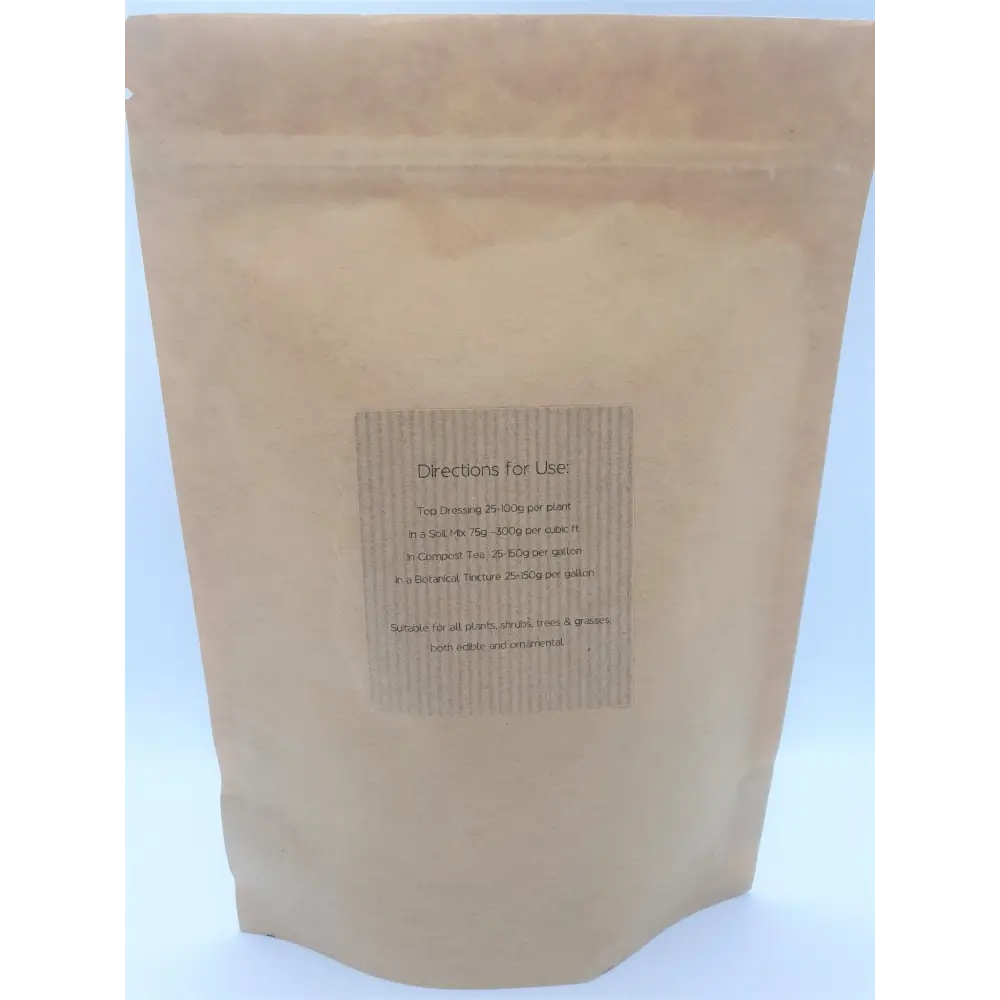

Diastatic malted barley to feed soil enzymes and microbes.
from £10.99

A trace-mineral mix to round out your feeding.
from £11.99

Helps water and feed soak in evenly, with less run-off.
from £14.00