


Probiotic/Innoculant
Mycorrhizal Fungi Powder | 18 Species, Endo + Ecto
A plant-based root inoculant, 18 endo and ecto species.
from £6.99
Looking for the micronised version for foliar spray and root drench? → Micronised Rock Dust
The most fertile soils on Earth — the deep, dark, mineral-rich soils of volcanic regions like Iceland, Java, the Azores, and the slopes of Mount Etna — share one thing in common. They sit on basalt. When volcanic rock weathers naturally over millennia, it releases a steady stream of minerals and trace elements that create conditions for extraordinary plant growth. Volcanic rock dust is the practice of accelerating that process deliberately — applying crushed basalt to garden soil to remineralise it in a single season rather than waiting thousands of years.
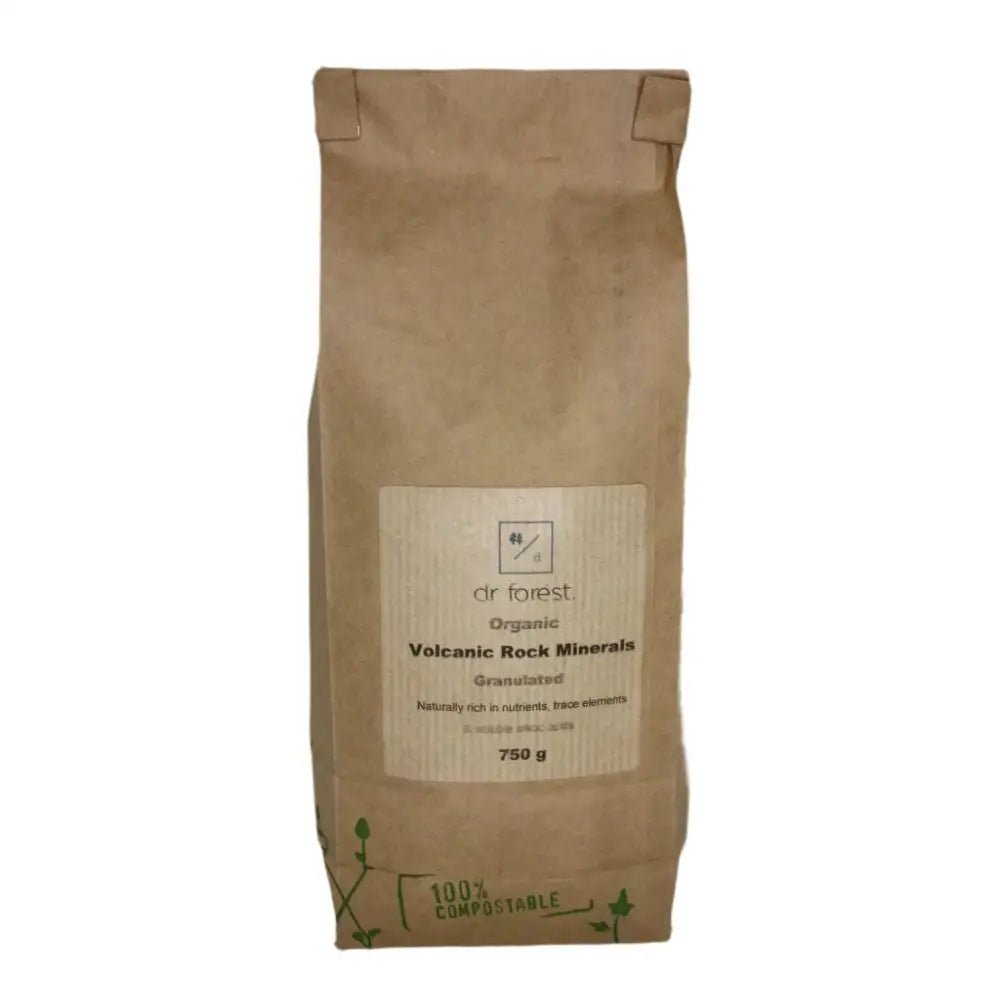
This product is ancient diabase basalt formed in volcanic eruptions millions of years ago, sourced from pristine geological deposits and crushed into a granular form for controlled, sustained mineral release. It contains 48% silica, 8.3% calcium, 5.1% potassium, 4.1% iron, plus magnesium, manganese, zinc, copper, boron, molybdenum, titanium, and dozens of other trace elements — along with unique mineral components including zeolites (which capture and slowly release nutrients, reducing leaching) and phonolites (which stimulate beneficial soil microbial activity).
The granular form is designed for sustained release over months and years — it goes down with a broadcast spreader and releases progressively over successive seasons, making it ideally suited to lawn renovation, raised-bed top-dressing and orchard floors where a dusty powder is not practical. It is less dusty and easier to handle than micronised basalt, and provides a long-term mineral reservoir in the soil that continues weathering and releasing trace elements with each watering and rainfall event. Completely natural, unprocessed, and OF&G certified organic.
Basalt is a dense igneous rock formed from cooled volcanic lava. It is the single most abundant rock type on Earth's surface, forming the ocean floors and the vast lava plateaus of volcanic regions. Its agricultural significance is that it contains the broadest spectrum of mineral elements of any common geological material — over 60 elements including every trace mineral that plants require. This is not a coincidence: basalt is the original source of most of the minerals found in fertile soils. When basalt weathers naturally over geological time, the minerals it releases form the foundation of soil fertility.
The observation that volcanic soils are exceptionally fertile is ancient — civilisations from Java to Sicily have farmed volcanic land for thousands of years. Modern soil science has confirmed why: freshly weathered basalt delivers silica, calcium, magnesium, potassium, iron, manganese, zinc, copper, boron, molybdenum, and dozens of other elements in forms that become progressively plant-available through chemical weathering and microbial activity. Applying crushed basalt to depleted garden soil replicates this natural process on a compressed timescale.
UK garden soils have been progressively depleted of trace minerals by decades of cropping, NPK-only fertilisation, and natural leaching from British rainfall. Basalt rock dust restores the full spectrum — over 60 elements — in a single application. The granular form weathers gradually through contact with soil moisture and microbial acids, releasing minerals in a steady, sustained supply that mirrors natural geological weathering. This addresses the "hidden hunger" that limits crop quality even when NPK levels are adequate.
Silicon is the second most abundant element in basalt (48% as SiO₂) and one of the most underappreciated nutrients in gardening. When absorbed by plant roots, silicon is deposited in cell walls as a physical barrier — a layer of opaline silica that piercing-sucking insects (aphids, whitefly, spider mites) and fungal pathogens cannot easily penetrate. Research has consistently shown that silicon-supplemented plants suffer less pest damage and lower rates of fungal infection. Basalt is the most economical and broadly available source of plant-available silicon for organic gardeners.
Basalt rock dust provides mineral surfaces and trace element substrates that soil micro-organisms colonise and utilise. The phonolite fraction in particular has been shown to stimulate beneficial bacterial and fungal populations. As microbes weather the rock particles — dissolving minerals through the organic acids they produce — they simultaneously multiply, increasing the biological activity of the soil. This creates a positive feedback loop: the biology weathers the rock, releasing minerals; the minerals feed the biology, which weathers more rock.
The trace minerals in basalt (iron, manganese, zinc, copper) are enzyme cofactors for the metabolic pathways that produce sugars, organic acids, and aromatic volatile compounds in crops. These are the compounds that determine flavour, sweetness, and aroma — the qualities that distinguish exceptional home-grown produce from bland supermarket equivalents. Mineral-rich volcanic soils consistently produce crops with higher Brix readings (sugar content) and more complex flavour profiles. Applying basalt to garden soil replicates the mineral conditions that make volcanic regions famous for food quality.
The zeolite minerals within this diabase basalt act as microscopic nutrient reservoirs. Their cage-like crystalline structure captures positively charged nutrient ions (potassium, calcium, magnesium, ammonium) and holds them against leaching. When plant roots release hydrogen ions during normal nutrient uptake, the zeolites exchange their captured nutrients in return — a natural, self-regulating slow-release mechanism embedded within the rock itself. This is particularly valuable in sandy soils and container media where nutrient leaching is the primary cause of poor performance.
The physical presence of rock dust granules in soil improves aeration and drainage by creating stable mineral particles that resist compaction. Over time, as the granules weather, the released calcium and magnesium contribute to soil aggregate formation — the same flocculation process that makes volcanic soils so naturally well-structured. The silica released during weathering also contributes to aggregate stability. The net effect over successive seasons of application is a progressively better-structured, better-drained, and more workable soil.
This is a dry granular product. Scatter on the soil surface, mix into growing media, or broadcast across beds and lawns. Water in well after application — basalt weathers through contact with soil moisture, so the more thoroughly it is incorporated into moist soil, the faster mineral release begins. The granules are far less dusty than micronised rock dust, but we still recommend wearing a mask if mixing large quantities in an enclosed space.
Scatter evenly over the soil surface and fork or rake lightly into the top few centimetres. Water in well. Use the higher rate (300g/m²) for first-time applications on soils that have never received rock dust, and the lower rate (100g/m²) for annual maintenance applications on previously treated soil. The minerals accumulate over successive seasons — each application builds on the previous one.
Mix thoroughly into potting compost, peat-free media, or coir before planting. The granules provide a long-term mineral reservoir that continues releasing trace elements throughout the growing season and beyond. Use the higher rate for mineral-poor media (pure coir, peat-free compost) and the lower rate for loam-based or compost-rich mixes that already contain some minerals.
Broadcast evenly across the lawn. The granular form is easy to spread by hand or with a lawn spreader, and is far less messy than micronised powder on turf. Water in well after application. The granules settle between grass blades and weather into the root zone over successive months, providing sustained trace mineral supply and silica for stronger, more disease-resistant grass.
Sprinkle rock dust granules between layers of compost material. The heat, moisture, and microbial acidity within an active compost heap weathers the rock particles far faster than they would weather in open soil — dramatically accelerating mineral release. The finished compost will be enriched with the full basalt mineral spectrum, creating a genuinely mineral-complete amendment.
Mix into the backfill soil when planting trees, shrubs, roses, and hedging. The granules provide a mineral reservoir that persists in the root zone for years, continuing to release trace elements as the tree or shrub establishes. Particularly valuable for long-lived plantings where you want sustained mineral supply without repeat applications.
When constructing a new raised bed, mix rock dust granules into the soil or compost fill before planting. This provides the geological mineral base that raised bed media almost always lack. Top up with 100g/m² each spring as part of your annual bed preparation.
Minerals in rock dust are released through weathering — a process that is dramatically accelerated by soil micro-organisms. Bacteria and fungi produce organic acids that dissolve mineral surfaces far faster than water alone. This means rock dust is most effective in soil with active biology: soil that has been enriched with compost, treated with Grow-Kashi, or regularly fed with organic matter. In biologically inert growing media (fresh coir, sterile potting mix), mineral release from rock dust will be slower. For the fastest results, combine rock dust with a biological inoculant.
For comprehensive soil remineralisation, use the granulated rock dust alongside Dr Forest Micronised Volcanic Rock Dust — the micronised for immediate mineral availability, the granules for the long-term reservoir. Add to Dr Forest Mineral Mix for a complete soil conditioning programme that also includes clay minerals, gypsum, and sea-shell meal. Combine with Grow-Kashi to maximise the biological weathering that releases minerals from the rock. Mix into compost heaps alongside Scottish Seaweed Meal for the richest, most mineral-complete finished compost possible.
25% of buyers here also chose Mycorrhizal Fungi Powder
A plant-based root inoculant, 18 endo and ecto species.
from £6.99
Clay minerals that help sandy soils hold nutrients.
from £11.00
An amino-acid foliar feed for quick uptake.
from £6.00


