Fertiliser
Seaweed Plant Food | Scottish Kelp Meal
Scottish kelp meal, trace minerals and biostimulants.
from £10.89
Free UK Delivery on Orders Over £40

Dr Forest
Couldn't load pickup availability
Dr Forest customers rate us 4.89/5 · 3,250+ reviews across Shopify, Amazon, Google and eBay
Most gardeners reach for alfalfa as a slow-release organic nitrogen fertiliser. That is fair — with an NPK of 2.5–0.3–2, it is a genuinely useful plant food. But the real reason professional growers prize it sits deeper inside the plant: triacontanol, a naturally occurring fatty alcohol that acts as a plant growth stimulant at concentrations so low they are measured in parts per billion.
Add 20+ amino acids, a full suite of trace minerals, soil-biology-stimulating saponins, and a gentle slow-release profile, and alfalfa meal pellets become one of the most multifaceted organic soil amendments available. Because it is 100% plant-based, it is the organic fertiliser of choice for vegan gardeners and anyone who objects to slaughterhouse-derived feeds like blood meal, bone meal, or feather meal.
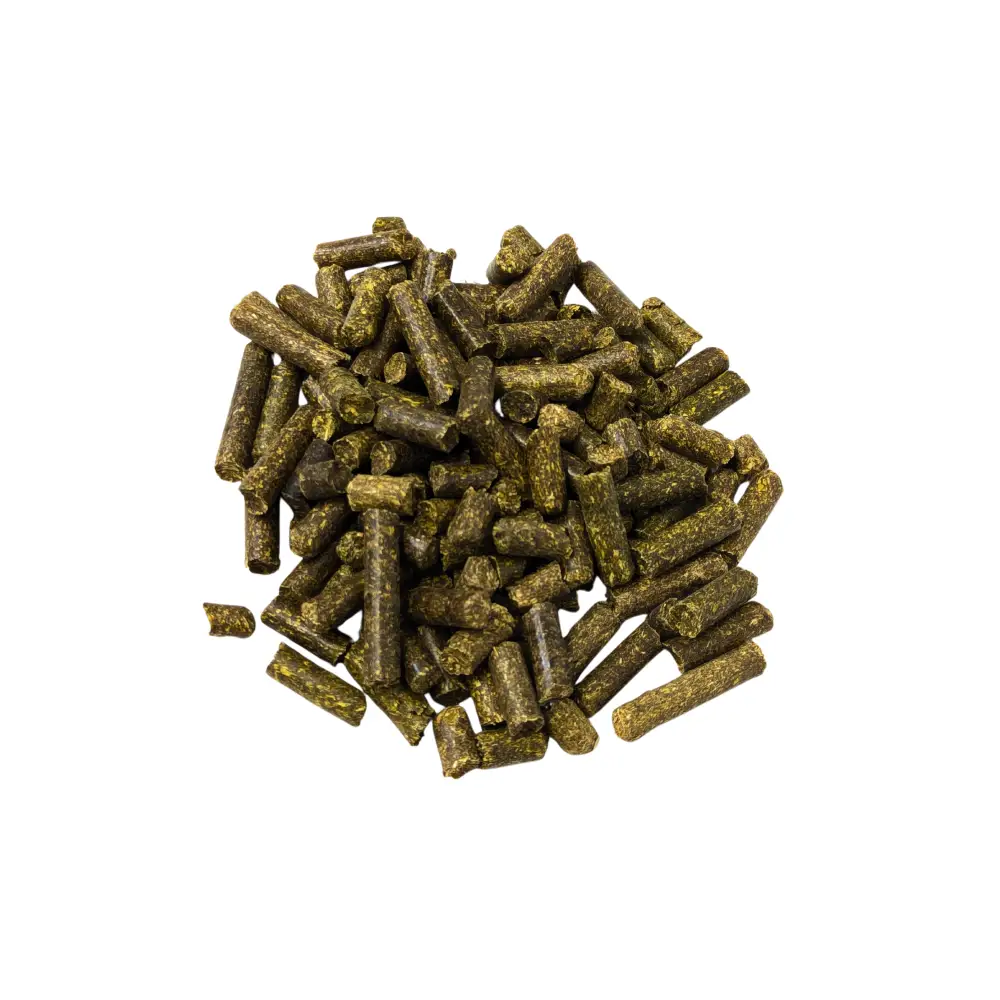
Alfalfa meal powder can mat together when wet and blow away when dry. The pelletised form stays where you put it, breaks down predictably, and is far easier to measure and apply precisely — especially in pots or raised beds where application accuracy matters most.
Every Dr Forest product is made by hand in small batches at our workshop in Stockport, Greater Manchester. We use recyclable packaging throughout and never use slaughterhouse by-products — in this product or any other.
Triacontanol (C₃₀H₆₂O) is a naturally occurring fatty alcohol found in the waxy cuticle of alfalfa leaves. First isolated in the 1970s by Stanley Ries and colleagues at Michigan State University, it has since been the subject of hundreds of published trials. Even at nanogram-level concentrations, triacontanol measurably increases photosynthetic rate, chlorophyll content, root growth, and ultimately yield across a wide range of food and ornamental crops.
The mechanism involves enhanced enzyme activity in the Calvin cycle, greater ATP production, and improved nutrient uptake efficiency — the plant runs more efficiently at a cellular level. No synthetic fertiliser contains it. It is unique to natural alfalfa sources.
Khan et al. (2016) found that triacontanol application increased photosynthetic pigment levels and yield components significantly across multiple vegetable crops. A 2020 meta-analysis by Naeem et al. in Frontiers in Plant Science confirmed positive effects across more than 40 crop species, including both field and container growing conditions. The mechanism centres on enhanced Rubisco activity and greater efficiency in the Calvin cycle.
Alfalfa's nitrogen is not free inorganic nitrate — it is locked into protein structures within the plant cell walls. Release depends on soil microbial activity: bacteria and fungi secrete proteolytic enzymes that break down these proteins into peptides, then amino acids, then ammonium and nitrate. This biological gating means alfalfa releases faster in warm, moist soil with active biology, and slows in cold or dry conditions. The plant only gets fed when conditions are good enough to grow.
When alfalfa protein degrades, it releases a spectrum of free amino acids directly into the soil solution. Research by Näsholm et al. (2009) in New Phytologist documented that plants can absorb several amino acids directly — bypassing the traditional nitrogen mineralisation cycle entirely. Key amino acids include glutamic acid and glutamine (central to nitrogen metabolism), proline (osmotic adjustment under drought), and glycine (trace mineral chelation).
Alfalfa contains a class of compounds called saponins — natural surfactants with documented effects on soil microbial diversity and activity. Research from Cornell University and the University of Queensland has shown that alfalfa-derived saponins selectively stimulate beneficial bacterial populations while suppressing certain soil pathogens. This contributes to the "soil health" effect experienced by long-term alfalfa users beyond what NPK analysis alone would predict.
Regular alfalfa applications produce measurable improvements in soil physical structure. The organic matter deposited as pellets decompose increases water-holding capacity in sandy soils and improves drainage in heavy clay. Alfalfa meal is one of the most reliable earthworm stimulants in the organic grower's toolkit — the combination of digestible plant protein, saponins, and increased microbial activity creates conditions that earthworms actively move toward. Higher worm populations mean better drainage, improved nutrient cycling, and deeper incorporation of organic matter.
Days 1–5: Pellets absorb soil moisture and soften. Saponins begin leaching into the rhizosphere. Weeks 1–2: Microbial colonisation; free amino acids and triacontanol become available. Weeks 2–4: Peak nitrogen mineralisation. Ammonium converted to nitrate by nitrifying bacteria. Primary growth phase. Weeks 4–8: Residual release continues at a lower rate. Organic matter from degraded pellets improves soil structure. Elevated microbial biomass continues cycling nutrients.
Alfalfa meal pellets work best when lightly incorporated into the top 5–10 cm of soil or compost, then watered in. Surface application works but is slower. Avoid deep burial — microbial breakdown is an aerobic process and needs oxygen to function efficiently.
Work lightly into the top layer. Particularly effective for brassicas and leafy greens during the growth phase. Safe to apply at transplanting.
Apply around the drip line, not at the stem. The second application at flower set supports fruit development with triacontanol and amino acids.
The triacontanol effect on rose flowering is well-documented by growers. Apply when soil temperature exceeds 10°C for best results. Many growers also brew alfalfa tea for a faster-acting version.
Water in well. A second light application post-harvest supports next year's bud development for currants, gooseberries, and raspberries.
Lighter rates in pots than open ground — the confined volume means nutrients concentrate more quickly. Safe for all container crops including seedlings.
Scatter evenly and water in well. Encourages slow, steady greening without the growth surge of synthetic lawn feeds. Feeds soil biology as well as the grass.
Safe to use near young roots. One of the only organic nitrogen sources suitable at this stage — the slow-release profile cannot scorch seedlings.
The high nitrogen content accelerates breakdown of carbon-heavy material. No precise rate needed — scatter a handful between brown layers.
Steep 100g of pellets in 10 litres of water for 3–5 days, stirring daily. Strain the liquid and apply directly to the root zone or as a dilute foliar spray. Makes triacontanol and amino acids available more quickly than dry application. Use within a day of straining. Warning: alfalfa tea develops a strong smell as it ferments — brew away from doors and windows.
Alfalfa meal is nitrogen-led (2.5–0.3–2) and is best used alongside a potassium-rich amendment during fruiting and flowering phases. Pair with Yorkshire Polyhalite or Sulphate of Potash for a balanced N-K profile through the season. For a complete programme, Dr Forest Bloom Fertiliser or All-Purpose 6-6-6 can be used in rotation.

Scottish kelp meal, trace minerals and biostimulants.
from £10.89

Diastatic malted barley to feed soil enzymes and microbes.
from £10.99