


Fertiliser
Scottish Seaweed Fertiliser | Ascophyllum Kelp Meal
Scottish kelp meal, trace minerals and biostimulants.
from £10.89
Alfalfa meal pellets
Soluble synthetic nitrogen feed
Customer highlight
Just implemented to the garden will hopefully get good results? Delivery was quick and price was good!
Editorial highlight from marketplace and store reviews — separate from the full review list below.
Alfalfa pellets are dried lucerne (Medicago sativa), milled and pressed into a pellet, used in the garden as a slow-release organic nitrogen fertiliser with an analysis of 2.5-0.3-2. The nitrogen is held in plant protein rather than as a soluble salt, so soil microbes release it over four to eight weeks and it cannot scorch roots or seedlings. Alfalfa is also the plant that triacontanol, a naturally occurring growth regulator, was first isolated from in 1977, which is why rose growers have used it for decades.
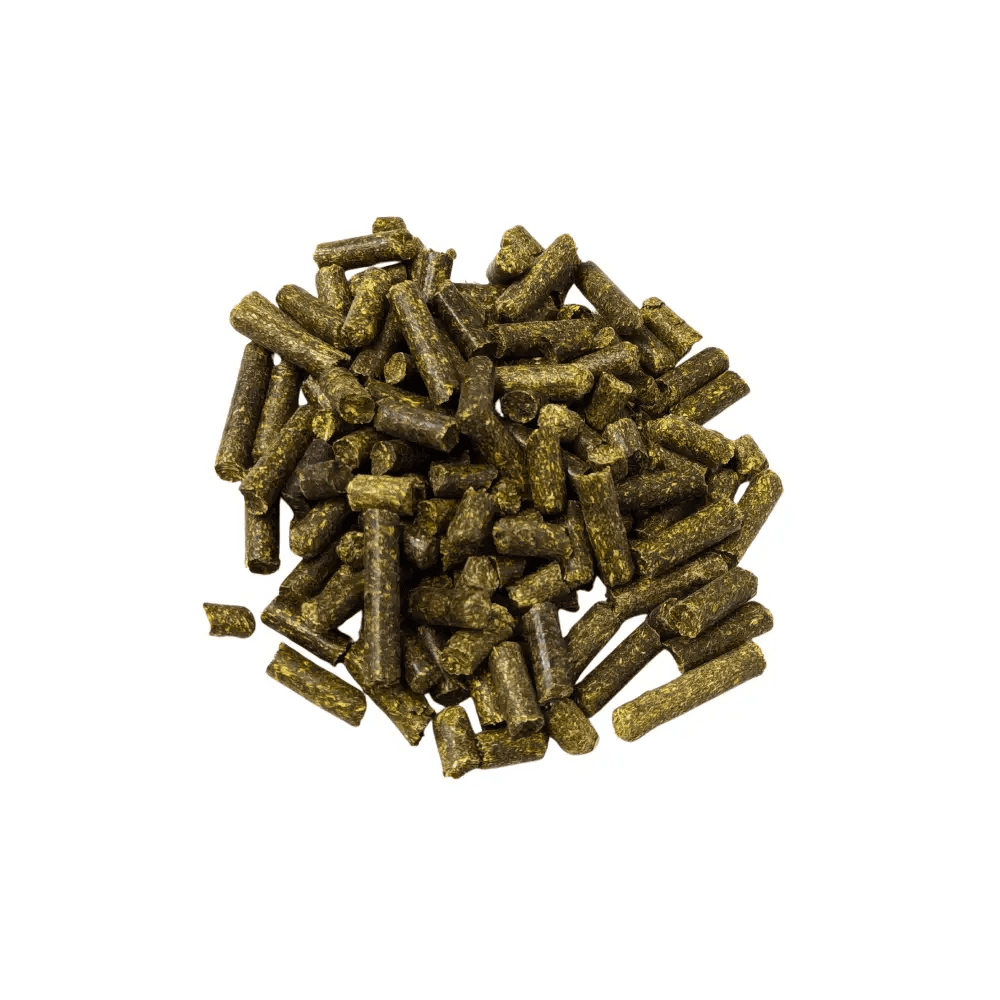
Dr Forest alfalfa meal pellets are a single-ingredient, plant-based feed for vegetable beds, roses, soft fruit, lawns and containers, with no animal by-products of any kind. Suitable for vegan and no-dig gardens.
Dried alfalfa is sold in three forms and they are all the same plant. A bale is the whole cut crop, dried, and is sold as horse and livestock forage. Alfalfa meal is that dried crop milled to a coarse powder. Alfalfa pellets are the meal pressed through a die under heat and pressure, which is the form we sell. For garden use the pellet wins on handling: loose meal blows about when dry and mats when wet, and a bale needs chopping before it will break down in a bed. Pellets pour, measure by the gram, and swell and fall apart within days of being watered in.
Dr Forest alfalfa pellets are packed in small batches at our workshop in Stockport, Greater Manchester, in recyclable packaging. Plant-based, made with organic ingredients, and suitable for vegan gardens. If you want the longer version of what alfalfa does and does not do, read What is alfalfa meal, and is it a good fertiliser? Made by Growers. Backed by Science.
Alfalfa is a deep-rooted perennial legume grown across the world as forage. The whole shoot, leaf and stem, is cut, dried and milled. Because it is a legume, the crop fixes its own nitrogen from the air and stores it as protein in the leaf, which is where the 2.5% nitrogen in the meal comes from. In a 52-week incubation, Dion and colleagues (2020, Canadian Journal of Soil Science) measured alfalfa meal at 2.59% total nitrogen, which sits neatly against the 2.5% on our label.
There is no chemical processing. The pellet is the plant, dried and pressed. That matters because everything else the leaf contains comes along with the nitrogen: amino acids, potassium, trace minerals and the waxy cuticle that carries triacontanol. For a comparison with other organic nitrogen sources see High nitrogen feed: what it does, and when to use it.
| Nutrient | Declared | Form in the pellet |
|---|---|---|
| Nitrogen (N) | 2.5% | Plant protein; released by microbial breakdown |
| Phosphorus | 0.3% | Organic phosphorus in plant tissue |
| Potassium | 2% | Potassium held in plant tissue; released as the pellet breaks down |
| Triacontanol | Trace | C₃₀ fatty alcohol in the leaf cuticle wax |
The nitrogen figure is modest next to a synthetic feed, and that is the point. All of it is locked in protein; none of it sits in the bag as soluble nitrate. Dion et al. found alfalfa meal mineralised 34–53% of its nitrogen over the year depending on the growing medium, with a short period of net immobilisation in the first week as microbes took up nitrogen to build their own biomass, and release levelling off after roughly 60 days. That is the mechanism behind the four-to-eight-week feed window and the reason you cannot scorch a seedling with it.
Alfalfa protein is broken to peptides, then amino acids, then ammonium and nitrate by soil bacteria and fungi. Dion et al. (2020) recorded a burst of net immobilisation in week one, then steady mineralisation to a plateau at around 60 days, and alfalfa meal supported the highest bacterial diversity of the five fertilisers tested in mineral soil. Warm, moist, aerated soil speeds this up; cold or waterlogged soil slows it to a crawl.
Ries, Wert, Sweeley and Leavitt isolated triacontanol from alfalfa in 1977 (Science, 195, 1339–1341). It is a 30-carbon primary alcohol in the leaf's epicuticular wax. Naeem, Khan and Moinuddin's 2012 review (Journal of Plant Interactions, 7(2), 129–142) reports activity at nanomolar concentrations, a 30% rise in Rubisco over control in treated plants, and yield gains of 12–31% in wheat, cotton and rice trials with purified triacontanol. How much of that carries across from a soil-applied pellet is not something the literature pins down.
Khan and colleagues (2009, Acta Horticulturae, 823, 199–208) sprayed tomatoes with 1 µM triacontanol alongside potassium and recorded higher leaf chlorophyll, carotenoids and nutrient uptake against untreated controls, with the best potassium-plus-triacontanol combination yielding 57.6% more fruit. Manai et al. (2024, Scientific Reports, 14, 12096) found weekly foliar triacontanol raised total tomato yield by 28% and held chlorophyll steady under salt stress where control plants lost 28% of theirs. Both used purified triacontanol as a foliar spray, so treat them as evidence for the molecule rather than a yield promise for the pellet.
As alfalfa protein degrades it releases free amino acids into the soil solution. Näsholm, Kielland and Ganeteg's 2009 Tansley review (New Phytologist, 182, 31–48) sets out the evidence that plant roots carry amino acid transporters and take up organic nitrogen in the field, while noting that how much of a plant's total nitrogen arrives this way is still debated. A protein-based feed at least gives the roots that option.
Across 537 field experiments, Shi et al. (2024, Nature Communications, 15, 3411) found organic fertilisation raised above-ground biomass by 56% against 42% for inorganic, lifted soil organic carbon in grasslands by 19% where inorganic managed 2%, and held plant diversity where inorganic fertilisation cut species richness by 18%. Alfalfa pellets are a small, whole-plant organic input; every application adds carbon as well as nitrogen.
Days 1–5: pellets take up water, swell and fall apart. Week 1: microbes colonise and briefly tie up nitrogen. Weeks 2–4: peak mineralisation, ammonium converted to nitrate, main feeding window. Weeks 4–8: residual release at a lower rate while the remaining fibre becomes soil organic matter.
Figures describe the published literature on alfalfa meal and triacontanol and are not product-specific yield guarantees.
Alfalfa meal pellets work best when lightly incorporated into the top 5–10 cm of soil or compost, then watered in. Surface application works but is slower. Avoid deep burial: microbial breakdown is an aerobic process and needs oxygen to function efficiently.
Work lightly into the top layer. Particularly effective for brassicas and leafy greens during the growth phase. Safe to apply at transplanting.
Apply around the drip line, not at the stem. The second application at flower set supports fruit development with triacontanol and amino acids.
The triacontanol effect on rose flowering is well-documented by growers. Apply when soil temperature exceeds 10°C for best results. Many growers also brew alfalfa tea for a faster-acting version. There is a longer piece on this in Alfalfa for roses: what fifty years of rose growing actually proves.
Water in well. A second light application post-harvest supports next year's bud development for currants, gooseberries and raspberries.
Lighter rates in pots than open ground: the confined volume means nutrients concentrate more quickly. Safe for all container crops including seedlings.
Scatter evenly and water in well. Encourages slow, steady greening without the growth surge of synthetic lawn feeds. Feeds soil biology as well as the grass. See Alfalfa for lawns for the honest case, including where it falls short.
Safe to use near young roots. One of the only organic nitrogen sources suitable at this stage: the slow-release profile cannot scorch seedlings.
The high nitrogen content accelerates breakdown of carbon-heavy material. No precise rate needed: scatter a handful between brown layers.
Steep 100g of pellets in 10 litres of water for 3–5 days, stirring daily. Strain the liquid and apply directly to the root zone or as a dilute foliar spray. Makes triacontanol and amino acids available more quickly than dry application. Use within a day of straining. Be warned that alfalfa tea develops a strong smell as it ferments, so brew away from doors and windows.
Alfalfa pellets are a gentle, slow nitrogen feed that also feeds soil life. They're mild (2.5-0.3-2), so cropping fruit still needs a potash feed alongside them, such as Sulphate of Potash (on apples, only if a soil test shows low potash).
Alfalfa meal is nitrogen-led (2.5-0.3-2) and is best used alongside a potassium-rich amendment during fruiting and flowering phases. Pair with Yorkshire Polyhalite or Sulphate of Potash for a balanced N-K profile through the season. For a complete programme, Dr Forest Bloom Fertiliser 2-8-4 or All Purpose Fertiliser 4-4-4 can be used in rotation. If you top-dress rather than dig, How to top dress like a pro covers the method.
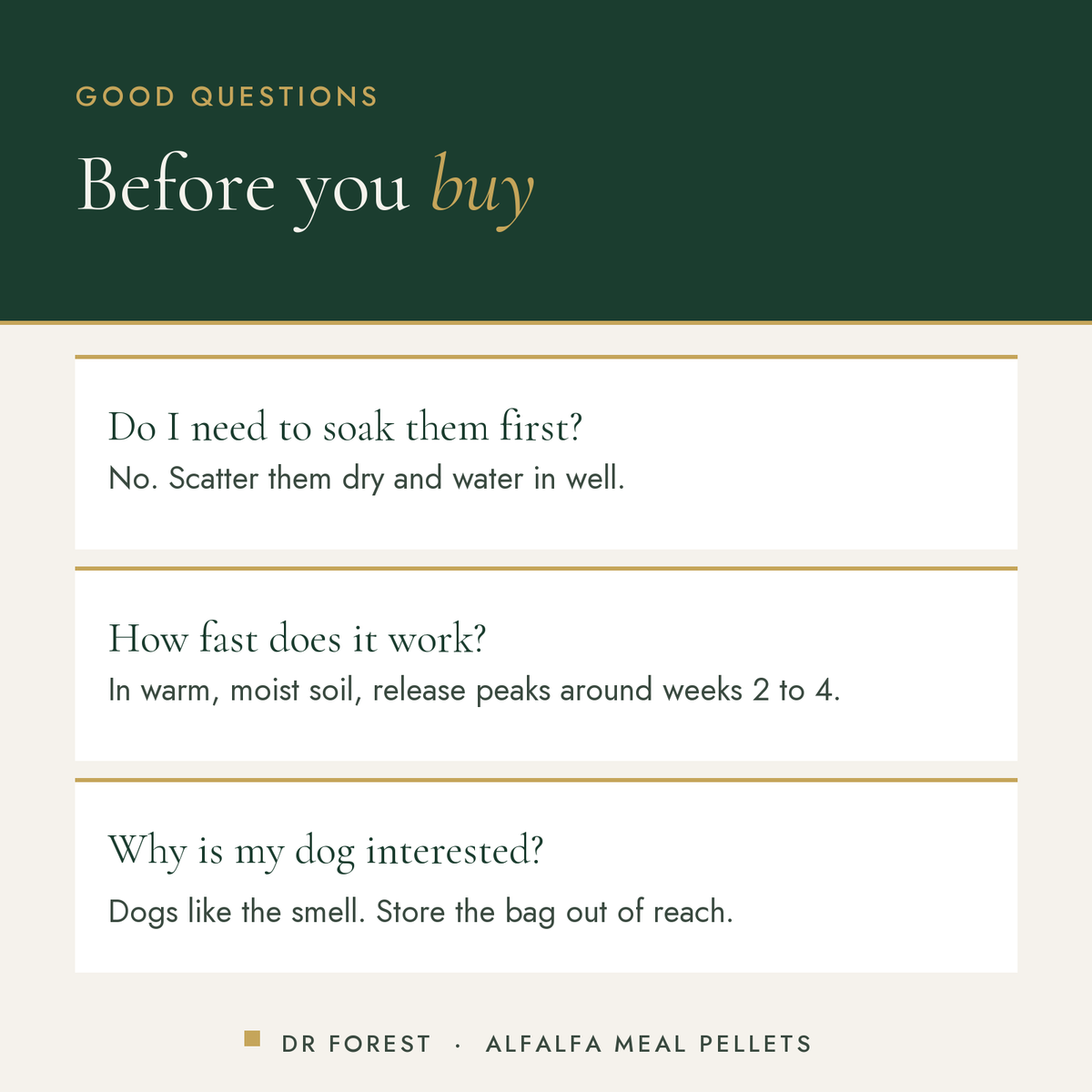
Keep the bag sealed, cool and dry. Pellets that get damp will swell and start to break down in the bag, and the smell will tell you. Store out of reach of dogs, who find the smell interesting.
Roses most famously: rose growers have used alfalfa for decades, at 100–150 g per bush in early spring and again after the first flush. It also suits tomatoes and cucumbers, soft fruit, leafy vegetables and lawns, and it's gentle enough to mix into seed and potting compost. It's a mild nitrogen feed (2.5-0.3-2), so heavy fruiting crops will still want a potash feed once they set fruit. More in alfalfa for roses.
Scatter them and work them lightly into the top layer of soil, or set them around the drip line of a plant rather than against the stem, then water in well. On vegetable beds use 100–150 g per m² before planting or as a side dressing every 4–6 weeks. For tomatoes and cucumbers, use 50–100 g per plant at planting and again at first flower set. For soft fruit, use 75–100 g per plant in early spring. In potting compost, mix in 5 g per litre before sowing or potting on.
Yes. At 2.5% nitrogen, alfalfa is a nitrogen-rich "green" that helps a heap full of woody, carbon-rich material heat up and break down. Scatter a light sprinkling between layers as you add material; there's no precise rate. For feeding plants directly, though, it does more good in the soil, where the slow release over four to eight weeks feeds both the plant and the soil life.
Keep the bag sealed, cool and dry, and the pellets stay in good condition. Damp is the problem: pellets that get wet swell and start to break down in the bag, and the smell will tell you. Store the bag out of reach of dogs, who find the smell interesting. Once they're in the soil, one dressing feeds for four to eight weeks.
No. Scatter them dry and water them in well. The water softens the pellets and starts the microbial breakdown that releases the nitrogen. On lawns, water thoroughly so the pellets break down rather than sitting on the surface, where dogs may be drawn to them.
15% of buyers here also chose Seaweed Plant Food
Scottish kelp meal, trace minerals and biostimulants.
from £10.89
A root inoculant, 18 endo and ecto species.
from £6.99