Fertiliser
Garden Calcium Carbonate | Lime Alternative
Raises pH gently, a natural lime alternative.
from £7.00
Free UK Delivery on Orders Over £40


Dr Forest
Couldn't load pickup availability
Dr Forest customers rate us 4.89/5 · 3,250+ reviews across Shopify, Amazon, Google and eBay
Phosphorus and calcium are the two minerals most closely tied to fundamental plant health. Phosphorus drives every energy-intensive process in the plant — root formation, cell division, flower initiation, fruit development, and the conversion of sunlight into sugars. Calcium is the structural mineral, responsible for cell wall rigidity, membrane integrity, and fruit firmness. Get these two right and almost everything else follows.
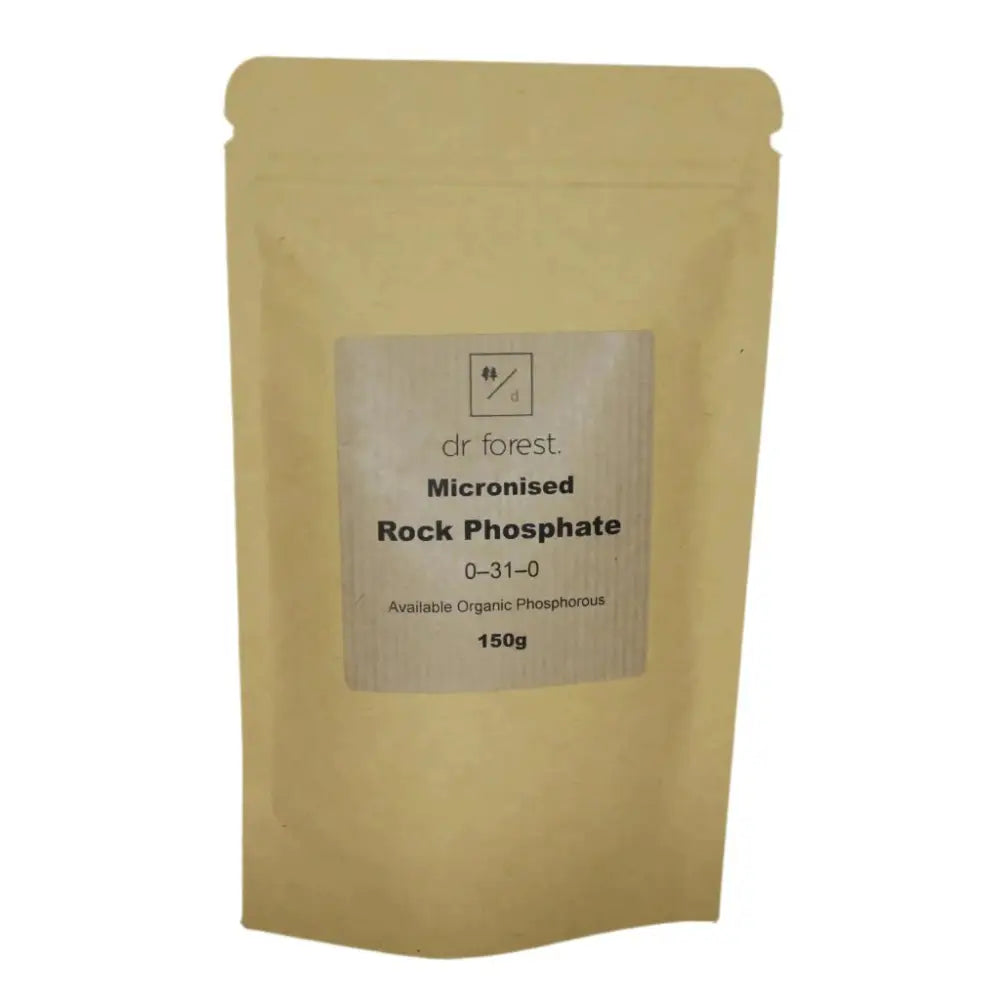
Organic Micro Cal-Phos supplies both in a single concentrated mineral powder, sourced from natural stone quarries and micronised to solution grade — far finer than conventional rock phosphate. At 31% phosphorus (P₂O₅) and 46% calcium (CaO), this is a high-analysis source of both nutrients in a naturally co-occurring, organically certified form. Critically, it is derived entirely from mineral rock — no bonemeal, no slaughterhouse by-products. The same nutrients that bonemeal provides, from a completely plant-based and mineral source, in a more concentrated and faster-acting form.
Organic Micro Cal-Phos is a natural limestone phosphate extracted from quarry by mechanical means only — crushing, classification, and sieving. No chemical treatment, no acid processing, no synthetic additives at any stage. This preserves the full mineral matrix exactly as it occurs in nature and is the basis for its EU organic certification under reference CE-004003-2022. The analysis is: Total P₂O₅ 29–31%, Calcium (CaO) 46%, with trace amounts of MgO (0.20%), K₂O (0.05%), and Fe₂O₃ — all naturally co-occurring in the mineral deposit.
Total P₂O₅ (31%) represents all the phosphorus present in the mineral, including fractions tightly bound in the crystal structure that will only become available over months to years through weathering, root exudate activity, and microbial organic acids. P₂O₅ soluble in 2% formic acid (11.3–20%) is the EU standard test for plant-available phosphorus in organic fertilisers. Formic acid mimics the organic acids produced by plant roots and mycorrhizal fungi. This fraction — up to 20% of total P₂O₅ — is what becomes available during the growing season. It is substantially higher than conventional coarse rock phosphate (typically 3–7%) due to the micronised particle size increasing the reactive surface area.
Conventional rock phosphate uses particles of 100–500 microns or larger. Micronisation to solution grade increases the reactive surface area exposed to soil water and root exudates by orders of magnitude. More surface area means faster dissolution, more phosphorus released in the first growing season, and higher plant-available P at any given application rate.
Coarse rock phosphate releases phosphorus over years, making it a long-term soil amendment but poorly suited to situations where phosphorus is needed promptly. Micronised rock phosphate provides measurably higher phosphorus uptake in the first growing season — at transplanting, during flowering, for seedlings, or to correct an active deficiency — while still building long-term mineral reserves.
The solution-grade particle size makes it possible to disperse this powder in water and apply it as a soil drench — something not feasible with granular rock phosphate. Liquid application delivers phosphorus directly to the active root zone for rapid uptake, rather than relying on slow top-down dissolution from the soil surface.
In ionic solution, calcium and phosphate react spontaneously to form insoluble tricalcium phosphate — which is why liquid fertilisers cannot normally contain both at high concentrations. In a dry mineral powder, they co-exist stably because there is no aqueous medium to drive the reaction. Micro Cal-Phos preserves both nutrients at very high analysis in a single product, delivering them simultaneously to the root zone where soil microbes and root exudates convert both into plant-available forms.
When using as a soil drench, mix the powder into a small amount of water first to form a smooth slurry, then add to the full application volume and stir well. This ensures even distribution of mineral particles. Stir or shake before each application pass to prevent settling — this is a suspension, not a solution.
Mix evenly through soil or potting compost before planting. Use 1.5 ml/L for already-fertile growing media or non-fruiting plants. Use 3 ml/L for phosphorus-deficient compost, new media with no existing reserves, or heavy-feeding fruiting crops like tomatoes and peppers.
Rake lightly into the soil surface or apply before rain. Use 50 g/m² as a maintenance rate on established beds; up to 150 g/m² when building fertility in new or depleted ground or correcting visible phosphorus deficiency.
Apply to the soil surface around the base of plants and water in thoroughly. For a standard 10 L pot, this is approximately 1.5–4.5 g total. Water the plant first, apply the top dressing, then water again to carry the mineral down to the root zone.
Pre-slurry the measured powder in a small amount of warm water, then add to the full volume and stir thoroughly. Use 1 g/L for routine maintenance; 2 g/L for correcting active phosphorus or calcium deficiency. Apply to moist soil at the root zone — not to dry soil. Stir before each pass as particles will settle.
Apply around the drip line (outer edge of canopy), not tight against the trunk. Work lightly into the soil surface and water in well. For newly planted trees, incorporate 500 g–1 kg into the planting hole at planting time.
Work directly into the soil at root level before setting the plant. Delivers phosphorus exactly where new roots will grow first. Particularly effective for tomatoes, peppers, aubergines, courgettes, and all fruiting crops.
At bulk density of 1.20 g/cm³: 1 ml ≈ 1.2 g. A level teaspoon (5 ml) ≈ 6 g. A level tablespoon (15 ml) ≈ 18 g. For liquid applications, weighing on a digital scale gives the most accurate results.
High phosphorus availability suppresses mycorrhizal colonisation. If using alongside mycorrhizal fungi at transplanting, incorporate Micro Cal-Phos at the lower end of the range for the first 6–8 weeks, then resume normal rates once the fungal network is established. The two products are compatible and complementary over the full season — this caution applies only to the immediate post-inoculation window.
Micronised Gypsum (additional calcium sulphate for intensive fruiting crops), Fulvic Acid Powder (chelates phosphate ions and improves their mobility in the root zone), Mycorrhizal Fungi (the fungal network is highly effective at accessing and delivering soil phosphorus — inoculate at planting and allow to establish before increasing P inputs), and Sulphate of Potash (potassium and phosphorus work synergistically during reproductive growth).


Raises pH gently, a natural lime alternative.
from £7.00

50% K2O, concentrated potash for fruit and flower.
from £6.25