


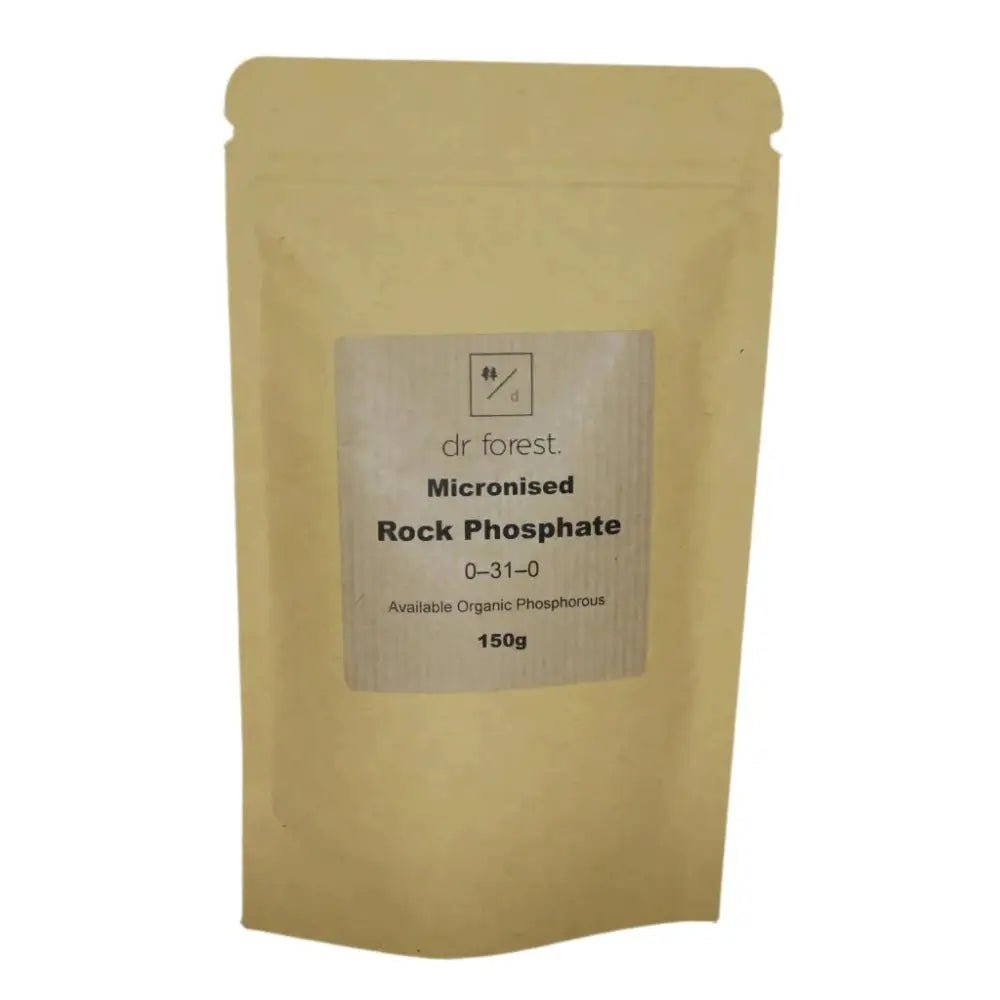
How Rock Phosphate Fertiliser compares
Full guide and scienceMicronised soft rock phosphate (this product)
- Very fine particle size, so far more mineral surface is exposed to soil water, root acids and microbes
- Up to 20% of the P₂O₅ is formic-acid soluble, the fraction that counts for the coming season
- Disperses in water: usable as a soil drench at 1–2 g per litre, as well as in the soil mix
- Still leaves a slow-release reserve behind for later seasons
Standard ground rock phosphate
- Coarser grind, typically 100–500 microns and upwards
- Releases phosphorus over years; little help for a deficiency this season
- Cannot be suspended in water for drench application
- Same raw mineral, similar total analysis on paper; the difference is how much you get this year
Customer highlight
This fertiliser arrived quickly and well packed in a thick paper bag in a sturdy cardboard box, it has been a good experience with this seller and I would be happy to buy from them again. Thank you Dr Forest's.
Editorial highlight from marketplace and store reviews — separate from the full review list below.
Rock phosphate fertiliser: micronised soft rock phosphate with 31% P₂O₅ and 49% CaO
Rock phosphate fertiliser is a natural calcium phosphate mineral, quarried and ground, that supplies phosphorus and calcium to the soil in one slow-release powder. Phosphorus runs the energy side of the plant: root growth, flower initiation and fruit fill. Calcium builds cell walls. This is a soft rock phosphate micronised to a very fine powder, which is what lets it release usefully in the first season rather than over a decade, and lets you apply it as a drench as well as a dry amendment.
Also sold as Micro Cal-Phos, it analyses at 31% total P₂O₅ and 49% CaO, with up to 20% of the P₂O₅ soluble in the 2% formic acid test used for soft rock phosphate. A single mined ingredient, no acid treatment, no additives, so it suits vegan growing. Packed by hand in Stockport, Greater Manchester, in 500 g, 1.5 kg, 3 kg, 9 kg and 18 kg sizes.
What is rock phosphate used for in the garden?
- Transplanting — worked into the planting hole or soil mix so phosphorus sits exactly where new roots grow first
- Flowering and fruit set — phosphorus demand peaks at bud initiation and during fruit fill; apply before that point
- Root crops — carrots, parsnips, beetroot and potatoes respond to phosphorus at sowing or planting with larger, denser roots
- Seedlings — small root systems reach very little soil phosphorus, so a little in the seed compost covers the gap
- Phosphorus deficiency — purple or reddish undersides on leaves and stems, late flowering and poor fruit set are the usual signs
- Low-calcium soils — at 49% CaO this is one of the highest-calcium mineral inputs you can buy, without the strong liming effect of a carbonate
- New beds — a long-term phosphorus and calcium reserve for no-dig beds and allotment ground
Why micronised rather than ordinary ground rock phosphate?
Micronised soft rock phosphate (this product)
- Very fine particle size, so far more mineral surface is exposed to soil water, root acids and microbes
- Up to 20% of the P₂O₅ is formic-acid soluble, the fraction that counts for the coming season
- Disperses in water: usable as a soil drench at 1–2 g per litre, as well as in the soil mix
- Still leaves a slow-release reserve behind for later seasons
Standard ground rock phosphate
- Coarser grind, typically 100–500 microns and upwards
- Releases phosphorus over years; little help for a deficiency this season
- Cannot be suspended in water for drench application
- Same raw mineral, similar total analysis on paper; the difference is how much you get this year
Dr Forest is a small-batch fertiliser maker in Stockport, Greater Manchester. This rock phosphate is a single quarried mineral, ground with nothing added, weighed and packed by hand. For where phosphorus fits alongside nitrogen and potash, read What is a bloom fertiliser?, which covers available versus total P. Made by Growers. Backed by Science.
The science of rock phosphate: why particle size decides how much phosphorus you actually get
What soft rock phosphate actually is
Rock phosphate is a sedimentary calcium phosphate mineral. This one is a natural limestone phosphate extracted from the quarry by mechanical means only: crushing, classification and sieving. No acid, no heat, no additives, so the mineral matrix is as it came out of the ground. Declared analysis: total P₂O₅ 29–31%, CaO 49%, with trace MgO (0.20%), K₂O (0.05%) and iron oxide from the deposit.
Particle size matters because rock phosphate is sparingly soluble in plain water. What breaks it down is acidity: protons and organic acids released by roots and soil microbes, plus slow weathering. The finer the particle, the more surface those acids can attack, and the larger the fraction that releases in a season. The FAO review of phosphate rocks for direct application puts it plainly: solubility increases as particle size decreases, and the historic EU standard for soft ground rock phosphate required 90% of the material to pass a 0.063 mm sieve for that reason.[6] Mycorrhizal fungi work from the other side, reaching soil the roots never touch; see What are mycorrhizal fungi?
Composition and nutrient content
| Nutrient | Declared analysis | Form |
|---|---|---|
| Phosphorus (total P₂O₅) | 29–31% | Calcium phosphate mineral, slow release |
| Phosphorus soluble in 2% formic acid | 11.3–20% P₂O₅ | The fraction available in the coming season |
| Calcium (CaO) | 49% | Calcium phosphate, mild liming effect |
| Magnesium (MgO) | 0.20% | Trace, naturally occurring |
| Potassium (K₂O) | 0.05% | Trace, naturally occurring |
| Iron (Fe₂O₃) | Trace | Naturally occurring |
The two phosphorus figures mean different things. Total P₂O₅ is everything in the rock, including phosphate locked in the crystal that only comes out over years. The 2% formic acid test is the standard for soft ground rock phosphate in EU fertiliser law; formic acid stands in for the acids roots and fungi produce, so it estimates what a plant can reach in a season. Up to 20% of this material passes that test. Nitrogen and potassium are effectively absent: this is a phosphorus and calcium input to add to a feed, not a feed on its own.
Mechanisms of action
Most soil phosphorus is locked up, so roots have to work for it
Vance, Uhde-Stone and Allan (2003, New Phytologist) review how plants cope with a nutrient that is abundant in soil yet largely unavailable, bound to iron, aluminium and calcium. Roots exude organic acids that chelate those metals and free phosphate, and around 80% of land plants also rely on mycorrhizal fungi for phosphorus. A finely ground calcium phosphate gives those mechanisms far more surface to work on.[1]
Root acidity and organic acids dissolve calcium phosphate
Hinsinger (2001, Plant and Soil) reviews rhizosphere phosphorus chemistry: soil solution P is governed by pH, competing anions and the concentration of calcium, iron and aluminium, and roots alter all three by releasing protons, carbon dioxide and organic ligands. That is what turns a rock phosphate particle into plant-available phosphate, and it runs faster on a fine powder than on a coarse grit.[2]
Mycorrhizal fungi deliver phosphorus the roots cannot reach
Smith and Smith (2011, Annual Review of Plant Biology) show that the mycorrhizal pathway for phosphorus uptake operates whether or not the plant shows a visible growth response, with hyphae drawing phosphate from well beyond the root depletion zone. On a slow-release mineral, an established fungal network is one of the main routes by which the phosphorus becomes useful.[3]
High soluble phosphate switches the fungal partnership off
Breuillin and colleagues (2010, The Plant Journal) found that phosphate supply systemically inhibits arbuscular mycorrhizal development in petunia and represses the genes involved in mycorrhizal functioning. Well-fed plants stop paying for the fungus. Hence the caution on the How to Use tab about the first 6–8 weeks after inoculating: a slow-release mineral is far gentler than soluble phosphate, but the principle holds.[4]
Calcium is structural, and it does not move once it is in place
White and Broadley (2003, Annals of Botany) describe calcium's structural roles in cell walls and membranes and list blossom end rot in tomato, tip burn in lettuce and bitter pit in apple among the disorders that follow local calcium shortage. Ho and White (2005, Annals of Botany) go further on blossom end rot: the fast-expanding end of the fruit runs short of calcium even when the soil has plenty. Steady watering matters as much as supply, which is why we call this a long-term calcium builder rather than a quick fix.[5][7]
Scientific references
- Vance, C.P., Uhde-Stone, C. & Allan, D.L. (2003). Phosphorus acquisition and use: critical adaptations by plants for securing a nonrenewable resource. New Phytologist, 157(3), 423–447.
- Hinsinger, P. (2001). Bioavailability of soil inorganic P in the rhizosphere as affected by root-induced chemical changes: a review. Plant and Soil, 237(2), 173–195.
- Smith, S.E. & Smith, F.A. (2011). Roles of arbuscular mycorrhizas in plant nutrition and growth: new paradigms from cellular to ecosystem scales. Annual Review of Plant Biology, 62, 227–250.
- Breuillin, F. et al. (2010). Phosphate systemically inhibits development of arbuscular mycorrhiza in Petunia hybrida and represses genes involved in mycorrhizal functioning. The Plant Journal, 64(6), 1002–1017.
- White, P.J. & Broadley, M.R. (2003). Calcium in plants. Annals of Botany, 92(4), 487–511.
- Zapata, F. & Roy, R.N. (eds) (2004). Use of phosphate rocks for sustainable agriculture. FAO Fertilizer and Plant Nutrition Bulletin 13. Rome: FAO/IAEA.
- Ho, L.C. & White, P.J. (2005). A cellular hypothesis for the induction of blossom-end rot in tomato fruit. Annals of Botany, 95(4), 571–581.
Figures describe the published literature on rock phosphate and plant phosphorus nutrition and are not product-specific yield guarantees.
How to use rock phosphate fertiliser: application rates, methods and timing
At bulk density of 1.20 g/cm³: 1 ml ≈ 1.2 g. A level teaspoon (5 ml) ≈ 6 g. A level tablespoon (15 ml) ≈ 18 g. For liquid applications, weighing on a digital scale gives the most accurate results.
When using as a soil drench, mix the powder into a small amount of water first to form a smooth slurry, then add to the full application volume and stir well. This ensures even distribution of mineral particles. Stir or shake before each application pass to prevent settling: this is a suspension, not a solution.
Application rates
Soil mix incorporation, before planting
Mix evenly through soil or potting compost before planting. Use 1.5 ml/L for already-fertile growing media or non-fruiting plants. Use 3 ml/L for phosphorus-deficient compost, new media with no existing reserves, or heavy-feeding fruiting crops like tomatoes and peppers.
Outdoor beds and borders
Rake lightly into the soil surface or apply before rain. Use 50 g/m² as a maintenance rate on established beds; up to 150 g/m² when building fertility in new or depleted ground or correcting visible phosphorus deficiency.
Top dressing, established containers
Apply to the soil surface around the base of plants and water in thoroughly. For a standard 10 L pot, this is approximately 2–5 g total. Water the plant first, apply the top dressing, then water again to carry the mineral down to the root zone.
Liquid soil drench
Pre-slurry the measured powder in a small amount of warm water, then add to the full volume and stir thoroughly. Use 1 g/L for routine maintenance; 2 g/L for correcting active phosphorus or calcium deficiency. Apply to moist soil at the root zone, not to dry soil. Stir before each pass as particles will settle.
Trees and shrubs
Apply around the drip line (outer edge of canopy), not tight against the trunk. Work lightly into the soil surface and water in well. For newly planted trees, incorporate 500 g–1 kg into the planting hole at planting time.
Transplant boost
Work directly into the soil at root level before setting the plant. Delivers phosphorus exactly where new roots will grow first. Particularly effective for tomatoes, peppers, aubergines, courgettes, and all fruiting crops.
On fruit trees and soft fruit
Established fruit needs very little phosphate, and many long-cultivated gardens already have plenty. Only use rock phosphate where a soil test shows phosphate is low (Index 0 or 1). It works slowly and does best in acid soil, below about pH 6. In chalky or limed soil it releases very little.
Planting fruit trees and bushes on low-phosphate soil
- Index 0 (low): 60 g per m². Index 1: 30 g per m².
- Mix it evenly through the soil you dig out and through the surrounding area (about 1 m² per tree or bush), then backfill. That's 30–60 g per tree, or 2–3 level tablespoons (a level tablespoon holds about 18 g).
- Don't pile it in the bottom of the hole.
New soft fruit and strawberry beds on low-phosphate soil: use the same rates, forked into the top 15–20 cm before planting.
Established trees and bushes: none needed unless a soil test shows low phosphate. If it does, give one dressing in early spring, raked or lightly forked in under the branches. Phosphate barely moves through soil, so work it in rather than leaving it on the surface.
- Index 0: trees 25 g per m², soft fruit 35 g per m².
- Index 1: trees 13 g per m², soft fruit 23 g per m².
Good to know
- Don't combine it with mycorrhizal fungi at planting. Plenty of phosphate makes roots less willing to partner with the fungi.
- Walnuts: don't add fertiliser to the planting hole. Phosphate deficiency is rare in walnuts.
- Not a regular feed for figs, lemons or blueberries. Figs need very little phosphate. Citrus want nitrogen, and extra phosphate can upset their uptake of copper and zinc. Blueberries grow in acid soil where rock phosphate dissolves well, but they rarely need extra phosphate. For these three, use it only as a one-off pre-plant dressing where a soil test shows phosphate is low. Established fruit rarely needs it.
Step-by-step application
- Pick the method. Soil mix or planting hole before planting; top dressing or drench once plants are in.
- Measure by weight where you can. A digital scale beats spoons for drench rates.
- Slurry, apply to moist soil, water in. Wet the powder first for a drench; water dry soil before and after a top dressing so the mineral reaches the roots.
High phosphorus availability suppresses mycorrhizal colonisation. If using alongside mycorrhizal fungi at transplanting, incorporate rock phosphate at the lower end of the range for the first 6–8 weeks, then resume normal rates once the fungal network is established. The two products are compatible and complementary over the full season; this caution applies only to the immediate post-inoculation window.
Liquid Gypsum for additional calcium sulphate on intensive fruiting crops. Fulvic Acid Powder chelates phosphate ions and improves their mobility in the root zone. Mycorrhizal Fungi Powder: the fungal network is highly effective at accessing and delivering soil phosphorus, so inoculate at planting and allow it to establish before increasing P inputs. Sulphate of Potash, because potassium and phosphorus work together during reproductive growth. For the whole feeding plan on a bed you rarely dig, see How to top dress like a pro.
Keep sealed, cool and dry. The mineral does not degrade, but damp powder cakes and is awkward to measure. Keep out of reach of children and pets, and avoid breathing the dust.
Frequently asked questions about rock phosphate fertiliser
Anything putting on new roots or setting flowers and fruit: young plants and transplants, fruiting crops such as tomatoes and peppers, and new or depleted beds where you're building fertility. It's also the one to reach for when tomatoes show purple undersides to their leaves, the classic sign of phosphorus shortage. Established borders on fertile soil need far less, and very high phosphorus works against mycorrhizal fungi, so test or go gently.
Three worth knowing. It's slow: total P₂O₅ is 31%, but only up to 20% of that is in the formic-acid-soluble fraction that plants can reach this season. The rest comes out over years. It works best in neutral to acid soil, because root and microbial acids are what dissolve it. And it supplies only phosphorus and calcium, so you still need nitrogen and potassium from somewhere else. It also won't dissolve fully in water; it makes a suspension that settles.
Part of it works this season and part of it lasts for years. Up to 20% of the phosphate is in the faster, formic-acid-soluble fraction. The rest is locked in the mineral and is released slowly as roots, microbes and weathering break it down. That's why beds and borders only need 50–150 g per m², repeated every 6–12 weeks in the growing season, and why each dose leaves a reserve behind for later seasons.
Both supply phosphorus and calcium. Rock phosphate is a single quarried mineral with no animal-derived ingredients, so it suits vegan growing. Bone meal is an animal by-product and also carries some nitrogen. This rock phosphate is micronised, so more of it becomes available in the first season than with a coarse grind, and it can be stirred into water as a drench. Bone meal can't.
It's a single quarried mineral, ground with nothing added and no acid treatment, and it has no animal-derived ingredients. We make no certification claim for it. If you grow under a certification scheme, check it against your scheme's input rules before use.
For beds and borders, rake 50–150 g per m² lightly into the surface every 6–12 weeks in the growing season, or apply it before rain. Use 50 g as maintenance and up to 150 g when building new or depleted ground or correcting a phosphorus shortage. In established containers, top-dress at 0.2–0.5 g per litre of soil every 6–8 weeks. In new potting mixes, stir it through before planting. As a drench, mix the powder with a little water first, then top up and keep it stirred, because it settles.


