Skip to product information
1 of 2

Dr Forest

High Phosphorus Fertiliser UK | Organic 15% P Plant Food

High Phosphorus Fertiliser UK | Organic 15% P Plant Food

Regular price £12.00 GBP
Regular price Sale price £12.00 GBP
Sale Sold out
Shipping calculated at checkout.
Size
Quantity

Organic phosphorus meal — 15% phosphorus calcined plant meal for roots, flowers, fruit & all plants

15% Phosphorus Calcined Plant Meal Bone Meal Alternative Vegan & Pet Safe Organic Certified Slow Release

Phosphorus is the nutrient that builds roots and triggers reproduction. It is the central component of ATP — the molecule that powers every energy-requiring process in the plant — and the backbone of DNA and RNA. Without adequate phosphorus, roots remain shallow and weak, flowering is delayed or sparse, fruit set fails, and seeds are poorly developed. It is the nutrient most critical at two points in a plant's life: establishment (when roots are forming) and reproduction (when flowers, fruit, and seed are developing).

This phosphorus meal is a calcined plant meal — plant material that has been heat-treated to concentrate nutrients and improve availability — delivering 15% phosphorus in a slow-release form that becomes fully available over the growing season. It also contains nitrogen and potash as secondary nutrients, providing a more complete feed than single-nutrient phosphorus sources. Unlike bone meal — the traditional organic phosphorus source — this product is entirely plant-based: no animal by-products, no slaughterhouse waste, no risk of attracting foxes or rodents to your garden. It is the vegan, animal-free alternative to bone meal with a higher and more reliably available phosphorus content.

Manufactured in the UK by an independent British fertiliser company, this is the most economical plant-based granular phosphorus fertiliser on the market. It is organic certified, safe for pets, birds, and children, and suitable for use on lawns, vegetables, fruit trees, roses, flower beds, shrubs, hedging, container plants, houseplants, and all garden plants.

15%Phosphorus (P)
SlowRelease Profile
3 monthsActive in Soil
100%Plant-Based

What phosphorus meal is used for in the garden

  • Root development at planting and transplanting — phosphorus is the nutrient most critical during root establishment; incorporating phosphorus meal into planting holes and seed beds gives new plants, transplants, trees, shrubs, and hedging the energy they need to build a strong root system from day one
  • Flowering and bloom production in roses and flower beds — phosphorus drives the transition from vegetative growth to reproductive growth; roses, perennials, annuals, and flowering shrubs produce more abundant and longer-lasting blooms when phosphorus is adequate during bud formation
  • Fruit set and development in vegetables and fruit trees — tomatoes, peppers, courgettes, strawberries, apples, pears, and all fruiting crops require phosphorus for successful pollination, fruit set, and seed development; deficiency leads to poor fruit set and small, underdeveloped fruit
  • Root crops — carrots, parsnips, beetroot, potatoes, and turnips — root vegetables are entirely dependent on strong root growth for yield; phosphorus meal applied before sowing or planting directly feeds the part of the plant you harvest
  • Lawn establishment and repair — new lawns from seed or turf need phosphorus to build the dense root network that makes turf drought-resistant and hard-wearing; apply at seeding, turfing, or overseeding for faster establishment
  • Bulb planting — tulips, daffodils, alliums, and all spring bulbs — bulbs planted in autumn benefit from phosphorus meal mixed into the planting hole; the phosphorus is available when root growth begins in late winter and supports strong flowering in spring
  • Tree and shrub planting — newly planted trees, hedging, and shrubs establish faster with phosphorus in the root zone; mix into the backfill soil when planting bare-root or container-grown stock
  • Container plants and houseplants — mix into potting soil before planting or apply as a top dressing to support root health and flowering in pots, containers, hanging baskets, and indoor plants

Why plant-based phosphorus rather than bone meal?

Calcined Phosphorus Meal (this product)

  • 15% phosphorus from calcined plant meal — no animal by-products or slaughterhouse waste
  • Slow-release over the growing season — phosphorus is mineralised gradually by soil biology
  • Does not attract foxes, badgers, dogs, or rodents — a significant practical advantage over bone meal
  • Contains secondary nutrients: nitrogen and potash for a more complete feed
  • Vegan-friendly, pet-safe, child-safe
  • Organic certified — suitable for organic gardening and growing
  • Consistent phosphorus content — not variable like animal-derived sources

Bone Meal (traditional organic phosphorus)

  • Derived from ground animal bones — a slaughterhouse by-product
  • Attracts foxes, badgers, dogs, and rodents who dig it up — a common complaint
  • Phosphorus availability is variable and dependent on processing method
  • Slow to release in acid soils; very slow in neutral or alkaline soils
  • Not suitable for vegan or plant-based growing systems
  • Can carry a risk of prion contamination (BSE), though UK-sourced bone meal is regulated
  • Often lower in available phosphorus than the label suggests due to poor solubility

The science of phosphorus: root energy, flower initiation, and why it cannot move through soil

Phosphorus — the energy currency of every living cell

Phosphorus occupies a unique position in plant biochemistry. It is the central atom in adenosine triphosphate (ATP) — the molecule that stores and transfers energy in every living cell. Every metabolic process that requires energy — cell division, nutrient transport, protein synthesis, photosynthesis — depends on ATP and therefore on phosphorus. It is also a structural component of DNA, RNA, and cell membranes (phospholipids). No other nutrient is so fundamentally embedded in the machinery of life.

Phosphorus has a second critical role that is less well understood by gardeners: it is the nutrient that triggers the transition from vegetative growth to reproductive growth. When phosphorus is adequate, plants flower earlier, set more fruit, and produce viable seed. When it is deficient, plants remain vegetative — they grow leaves but fail to flower prolifically. This is why phosphorus is the nutrient to focus on at planting (for roots) and at the onset of flowering (for fruit and bloom production).


Phosphorus in root development — why it matters most at planting

  • New roots require enormous amounts of ATP for cell division, elongation, and membrane construction
  • Phosphorus is immobile in soil — it does not move with water like nitrogen or potassium
  • Roots must physically grow to the phosphorus; phosphorus does not come to the roots
  • Placing phosphorus in the root zone at planting gives new roots immediate access to the energy they need
  • Deficiency at establishment permanently stunts root architecture — the plant never fully recovers
  • This is why phosphorus meal mixed into planting holes is so much more effective than surface application

Phosphorus in flowering and fruiting — the reproductive switch

  • Flower initiation requires a surge of energy — phosphorus-dependent ATP production
  • Pollen formation and pollination tube growth are among the most phosphorus-demanding processes in the plant
  • Fruit set and seed development require phosphorus for DNA replication in every dividing cell
  • Deficiency during flowering results in poor fruit set, small fruit, and low seed viability
  • Crops with high reproductive demand — tomatoes, peppers, strawberries, roses, fruit trees — respond strongly to adequate phosphorus
  • Unlike nitrogen, phosphorus does not promote excessive foliage at the expense of flowering

Five mechanisms of action

01

ATP Synthesis & Energy Transfer

Adenosine triphosphate (ATP) is the universal energy molecule in all living cells. Every process that moves a molecule, divides a cell, or builds a structure requires ATP. Phosphorus is the element at the core of the high-energy bonds that make ATP functional. Adequate phosphorus in the root zone ensures that the plant's energy production matches its growth demands — from root tip elongation to flower petal expansion.

02

Root Architecture & Establishment

Root growth is the most phosphorus-intensive process in a young plant. Cell division at the root tip, membrane construction in new root hairs, and the energy cost of pushing through soil resistance all demand continuous ATP supply. Plants with adequate phosphorus at establishment develop deeper, more branched root systems that access more water and nutrients throughout their life. This early advantage compounds over the entire growing season.

03

Flower Initiation & Fruit Set

The transition from leaf production to flower production is one of the most energy-demanding events in a plant's life cycle. Phosphorus drives this transition by supplying the ATP needed for flower bud differentiation, pollen grain formation, pollen tube growth during fertilisation, and the rapid cell division that follows successful pollination. Crops and ornamentals with adequate phosphorus flower earlier, set more fruit, and develop larger, better-formed blooms.

04

DNA, RNA & Cell Division

Phosphorus forms the backbone of DNA and RNA — the molecules that carry genetic information and direct protein synthesis. Every time a cell divides, the entire DNA complement must be replicated, consuming phosphorus. Rapidly growing tissue — root tips, flower buds, developing fruit, germinating seeds — has the highest rate of cell division and therefore the highest phosphorus demand. This is why deficiency symptoms always appear first in the newest, most actively growing parts of the plant.

05

Seed Development & Vigour

Seeds store phosphorus as phytate — a phosphorus reserve that fuels germination and early seedling growth before the roots are developed enough to absorb soil phosphorus. Plants grown with adequate phosphorus produce seeds with higher phytate reserves, resulting in more vigorous germination and stronger seedlings. For seed-saving gardeners and growers, phosphorus nutrition of the parent plant directly determines the quality of the next generation.

Scientific References

  1. Marschner, H. (2012). Mineral Nutrition of Higher Plants (3rd ed.). Academic Press. [Phosphorus metabolism and function]
  2. Havlin, J.L. et al. (2014). Soil Fertility and Fertilizers (8th ed.). Pearson. [Phosphorus cycling and availability]
  3. Vance, C.P. et al. (2003). Phosphorus acquisition and use: critical adaptations by plants for securing a non-renewable resource. New Phytologist, 157(3), 423–447.
  4. Lambers, H. et al. (2006). Root structure and functioning for efficient acquisition of phosphorus. Annals of Botany, 98(4), 693–713.
  5. Raghothama, K.G. (1999). Phosphate acquisition. Annual Review of Plant Physiology and Plant Molecular Biology, 50, 665–693.
  6. Shen, J. et al. (2011). Phosphorus dynamics: from soil to plant. Plant Physiology, 156(3), 997–1005.

How to use phosphorus meal: application rates for vegetables, flowers, lawns, trees & all plants

Place phosphorus where the roots are

Phosphorus is immobile in soil — it stays exactly where you put it and does not move with water. Surface-scattering phosphorus meal is far less effective than incorporating it into the root zone. For the best results, mix the granules into planting holes, seed beds, or the top 10–15 cm of soil rather than leaving them on the surface. For established plants and lawns where digging is impractical, apply as a top dressing and water in well — earthworm activity and natural soil movement will gradually incorporate it.

Application rates

Planting holes — trees, shrubs, hedging & roses

Rate: 50–100g mixed into backfill soil per planting hole | Frequency: Once at planting

Mix the granules thoroughly into the backfill soil before planting bare-root or container-grown trees, shrubs, hedging, and roses. This places phosphorus directly in the root zone where it is immediately accessible to developing roots. The most effective single application you can make for establishment.

Vegetable beds — pre-sowing or pre-transplanting

Rate: 50–150g per m² | Frequency: Once per crop, worked into the soil before planting

Scatter over the bed and fork or rake into the top 10–15 cm before sowing or transplanting. Use the higher rate for root crops (carrots, parsnips, beetroot, potatoes) and fruiting crops (tomatoes, peppers, courgettes, strawberries). Use the lower rate for leafy crops where nitrogen is more critical than phosphorus.

Flower beds, borders & roses

Rate: 75–125g per m² | Frequency: Once in early spring, optionally again at midsummer for repeat-flowering roses

Apply in early spring as growth begins, working into the soil surface around established plants. For roses, a second application at midsummer supports the second flush of blooms. For annual flower beds, incorporate before planting out.

Lawns — new turf, overseeding & establishment

Rate: 50–100g per m² | Frequency: Once at establishment

Work into the top 5 cm of prepared soil before laying turf or sowing grass seed. Phosphorus drives the root development that makes new lawns establish quickly, resist drought, and tolerate heavy use. For overseeding into existing lawns, apply at 50g/m² after seeding and water in thoroughly.

Fruit trees and soft fruit

Rate: 100–150g per m² under the canopy | Frequency: Once in early spring

Scatter under the canopy drip line of apples, pears, plums, cherries, and soft fruit (strawberries, raspberries, blackcurrants, gooseberries). Fork lightly into the soil surface and water in. Supports fruit set and development during the critical spring flowering period.

Bulb planting

Rate: A generous pinch (5–10g) per planting hole | Frequency: Once at planting

Mix into the base of each planting hole or trench when planting tulips, daffodils, alliums, crocuses, and all spring-flowering bulbs in autumn. The phosphorus will be available when roots begin growing in late winter and supports strong flowering in spring.

Containers, pots & houseplants

Rate: 1–4g per litre of soil (top dressing) | Frequency: Every 4–12 weeks during the growing season

Sprinkle evenly over the soil surface in pots, containers, hanging baskets, and indoor plants. Water in well. For mixing into potting soil before planting, use 2.5–5g per litre of growing medium. Particularly valuable for flowering houseplants and container roses.

General outdoor beds — maintenance

Rate: 50–200g per m² | Frequency: Every 6–12 weeks during the growing season

For established beds, borders, and garden areas as a general phosphorus maintenance application. Apply to moist soil and water in lightly to begin the release process. Adjust the rate based on crop demand — fruiting and root crops need more; leafy crops need less.

Step-by-step application

  1. Measure the correct amount. For outdoor beds, weigh 50–200g per m² depending on the crop (see rates above). For containers, measure 1–4g per litre of soil. A tablespoon is approximately 17g; a teaspoon is approximately 5g.
  2. Incorporate into the root zone wherever possible. Fork or rake into the top 10–15 cm of soil for beds and borders. Mix into planting holes for trees, shrubs, and bulbs. For lawns and established plants, scatter on the surface and water in well.
  3. Water in after application. Moisture activates the microbial breakdown that releases the phosphorus. Apply to moist soil and water lightly after spreading.
  4. Time applications to plant need. The greatest phosphorus demand occurs at planting (roots) and flowering (reproduction). Focus applications on these two critical windows for maximum impact.
  5. Store dry. Keep unused product sealed in a cool, dry place away from direct sunlight. The granules absorb moisture and will begin to break down if stored damp.
When phosphorus matters most — the two critical windows

Phosphorus demand is not constant through the growing season. It peaks at two points: establishment (when new roots are forming after planting, transplanting, or sowing) and reproduction (when flowers are forming and fruit is setting). These are the windows where phosphorus meal makes the biggest difference. For most gardeners, this means applying at planting time in spring and again at the onset of flowering. In between, nitrogen and potassium are usually the more limiting nutrients.

Works well combined with…

For a complete planting feed, combine phosphorus meal with Nitrogen Meal (12-3-4) for balanced root-and-shoot establishment. During the flowering and fruiting phase, pair with Sulphate of Potash to provide the potassium that drives flower size, fruit quality, and flavour development. For a ready-made balanced feed, use Dr Forest Bloom 2-8-4 — which contains phosphorus meal as one of its phosphorus sources — during the reproductive phase. Add Seaweed Powder as a biostimulant to improve nutrient uptake efficiency alongside any phosphorus application.

Frequently asked questions about phosphorus meal

Yes — it is the best plant-based alternative to bone meal available. It delivers 15% phosphorus from calcined plant meal, with no animal by-products, no slaughterhouse waste, and no risk of attracting foxes, badgers, or rodents to your garden — the single most common complaint about bone meal. The phosphorus availability is consistent and reliable, unlike bone meal which varies widely depending on processing method and soil pH. It is vegan-friendly, organic certified, and suitable for all the same applications as bone meal: planting, root development, flowering, and fruiting.
It is a granular calcined plant meal — plant material that has been heat-treated to concentrate nutrients and improve their availability to plants. It contains no animal products, no bone, no blood meal, no feather meal, and no synthetic chemistry. Calcination is a controlled heating process that breaks down the plant material and makes the phosphorus and secondary nutrients (nitrogen and potash) more readily available in the soil. It is manufactured in the UK by an independent British fertiliser company and is certified for use in organic growing systems.
Yes — phosphorus is essential for lawn root development, particularly when establishing new lawns from seed or turf, overseeding, or repairing damaged areas. Apply 50–100g/m² and work into the prepared soil before sowing or laying turf. For established lawns, phosphorus is less frequently needed than nitrogen, but an annual spring application at 50g/m² supports root depth and drought resilience. Combine with Nitrogen Meal for a complete lawn renovation feed.
Yes. Phosphorus drives the transition from leaf growth to flower production and fuels the energy-intensive processes of bud formation, pollen development, and petal expansion. Roses given adequate phosphorus in early spring produce more flower buds, larger blooms, and a longer flowering season. Apply 75–125g/m² in early spring and optionally again at midsummer for repeat-flowering varieties. Combine with Sulphate of Potash during flowering for the best bloom quality and colour.
Yes. This is a plant-based product with no synthetic chemistry, no pesticides, and no toxic compounds. Unlike bone meal, it does not attract foxes, badgers, dogs, or rodents. It is safe for pets, birds, children, and soil organisms when used as directed. Once the granules have been watered in, the treated area is safe for normal use. As with any fertiliser, avoid direct ingestion and wash hands after handling.
Phosphorus is the least mobile of all plant nutrients in soil. Unlike nitrogen and potassium, which dissolve and move with water, phosphorus binds tightly to soil particles and stays exactly where you place it. Surface-applied phosphorus can take months or years to reach the root zone through natural incorporation. Mixing it into the top 10–15 cm — or directly into planting holes — places it where roots can access it immediately. This is the single most important application technique for phosphorus and makes a measurable difference to establishment speed and flowering performance.
Yes. Use as a top dressing at 1–4g per litre of soil every 4–12 weeks during the growing season, or mix 2.5–5g per litre into potting soil before planting. Particularly valuable for flowering houseplants (orchids, African violets, peace lilies), container roses, and any potted plant where you want to encourage blooming rather than just leaf growth. Water in well after application.
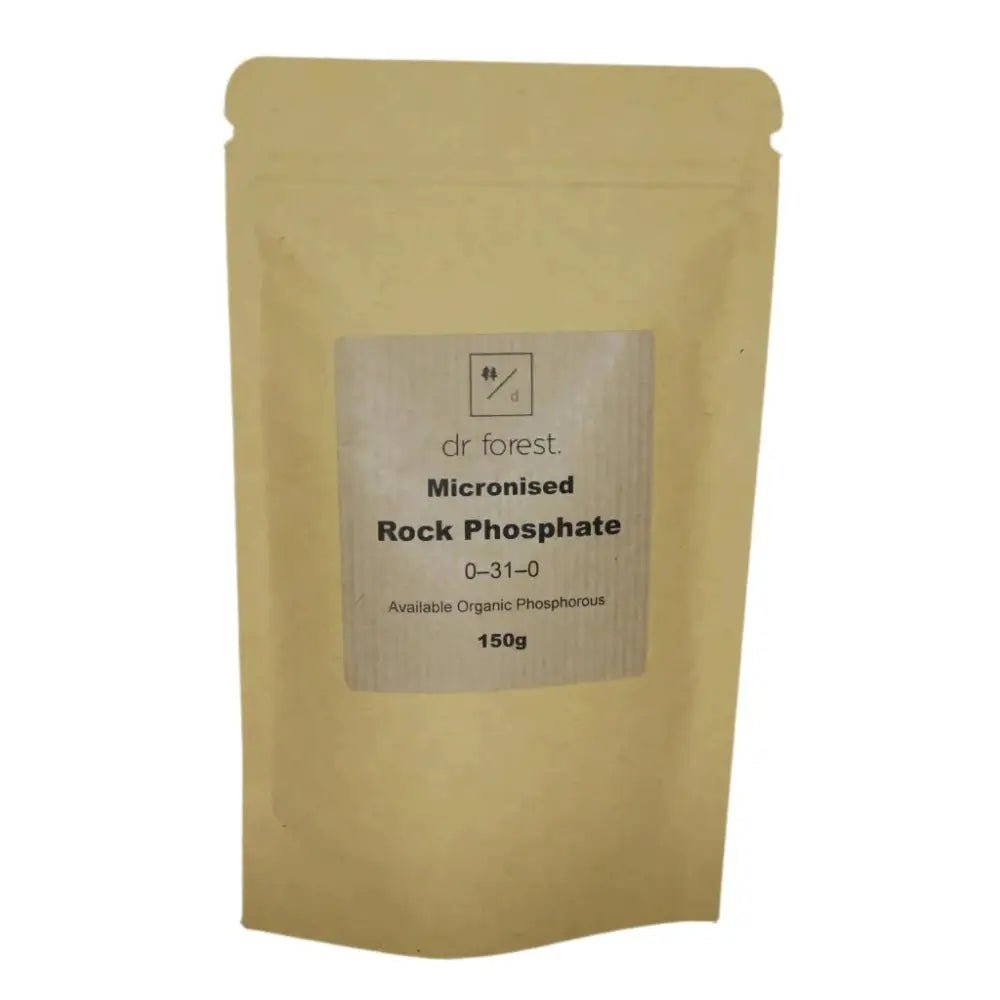
Rock phosphate is a mined mineral that releases phosphorus very slowly — often over years rather than months — and its availability is heavily dependent on soil pH (it releases best in acid soils below pH 6.5). Phosphorus meal is a calcined plant meal that releases over the growing season through a combination of the calcination process (which makes nutrients more immediately available) and biological mineralisation, regardless of soil pH. For gardeners who need phosphorus available within the current season — for root establishment, flowering, or fruit set — phosphorus meal is the more responsive and reliable option. Dr Forest also sells Micronised Rock Phosphate (0-31-0) for long-term soil phosphorus building, which serves a different purpose.

From our phosphorus range

View full details