
Fertiliser
Rock Phosphate Fertiliser | 31% P, 46% Ca, Micronised
Slow-release phosphorus and calcium for roots.
from £6.99
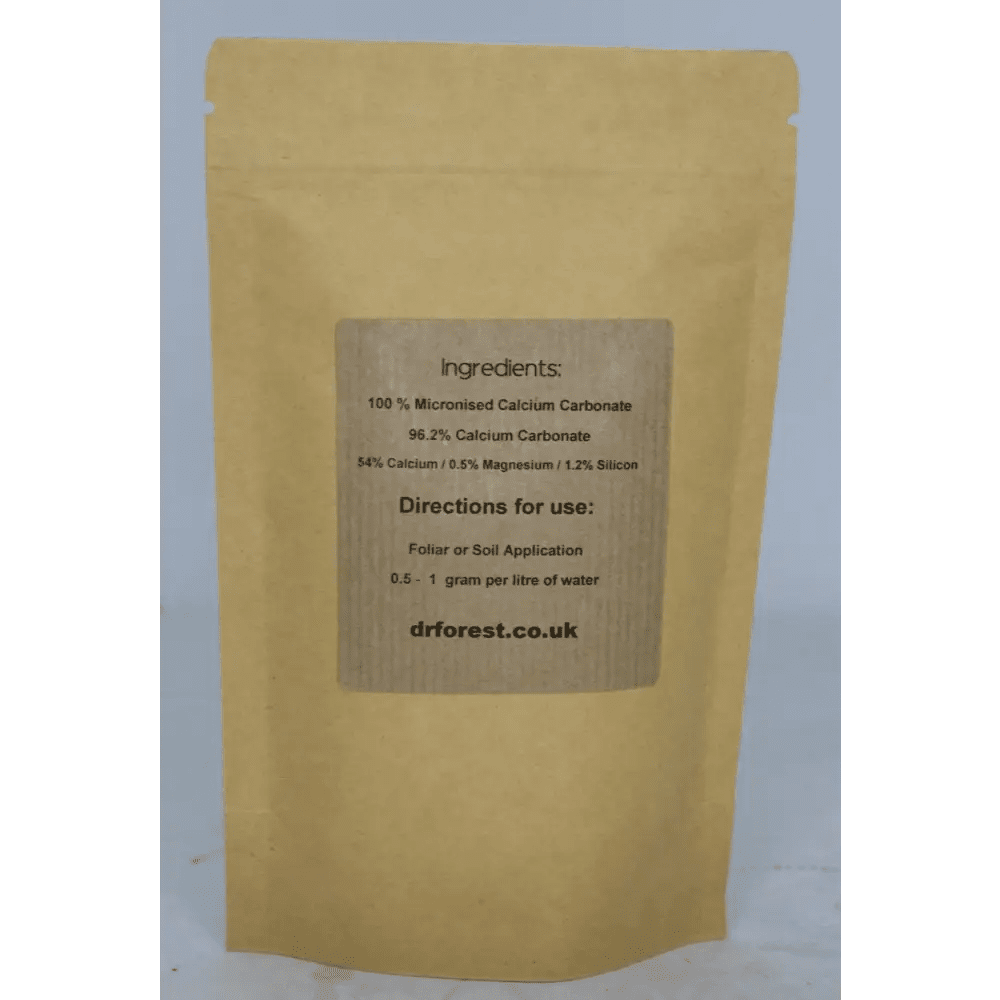
The simplest and most concentrated calcium source available: 96.2% pure calcium carbonate from quarry-extracted natural limestone, mechanically crushed and micronised to 63 microns. No chemical processing, no additives, no fillers. At 54.1% CaO, this delivers more calcium per gram than gypsum (23% Ca), bone meal (~20% Ca), or any liquid calcium product on the market. The micronised particle size means it reacts rapidly in soil — far faster than agricultural lime — making it effective as both a calcium source and a fast-acting pH corrector for acidic soils.
The carbonic solubility exceeds 91% — meaning over 91% of the calcium carbonate dissolves in the weak carbonic acid that naturally occurs in soil water. This is the measure that matters for plant availability: it tells you how much of the product will actually release calcium into the soil solution under normal growing conditions, not just in a laboratory acid bath.
| Component | Content |
|---|---|
| Calcium carbonate (CaCO₃) | 96.20% |
| Calcium (CaO) | 54.10% |
| Silica (SiO₂) | 1.20% |
| Iron (Fe₂O₃) | 0.71% |
| Magnesium (MgO) | 0.48% |
| Potassium (K₂O) | 0.05% |
| Manganese (MnO) | 0.01% |
| Sodium (Na₂O) | 0.01% |
Neutralising value: 54 | Carbonic solubility: >91% | 95% passes 63µ sieve | EU organic compliant
Every Dr Forest product is made by hand in small batches at our workshop in Stockport, Greater Manchester. We source ingredients for quality, not cost.
Calcium carbonate is the most common liming material in agriculture. But its effectiveness depends almost entirely on particle size. A coarse limestone chip can sit in soil for years without fully dissolving. The same mineral ground to 63 microns has an enormously greater surface area exposed to soil acids, root exudates, and microbial activity — accelerating dissolution from months to weeks. This is why micronised limestone acts as both a rapid pH corrector and a plant-available calcium source, while coarse ag-lime is essentially a long-term soil amendment with minimal short-term benefit.
Calcium carbonate dissolves in acid: CaCO₃ + 2H⁺ → Ca²⁺ + H₂O + CO₂. In soil, the acid comes from three sources: carbonic acid (CO₂ dissolved in soil water), organic acids from root exudates, and organic acids from microbial metabolism. The reaction consumes hydrogen ions (H⁺) — which is precisely how it raises pH. Each molecule of CaCO₃ that dissolves removes two hydrogen ions from the soil solution and releases one calcium ion. The 91%+ carbonic solubility of this product confirms that over 91% of the CaCO₃ dissolves under these natural soil conditions.
Calcium cross-links pectin chains in cell walls, providing the structural rigidity that prevents fruit splitting, blossom end rot, tip burn, and bitter pit. It also functions as a secondary messenger in cell signalling — triggering defence responses to pathogen attack, regulating stomatal opening, and controlling pollen tube growth. Calcium is phloem-immobile: once deposited in a cell wall, it cannot be moved. Actively growing tissues need continuous external supply. Micronised CaCO₃ applied as a foliar spray or drench delivers calcium directly to where demand is highest.
Soil pH governs the availability of almost every plant nutrient. Below pH 6.0, phosphorus becomes increasingly locked up with aluminium and iron. Molybdenum availability drops sharply. Aluminium and manganese can reach toxic levels. Calcium and magnesium leach faster than they are replaced. Raising pH from 5.5 to 6.5 with calcium carbonate doesn't just add calcium — it unlocks the phosphorus, molybdenum, and other nutrients that were already present in the soil but chemically unavailable. This is often the single most cost-effective intervention in acidic soil management.
A 1 cm limestone chip has approximately 6 cm² of surface area. The same mass ground to 63µ particles has a surface area measured in thousands of square centimetres. Chemical reactions happen at surfaces — the more surface exposed to soil acids, the faster the CaCO₃ dissolves and the faster pH rises. Standard agricultural lime (2–4 mm particles) may take 6–12 months to fully react. Micronised limestone at 63µ achieves measurable pH correction within 2–4 weeks under active growing conditions.
Lower-grade liming materials contain 70–85% CaCO₃ with the balance being clay, silica, and other inert fillers. These fillers contribute no calcium, no pH correction, and no agronomic benefit — they are dead weight. At 96.2% CaCO₃, this product delivers 54.1% CaO per kilogram applied. You need less product per square metre to achieve the same result, and the dosing calculations are more precise because almost everything in the bag is active ingredient.
Most beneficial soil bacteria and fungi prefer a pH of 6.0–7.0. In acidic soils (pH <5.5), bacterial activity declines sharply while pathogenic fungi — particularly Fusarium and Pythium — thrive in the absence of bacterial competition. Correcting soil pH with calcium carbonate shifts the microbial balance in favour of beneficial organisms. The calcium itself also improves soil structure by flocculating clay particles, improving aggregation, aeration, and water infiltration.
The correct application rate for pH correction depends on your current soil pH, target pH, soil type (clay vs sand), and buffering capacity. The rates below are general guidelines. For precise liming, have your soil tested and calculate the requirement based on the neutralising value (54) and your soil's lime requirement figure.
Add the powder to water and stir vigorously. The micronised particles suspend readily at this concentration. Apply as a foliar spray or pour directly around the root zone. For foliar use, strain through a fine sieve before adding to a sprayer to prevent nozzle blockages. Delivers calcium directly to actively growing tissue.
Scatter evenly under the canopy from trunk to drip line. Lightly rake into the top few centimetres of soil and water in. The micronised particles begin reacting within days.
Broadcast over the root zone. Work into the soil surface where possible. The higher rate reflects the greater calcium demand of productive orchard trees and the need for ongoing pH management.
Scatter evenly over the lawn surface. The fine powder settles into the turf canopy with watering or rain. Improves soil pH and calcium availability for root development and cold tolerance.
Incorporate thoroughly before planting. Buffers pH and provides slow-release calcium throughout the growing season. Start at the lower end for mixes that already contain lime; use the higher end for peat-based or coir-based media that tend to be acidic.
Use alongside Dr Forest Cal-Mag Supplement for combined calcium and magnesium delivery with boron. Pair with Yorkshire Polyhalite for a complete secondary nutrient package (Ca, Mg, K, S). For liquid foliar calcium during fruiting, add Cal-Mino amino acid chelated calcium. Do not mix with phosphate fertilisers in liquid form — calcium and phosphate precipitate when dissolved together.
36% of buyers here also chose Rock Phosphate Fertiliser
Slow-release phosphorus and calcium for roots.
from £6.99
A trace-mineral mix to round out your feeding.
from £11.99
A plant-based root inoculant, 18 endo and ecto species.
from £6.99