Liquid Seedling Fertiliser | Root Starter
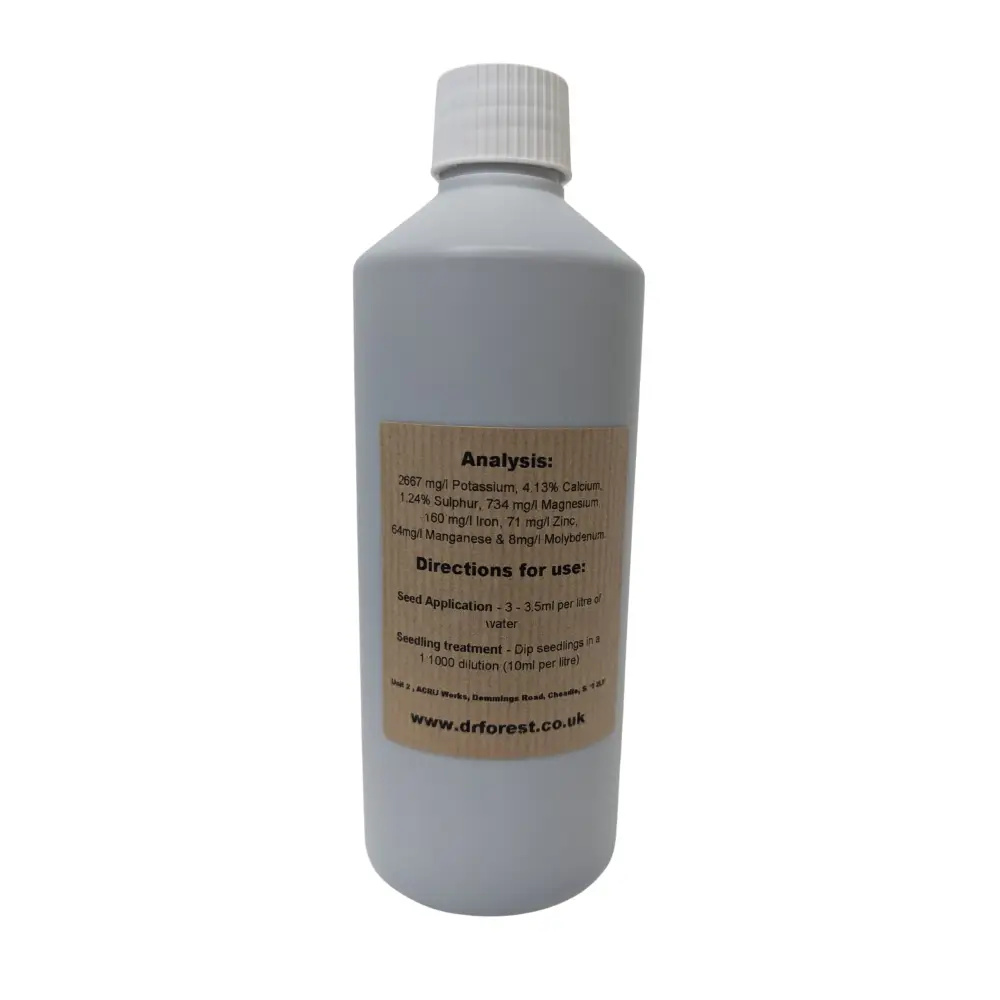
A gentle root starter for seedlings and cuttings.
from £12.99
Free UK Delivery on Orders Over £40


Dr Forest
Couldn't load pickup availability
Dr Forest customers rate us 4.89/5 · 3,250+ reviews across Shopify, Amazon, Google and eBay
Calcium and phosphorus are the two most important minerals for photosynthesis and sugar production in plants. But here is the problem: in ionic form, they are chemically incompatible. Mix dissolved calcium with dissolved phosphate and they precipitate out of solution instantly — locked up and unavailable. This is why no conventional liquid fertiliser can deliver both. This product solves that problem. By suspending micronised mineral calcium phosphate in colloidal form with fulvic acid, both elements coexist in a single plant-available liquid — something that is not possible with any dissolved salt formulation.
The source is natural mineral calcium phosphate — rich in calcium, phosphorus, silicon, manganese, and iron. Micronised and suspended in a fulvic acid carrier that improves foliar and root uptake while feeding soil biology. ACO certified organic (456AI). Suitable as a foliar spray, soil drench, or fertigation input across all growth stages from pre-planting to fruit fill.
| Nutrient | Content (w/v) |
|---|---|
| Calcium (Ca) | 24.56% |
| Silicon (Si) | 10.73% |
| Total Phosphorus (P) | 10.71% |
| — citrate insoluble P | 7.56% |
| — citrate soluble P | 3.15% |
| — water soluble P | 20 mg/L |
| Manganese (Mn) | 1.66% |
| Iron (Fe) | 0.86% |
| Magnesium (Mg) | 0.34% |
| Potassium (K) — organic | 0.15% |
| Zinc (Zn) | 0.14% |
| Copper (Cu) | 162 mg/L |
SG: 1.5 | pH: 6.5–8.5 | Appearance: thick, mid-brown liquid, citrus odour
Every Dr Forest product is made by hand in small batches at our workshop in Stockport, Greater Manchester. We source ingredients for quality, not cost. Supplied in recycled plastic bottles.
Calcium (Ca²⁺) and phosphate (PO₄³⁻) ions are strongly attracted to each other. In any dissolved solution, they react immediately to form insoluble calcium phosphate precipitate — a white solid that drops out of solution and becomes unavailable to plants. This is why no conventional liquid fertiliser can contain both. It is also why adding soluble phosphate to calcium-rich soil often results in rapid lock-up. The colloidal micronised form sidesteps this chemistry entirely: the minerals are suspended as ultra-fine particles, not dissolved ions. They do not react with each other because they are not in ionic form.
In a micronised mineral suspension, the mineral particles are ground to sub-200-micron size and held in liquid by fulvic acid and surfactant action. Because the calcium and phosphorus remain locked in their mineral matrix rather than dissolved as free ions, they cannot precipitate. Once applied to soil or leaf surfaces, the particles are broken down by root exudates, microbial activity, and organic acids into plant-available ionic forms — but by that point they are in the rhizosphere, not in a mixing tank. This is why micronised suspensions can deliver mineral combinations that dissolved solutions cannot.
The phosphorus in this product exists in three forms: citrate insoluble (7.56%), citrate soluble (3.15%), and water soluble (20 mg/L). The citrate-soluble fraction is the most agronomically significant — it represents phosphorus that dissolves in the weak organic acids produced by plant roots and soil microorganisms. This is precisely the mechanism by which plants access phosphorus from rock-based sources. The high citrate-soluble fraction confirms that this phosphorus is genuinely plant-available through natural root activity, not just on paper.
Calcium cross-links pectin chains in cell walls, providing structural rigidity. It also functions as a secondary messenger in cellular signalling pathways — triggering defence responses to pathogen attack, regulating stomatal opening, and controlling pollen tube growth during fertilisation. Calcium is phloem-immobile: once deposited in a cell wall, it cannot be redistributed. This means actively growing tissues — root tips, shoot tips, developing fruit — require continuous external supply. Foliar and drench application of micronised calcium delivers it directly to where demand is highest.
Phosphorus is a component of ATP (adenosine triphosphate) — the molecule that stores and transfers energy in every living cell. Every metabolic reaction that requires energy — photosynthesis, sugar transport, cell division, root growth, flowering — depends on phosphorus. Deficient plants cannot produce enough ATP to power normal growth, resulting in stunted root systems, delayed flowering, and poor fruit set. Phosphorus is also a key component of DNA, RNA, and cell membranes.
At 10.73%, the silicon content of this product is unusually high. Silicon deposits in cell walls as amorphous silica, forming a physical barrier against fungal penetration and insect feeding. Research consistently demonstrates that silicon-supplemented plants show improved resistance to powdery mildew, botrytis, and other foliar pathogens. Silicon also improves water use efficiency by reducing transpiration through thickened cuticles, and increases tolerance to heavy metal toxicity in contaminated soils.
At 1.66% Mn and 0.86% Fe, this product delivers meaningful micronutrient supplementation as a secondary benefit. Manganese is required for the water-splitting reaction in photosystem II — the first step of photosynthesis. Iron is essential for chlorophyll synthesis and electron transport. Both are commonly deficient in alkaline or calcareous soils. Receiving them alongside calcium and phosphorus from a single product simplifies the nutrition programme and reduces the number of separate inputs required.
This is a heavy mineral suspension (SG 1.5) — significantly denser than water. The particles settle rapidly during storage. Shake vigorously for 15–20 seconds before measuring. Add to a small amount of warm water (20–30°C) and stir for at least 30 seconds before topping up. Maintain constant agitation during sprayer use. Use a coarse inline filter (500 micron / 35 mesh) to prevent blockages from contaminants.
Apply weekly or as required. Target all growth stages from planting through to fruit fill. Ensure thorough foliage coverage. Where higher water volumes are needed, do not exceed the maximum product rate per hectare.
Apply every 2–4 weeks or as required. Particularly valuable from pre-flower through fruit fill for calcium-dependent fruit quality and phosphorus-driven energy metabolism.
Apply every 2–4 weeks or as required. Silicon content improves disease resistance and structural strength in managed landscapes.
Adjust water volume depending on canopy closure. Apply at key growth stages based on crop monitoring and soil test data.
Use the higher rate for soil amelioration where phosphorus and calcium deficiencies have been identified. Use the lower rate for maintenance fertigation. Always consider nitrogen and phosphorus crop requirements based on reliable soil test data.
Apply in-furrow at planting for immediate root-zone access to calcium and phosphorus. Rate depends on crop, row spacing, and soil type.
For targeted foliar application to individual plants or small areas showing deficiency symptoms.
Shake well before use. Dilute 45 ml into a 9-litre watering can. The diluted mix can be applied as a soil drench around the root zone or poured over foliage as a foliar feed. Repeat every 2–4 weeks or as required during the growing season.
Pre-planting: Drench soil before planting to build calcium and phosphorus reserves. Planting & establishment: Apply as a root drench to support root cell division. Vegetative growth: Every 2–4 weeks to support strong structural development. Pre-flower to fruit fill: Every 2–3 weeks to fuel flowering energy and fruit cell wall construction.
Micronised mineral suspensions leave a visible residue on leaves and fruit. This is normal and not harmful. If produce appearance matters close to harvest, switch to soil drench application or spray earlier in the growing season.
Use alongside Yorkshire Polyhalite for slow-release K, Ca, Mg, and S in the soil. Pair with Micro-7 for complete chelated trace element coverage. Add Seaweed Powder for biostimulant activity and improved foliar wetting. Compatible with most fertiliser inputs due to the non-ionic colloidal format — but avoid combining with concentrated dissolved calcium or phosphate solutions. Jar-test before mixing with any new product.


A gentle root starter for seedlings and cuttings.
from £12.99

Concentrated seaweed biostimulant for steady, resilient growth.
from £12.99

A foliar amino-acid biostimulant for quick uptake.
from £14.99