
Wetting Agent
Natural Wetting Agent for Plants, Soil, Lawn & Grass
Helps water and feed soak in evenly, with less run-off.
from £14.00
Amino acids are the most efficiently absorbed form of nitrogen a plant can receive. When you apply inorganic nitrogen (ammonium or nitrate), the plant must convert it through multiple energy-intensive enzymatic steps into amino acids before it can build a single protein. When you apply amino acids directly, the plant absorbs them intact — pre-assembled, ready for immediate incorporation into proteins, enzymes, and hormones — without expending any of the metabolic energy that de novo synthesis requires. This is why amino acid foliar sprays produce such rapid, visible responses: faster green-up than urea, faster recovery from stress than any conventional nitrogen feed, and faster metabolic resumption after damage from hail, frost, herbicide, or drought.
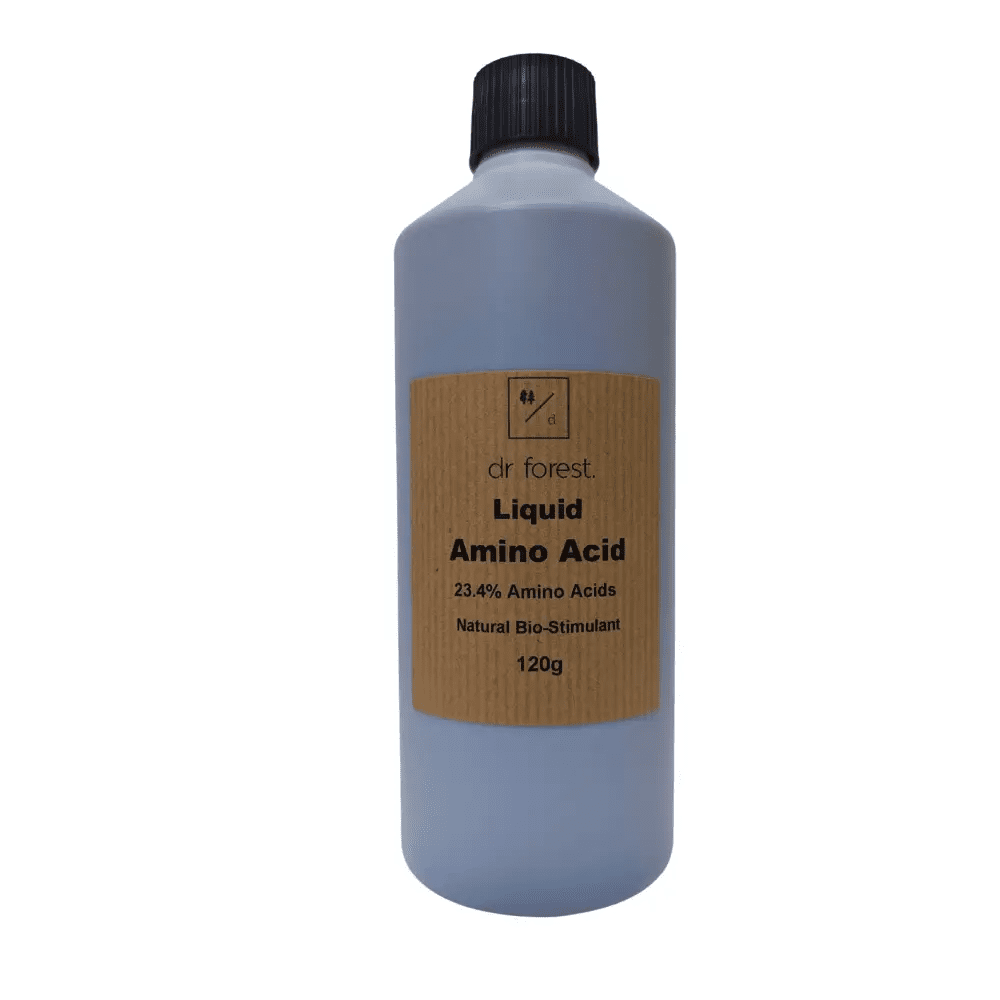
This is a concentrated liquid amino acid biostimulant derived entirely from plant-based protein sources — no animal by-products. It delivers 23.4% total amino acids (234 g/L) including 20.9% free amino acids (209 g/L) — the free amino acid fraction is the portion that is immediately available for foliar absorption without any further breakdown. The 3.9% nitrogen content provides a meaningful nitrogen contribution alongside the biostimulant effect, making this a genuine dual-function product: biostimulant and nitrogen feed in a single bottle. The mildly acidic pH (4.5–5.5) ensures rapid absorption through the leaf cuticle and stomata. Compatible with most tank-mix partners and suitable for all crops at all growth stages.
The leaf surface is not a sealed barrier. It is punctuated by thousands of stomata (gas exchange pores) and covered by a waxy cuticle that, while designed to prevent water loss, is permeable to small organic molecules — particularly at the mildly acidic pH range (4.5–6.0) where most amino acids carry a net neutral charge. At this pH, amino acids exist as zwitterions — molecules with both positive and negative charges that cancel out, making them small, uncharged, and able to pass through the cuticle and stomatal pores with remarkable efficiency.
This product has a pH of 4.5–5.5 — exactly in the optimal range for foliar amino acid absorption. The free amino acid fraction (20.9% — the majority of the total amino acid content) requires no further enzymatic breakdown before absorption. The molecules are ready to cross the leaf surface and enter the plant's metabolic system within minutes of application. Once inside the leaf cells, they are incorporated directly into proteins, enzymes, and hormones, or used as precursors for the synthesis of secondary metabolites (defence compounds, flavour molecules, pigments).
Synthesising amino acids from inorganic nitrogen is the most energy-expensive process in plant metabolism — consuming up to 25% of total photosynthetic energy. Every amino acid absorbed intact through the leaf is one fewer that the plant must build from scratch. At 209 g/L of free amino acids, a single foliar application of this product delivers billions of pre-assembled molecular building blocks that the plant incorporates directly into proteins without any energy expenditure. The energy saved is redirected to growth, flowering, fruit production, and stress defence — producing the rapid growth response that growers observe within days of application.
Abiotic stress (frost, hail, herbicide, drought, heat) damages the plant's protein synthesis machinery — enzymes denature, ribosomes stall, and the metabolic pathway from inorganic nitrogen to finished amino acid slows or stops. Meanwhile, the plant urgently needs new proteins to repair damaged tissue. This creates a metabolic crisis: the plant needs proteins faster than it can build them. Supplying pre-formed amino acids through foliar spray breaks this bottleneck — the plant receives the finished building blocks it cannot currently manufacture, allowing repair to begin immediately. This is why amino acid foliar sprays are the most effective recovery treatment after stress events.
Amino acids bind mineral ions (iron, zinc, copper, manganese, calcium) into small organic complexes that cross cell membranes more easily than free mineral ions. When applied alongside a mineral foliar feed or micronutrient spray, the amino acids chelate the minerals and carry them into the leaf cell — significantly increasing the percentage of applied mineral that is actually absorbed. This is why amino acid sprays are recommended as tank-mix partners with micronutrient applications: they multiply the effectiveness of every mineral in the spray solution.
Several amino acids are direct precursors to plant hormones. L-Tryptophan is the precursor to indole-3-acetic acid (IAA) — the primary auxin that drives root initiation and elongation. L-Methionine is the precursor to ethylene via S-adenosylmethionine (SAM) — the hormone that regulates fruit ripening. L-Arginine is the precursor to polyamines — compounds that regulate cell division and stress tolerance. Supplying these amino acids via foliar spray ensures the plant's hormone production pathways are never substrate-limited.
The flavour, aroma, colour, and nutritional value of fruit and vegetables are produced by secondary metabolites — phenolics, flavonoids, anthocyanins, terpenes, vitamins — that are all synthesised from amino acid precursors. L-Phenylalanine is the entry point for the entire phenylpropanoid pathway (lignin, flavonoids, phenolic defence compounds). L-Tyrosine is the precursor to betalain pigments. L-Cysteine feeds glutathione biosynthesis (the plant's master antioxidant). Regular amino acid foliar applications ensure these pathways run at full capacity, producing crops with measurably higher flavour compound, vitamin, and antioxidant content.
This is a foliar specialist — the liquid format, pH 4.5–5.5, and high free amino acid content are optimised for leaf absorption. While it can be used as a soil drench, foliar spray is the primary and most effective application method. Shake well before use. Apply in morning or evening when the sun is not intense, to minimise the risk of leaf scorch and maximise stomatal uptake.
Shake well. Mix 3 ml per litre of water and apply as a fine foliar spray to both upper and lower leaf surfaces. Apply in the early morning or late evening when stomata are open and evaporation is minimal. This is the standard maintenance rate for routine biostimulant application throughout the growing season — from planting through harvest. Suitable for all plants: vegetables, fruit, herbs, roses, ornamentals, lawns, shrubs, and trees. Regular application produces cumulative improvements in growth rate, leaf colour, stress tolerance, and crop quality.
Apply at 4 ml/L as a recovery spray immediately after a stress event — frost damage, hail damage, herbicide stress, drought recovery, or heat shock. The elevated rate delivers a larger dose of pre-formed amino acids to a plant whose own protein synthesis machinery is impaired. The amino acids allow repair to begin immediately without waiting for the plant's own recovery. Can also be applied before an anticipated stress event (forecast frost or heatwave) to pre-load the plant with osmolytes and defence precursors.
At 10 ml/L, this rate delivers a concentrated dose of amino acid-form nitrogen — the fastest-acting organic nitrogen available via foliar spray. Use when you see nitrogen deficiency symptoms: pale green or yellowing lower leaves, reduced growth rate, stunted development. The amino acid nitrogen is absorbed through the leaves and enters the metabolic system within minutes — far faster than urea or any soil-applied nitrogen source. This is a correction rate, not a maintenance rate — revert to 3 ml/L once the deficiency is resolved.
Apply with a sprayer or watering can fitted with a rose. The amino acids drive rapid green-up, improve tillering (lateral shoot production for density), and enhance drought tolerance. Particularly effective as a recovery spray after heavy use, drought, or scalping. Combine with Dr Forest Brix+ for a dual biostimulant foliar programme on lawns.
Do not mix with strongly alkaline products — perform a jar test to confirm compatibility with other products before tank mixing. Do not pre-mix or store in diluted form — make fresh each time. Store frost-free in a cool, dark place. At temperatures below 5°C the product may crystallise. Avoid contact with eyes and skin. Keep out of reach of children. If swallowed, seek medical advice. Shelf life approximately 2 years when stored correctly in the original unopened packaging.
Tank-mix with Dr Forest Brix+ for a combined amino acid + growth hormone foliar programme — the amino acids provide building blocks, the Brix+ triacontanol and cytokinins provide the metabolic signals. Add to Dr Forest Seaweed Powder foliar sprays for complementary trace minerals and polysaccharides. Use alongside Activated Biochar Condensate soil drenches on alternate weeks — karrikins from the condensate stimulate growth, amino acids from this product provide the building blocks. Feed with Dr Forest granular fertilisers as the base NPK — the amino acids increase the efficiency of nutrient uptake from the soil fertiliser programme.
35% of buyers here also chose Natural Wetting Agent for Plants, Soil & Lawn
Helps water and feed soak in evenly, with less run-off.
from £14.00
Concentrated seaweed biostimulant for steady, resilient growth.
from £12.99
An amino-acid foliar feed for quick uptake.
from £6.00


