Wetting Agent
Natural Wetting Agent for Plants | Soap Nuts
Helps water and feed soak in evenly, with less run-off.
from £14.00
Free UK Delivery on Orders Over £40


Dr Forest
Couldn't load pickup availability
Dr Forest customers rate us 4.89/5 · 3,250+ reviews across Shopify, Amazon, Google and eBay
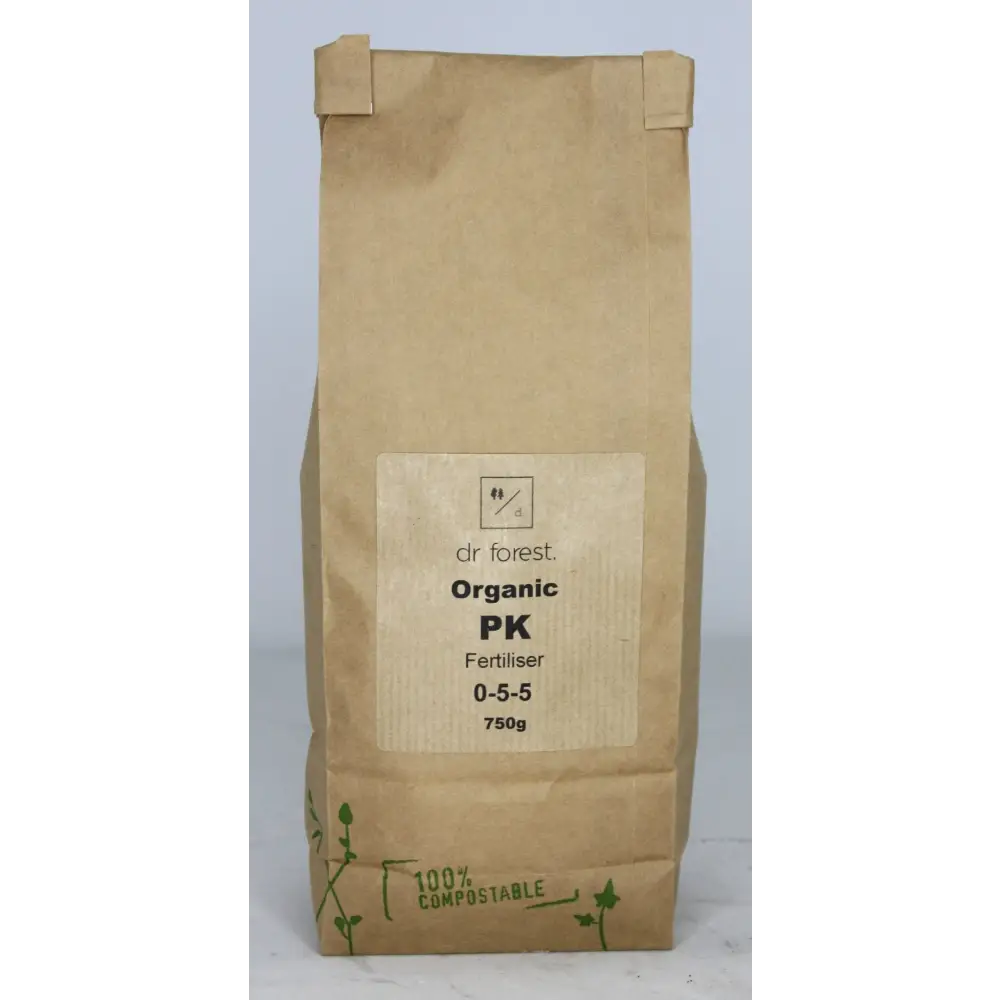
A ground mineral fertiliser blended from natural igneous and sedimentary rocks — quarry-extracted, mechanically crushed, and sieved. No chemical processing, no synthetic additives, no nitrogen. This delivers phosphorus for root development and energy, potassium for flowering and fruiting, calcium for cell wall strength, magnesium for photosynthesis, plus iron, sulphur, and trace elements — all from unprocessed mineral sources in a single application.
The zero-nitrogen formula is the key advantage. Most general-purpose fertilisers push vegetative growth whether you want it or not. This product lets you build phosphorus, potassium, calcium, and magnesium levels in the soil without adding any nitrogen — essential for flowering and fruiting stages, autumn soil preparation, and situations where nitrogen is already adequate or excessive.
| Nutrient | Content |
|---|---|
| Phosphorus (P₂O₅) | 5.10% |
| Potassium (K₂O) | 5.00% |
| Calcium (CaO) | 11.40% |
| Magnesium (MgO) | 3.10% |
| Sulphur (SO₃) | 4.20% |
| Iron (Fe₂O₃) | 3.30% |
| Manganese (Mn) | 0.05% |
| Copper (Cu) | 0.01% |
| Boron (B) | 0.01% |
| Zinc (Zn) | 0.003% |
Form: ground powder | EU organic compliant
Every Dr Forest product is made by hand in small batches at our workshop in Stockport, Greater Manchester. We source ingredients for quality, not cost. Supplied in compostable packaging.
This product is not a dissolved chemical fertiliser. It is finely ground natural rock — a blend of igneous and sedimentary minerals that have been quarry-extracted and mechanically processed. The nutrients are locked in mineral crystal lattices and released gradually through two natural mechanisms: dissolution by root exudates (organic acids secreted by plant roots) and weathering by soil microorganisms (bacteria and fungi that produce acids as metabolic by-products). This means the nutrients become plant-available at a rate governed by biological activity — not a flush-and-fade pattern like water-soluble salts.
Phosphorus is a component of ATP, the universal energy currency of living cells. Every reaction requiring energy — photosynthesis, cell division, sugar transport, nitrogen fixation — depends on phosphorus. It is particularly critical during root establishment (rapid cell division) and flowering (high energy demand). The citrate-soluble phosphorus in ground rock minerals is released by the same organic acids that plant roots produce naturally, making it available precisely where and when roots are actively growing.
Potassium regulates stomatal opening (water loss), activates over 60 enzymes, and governs the transport of sugars from leaves to fruit. Potassium-sufficient plants produce firmer, sweeter, better-coloured fruit with longer shelf life. Deficient plants wilt under mild drought, produce watery fruit, and show marginal leaf scorch. The potassium in mineral rock is released as the feldspar and mica components weather — a gradual, sustained supply that avoids the flush-and-crash of soluble potassium salts.
At 11.4% CaO, this product delivers substantial calcium. Calcium cross-links pectin in cell walls, providing structural rigidity. It is immobile in the phloem — once deposited, it cannot be redistributed. Actively growing tissues (root tips, fruit, shoot tips) require continuous external supply. Rock-derived calcium releases steadily as the mineral weathers, maintaining availability throughout the growing season without the rapid leaching associated with soluble calcium sources like calcium nitrate.
Most PK fertilisers contain no iron. This product delivers 3.3% Fe₂O₃ — a significant quantity from the igneous rock component. Iron is essential for chlorophyll synthesis and is a component of cytochromes and ferredoxin in the photosynthetic and respiratory electron transport chains. Iron deficiency (lime-induced chlorosis) is the most common micronutrient problem in alkaline soils. The slow-release iron oxide form weathers gradually, providing sustained availability rather than the rapid oxidation and lock-up that occurs with soluble iron salts.
Magnesium (3.1% MgO) is the central ion in every chlorophyll molecule and activates over 300 enzymes. Sulphur (4.2% SO₃) is a component of the amino acids cysteine and methionine — essential for protein synthesis. Both are commonly deficient in sandy, acidic, or heavily cropped soils. Receiving them alongside P, K, and Ca from a single mineral source simplifies the nutrition programme and ensures secondary nutrients are not neglected while primary nutrients are addressed.
Nitrogen drives vegetative growth — leaf expansion, stem elongation, chlorophyll production. During flowering and fruiting, excess nitrogen diverts the plant's resources away from reproductive development into unwanted leaf growth. It dilutes sugar concentration in fruit, delays ripening, and promotes soft, disease-susceptible tissue. A zero-nitrogen PK formula lets you build phosphorus, potassium, calcium, and magnesium reserves without any of these side effects — essential for pre-flower feeding, fruit fill, autumn soil preparation, and any situation where nitrogen is already sufficient.
This is a fine ground powder, not a liquid. Scatter evenly over the soil surface and work in lightly with a rake or fork. Water after application to begin the weathering process. The minerals release gradually through root exudate activity and microbial weathering — there is no risk of root burn at recommended rates.
Use the lower rate (100 g/m²) for maintenance on reasonably fertile soil. Use the higher rate (300 g/m²) for new beds, heavily cropped areas, or soils with known phosphorus, potassium, or calcium deficiency. Scatter evenly, rake in lightly, and water.
Spread evenly under the canopy from the trunk to the drip line. Use the lower rate for young trees and the higher rate for mature, heavy-cropping specimens. Lightly fork into the top few centimetres of soil and water in.
Scatter evenly over the lawn surface. The fine powder will settle into the turf canopy with watering or rain. Particularly valuable in autumn to build root reserves and improve cold tolerance without stimulating late-season top growth.
Autumn/winter: Apply after harvest or during winter soil prep to build mineral reserves for the following season. The slow-release minerals will not leach or stimulate unwanted growth. Pre-planting: Incorporate into beds 2–4 weeks before planting to allow initial weathering. Mid-season: Top dress around fruiting plants at the start of flowering to support fruit set and fill without adding nitrogen.
Pair with Dr Forest Veg 4-4-4 or All-Purpose 6-6-6 during vegetative growth, then switch to this PK mineral fertiliser at flowering for nitrogen-free reproductive support. Use alongside Seaweed Powder for biostimulant activity. Combine with Yorkshire Polyhalite for additional slow-release K, Ca, Mg, and S. For liquid foliar feeding during fruiting, add Cal-Mino for chelated calcium delivery.


Helps water and feed soak in evenly, with less run-off.
from £14.00

Fully soluble kelp for foliar or root feeding.
from £6.50

An organic potassium feed for fruiting and flowering.
from £6.99