


Fertiliser
Seaweed Fertiliser | Soluble Plant Food Powder
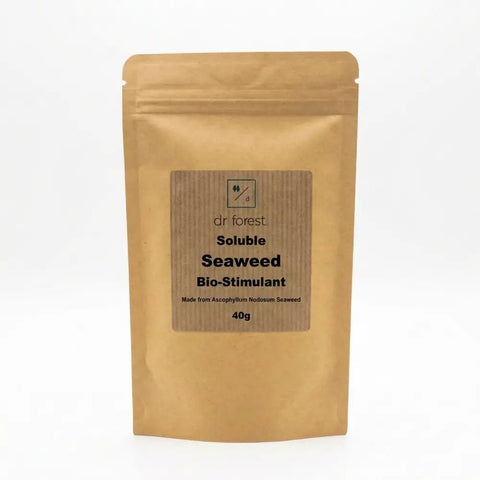
Fully soluble kelp for foliar or root feeding.
from £6.50
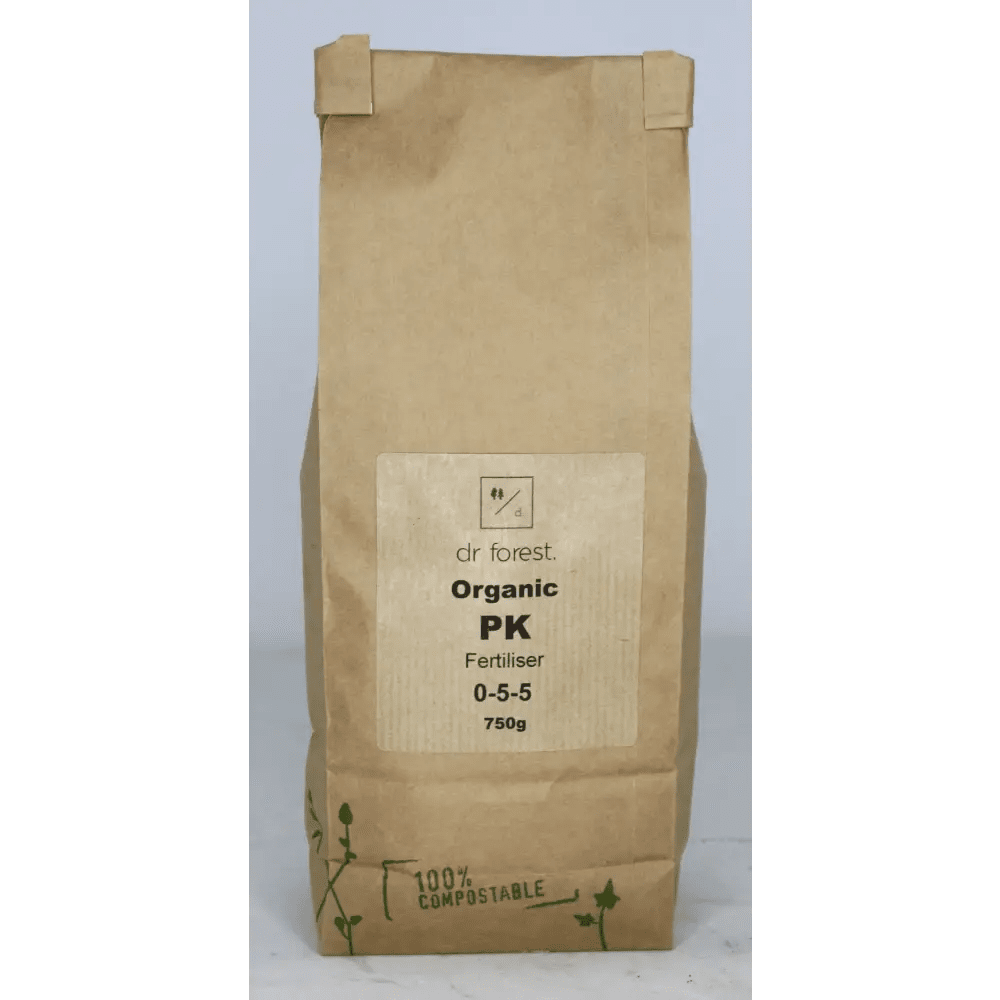
Ground rock mineral PK 0-5-5 (this product)
Soluble PK booster (superphosphate, muriate of potash, liquid PK)
Customer highlight
Used in conjunction with other Dr Forest late bloom NPK ammendments this gives your plants everything they need, the best results I have ever achieved.
Editorial highlight from marketplace and store reviews — separate from the full review list below.
This organic PK fertiliser is a finely ground blend of natural igneous and sedimentary rock, quarried, crushed and sieved, that supplies phosphorus, potassium, calcium and magnesium with no nitrogen at all. The nutrients sit inside the mineral crystals and come out slowly, as plant roots and soil microbes produce the mild acids that weather rock. That makes it a feed for building reserves in the soil rather than a quick hit. Dr Forest packs it by hand in small batches in Stockport, Greater Manchester, and it goes out in compostable packaging.
The zero-nitrogen analysis is the point of it. Most general feeds push leaf growth whether you want it or not. This one lets you raise phosphorus, potassium, calcium and magnesium levels for flowering and fruiting, for autumn soil preparation, or for beds where nitrogen is already plentiful, without a flush of soft growth on top.
Dr Forest is a small-batch organic fertiliser business in Stockport, Greater Manchester. This is a mined mineral product with no animal inputs, weighed and packed by hand at our workshop and supplied in compostable packaging. If you are choosing between a mineral PK and a high-phosphorus organic blend, what is a bloom fertiliser? sets out the difference. Made by Growers. Backed by Science.
It is rock, ground fine. A blend of igneous rock (the source of most of the potassium, magnesium and iron) and sedimentary rock (the main source of phosphorus and calcium), quarried, crushed, sieved and blended. No acid treatment, no chemical processing. The nutrients are held in the crystal lattices of minerals such as feldspar, mica, apatite and calcite, and they only become plant-available when those minerals dissolve.
That dissolution is what everything else on this page depends on. Harley and Gilkes (2000) reviewed the geochemistry of silicate rock powders and found that release depends on how far the soil solution is from equilibrium with the mineral, on the surface area exposed (which is why the powder is ground fine), and on biological activity in the root zone, which supplies the acids that attack mineral surfaces [1]. Swoboda, Döring and Hamer (2022) reached a similar conclusion: slow and inconsistent weathering held rock powders back historically, and results in any trial come down to the rock, the grind, the rate and the soil [2]. Best to be straight about that. Ground rock builds a reserve over seasons, and how fast depends on the soil it lands in.
| Nutrient | Declared as | Analysis |
|---|---|---|
| Phosphorus | P₂O₅ | 5.10% |
| Potassium | K₂O | 5.00% |
| Calcium | CaO | 11.40% |
| Magnesium | MgO | 3.10% |
| Sulphur | SO₃ | 4.20% |
| Iron | Fe₂O₃ | 3.30% |
| Manganese | Mn | 0.05% |
| Copper | Cu | 0.01% |
| Boron | B | 0.01% |
| Zinc | Zn | 0.003% |
Two things stand out. Calcium is the largest single nutrient, more than twice the phosphorus or potassium, so this behaves partly as a gentle calcium fertiliser and partly as a PK feed. And the figures are totals held in the rock, not water-soluble fractions, which is why the application rates are generous by the standards of soluble feeds.
Phosphorus in sedimentary rock is mostly calcium phosphate, and it does not dissolve readily on its own. Hinsinger (2001), reviewing phosphorus bioavailability in the rhizosphere in Plant and Soil, described how roots change the chemistry of the soil around them, releasing protons and organic anions such as citrate and malate that dissolve sparingly soluble calcium phosphates, and noted that the response varies with the plant's nutrient status and is more pronounced under phosphorus deficiency [3]. In practice, phosphorus is released where roots are actively growing and asking for it.
Manning (2010), in Agronomy for Sustainable Development, reviewed the silicate minerals that hold potassium. Feldspars dissolve slowly; micas and nepheline considerably faster, and nepheline about a hundred times faster than potassium feldspar. Soil organisms and plant roots speed all of them up [4]. The potassium here is a reserve that soil biology draws on over the season, a different thing from the near-instant availability of sulphate of potash.
Wang and colleagues (2013), reviewing potassium in the International Journal of Molecular Sciences, list its roles in enzyme activation, protein synthesis, photosynthesis, osmoregulation, stomatal movement and phloem transport, and its part in drought tolerance and crop quality [5]. It is the nutrient most closely tied to how fruit fills and how a plant copes with a dry spell, which is why a potassium reserve going into flowering matters.
White and Broadley (2003), in Annals of Botany, describe calcium as required for structural roles in the cell wall and membranes [6]. Standard texts add that it is barely mobile in the phloem, so fast-growing tissues that transpire little, such as fruit and shoot tips, need a continuous supply from the soil [7]. At 11.4% CaO this product delivers that supply steadily as the rock weathers. If blossom end rot is the problem you are chasing, read blossom end rot in tomatoes first; it is usually a watering issue rather than a calcium shortage.
Magnesium (3.1% MgO) is the central atom of every chlorophyll molecule; sulphur (4.2% SO₃) goes into the amino acids cysteine and methionine and so into every protein [7]. Both are commonly short on sandy, acidic or heavily cropped soils. Getting them in the same bag as phosphorus, potassium and calcium is a practical advantage, because they are the nutrients most often left out of a feeding plan.
At 3.3% Fe₂O₃ this blend carries far more iron than a typical PK feed, but iron oxide is one of the least soluble things in soil. Colombo and colleagues (2014), in the Journal of Soils and Sediments, note that soils usually hold abundant total iron while the available fraction is very low, especially at high pH, and that plants and microbes mobilise it by releasing organic acids and siderophores [8]. Treat the iron here as a long-term contribution to the soil pool. It will not fix chlorosis this season; for a quick correction, a chelated liquid such as Liquid Micronutrients is the right tool.
Much of the trial work on rock powders is on basalt in cereals, so read across to a garden blend with care. Kelland and colleagues (2020) grew sorghum in soil amended with crushed basalt at 10 kg per m² and recorded a 21% (± 9.4%) yield increase after 120 days with no P or K fertiliser added [9]. That rate is well above anything on this page, and sorghum is not a tomato. Van Straaten (2006) argued that rock and mineral fertilisers are most useful on weathered, acidic, nutrient-depleted soils and when combined with organic matter [10]. The sensible reading for a UK garden: ground rock works slowly, and best in a living soil with organic matter to drive the weathering. So pair it with compost or Seaweed Extract Powder and keep the soil covered.
Figures describe the published literature on ground rock minerals and plant nutrition. They are not product-specific yield guarantees.
This is a fine ground powder, not a liquid. Scatter evenly over the soil surface and work in lightly with a rake or fork. Water after application to begin the weathering process. The minerals release gradually through root exudate activity and microbial weathering, so there is no risk of root burn at recommended rates.
Ground rock releases over months. Where you can, incorporate it 2–4 weeks before planting so weathering has started, and pair it with a nitrogen feed during vegetative growth, because this one contains none.
Use the lower rate (100 g/m²) for maintenance on reasonably fertile soil. Use the higher rate (300 g/m²) for new beds, heavily cropped areas, or soils with known phosphorus, potassium, or calcium deficiency. Scatter evenly, rake in lightly, and water.
Measure the canopy from the trunk out to the drip line and apply at the bed rate across that area. Use the lower rate for young trees and the higher rate for mature, heavy-cropping specimens. Lightly fork into the top few centimetres of soil and water in.
Scatter evenly over the lawn surface. The fine powder will settle into the turf canopy with watering or rain. Particularly valuable in autumn to build root reserves and improve cold tolerance without stimulating late-season top growth.
Autumn/winter: Apply after harvest or during winter soil prep to build mineral reserves for the following season. The slow-release minerals will not leach or stimulate unwanted growth. Pre-planting: Incorporate into beds 2–4 weeks before planting to allow initial weathering. Mid-season: Top dress around fruiting plants at the start of flowering to support fruit set and fill without adding nitrogen.
Pair with Organic All Purpose Fertiliser 4-4-4 during vegetative growth, then switch to this PK mineral fertiliser at flowering for nitrogen-free reproductive support. Use alongside Seaweed Extract Powder for biostimulant activity. Combine with Yorkshire Polyhalite for additional slow-release K, Ca, Mg and S. For liquid foliar feeding during fruiting, add Amino Chelated Calcium for chelated calcium delivery.
Keep the bag sealed and dry. Ground rock does not degrade, but damp powder cakes and is harder to spread. Keep out of reach of children and pets, as with any fertiliser.
This one goes on before or at planting, or as a mid-season top dressing, at 100–300 g per m². Use the lower rate on reasonably fertile soil and the higher rate for new beds or hard-cropped ground. It's ground rock and releases over months, so put it down a few weeks before plants start flowering rather than waiting for the first buds. It also suits autumn, after harvest, to build reserves for next season, and lawns in autumn, because it adds no nitrogen to push late soft growth.
For a slow, season-long reserve, scatter this ground-rock PK at 100–300 g per m² and work it into the top few centimetres. It also brings calcium (11.4% CaO), magnesium (3.1% MgO) and sulphur, with no salt load and nothing to wash out over winter. If plants need a quick lift this season, use a soluble feed alongside it, such as Bloom Booster 2-10-5, and add compost: soil life is what weathers the rock.
19% of buyers here also chose Natural Wetting Agent for Plants, Soil & Lawn
Fully soluble kelp for foliar or root feeding.
from £6.50
An amino-acid foliar feed for quick uptake.
from £6.00


