



Fertiliser
Organic Amino Acid Fertiliser | Foliar Feed
An amino-acid foliar feed for quick uptake.
from £6.00
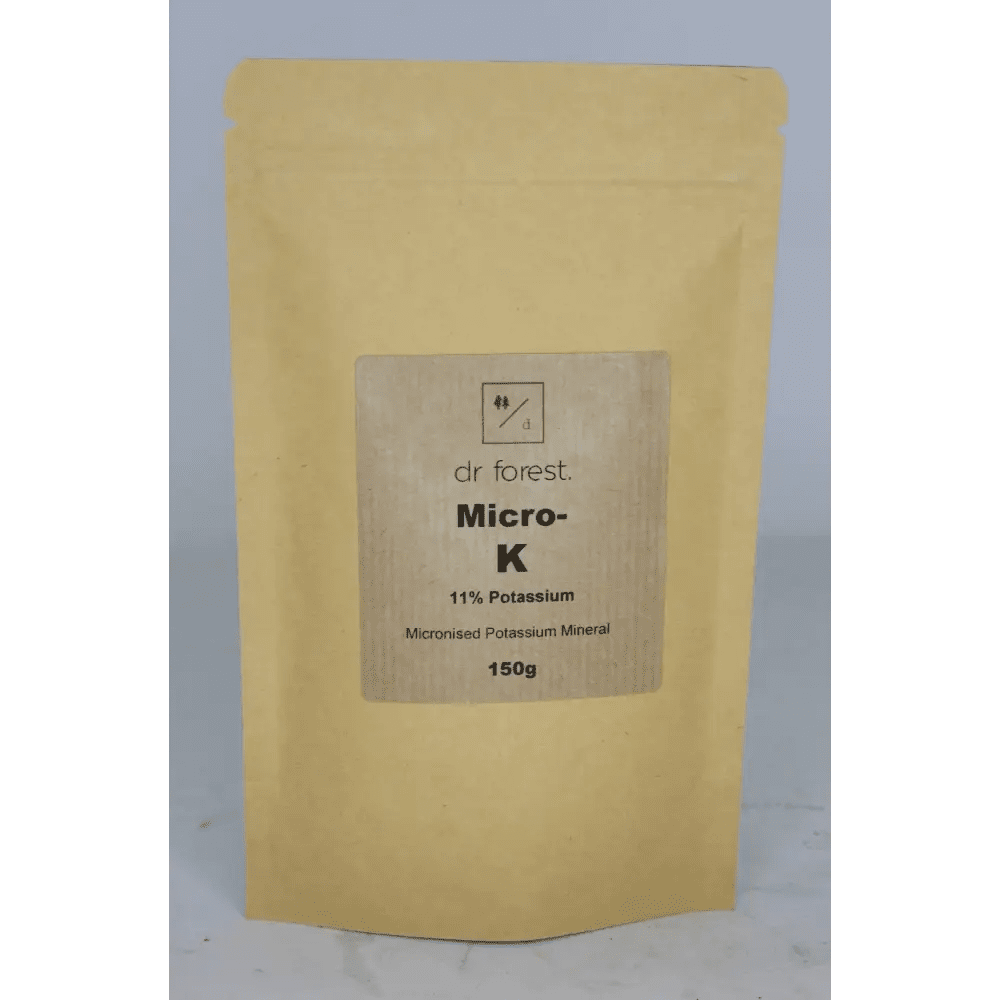
Micro-K micronised potassium mineral, 11% K₂O
Sulphate of potash or muriate of potash, 50–60% K₂O
Customer highlight
good
Editorial highlight from marketplace and store reviews — separate from the full review list below.
Micro-K is a potassium rich fertiliser made from a single quarried rock, ground fine enough to suspend in water, with 11% K₂O and no chloride. The potassium sits inside the rock rather than in a soluble salt, so it comes out gradually as the particles dissolve in soil moisture instead of arriving in one pulse and leaching away. Dr Forest packs it in small batches in Stockport, Greater Manchester, and it is the slow-release counterpart to our Sulphate of Potash (50% K₂O) and Liquid Potassium Feed (15% K₂O).
Three ways to use it: as a soil drench from the watering can, as a foliar potassium feed during fruiting, or broadcast dry on beds, borders and lawns to build a reserve. Nothing is added; it is rock, micronised and bagged, in sizes from 500 g to 9 kg.
Dr Forest is a small-batch organic fertiliser company in Stockport, Greater Manchester, founded in 2020. Micro-K is a single quarried rock with no animal by-products and no additives, so it suits vegan and no-dig gardens as it is. The 1.5 kg, 3 kg and 9 kg sizes come in recyclable packaging. If you are deciding between potash types, read Polyhalite vs sulphate of potash: which potash should you use? Made by Growers. Backed by Science.
Potassium is the most abundant cation in plant tissue, and unlike nitrogen or phosphorus it never becomes part of a protein, a membrane or a strand of DNA. It stays as a free ion, K⁺, and does its work by moving about: into guard cells to open a stoma, into the phloem to carry sugar, across a membrane to keep the charge balanced. Wang and colleagues (2013, International Journal of Molecular Sciences) list its jobs as enzyme activation, protein synthesis, photosynthesis, osmoregulation, stomatal movement, energy transfer, phloem transport, cation–anion balance and stress resistance.1
For a gardener the practical effect is on the things you can taste and see. Lester, Jifon and Makus (2010, Plant and Soil) call potassium the cation with the strongest influence on the quality attributes that decide fruit marketability and consumer preference, and note that soil supply often fails to keep up with fruit demand during development.2 That is the case for foliar potassium as a second route in. For the nutrient basics, see What is a fertiliser?
| Property | Value | Note |
|---|---|---|
| Potassium (K₂O) | 11% | Held in the mineral lattice, released by dissolution |
| Chloride | None | Suits chloride-sensitive crops |
| Form | Micronised powder | Suspends in water; settles on standing |
| Origin | Quarried rock | Ground and bagged, no chemical processing |
| Other minerals | Trace elements of the parent rock | Not declared individually |
Eleven per cent is modest next to a refined potash salt. For a rock source the number that matters is how fast it gives the potassium up, and that is decided by mineralogy, particle size and what roots and soil biology do to the particle surface.
Humble and Raschke (1971, Plant Physiology) used electron-probe analysis on broad bean leaves and measured roughly 4 × 10⁻¹² gram-equivalents of K⁺ moving into each pair of guard cells as a stoma opened from 2 to 12 micrometres, enough, with its balancing anions, to account for the change in guard-cell volume.3 Wang et al. (2013) describe adequate potassium as essential to drought resistance through root elongation and membrane stability.1
Potassium is needed to load sucrose into the phloem and move it from leaf to fruit; Wang et al. (2013) list phloem transport of photoassimilates among its core roles.1 In field melon trials, Lester, Jifon and Makus (2010) found that weekly foliar potassium during fruit development, as potassium sulphate or glycine-complexed potassium, gave the largest gains in firmness, sugars, ascorbic acid and beta-carotene, and that feeding through the leaf outperformed soil application for the same forms.2
The same review reports that higher tissue potassium reduced chilling damage and increased cold resistance in the crops studied, and that maintaining adequate potassium is critical for drought resistance.1 This is the basis for the autumn potash dressing on lawns and fruit trees: get the tissue concentration up before the first frost.
Harley and Gilkes (2000, Nutrient Cycling in Agroecosystems) reviewed silicate rock powders as fertilisers and set out the rules: dissolution happens at the mineral surface, mainly at defects; it is driven by the soil solution being out of equilibrium with the mineral as roots and leaching remove ions; root exudates and microbial acids speed it up; and release rates are best predicted per unit of surface area.4 Grinding a rock to micron size multiplies that surface area, which is the point of micronising. They are also candid that slow dissolution is the main limit on rock powders in agriculture, which is why we do not sell this as a substitute for a soluble salt when a plant is visibly short.
Manning (2010, Agronomy for Sustainable Development) reviewed mineral potassium sources and found that nepheline dissolves around 100 times faster than potassium feldspar, so a rock's usefulness depends on which mineral carries the potassium, as much as on its K₂O figure.5 Mohammed and colleagues (2014, European Journal of Soil Science) grew leeks in sandy soil with microcline feldspar, biotite mica and nepheline syenite against potassium chloride: the soluble salt gave the fastest growth, biotite came next and weathered to vermiculite during the trial, while neither the feldspar nor the nepheline syenite grew the leeks any better than the untreated control, though tissue analysis showed the nepheline had given up some potassium.6 The honest reading: a ground mineral is a reserve and a slow feed, best used alongside a faster source at peak demand.
Fernández and Eichert (2009, Critical Reviews in Plant Sciences) reviewed foliar fertilisation and concluded that stomata can significantly increase uptake and that relative humidity is a key factor, which is the case for spraying at dawn or dusk when the air is damp and the pores are open.7 One caution on any high-potassium programme: Xie, Cakmak and colleagues (2021, The Crop Journal) report that potassium suppresses magnesium uptake more strongly than the reverse, and that potassium-induced magnesium deficiency is widespread where potassium is applied heavily.8 Feed magnesium alongside if you are pushing potassium through fruiting.
These studies describe potassium and ground-mineral fertilisers as a class. They are not trials of this product and are not yield guarantees.
Micro-K suspends in water for foliar spraying and soil drenching. Stir or shake well before and during application; as a mineral suspension it will settle over time. It can also be broadcast directly onto soil as a dry amendment for long-term potassium building. For a 10-litre watering can, 5–10 g is 1–2 level teaspoons.
Rock-bound potassium releases over weeks and months. If a plant is already showing scorched leaf margins in mid-season, use a soluble potash for the quick correction and use Micro-K to stop it happening next year.
Suspend in water and apply to the root zone. Particularly useful during peak fruiting and flowering when potassium demand spikes. Use at the higher rate for heavy-feeding crops like tomatoes and peppers.
Spray both leaf surfaces in early morning or late evening. Stir the solution regularly during spraying to maintain suspension. Foliar potassium is absorbed rapidly and can supplement root uptake during peak demand.
Scatter evenly and work into the top layer if possible. Water in. The micronised particles release potassium gradually as they dissolve in soil moisture. Use the higher rate for known-deficient soils or heavy-feeding crops.
Measure the canopy from the trunk out to the drip line, apply at the bed rate across that area, and work it into the soil. Water in thoroughly. Particularly important for fruit trees, vines and ornamental trees where potassium supports fruit quality and winter hardiness.
Broadcast evenly and water in. The autumn application is particularly important for winter hardening. Potassium improves frost tolerance, wear resistance and spring recovery.
For higher-concentration soluble potassium during peak fruiting, combine with Sulphate of Potash (50% K₂O). Use alongside Yorkshire Polyhalite for balanced K, Ca, Mg and S. Pair with Liquid Magnesium to hold the K:Mg balance, since heavy potassium can induce magnesium deficiency if magnesium is not also supplied. Add Seaweed Powder for biostimulant activity. For a top-dressing method that works on any bed, see How to top dress like a pro.
Keep the bag sealed, cool and dry; shelf life is indefinite when kept dry. Mixed suspensions are for same-day use, as the particles settle and cake in the can. Keep out of reach of children and pets.
No. Epsom salt is magnesium sulphate, so it supplies magnesium and sulphur but no potash. It's useful alongside a potassium feed, though, because heavy potassium feeding can push magnesium short, especially in pots. If you need magnesium, use a magnesium product. For potassium, use a potash source such as this one, sulphate of potash or polyhalite, which carries both.
Quickly with a soluble source, then long term with a slow one. For brown, scorched edges on older leaves this season, use sulphate of potash (50% K₂O, soluble) or a liquid potassium feed, and spray this powder at 0.5–1 g per litre on both leaf surfaces every 7–14 days during fruiting. To build the soil's reserve, broadcast it at 150–350 g per m² once or twice a year on beds, or 50–150 g per m² on lawns in spring and autumn. Keep an eye on magnesium while you do it.
Here. This micronised rock potash (11% K₂O, no chloride) comes in 500 g, 1.5 kg, 3 kg and 9 kg sizes, packed in Stockport and posted to any UK address. If you need something stronger or faster, we also make sulphate of potash at 50% K₂O and a liquid potassium feed at 15% K₂O.
20% of buyers here also chose Organic Amino Acid Fertiliser
An amino-acid foliar feed for quick uptake.
from £6.00
Gentle nitrogen and natural growth compounds from lucerne.
from £12.00


