


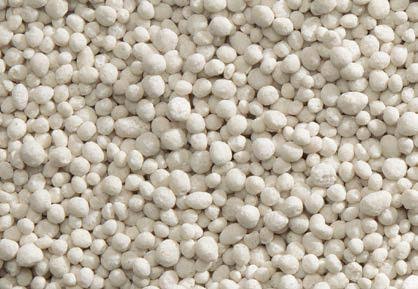
Kieserite fertiliser — water-soluble magnesium and sulphur for plants
Kieserite is naturally occurring magnesium sulphate monohydrate (MgSO₄·H₂O), a mined mineral supplying 25% MgO and 50% SO₃ in the sulphate form plant roots absorb directly. It is fully water-soluble at around 393 g per litre, so the magnesium is available to the plant as soon as the granules wet — no waiting on soil acidity, soil bacteria or a pH change to unlock it. That is the difference that matters, because the cheap alternatives are barely soluble at all. Dr Forest supplies it as a single-ingredient granule: one mineral, nothing blended in, nothing added.
This is a garden fertiliser for plants and soil. It is not a human supplement, not a bath salt, and not food grade. Do not ingest. If you want a magnesium supplement or Epsom bathing salts, this is the wrong product.
Against Epsom salts the difference is concentration and format, not speed. Both are soluble sulphates and both act fast. Kieserite is the monohydrate at 15% magnesium; Epsom salt is the heptahydrate at 9.8%, so you carry and spread noticeably less product for the same dose. Kieserite comes as a granule you broadcast over soil, where Epsom salt is a fine crystal that suits being dissolved and sprayed. Use Epsom on the leaf, kieserite on the ground.
What gardeners use kieserite for
- Interveinal yellowing — yellow between the veins on older, lower leaves while the veins stay green. The signature magnesium deficiency in tomatoes, roses, apples and vines.
- Tomatoes in growing bags and borders — heavy potash feeding suppresses magnesium uptake. Kieserite restores the balance without adding more potassium.
- Potatoes — one of the most magnesium-hungry crops on the allotment, and among the first to show it in the haulm.
- Roses and flowering shrubs — magnesium sits at the centre of every chlorophyll molecule, so leaf colour and flower quality both depend on it.
- Top fruit and soft fruit — apples, pears, currants and raspberries on light soils lose magnesium to leaching over winter.
- Ericaceous plants — rhododendron, camellia, azalea and blueberry need magnesium but cannot take dolomitic lime, which would push the pH up.
- Lawns — magnesium deepens the green without forcing the soft, disease-prone growth a nitrogen-only feed gives you.
- Sulphur correction — UK soils have received far less atmospheric sulphur since coal burning declined. Brassicas, onions and leeks notice.
- Over-limed beds — excess calcium suppresses magnesium uptake. Kieserite corrects it without raising pH further.
- No-dig beds — broadcast over the mulch and water in. No cultivation needed.
Kieserite compared with the alternatives
Kieserite granules — soluble sulphate, soil-applied
- 15% magnesium, half as much again per kilo as Epsom salt
- 393 g/L soluble, so the magnesium is available as soon as it wets
- Works at any soil pH, including ericaceous beds and acid-loving fruit
- Carries 20% sulphur alongside the magnesium
Epsom salts — soluble sulphate, foliar-first
- 9.8% magnesium, so you spread more product for the same dose
- 710 g/L soluble — also fast, and better suited to a spray tank
- Fine crystal rather than a granule, so it spreads less evenly on soil
- The right tool for a foliar correction on a plant already yellowing
Magnesium oxide and dolomitic lime — barely soluble
- Magnesium oxide dissolves at 0.006 g/L, dolomite little better
- Releases only as soil acid attacks it, so it stalls at pH 7 and above
- Dolomite raises pH, ruling it out on blueberries, azaleas and camellias
- Months to respond, and often no response at all on alkaline ground
Typical analysis
| Parameter | Value |
|---|---|
| Magnesium oxide (MgO) | 25% |
| Magnesium (elemental Mg) | 15% |
| Sulphur trioxide (SO₃) | 50% |
| Sulphur (elemental S) | 20% |
| Chloride | Nil |
| Solubility in water | Approx. 393 g/L — fully soluble |
| pH in solution | Approx. 7.0 (neutral) |
| Form | Granular, magnesium sulphate monohydrate MgSO₄·H₂O |
| Ingredients | Kieserite. Nothing else. |
One ingredient, screened and graded, nothing added. Safe around children, pets and bees once watered in. Made by Growers. Backed by Science.
Why magnesium is the nutrient most UK gardens are quietly short of
The chlorophyll problem
Every chlorophyll molecule holds a single magnesium ion at its centre. Between 15 and 35% of the magnesium in a leaf is committed to chlorophyll; the rest activates enzymes and stabilises ribosomes in the cytoplasm (Marschner, 2012). When supply runs short, the plant strips magnesium out of its oldest leaves and moves it to the growing tip. That is why deficiency shows as yellowing between the veins on the lower leaves first while new growth still looks healthy.
The damage starts before the yellowing does. Cakmak and Kirkby (2008) showed that magnesium shortage blocks sugar export from the leaf well before any visible symptom appears. Sugars accumulate, photosynthesis backs up, and surplus light energy generates reactive oxygen species that bleach the tissue. A plant can be losing yield for weeks while still looking green.
How magnesium behaves in soil
Magnesium is a divalent cation held on clay and organic matter, but it binds more weakly than calcium and carries a larger hydration shell, so it sits further from the exchange surface. Gransee and Führs (2013) identify this as the reason magnesium leaches more readily than any other major cation. On sandy or free-draining ground, a wet UK winter strips a meaningful fraction of exchangeable magnesium out of the root zone.
Uptake is competitive too. Potassium, calcium and ammonium all compete with magnesium at the root surface, and high concentrations of any of them suppress it (Senbayram et al., 2015). This is the trap most tomato growers fall into: a summer of high-potash liquid feed drives magnesium deficiency in a soil that has plenty of magnesium in it.
Mechanisms of action
Chlorophyll assembly
Magnesium chelatase inserts magnesium into the protoporphyrin ring, the committed step of chlorophyll biosynthesis. Without enough magnesium the pathway stalls and the leaf cannot build the pigment, no matter how much nitrogen is available.
Phloem loading and sugar export
Sucrose export runs on a proton gradient maintained by magnesium-activated H⁺-ATPase. Cakmak and Kirkby (2008) showed magnesium-deficient plants accumulating carbohydrate in the source leaf while roots and fruit are starved. Roots shrink first, which then worsens uptake of everything else.
Enzyme activation and ATP
ATP is biologically active as the Mg-ATP complex. Every kinase, every phosphatase, every ATP-spending step of the Calvin cycle needs magnesium as the counter-ion. Tränkner et al. (2018) place magnesium alongside potassium as a co-limiting factor for photosynthetic efficiency for exactly this reason.
Photoprotection
A leaf that cannot export sugar still absorbs light. The surplus energy produces reactive oxygen species, and magnesium-deficient leaves are markedly more prone to photooxidative damage in high light. Greenhouse tomatoes and south-facing rose beds show symptoms first in a bright summer.
Sulphate for protein synthesis
The 20% sulphur arrives already as sulphate, the form roots absorb. Sulphur builds cysteine and methionine, and sits at the heart of the glucosinolates that give brassicas and alliums their flavour and pungency. Guo et al. (2016) note that magnesium and sulphur deficiency now frequently occur together in intensively cropped soils.
Solubility decides everything
Only water-soluble magnesium can be absorbed directly by the root. Kieserite dissolves at roughly 393 g/L; magnesium oxide manages 0.006 g/L and magnesium carbonate 0.106 g/L. That is a gap of four to five orders of magnitude, and it is why a bag of magnesium oxide can sit in a neutral soil for a season and do almost nothing.
Kieserite against magnesium oxide
Orlovius and McHoul (2015) compared kieserite with magnesium oxide on potato and sugar beet across multiple sites. Kieserite gave consistently higher leaf magnesium concentrations, because sulphate magnesium is available to the plant straight away while oxide and carbonate forms depend on soil acidity to release them. On neutral or alkaline ground the oxide barely moves at all.
| Magnesium source | Compound | Solubility in water |
|---|---|---|
| Epsom salt | MgSO₄·7H₂O | 710 g/L |
| Kieserite | MgSO₄·H₂O | 393 g/L |
| Magnesium carbonate | MgCO₃ | 0.106 g/L |
| Magnesium hydroxide | Mg(OH)₂ | 0.009 g/L |
| Magnesium oxide | MgO | 0.006 g/L |
Both sulphates are fast. Everything below them on that table is effectively locked up until the soil is acid enough to dissolve it, which is why a magnesium problem on a chalky or limed garden does not respond to dolomite at all.
Where magnesium fits with calcium
Magnesium and calcium compete, so correcting one without thinking about the other creates the opposite problem. On a heavy soil that needs both, pair kieserite with granulated gypsum — calcium sulphate supplies calcium and sulphur without shifting pH, which lets you lift both cations while keeping the ratio sane. The historic 5:1 calcium-to-magnesium "ideal ratio" from the Albrecht school has not held up: Kopittke and Menzies (2007) reviewed the evidence and found no consistent yield benefit from targeting a fixed ratio. Feed to the deficiency, not to a ratio.
Scientific references
- Cakmak, I. & Kirkby, E.A. (2008). Role of magnesium in carbon partitioning and alleviating photooxidative damage. Physiologia Plantarum, 133(4), 692–704.
- Gransee, A. & Führs, H. (2013). Magnesium mobility in soils as a challenge for soil and plant analysis, magnesium fertilization and root uptake under adverse growth conditions. Plant and Soil, 368, 5–21.
- Senbayram, M., Gransee, A., Wahle, V. & Thiel, H. (2015). Role of magnesium fertilisers in agriculture: plant–soil continuum. Crop and Pasture Science, 66(12), 1219–1229.
- Guo, W., Nazim, H., Liang, Z. & Yang, D. (2016). Magnesium deficiency in plants: an urgent problem. The Crop Journal, 4(2), 83–91.
- Tränkner, M., Tavakol, E. & Jákli, B. (2018). Functioning of potassium and magnesium in photosynthesis, photosynthate translocation and photoprotection. Physiologia Plantarum, 163(3), 414–431.
- Hermans, C. & Verbruggen, N. (2005). Physiological characterization of Mg deficiency in Arabidopsis thaliana. Journal of Experimental Botany, 56(418), 2153–2161.
- Grzebisz, W. (2013). Crop response to magnesium fertilization as affected by nitrogen supply. Plant and Soil, 368, 23–39.
- Orlovius, K. & McHoul, J. (2015). Effect of two magnesium fertilizers on leaf magnesium concentration, yield, and quality of potato and sugar beet. Journal of Plant Nutrition, 38(13), 2044–2054.
- Kopittke, P.M. & Menzies, N.W. (2007). A review of the use of the basic cation saturation ratio and the "ideal" soil. Soil Science Society of America Journal, 71(2), 259–265.
- Dadebo, M.M., Tan, Q., Wu, S., Sun, X., Li, M., Hashem, I.A. & Hu, C. (2026). Foliar magnesium application enhances fruit external and interior quality and nitrogen use efficiency of tomato under high nitrogen supply. Agronomy, 16(13), 1218.
- Bai, R., Liu, H., Liu, Y. & Yong, J.W.H. (2024). Effects of foliar application of magnesium fertilizer on photosynthesis and growth in grapes. Agronomy, 14(11), 2659.
- Shaddox, T. & Munshaw, G. (2019). Magnesium for Kentucky turfgrasses. University of Kentucky Cooperative Extension Service, AGR-243.
- Marschner, P. (ed.) (2012). Marschner's Mineral Nutrition of Higher Plants, 3rd edition. Academic Press, London.
How to use kieserite — directions for use by crop
A level tablespoon holds roughly 15 g, a level teaspoon about 5 g. Kieserite needs soil moisture to dissolve, so scatter it on damp ground and water it in, or apply just before rain. Broadcast onto bone-dry soil in July it will sit on the surface doing nothing until the weather breaks.
Magnesium competes with calcium and potassium at the root. Overloading a soil with magnesium suppresses calcium uptake, which brings blossom end rot in tomatoes and bitter pit in apples, and it degrades the crumb structure of clay soils. Do not exceed 30 g per square metre in a season, and skip the application entirely if a soil test shows a Magnesium Index of 3 or above. If leaves are yellow but the veins are yellow too, the problem is nitrogen or iron, not magnesium.
Application rates by crop
Tomatoes, peppers and aubergines
The classic case. A summer of high-potash tomato feed suppresses magnesium uptake and the lower leaves yellow between the veins by midsummer. Work 20 g/m² into border soil before planting, then scatter a second 10 g/m² and water it in as the first truss sets. In pots and growing bags, mix 3–5 g per 10 litres of compost before planting.
Potatoes
Potatoes remove more magnesium than almost anything else on the plot, and the haulm shows it early: interveinal yellowing on lower leaves spreading upward as tubers bulk. Scatter along the trench and cover. Use the upper end of the range on light sandy soils.
Rate scaled from field trials on potato and sugar beet, Orlovius & McHoul (2015), J. Plant Nutrition 38(13): 2044–2054.Roses and flowering shrubs
Apply in March as growth breaks, spread across the root zone rather than at the stem, and water in. A second dose after the first flush carries colour through the later blooms. Roses on chalk or heavily limed beds respond particularly well, because the excess calcium has been suppressing magnesium uptake.
Apples, pears and top fruit
Spread evenly under the canopy out to the drip line, never in a ring at the trunk. Magnesium deficiency in apples shows as interveinal yellowing followed by early leaf drop from the base of the shoot, and it is worse in a heavy cropping year. Repeat annually on sandy orchard soils.
Strawberries, raspberries and currants
Soft fruit on light soil loses magnesium over winter. Apply along the row in March and water in. For strawberries, apply after cutting back old foliage rather than during fruiting. Blackcurrants are especially prone and benefit from the sulphur as well.
Brassicas, onions and leeks
This group is fed as much for the sulphur as the magnesium. Sulphur builds the compounds responsible for flavour and pungency in cabbage, sprouts, onions and leeks. Rake into the top 10 cm of the bed a week or two before transplanting.
Grapes and vines
Magnesium deficiency in vines is common and unmistakable: yellowing between the veins on basal leaves, often with a reddish margin on dark varieties, worsening as bunches fill. Apply around the base out to the spread of the canopy and water in well.
Rhododendron, camellia, azalea and blueberry
These plants need magnesium but cannot tolerate the pH lift from dolomitic lime, which makes kieserite the sensible route for ericaceous beds. Scatter over the mulch, water in, and top the mulch back up.
Lawns — dry granules
Magnesium deepens turf colour without forcing the lush, soft growth a straight nitrogen feed produces. Apply to damp grass on a still day, water in properly, and leave the mower for two or three days. Granules left sitting dry on turf in sun can mark the leaf. Useful on sandy lawns that have been sanded and top-dressed repeatedly, where magnesium leaches out fastest. Turf research puts the useful range at 0.5–1 lb magnesium per 1,000 sq ft, which works out at 16–32 g/m² of kieserite; stay at the lower end unless a soil test has confirmed a shortage, and never exceed 30 g/m² in a season.
Shaddox & Munshaw (2019), Magnesium for Kentucky turfgrasses, University of Kentucky Cooperative Extension AGR-243.Lawns — liquid feed
Liquid suits turf better than most things, because you cannot rake granules into an established lawn and anything left on the surface has to wait for rain. Dissolve, strain, and apply through a watering can with a fine rose or a hose-end feeder, then water the lawn afterwards to move it off the leaf and into the root zone.
The light top-up delivers about 3 g/m² a pass and matches the foliar rate in the turf literature. Published turf foliar guidance is written for low-volume professional sprayers and works out near 79 g/L, which will scorch a domestic lawn applied through a can — the rates here deliver the same magnesium per square metre at a concentration turf tolerates. Do not go above 13 g/L on grass.
Converted from Shaddox & Munshaw (2019), AGR-243 — foliar 0.1 lb Mg per 1,000 sq ft.The product that turns a lawn dark green within days and blackens moss is iron sulphate, not magnesium sulphate. They are different minerals doing different jobs, and they are constantly confused. Magnesium builds chlorophyll over three to six weeks and does nothing to moss. If your lawn is pale because it is short of magnesium — older leaves yellowing between the veins, worst on sand, worst after a hard winter — kieserite is the right answer. If you want an instant colour hit or you are fighting moss, buy iron and leave this on the shelf.
Worth testing before you treat. Turf guidance says apply magnesium when a soil test reads at or below 20 ppm; in UK terms that is Magnesium Index 0 or 1. Lawns that have been limed recently, or fed heavily on autumn potash, are the likeliest to be genuinely short, because calcium and potassium both displace magnesium from the soil's exchange sites.
Conifers and evergreen hedging
Bronzing and yellowing of older needles on the inside of the plant is a classic magnesium picture in conifer hedging, particularly on hedges that have never been fed. Apply along both sides of the hedge line out to the spread of the branches.
General soil correction — beds, borders and no-dig plots
At Magnesium Index 0 or 1, use 25 g/m². At Index 2, use 15 g/m² as maintenance. At Index 3 or above, do not apply. On sandy soils an annual application is normal; on heavy clay every second or third year is usually enough. For no-dig beds, broadcast over the mulch and water in — no cultivation needed.
Using kieserite as a liquid feed
The granules are made for broadcasting, but the mineral itself is fully soluble, so you can dissolve it and water it on or spray it. Two things to understand before you do.
First, dissolving takes time. A 2–5mm granule in cold, still water needs two to four hours to go into solution. That is granule size and surface area, not low solubility — kieserite saturates at around 393 g per litre, and the 13 g/L foliar rate below is barely 3% of that. Warm water and a stir at the start and end cut the time considerably.
Second, this is mined rock rather than a refined laboratory salt, so a little insoluble grit is normal. Let the solution stand, then decant the clear liquid or strain it through muslin before it goes anywhere near a sprayer.
Magnesium sulphate solution plus any soluble calcium — gypsum, calcium nitrate, an amino-chelated calcium — precipitates calcium sulphate on the spot. Calcium sulphate dissolves at roughly 2.4 g per litre against kieserite's 393, so it drops out as a white sludge that blocks nozzles and takes both nutrients out of solution with it. Mix and apply them separately. Applied to soil on different days they work together perfectly well; in the same tank they cancel each other out.
How to make it up
- Weigh into a bucket. Work out the total volume you need first, then the weight from the rate cards below. A level tablespoon is roughly 15 g.
- Start with warm water. Add about a third of the final volume, hand-warm rather than hot, and stir hard for a minute.
- Leave it two to four hours. Cover it and walk away. Stir again when you come back — the last of the granules go quickly once the water is saturated near the bottom.
- Top up to volume and settle. Add the remaining cold water, then leave it twenty minutes for any grit to drop out.
- Decant or strain. Pour off the clear liquid, or strain through muslin. Essential for a sprayer, optional for a watering can. Use it within a day or two.
Working out the rate
Most published magnesium spray guidance is written for Epsom salt. Kieserite carries about half as much magnesium again per gram, so use roughly two-thirds the Epsom weight for the same dose.
| Published Epsom rate | Epsom | Magnesium delivered | Kieserite equivalent |
|---|---|---|---|
| 0.5% solution | 5 g/L | 0.49 g Mg/L | 3 g/L |
| 1% solution | 10 g/L | 0.99 g Mg/L | 6.5 g/L |
| 2% solution (standard horticultural foliar) | 20 g/L | 1.97 g Mg/L | 13 g/L |
| 5% solution (field-scale, not for gardens) | 50 g/L | 4.93 g Mg/L | 33 g/L |
Foliar spray — general correction
Two per cent Epsom solution is the long-standing horticultural foliar rate, and 13 g/L of kieserite matches it. Start at 6.5 g/L on anything you have not sprayed before and test a few leaves first. Spray early morning or evening, never in strong sun, and wet the undersides as well as the tops — most magnesium goes in through the lower leaf surface.
2% w/v magnesium sulphate, three applications: Dadebo et al. (2026), Agronomy 16(13): 1218.Foliar spray — tomatoes and peppers
The tomato trial behind this rate applied 2% magnesium sulphate three times during vegetative growth and recorded gains in fruit yield, vitamin C, titratable acidity and colour alongside better nitrogen use. Useful as a rescue on plants already yellowing between the veins, where the soil correction will take too long to save the current crop.
Dadebo et al. (2026), Agronomy 16(13): 1218.Foliar spray — apples, pears and top fruit
Tree fruit guidance puts Epsom at 2 kg per 100 litres, which is the same 2% solution. Start once the leaves are properly developed or at petal fall, and repeat where symptoms are already showing. Soil correction still does the long-term work; the spray buys you this season's crop.
BC Tree Fruit Production Guide, magnesium section — 2 kg magnesium sulphate per 100 L.Foliar spray — grapes and vines
Go far lighter here than anywhere else. The vine trial that measured this found the response peaked at 2.14 mM and fell away above it — the equivalent of about 0.35 g of kieserite per litre. Spraying vines at the tomato rate during fruit fill overshoots the optimum rather than improving on it. Late afternoon on a dry day.
Bai, Liu, Liu & Yong (2024), Agronomy 14(11): 2659 — optimum 2.14 mM MgSO₄·7H₂O.Soil drench — beds and borders
This is the dry soil rate delivered in water rather than a different dose. Four grams per litre over five litres per square metre puts down 20 g/m², exactly the general bed rate. Use it where you want the magnesium down at root depth immediately, or on a no-dig bed where you would rather not have granules sitting on the mulch. The seasonal ceiling of 30 g/m² is the same whichever way you apply it.
Soil drench — pots, containers and growing bags
Water it on in place of one normal watering, enough to wet the whole rootball and just start to run from the base. One gram per litre monthly through a season lands close to the 3–5 g per 10 litres you would have mixed into the compost at potting. Skip it if the feed you are already using declares magnesium.
A litre of solution is a delivery method, not an extra dose. Whatever goes on as liquid counts towards the same 30 g per square metre seasonal ceiling as the dry granules, and the same rule applies about not applying at all above Magnesium Index 3. Foliar sprays are the one exception worth noting — they bypass the soil entirely, so they correct the plant without loading the ground, which is exactly why they suit a mid-season rescue.
Step-by-step application
- Check the symptom first. Magnesium deficiency yellows the tissue between the veins while the veins stay green, and it starts on the oldest leaves. If the whole leaf is pale, or new growth is affected first, look at nitrogen or iron instead. Our guide to yellow leaves on tomato plants walks through the patterns.
- Weigh it rather than guessing. Twenty grams per square metre is roughly a heaped tablespoon — far less than most people scatter by eye.
- Spread evenly on moist soil. Broadcast across the whole root zone. Never pile it against stems or trunks.
- Water it in. Five to ten litres per square metre, or apply just before forecast rain. This is what starts the dissolution.
- Reassess on the new growth. Leaves already damaged will not re-green, because magnesium moves out of them and does not come back. Judge the result on leaves that emerge afterwards, three to six weeks on.
Five common mistakes
- Applying it dry and walking away — without water the granules do nothing.
- Expecting old leaves to recover — they will not. The plant has already withdrawn their magnesium.
- Tipping dry granules into a sprayer — they need two to four hours in water first, and straining afterwards. Dissolve properly and the solution sprays fine; skip that step and you block the nozzle. See the liquid feed section above, and our take on when a magnesium spray helps in Epsom salt for roses: does it actually work?
- Mixing it with a calcium feed in one tank — you get calcium sulphate sludge and lose both nutrients.
- Adding magnesium to an already magnesium-rich clay — many UK clays are. Test before correcting.
- Assuming any yellow leaf means magnesium — overwatering, nitrogen shortage and iron chlorosis each yellow foliage in a different pattern.
Granulated Gypsum is the natural partner. Kieserite supplies magnesium and sulphur; gypsum supplies calcium and sulphur. Because magnesium and calcium compete at the root, lifting one without the other tends to create the deficiency you have just corrected in reverse. Both are pH neutral and both are granular, so they spread together and suit the same beds — particularly heavy clay, where the gypsum also improves structure. Apply them in the same pass as dry granules, at their own rates, and water in together. What you must not do is dissolve the two into one watering can: sulphate plus calcium precipitates calcium sulphate and you lose both.
Avoid stacking kieserite with dolomitic lime in the same year. Both supply magnesium and you will overshoot.
Keep the bag closed in a dry place, off a concrete floor. Kieserite draws moisture from the air, so an open bag in a damp shed will cake into a block — break it up with a trowel and use it as normal, the analysis is unchanged. Wear gloves if you have sensitive skin, wash hands afterwards, and store out of reach of children and pets as you would any garden fertiliser.


