


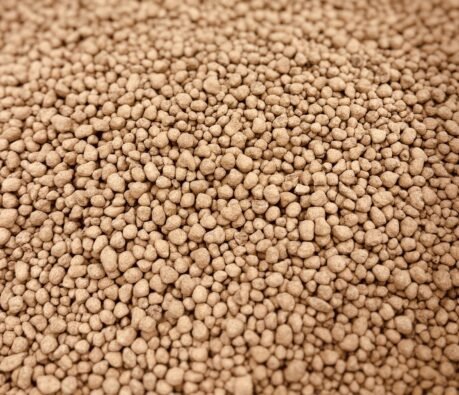
Granulated gypsum for clay soil, lawns and calcium-hungry crops
Granulated gypsum is a naturally mined mineral — calcium sulphate — screened into 2–5mm granules. It feeds plants calcium and sulphur, and it helps break up sticky clay, without changing your soil's pH. The calcium is what does the work on clay. It swaps places with the sodium clinging to the clay particles, and once that happens the particles stop smearing together and start clumping into crumbs. Crumbs are what let water drain away and roots push through.
The analysis is 40% SO₃, 30% CaO and 3% MgO plus trace elements. In plain numbers that is 16% sulphur, 21% calcium and just under 2% magnesium. Magnesium is unusual in a gypsum, so a single granule covers all three of the nutrients that sit just behind N-P-K in importance. This is mined rock, not the gypsum recovered from power station chimneys or recycled out of old plasterboard. The granules spread to 36 metres from a tractor spreader and do not blow about the way a powder does.
Worth knowing: the national fertiliser guide British farmers work from (RB209, published by the AHDB) lists quarried gypsum at 40% SO₃. This sits exactly on the figure British growers already use to work out how much sulphur to put on, so the rates further down translate straight across.
What it does
- Loosens sticky clay. Calcium pushes sodium off the surface of the clay particles, and they clump into crumbs instead of slumping into an airless pan.
- Feeds sulphur in the form roots can use immediately. Plants take sulphur up as sulphate, and that is exactly what gypsum is. Yellow powdered sulphur has to be converted by soil bacteria first, which stalls in cold or dry ground.
- Adds calcium without liming. Lime and shell meal both make soil more alkaline. Gypsum does not, so it is one of the few ways to feed calcium to soil that is already where you want it.
- Keeps phosphorus out of ditches and ponds. In American field trials, two annual applications cut the phosphorus washing off the surface by around 40%.
- Stops the surface crusting over. The hard cap that forms after heavy rain is what traps seedlings underground. Gypsum keeps the top centimetre crumbly enough for them to get through.
- Adds magnesium as well. 3% MgO, which most agricultural gypsums do not carry at all.
Granulated, micronised or liquid?
Granulated gypsum (this product)
- 2–5mm granule, spread-tested to 36m from a tractor-mounted broadcast spreader, with none of the dust of a powder
- Best for whole lawns, beds, allotments, paddocks and field-scale work
- Dissolves progressively with rainfall rather than all at once
- Handles and stores like any granular fertiliser, and mixes straight in with your other dry feeds in the spreader
Micronised gypsum powder
- Dissolves faster, because ground-up powder has far more surface touching the soil
- Better for potting mixes, small containers and precise dosing by the gram
- Dusty in wind; awkward to spread evenly over a large area
Liquid gypsum
- A ready-mixed liquid you put on through a watering can or sprayer
- Fastest to act; useful for spot-treating a patch or an established lawn you don't want to walk a spreader over
- Carries far less material per pound spent, so a poor choice when you need tonnage on the ground
Worth being straight about this: gypsum does not work on every clay. It works where the clay has gone slumped — where sodium has pushed the calcium off the particles and the soil has collapsed into a greasy mud that sets hard. Plenty of British clay is simply heavy rather than slumped, and on that sort of ground gypsum does far less. The RHS puts it carefully: "Some, but not all, clay soils respond to extra calcium." Our advice is theirs — do a marked patch first and look at it after a winter. A quick test: if your soil crumbles when you squeeze a moist handful, it is not slumped, and compost will do more for it than gypsum.
Bagged and dispatched from Stockport, Greater Manchester. A mined mineral, carrying no animal by-products — here or anywhere else in the Dr Forest range. Safe around children, pets, bees and wildlife once watered in.
The science
Gypsum is one of the better-studied soil amendments and one of the most oversold. Here is what the evidence actually shows, and where it runs out. If you only want to know how much to put down, skip to the next two tabs.
What is actually in it
Calcium sulphate comes in two forms: one with water locked into the crystal, one without. The chemistry puts a hard ceiling on how much calcium and sulphur any gypsum can possibly contain, which makes the table below a useful lie-detector for label claims.
| Anhydrite (no water) | Gypsum (water in the crystal) | |
|---|---|---|
| Calcium (Ca) | 29.44% | 23.28% |
| Sulphur (S) | 23.55% | 18.62% |
| as SO₃ | 58.81% | 46.50% |
| as CaO | 41.19% | 32.57% |
| Water locked in the crystal | 0% | 20.93% |
So any product claiming more than 29.44% calcium or 58.81% SO₃ is either measuring it a different way, printing CaO where it means Ca, or is not what it says on the bag. To convert between the two ways of writing it: sulphur × 2.5 gives SO₃, and calcium × 1.4 gives CaO.
Gypsum dissolves at about 2.5 grams per litre of water, roughly 200 times more readily than ground limestone. That is why it acts in weeks rather than years. A 2–5mm granule has far less surface touching the soil than a powder, so it releases more slowly and keeps going for longer.
Why it will not change your pH
Lime raises pH because the carbonate in it mops up acid. Gypsum contains no carbonate at all — it splits into calcium and sulphate, and sulphate cannot mop up anything. So the calcium gets on with its job while the pH stays exactly where it was. The trade term for this is a neutralising value of zero, and it is the single most useful thing about gypsum.
The field data agree. Chaganti and colleagues found no pH change at either rate they tested (Agronomy Journal, 2019). Anderson and colleagues found no pH rise on acid Australian soils (Agronomy, 2021). Where any shift shows up at all it is slightly downward, a tenth to three tenths of a point. That is why gypsum is the calcium you reach for on blueberries, rhododendrons and camellias — anything where you have spent years getting the soil acid and would rather not undo it.
How calcium unsticks clay
Clay particles are microscopic flat plates with a negative charge on the surface, and something has to balance that charge. What balances it makes all the difference. Sodium holds the plates apart, so they slide over each other like wet playing cards — that is the greasy, structureless mud that dries into a pan you could pave a drive with. Calcium has twice the charge in a smaller package, and it lets the plates pull together into crumbs. Crumbs stack up, and the gaps between them are the drainage, the air and the room for roots.
There is a second half to it, and it is the part most explanations leave out. Quirk and Schofield showed back in 1955 that soil stops draining once the water sitting in it becomes too pure — clean rainwater falling on a sodium-heavy clay is the worst case there is. Gypsum dissolving into that water fixes the problem straight away, holding the structure together while the slower calcium-for-sodium swap gets on with the real work. The more sodium a soil is carrying, the more dissolved calcium it needs: roughly nine times more on badly affected ground than on clean ground.
Research findings
Rain soaked in twice as fast
On soils prone to crusting, gypsum at 5 tonnes per hectare under simulated heavy rain roughly doubled the rate water soaked in, and cut the amount of soil washed off the surface by 30–50%. Miller, Soil Science Society of America Journal 51:1314–1320, 1987. The trial used phosphogypsum, an industrial by-product that dissolves faster than mined rock, so expect the same effect from mined gypsum spread over a longer period (Keren and Shainberg, 1981).
Looser soil, water reaching deeper
The soil went from tightly packed to noticeably looser, water penetrated 27cm instead of 17cm, and it kept soaking in for 158 minutes instead of 102. Air space in the soil rose by 3.7%. Luo et al., Agronomy 15:35, 2025. Read with the caveat attached: this was phosphogypsum on a Chinese salt-affected soil, and you should not assume it carries straight across to a British garden.
Still working twenty-six years later
One application, measured again more than a quarter of a century on: sodium was still down, most noticeably between 25cm and a metre deep, and calcium had worked its way to 1.25 metres. Gypsum is slow, but it is not temporary. Green et al., Soil and Tillage Research 233:105780, 2023.
Crumb structure survived the frosts
Freezing and thawing is what smashes soil crumbs apart over a British winter. Calcium sulphate at just 0.2% by weight kept crumbs measurably more stable through freeze–thaw across six different soils. Lime, tested alongside, made almost no difference. Lehrsch, Sojka & Jolley, CATENA Supplement 24:115–127, 1993.
Phosphorus stayed in the field instead of the stream
On ground testing very high for phosphorus, two annual applications at 2.24 tonnes per hectare cut the phosphorus washing off the surface by about 40%. King, Williams, Dick & LaBarge, Journal of Environmental Quality 45:1722–1730, 2016. This trial used gypsum recovered from power station flue gas rather than mined rock.
The same result on clay, in a wet climate
Finland is the closest published match to British conditions — clay soil, plenty of rain. Gypsum at 4 tonnes per hectare across 91% of the farmland in a small river catchment cut phosphorus washing off the land by 57–64%, depending on which analysis you read, and the benefit ran four to five years. Ekholm et al., Agricultural and Food Science 21(3), 2012.
A quarter more cauliflower
Gypsum at 4 tonnes per hectare raised cauliflower yield by 25%, and sulphur treatments raised broccoli by up to 14%. The same trial recorded a small downward pH shift under gypsum, and an upward one under lime. Acta Horticulturae 627:22.
The sulphur reached the plants, quickly
Sulphur in the soil rose three- to eightfold after gypsum, and the sulphur measured in the leaves of the crop rose between 15% and 97% depending on the site. Chaganti, Culman, Dick & Kost, Agronomy Journal 111:1109–1117, 2019.
Why British soils ran out of sulphur
For most of the industrial era, British crops were fertilised with sulphur by accident. Coal smoke put it there. Then the Clean Air Acts cleaned up the smoke, power stations were fitted with scrubbers, and coal generation ended altogether. The free sulphur went with it, and nobody replaced it.
| Measure | Figure |
|---|---|
| UK SO₂ emissions, 1990 | 3,744 kilotonnes |
| UK SO₂ emissions, 2024 | 84 kilotonnes — the lowest on record, a 98% fall |
| Phasing of the decline | −9% 1970–1991 · −83% 1991–2005 · −99% 2005–2022 |
| Sulphur deposited on farmland, 1996 | 5–25 kg S/ha/yr |
| Projected by 2010 | 5–10 kg S/ha/yr |
| Plant-available soil S worldwide, 2000–2020 | Down 34–86% |
Sulphur is what plants build protein with, and it is the element behind flavour in a whole category of crops. The compounds that make cabbage taste of cabbage, mustard taste hot and an onion make you cry are all sulphur compounds. A plant short of sulphur cannot use its nitrogen properly either, so the nitrogen you paid for washes away instead of going into growth.
British trial data are specific about this. The levy board that funds farming research monitored four crops across England and Wales and found worthwhile yield increases from sulphur in 32% of oilseed rape trials, 15% of spring barley, 13% of winter barley and 10% of winter wheat. Light, sandy ground responded more than twice as often as heavy ground did. The biggest single result was an 81% yield increase in oilseed rape on light soil.
Rothamsted's work on malting barley found worthwhile responses in five trials out of eight. The sites that responded had markedly less sulphur in the soil than the ones that did not, and a simple lab test — the ratio of nitrogen to sulphur in the grain — told the two groups apart every time. That test is still the most reliable way to know whether you have a problem.
Look at which leaves are going yellow. Sulphur shortage shows on the youngest growth; nitrogen shortage shows on the oldest. The reason is simple: a plant can pull nitrogen back out of its old leaves to feed new growth, but it cannot do that with sulphur, so the newest leaves are the ones that go pale. A leaf analysis measuring the nitrogen-to-sulphur ratio will confirm it if you want certainty.
Where gypsum does not help
A page that only lists benefits will disappoint somebody. Here is where gypsum genuinely does not deliver, and the evidence is solid on all of it.
It does not fix compaction
- Gypsum changes soil chemistry, not soil physics. In American trials on ordinary soil it made no measurable difference to how hard the ground was to push a probe through.
- Compaction from machinery, footfall or waterlogging needs aeration, deep-rooting cover crops or a fork.
It does not reliably fix blossom end rot
- It is a watering problem far more than a calcium problem. Calcium only travels around a plant in the water the roots draw up, and when a fruit is swelling fastest the plant sends that water to the leaves first. The end of the fruit runs short no matter how much calcium is sitting in the soil.
- UC Cooperative Extension: "Adding calcium to the soil rarely alleviates the problem" and "blossom-end rot is primarily a water issue." Consistent watering does more than any amendment.
It does not work on carrot cavity spot
- Cavity spot is caused by Pythium, a soil-borne mould. The AHDB's own guidance states plainly that gypsum will not reduce it. Lime does help, cutting it by a quarter to a half, but that works by shifting the pH rather than by adding calcium.
It does not correct bitter pit in apples by itself
- Torres and colleagues (Frontiers in Plant Science 15:1383645, 2024) conclude that the calcium shortage in a bitter-pitted apple "is minimally corrected through improved Ca fertilization" — put plainly, adding calcium to the soil barely touches it. The balance between potassium, magnesium and calcium inside the fruit predicts bitter pit better than the amount of calcium does.
It will not "balance" your soil
- The idea that soil needs a fixed ratio of calcium to magnesium to potassium — sold as cation balancing, or the Albrecht method — has not survived testing. Kopittke and Menzies (Soil Science Society of America Journal 71:259–265, 2007) found soil fertility cannot be pinned to nutrient ratios at all, and that the original experiments failed to allow for pH.
- Yields were unaffected across calcium-to-magnesium ratios running from 0.25:1 all the way to 31:1. Within any sensible range, the ratio simply does not matter.
At 20 tonnes per hectare — roughly ten times any garden rate — gypsum halved earthworm numbers and cut their total weight by two thirds over five months (Chen et al., Journal of Environmental Quality 43:263–272, 2014). Heavy rates on soil that is not acid can also strip out potassium and magnesium, because the sulphate pairs up with magnesium and washes it away as Epsom salt. Stay inside the rates on the next tab and none of this applies.
References
- Quirk, J.P. & Schofield, R.K. (1955) The effect of electrolyte concentration on soil permeability. Journal of Soil Science 6:163–178.
- Miller, W.P. (1987) Infiltration and soil loss of three gypsum-amended Ultisols under simulated rainfall. Soil Science Society of America Journal 51(5):1314–1320.
- Lehrsch, G.A., Sojka, R.E. & Jolley, P.M. (1993) Freezing effects on aggregate stability of soils amended with lime and gypsum. CATENA Supplement 24:115–127.
- Keren, R. & Shainberg, I. (1981) Effect of dissolution rate on the efficiency of industrial and mined gypsum in improving infiltration of a sodic soil. Soil Science Society of America Journal 45.
- Oster, J.D. (1982) Gypsum usage in irrigated agriculture: a review. Fertilizer Research 3(1):73–89.
- Campbell, G.W. & Smith, R.I. (1996) Spatial and temporal trends in atmospheric sulphur deposition to agricultural surfaces in the United Kingdom. International Fertiliser Society Proceeding 378.
- Kopittke, P.M. & Menzies, N.W. (2007) A review of the use of the basic cation saturation ratio and the "ideal" soil. Soil Science Society of America Journal 71:259–265.
- Chen, L., Kost, D., Tian, Y. et al. (2014) Effects of gypsum on trace metals in soils and earthworms. Journal of Environmental Quality 43:263–272.
- King, K.W., Williams, M.R., Dick, W.A. & LaBarge, G.A. (2016) Decreasing phosphorus loss in tile-drained landscapes using flue gas desulfurization gypsum. Journal of Environmental Quality 45(5):1722–1730.
- Ekholm, P. et al. (2012) Gypsum amendment of soils reduces phosphorus losses in an agricultural catchment. Agricultural and Food Science 21(3).
- Chaganti, V.N., Culman, S.W., Dick, W.A. & Kost, D. (2019) Agronomy Journal 111(3):1109–1117. DOI 10.2134/agronj2018.10.0683.
- Anderson, G.C., Pathan, S., Hall, D.J.M. et al. (2021) Agronomy 11(5):826. DOI 10.3390/agronomy11050826.
- Green, H., Larsen, P., Koci, J. et al. (2023) Long-term effects of gypsum on the chemistry of sodic soils. Soil and Tillage Research 233:105780.
- Torres, E., Kalcsits, L. & Nieto, L.G. (2024) Is calcium deficiency the real cause of bitter pit? A review. Frontiers in Plant Science 15:1383645.
- Luo, A., Li, J., Xiao, Y., He, Z. & Liang, J. (2025) Agronomy 15:35. DOI 10.3390/agronomy15010035.
- Chen, L. & Dick, W.A. (2011) Gypsum as an Agricultural Amendment: General Use Guidelines. Ohio State University Extension Bulletin 945.
- AHDB, Nutrient Management Guide (RB209), Sections 3–7, 2020–2023 editions.
- Defra (2026) Emissions of air pollutants in the UK — Sulphur dioxide.
- AHDB projects PR374 (Carver) and PR369 (Zhao, Rothamsted Research), sulphur monitoring and malting barley.
How to use granulated gypsum
A rounded tablespoon holds roughly 20g of granules and a standard 250ml cup roughly 300g. At the general soil-conditioning rate of 200 g/m², a 1.5kg bag covers about 7.5 m², 4kg covers 20 m², 9kg covers 45 m², 15kg covers 75 m² and 30kg covers 150 m². At the 50 g/m² lawn maintenance rate those same bags cover 30, 80, 180, 300 and 600 m². On a lawn there is no need to rake them in; they work their way down through the grass on their own.
Two very different jobs, two very different rates
This trips people up, so it is worth being blunt about it. Gypsum is used at one order of magnitude to feed a crop sulphur and calcium, and at another to change the structure of a soil.
| Purpose | Product rate | Delivers |
|---|---|---|
| Sulphur nutrition (most vegetables, potatoes, peas) | 6–7 g/m² | 25 kg SO₃/ha |
| Sulphur nutrition (vegetable brassicas, oilseed rape) | 12.5–18.8 g/m², up to 20 g/m² for oilseed rape | 50–80 kg SO₃/ha |
| Lawn maintenance | 50–100 g/m² | 0.5–1 t/ha |
| General soil conditioning | 200 g/m² | 2 t/ha |
| Heavy clay improvement | 400–600 g/m² | 4–6 t/ha |
| Digging into a new lawn or bed before planting | 500 g/m² | 5 t/ha |
If you apply 200 g/m² for structure, you have also applied 800 kg SO₃/ha — vastly more sulphur than any crop needs in a season. That is fine as a one-off, because the surplus simply washes through over the winter. It is not fine every year on the same ground.
Directions by application
New beds and borders
Broadcast evenly over the cleared bed and fork into the top 5cm. Water in, or apply before rain is forecast. On very heavy or previously waterlogged ground go to 400 g/m². Leave a month before re-working the soil, and try a marked test patch alongside an untreated strip so you can see whether your particular clay is responding.
Heavy clay improvement
Published UK granular gypsum guidance for clay soils. Spread and incorporate to 10cm where you can; where you cannot dig, apply to the surface and let winter rain carry it down. Expect softer soil within twelve months and the full effect over two to three seasons. Pair with generous compost — organic matter improves clay unconditionally, gypsum only conditionally.
Established lawns
Use a walk-behind spreader set to the right rate, ideally just before rain. Drop spreaders lay a neater stripe; the spinning sort covers ground faster but drifts on a dry windy day. If rain does not turn up within a couple of days, water it in. Ordinary lawns can be done any time the ground is not frozen or sitting under water. Fine, closely-mown turf is happiest treated between late winter and early summer.
Compacted, waterlogged or slow-draining turf
The holes are the whole point — they get the gypsum down where the roots are instead of leaving it sitting on the thatch. Hollow-tine first, sweep up the cores, spread the granules and brush them into the holes with a stiff broom or a drag mat. Be clear about what is doing what: the aeration relieves the compaction, and the calcium then helps the new air spaces survive rather than closing straight back up. On soil that was never slumped in the first place, trials found no measurable change in how compacted it was.
New lawns, before seeding or turfing
This is the one chance you will ever get to work calcium right through the depth of the soil instead of waiting years for rain to carry it down. Rotavate or fork into the top 10–15cm, level, firm, water thoroughly and leave it a week before seeding. On heavy clay it is worth the extra afternoon.
Vegetable plots and allotments
Two jobs, two very different rates — see the table above, and the crop-by-crop list on the next tab. If you are not chasing a specific problem and just want a sensible default, 20 g/m² raked in at planting covers the sulphur needs of almost everything on a plot and adds useful calcium with it.
Containers, raised beds and potting mixes
Roughly 60g in a 60-litre bag of compost, or 600g to 1.2kg per cubic metre. Peat-free and coir composts are often short of calcium, and gypsum is one of the few ways to top it up without pushing the pH up too. Mix it through while the compost is still dry. For raised beds, use the bed rates above instead — the per-litre rate is for containers.
Salt damage — de-icing spray, pet spots, coastal flooding
This is gypsum doing the thing it is genuinely best at — swapping calcium in for salt so the salt can be washed out. Spread it, then water heavily or wait for a proper spell of rain to carry the salt down and away. For ground flooded with seawater, UK guidance is a single dose of 500 g/m² once it has dried out. One caveat worth taking seriously: on ground that drains badly, gypsum without enough water to flush it through can leave roots drier than before, not wetter.
Compost heaps
That sharp ammonia smell off a hot heap is nitrogen escaping into the air. Gypsum grabs it and holds it in the heap as a plant food instead. Trial work on dairy manure halved the nitrogen lost this way. It also firms up the greasy, slumped texture heaps get when they are too wet. This is for an open heap you turn, with air moving through it. Never add gypsum to a sealed or waterlogged manure or slurry store — see the warning below.
Clearing a muddy pond
Muddy pond water is clay hanging in suspension — the same problem as slumped soil, and calcium settles it the same way, by clumping the particles until they are heavy enough to sink. Published rates vary depending on whether they are measured by surface area or by volume of water, so the sensible approach is to start at the low end and give it a few days before adding more. Mix it into a slurry with pond water and spread it about rather than tipping dry granules in one spot. It does not kill fish, does not change the water's pH and does not harm livestock drinking from it.
Applying it, step by step
- Work out which job you are doing. Feeding sulphur and calcium, or changing soil structure? The rates differ by a factor of ten to thirty. Weigh out for the area rather than eyeballing it.
- Test a patch first on clay. Mark out a few square metres, treat it at 400 g/m², leave an untreated strip beside it and compare them after a winter. Some clays respond dramatically and some barely at all, and no soil test predicts which reliably.
- Spread evenly. Broadcast or drop spreader for anything over a few square metres; by hand in two passes at right angles for small beds. The 2–5mm granule throws to 36 metres, so halve your spreader setting and do two overlapping passes rather than one heavy one.
- Incorporate where you can. Fork or rotavate into the top 5–10cm on bare ground. Rates above 250 g/m² work considerably better incorporated than left on the surface. On established turf, leave it on top and let rain do the work.
- Water it in. Granules need moisture to start dissolving. Roughly 25mm of rainfall dissolves about 53 g/m² of gypsum, so a heavy autumn will work through a 200 g/m² dressing over a season. Apply before rain if you can and save yourself the hose.
- Give it time, then look again. Sulphur and calcium are available within weeks. Structural change takes longer — expect softer soil inside twelve months and the full benefit over two to three years.
Never mix gypsum into stored manure or slurry. Under anaerobic conditions the sulphate can be reduced to hydrogen sulphide, a genuinely dangerous gas. Spreading gypsum onto ground after manure has been applied is fine and is a recognised conservation practice, and so is adding it to an open, turned compost heap. The hazard is specific to sealed or waterlogged stores where air cannot get in.
What it goes with
| Combination | Verdict |
|---|---|
| Garden lime | Compatible, and often complementary — lime lifts pH, gypsum opens structure without touching pH. Apply together or in rotation. |
| Dry granular fertilisers | Yes. A 2–5mm granule mixes evenly with other granular feeds in the spreader. Powdered gypsum does not — the fine stuff sinks to the bottom and comes out first. |
| Compost and organic amendments | Yes, applied to the same ground. The two do different jobs and the combination beats either alone. |
| Manure or slurry, mixed in storage | No. See the warning above. |
| Other sulphur sources | Count the total. If you are already applying polyhalite, Epsom salt or an ammonium sulphate feed, reduce the gypsum accordingly. |
| Ericaceous plantings | Yes, and this is where gypsum earns its keep. It has no effect on pH at all, so nothing you have done to acidify the soil for blueberries, rhododendrons, azaleas or camellias gets undone. |
- Granulated Polyhalite: Yorkshire-mined, adds potassium alongside more calcium, magnesium and sulphur, and goes out of the same spreader.
- Granulated Rock Dust: basalt, for the trace minerals gypsum does not carry.
- Liquid Gypsum: for spot-treating a patch, or an established lawn you would rather not walk a spreader across.
Worth reading: how to feed a lawn the organic way and what organic dry amendments actually do.
Rates by crop and site
The sulphur rates below follow RB209, the national fertiliser guide British farmers work from, converted from kilos per hectare into grams per square metre at this product's 40% SO₃ analysis. RB209 is explicit that these are conditional: apply "where sulphur deficiency has been recognised or is expected." The risk is highest on sandy soils in any rainfall, on loam and light silty soils in a wet region, and on clay only where more than 375mm of rain falls over the winter.
Vegetables
| Crop | Rate | Timing & notes |
|---|---|---|
| Brassicas — cabbage, sprouts, cauliflower, calabrese, kale, broccoli | 12.5–18.8 g/m² | At or soon after planting. The hungriest group in the garden for sulphur, because the compounds that give cabbage and mustard their flavour are built from it. One trial lifted cauliflower yield by 25%. |
| Onions, leeks, garlic, shallots | 6–7 g/m² | At or soon after planting. Onions and garlic build their heat and pungency out of sulphur. Trials show sulphur-fed bulbs taste noticeably sharper, though they do not grow any bigger. |
| Potatoes | 6–7 g/m² | In the seedbed. Gypsum is preferred to lime on acid ground because it adds calcium without raising pH. |
| Peas and beans | 6–7 g/m² | At or soon after planting. Peas and beans need sulphur to build protein, and to run the root nodules that fix their own nitrogen. |
| Tomatoes, peppers, chillies, aubergine | 6–7 g/m² for nutrition; 56–112 g/m² pre-plant where soil calcium tests low | Worked into the bed before planting. Steady, even watering matters far more here than anything you add; see the note below. |
| Carrots, parsnips, beetroot, swede, turnip | 6–7 g/m² | At or soon after planting. On heavy ground it also means less clay clinging to the roots when you lift them. |
| Lettuce and leafy salads | 6–7 g/m² | At or soon after planting. No published source links gypsum to tipburn — that is caused by water stress and muggy, still conditions, not by a shortage of calcium. |
| Courgette, squash, pumpkin, cucumber | 6–7 g/m² | At or soon after planting. |
| Sweetcorn, radish, celery, asparagus, herbs | 6–7 g/m² | At or soon after planting; early spring for established asparagus. |
Calcium only travels around a plant in the water the roots draw up. When a fruit is swelling fastest, the plant sends that water to the leaves in preference to the fruit, and the end of the fruit runs short no matter how much calcium is sitting in the soil. Californian extension research is direct about it: "Adding calcium to the soil rarely alleviates the problem." Sprays on the leaves do not help much either, because calcium will not travel back down out of a leaf once it has arrived. Mulching and watering steadily does more than anything you can buy. Gypsum is worth adding where a soil test shows calcium genuinely is low. It is not a fix for erratic watering.
Fruit
RB209 notes that "fruit crops are not generally thought to respond to sulphur" and recommends 15–25 kg SO₃/ha only where deficiency is recognised or expected — roughly 4–6 g/m², applied in spring.
| Crop | Rate | Timing & notes |
|---|---|---|
| Apples and pears | 0.9–1.4 kg per established tree, or 2.24–4.48 t/ha across a block | Late autumn, spread on the ground under the branches, out as far as the outermost tips. One USDA review reports better rooting density and larger fruit where phosphogypsum was applied together with lime. Do not rely on it for bitter pit — the small sunken brown spots that appear in stored apples. That is about how calcium moves inside the fruit, not how much is in the ground. |
| Young fruit trees | 4.5–9 kg per tree, spread under the branches | At planting or in the first dormant season. Also 0.5–1 kg per tree is the garden-scale figure, watered in well. |
| Strawberries, raspberries, currants | 4–6 g/m² | Spring. No gypsum-specific published rate exists for soft fruit; this is the RB209 fruit figure. |
| Blueberries and other ericaceous fruit | 4–6 g/m², or as part of a container mix at 1 g/litre | Spring. One of the few sensible ways to give an acid-loving plant calcium, since carbonate sources would undo your soil acidification. No gypsum-specific rate is published for ericaceous crops, so this is the RB209 fruit figure applied cautiously. |
Ornamentals
| Planting | Rate | Timing & notes |
|---|---|---|
| Roses | 227–454g per bush | Twice a year, spring and autumn. Work lightly into the surface and soak. |
| Herbaceous borders | 200 g/m² as a soil conditioner | Autumn or early spring, forked into the top 5cm before replanting. |
| Shrubs | 450–900g per shrub | Late autumn, spread over the root area and watered in. |
| Evergreens and conifers | Around 2.25kg per established tree | Mid to late autumn. |
| Rhododendrons, azaleas, camellias, heathers | 4–6 g/m² | Spring. No effect on pH, so your carefully acidified soil stays acidic. As above, no rate is published specifically for acid-loving plants, so start low. |
Field scale and grassland
UK sulphur recommendations from RB209, with the equivalent rate of this product at 40% SO₃.
| Crop | RB209 rate | This product | Timing |
|---|---|---|---|
| Oilseed rape | 50–80 kg SO₃/ha | 125–200 kg/ha | Late February to early March |
| Winter and spring cereals | 25–50 kg SO₃/ha | 62.5–125 kg/ha | Early March to end April |
| Grass for silage | 40 kg SO₃/ha per cut | 100 kg/ha per cut | Before each cut |
| Grazed grass | 20–30 kg SO₃/ha per 100 kg N/ha | 50–75 kg/ha | Spring and mid-season |
| Forage brassicas, fodder beet | 25 kg SO₃/ha | 62.5 kg/ha | Soils at risk |
| Soil structure, arable | — | 2.5–5 t/ha | After harvest or early in a fallow, incorporated to 10cm |
| Phosphorus runoff mitigation | — | 2.24 t/ha | Broadcast where soil P is high; within 5 days after manure |
Do not exceed 1 kg per square metre in any single application or in any one year. In practice, garden rates should sit at or below 600 g/m², and there is very little evidence that going higher achieves anything except washing magnesium and potassium out of the soil. If you are applying every year, get a soil test every few years to check where you have got to.


