
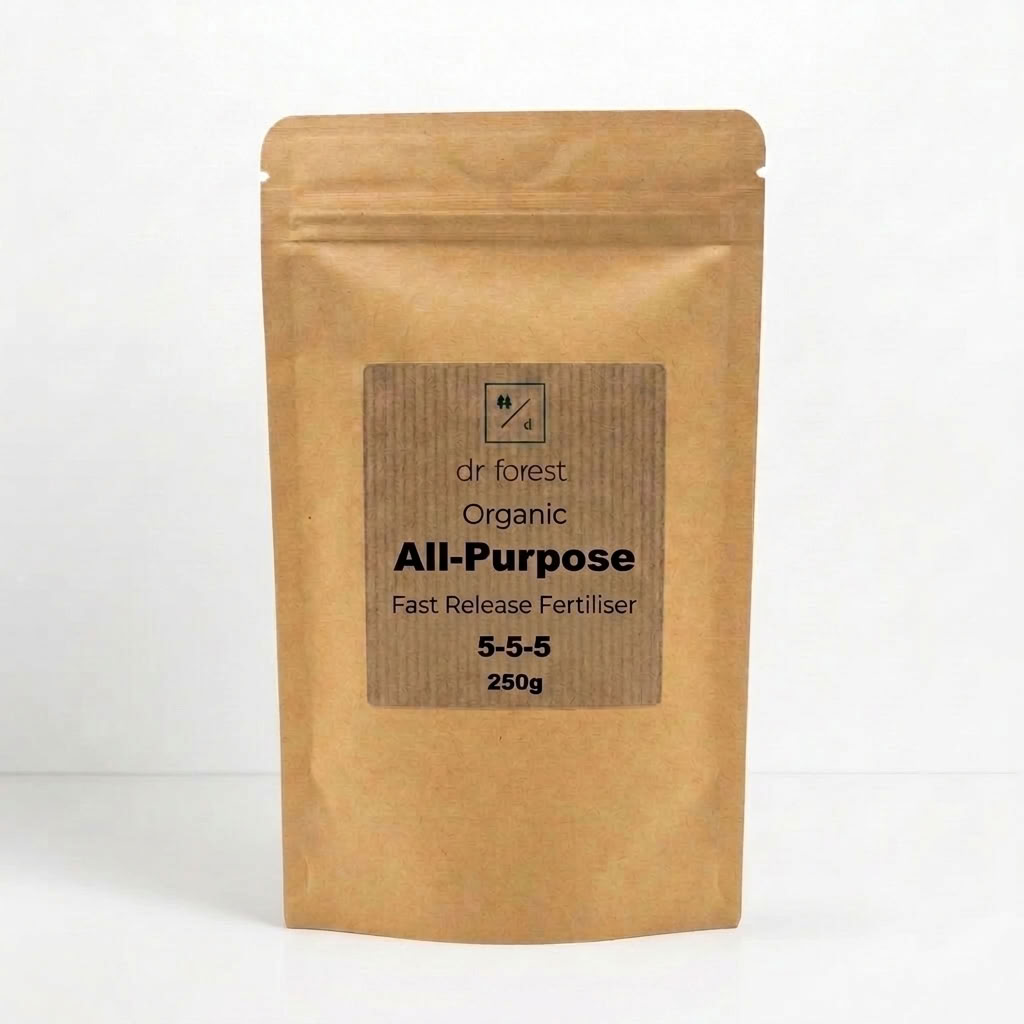
Organic All-Purpose Booster 5-5-5 — a fast-acting soluble powder for the moments a granular can't reach
All-Purpose Booster 5-5-5 is a solution-grade powder that makes up into a liquid solution when added to water, reaching the root zone within hours, for the moments when a plant needs a nutrient response now rather than over the coming weeks. It ships as a concentrated powder, not a bottled liquid — you add the water at home, so you are not paying to ship it around the country.
The nitrogen comes from amino acids and the potassium from Sulphate of Potash — both fully water-soluble, so the whole 5-5-5 soluble fraction is available to roots within hours of watering in. The phosphorus (micronised rock phosphate), calcium (micronised gypsum) and magnesium (Kieserite) are all micronised to an ultra-fine particle size, so even the mineral fraction breaks down fast. Soluble seaweed extract and humic and fulvic acid round out the formula.
This is not a replacement for a slow-release granular base feed. It is the tool for the specific moments listed below, where timing matters more than steady background supply — see Booster vs granular further down this tab, and the timing guide on the How to Use tab.
What All-Purpose Booster is used for in the garden
- Transplant establishment — a dilute drench at transplanting gives seedlings and young plants an immediate nutrient supply while roots establish, before a granular has had time to break down
- Rescuing a stalled or pale plant — when a plant has yellowed or stopped growing mid-season, a drench of Booster produces visible improvement within days, not weeks
- Between granular top-dressings — fills the gap when the last application of All Purpose 4-4-4 is running low and the next isn't due yet
- Container and small-pot performance — pots exhaust their nutrient supply faster than open soil; Booster extends productive life without waiting for a granular to break down
- Houseplant and indoor feeding — the solution format leaves no granules on the surface and no odour
- Lawn rescue drench — a fast-acting green-up for patchy or stressed turf, applied with a watering can
- Seedlings and young plants — a gentle, lower-rate feed for plants too small for full-strength granular
Booster vs granular — two different jobs
All-Purpose Booster 5-5-5 (soluble powder, fast release)
- Mixes into a liquid solution — nutrients reach the root zone within hours
- Applied as and when a plant needs a response — transplanting, stress, a growth surge
- Concentrated powder — you add the water, no shipping weight
- No standing nutrient reserve in the soil between applications
Organic All-Purpose Fertiliser 4-4-4 (granular, slow release)
- Breaks down over weeks as soil microbes and moisture work on it
- Applied on a fixed schedule as the background feed for the whole bed
- One application covers weeks, not one watering
- Builds a standing nutrient reserve — but can't respond to a sudden need
All seven inputs — what they do and why each one is in the formula
Every input in All-Purpose Booster 5-5-5 is chosen for how fast it becomes available to a plant, not just for the nutrient it carries. Two ingredients changed in this recipe: potassium now comes from Sulphate of Potash rather than a micronised potassium mineral, and magnesium now comes from Kieserite rather than Epsom salt.
Amino acids — nitrogen, fully soluble
Plant roots carry amino acid transporters that absorb these molecules whole, without waiting for soil bacteria to convert them first — the step that makes most organic nitrogen slow to act. This is the main reason Booster shows visible greening within days.
Sulphate of Potash — potassium, fully soluble
Sulphate of Potash (SOP) is roughly 50% K₂O and 18% sulphur, and it is genuinely chloride-free. It replaces the micronised potassium mineral used previously: because SOP dissolves completely in water, the whole potassium fraction is now soluble rather than split between a fast and a slow-release form. It also brings the sulphur along with it — a secondary nutrient that's easy to overlook but supports enzyme function and chlorophyll production.
Micronised rock phosphate — phosphorus, fast-breaking mineral
Phosphorus is the least mobile nutrient in soil. Milling it to an ultra-fine particle size increases its reactive surface area dramatically, so it starts releasing within days of a drench rather than sitting inert.
Micronised gypsum — calcium, fast-breaking mineral
A rapid-acting calcium source that keeps pace with the nitrogen-driven growth surge a Booster application triggers — without calcium and magnesium alongside it, fast nitrogen can trigger a secondary deficiency.
Kieserite — magnesium, naturally mined mineral
Kieserite (magnesium sulphate monohydrate) is roughly 25% MgO and 50% SO₃. It replaces the Epsom salt previously used in this formula. As a mined mineral rather than a refined salt, it sits alongside the gypsum and phosphate in the micronised fraction and contributes further sulphur to the feed.
Soluble seaweed extract — hormones and trace minerals
Provides natural cytokinins and auxins that stimulate root development and delay leaf senescence, plus over 60 trace elements in immediately available form.
Humic and fulvic acid — uptake enhancement
Fulvic acid chelates the mineral nutrients in the drench and increases the permeability of root cell membranes, so every other ingredient in the formula is absorbed more efficiently.
How to use All-Purpose Booster: preparation, rates & timing
Add the measured amount to water and stir briefly. The soluble fraction dissolves completely; the micronised fraction forms a fine, stable suspension. Mix fresh for each application — don't store the diluted solution.
Application rates
Root drench — standard feed
Standard rate for vegetables, plants and containers. Use the lower rate for maintenance, the higher rate for a visible deficiency or a growth surge.
Transplant drench
Gives seedlings and young plants immediate nutrition while their roots establish — the amino acids and seaweed hormones support rapid recovery.
Sluggish or pale plants — rescue drench
The soluble nitrogen and potassium produce visible greening within 3–7 days. Return to the standard rate once recovered.
Container and small pots
Containers exhaust nutrients faster than open soil, and the fully soluble potassium reaches roots immediately rather than waiting on soil biology.
Lawn quick-feed
A targeted rescue treatment for patchy or stressed turf, not a substitute for a regular granular lawn feed.
Step-by-step preparation
- Measure the powder. ¼ teaspoon (approx. 1g) per litre for standard feeding, ½ teaspoon (approx. 2.5g) for higher demand.
- Add to water and stir. The soluble fraction dissolves within seconds; the micronised fraction forms a fine suspension.
- Apply as a root drench. Saturate the root zone; for containers, apply until a little runs through the drainage holes.
- Use fresh. Mix only what you need — don't store the diluted solution.
Use the granular All Purpose 4-4-4 on its usual schedule as the background feed for the bed. Reach for the Booster at the specific moments a plant's need shifts faster than a granular can respond to: the day you transplant, the week a plant looks off-colour, the point a container plant runs dry between top-dressings, or straight after a stress event. One drench, timed right, does more than an extra granular application a fortnight early.
Use alongside the granular All Purpose Fertiliser 4-4-4 as the base feed, with Booster as the liquid top-up between applications. Switch to Bloom Booster 2-10-5 once a fruiting plant sets its first flower. Add Seaweed Powder to the same watering can for an enhanced biostimulant drench.
The science of fast-release feeding: why a soluble drench and a slow-release granular are not interchangeable
Two release curves, two jobs
A granular fertiliser like All Purpose 4-4-4 is built to be slow. Its minerals are sized so that soil moisture and microbial activity break them down gradually over weeks, releasing a steady trickle of nutrition that a bed can draw on all season. That is exactly the right behaviour for background feeding — but it means the release curve is fixed once the granules go down. It cannot speed up because a plant just went through transplant shock, or because a pot ran dry of nutrients faster than expected.
All-Purpose Booster inverts that curve deliberately. Every input is chosen to dissolve or break down within hours to days rather than weeks: amino acid nitrogen and Sulphate of Potash go into solution completely; the micronised rock phosphate, gypsum and Kieserite are milled fine enough to behave as near-soluble. The result is a feed you apply because of what's happening to the plant right now, not on a fixed calendar.
Granular 4-4-4 — steady background supply
- Release rate fixed by particle size and soil biology at the time of application
- One application covers the whole bed for weeks
- Cannot be sped up mid-cycle if a plant's needs change suddenly
- Builds a standing reserve in the soil
All-Purpose Booster — on-demand pulse
- Release rate is hours, regardless of soil biology
- Applied in response to a specific developmental moment
- Can be layered on top of a granular feed without disrupting it
- No standing reserve — nutrients are used or leached within days
Why sulphate of potash changes the release profile
The potassium mineral this formula used previously was micronised — fast for a mineral, but still part of the slower-breaking fraction alongside the phosphate and gypsum. Sulphate of Potash is a genuinely soluble salt, so switching to it moves the entire potassium supply into the fully soluble fraction alongside the amino nitrogen. Practically, that means nitrogen and potassium now arrive together, on the same timescale — which matters because potassium regulates the uptake and use of nitrogen inside the plant.
Five mechanisms of action
Amino Acid Direct Uptake
Root amino acid transporters absorb these molecules whole, bypassing the microbial conversion step that most organic nitrogen sources require — the fastest pathway for organic nitrogen into a plant.
Soluble Potassium and Nitrogen Together
Potassium activates the enzymes that put nitrogen to use in protein synthesis and growth. Delivering both in soluble form in the same drench means neither is left waiting on the other.
Sulphur From Two Mineral Sources
Sulphate of Potash and Kieserite both carry sulphur alongside their headline nutrient. Sulphur is a component of several plant enzymes and of chlorophyll synthesis, and is easy to under-supply in a simple N-P-K view of feeding.
Fulvic Acid Chelation & Membrane Transport
Fulvic acid wraps mineral nutrients in a form that resists binding to soil particles, and increases root cell membrane permeability — making every nutrient in the drench more effective per gram applied.
Calcium and Magnesium Keeping Pace
Fast nitrogen without matched calcium and magnesium can trigger a secondary deficiency — magnesium chlorosis or a calcium-related disorder. Micronised gypsum and Kieserite are included specifically to keep pace with the nitrogen-driven growth response.
Scientific References
- Näsholm, T. et al. (2009). Uptake of organic nitrogen by plants. New Phytologist, 182(1), 31–48.
- Canellas, L.P. & Olivares, F.L. (2014). Physiological responses to humic substances as plant growth promoters. Chemical and Biological Technologies in Agriculture, 1(1), 3.
- Shukla, P.S. et al. (2019). Ascophyllum nodosum-based biostimulants. Frontiers in Plant Science, 10, 655.
- Marschner, H. (2012). Mineral Nutrition of Higher Plants (3rd ed.). Academic Press.
- Lambers, H. et al. (2006). Root structure and functioning for efficient acquisition of phosphorus. Annals of Botany, 98(4), 693–713.
- Kopittke, P.M. & Menzies, N.W. (2007). A review of the use of the basic cation saturation ratio and the "ideal" soil. Soil Science Society of America Journal, 71(2), 259–265.