



Description
Another World First brought to you with love from the tiny but mighty team at Soil Smiths.
What it is
It’s the most intelligent plant feed in the world. We mean it.
From Adam – the designer:
It’s amino acids from a vegan source, fulvic acids from wood (not leonardite), carboxylic acid chelated food grade trace minerals. It also has a pinch of sugars from organic cane and wood sugars.
It’s a high brix solution that should build brix in the plant and give it some carbon energy savings that can help encourage exudation while supporting carbon metabolism through aiding chlorophyll and rubisco synthesis.
It’s designed to be a foliar but works well with compost extracts as a food source. I’ve tried to steer clear of animal products, sea products and mined fulvic acids. I think it will be a handy product for folks chasing nutrient density and carbon rich secondary metabolites.
When adding nitrogen to a system there are usually challenges: will the nitrogen leach? Will it be picked up by microorganisms busy decomposing the woody elements of the soil? Will it be sent into the atmosphere as nitrous oxide by other microbes?
We asked ourselves – what if the nitrogen was already in microbes? What if there was enough carbon to ensure that both the microbes and the plants were happy at the same time?
We started with a blank slate, and arrived at a product which not only feeds your plants, but does it so without upsetting the delicate balance of a Living Soil system. In order to do that, we had to balance out the nitrogen with carbon which we have found to be a very challenging task. We’ve aimed at a 3 to 1 carbon to nitrogen ratio or higher, which is the minimum required by lactobacillus – one of the groups of microbes included in the mix.
To top it off, we added 7 essential micronutrients to ensure your plants run on full steam.
It excels as a foliar feed, but can also be used as a regular soil drench in Living Soil systems or small pots.
And it is alive! When you purchase it, it’s shelf stable, but when you dilute it for use, you wake up a host of beneficial microorganisms.
Here’s a recent message from a client:

Benefits
- Healthier plants through upregulating photosynthesis
- Higher yields through a more effective nitrogen uptake – saving plant energy
- A non disruptive form of nitrogen as opposed to mineral nitrogen – particularly when applied as a foliar feed.
- A food and carbon resource for beneficial microorganisms in the soil
- Improved stress tolerance
- The product itself maxed out the BRIX meter at 32. Increases BRIX in plants
- Micronutrients – adding co-factors for plant and microbiology metabolic processes frequently missing in soils or substrates
- Above 90000 ppm of carbon in solution – increases carbon metabolism
- Microbes present help with pathogen suppression
- Amino acids chelate calcium in water; Fulvic acid chelates phosphorus – especially in combination with Guano Dust (micronised dry chicken manure – rich in phosphorus). These processes make these nutrients more available without the need for adding extras. It’s designed not to disrupt phosphorus solubilising microbes – allowing natural processes to occur via the soil food web (which you have tended to by using The Goop). This means that whilst the product delivers nitrogen and potassium, it makes calcium and phosphorus available even without special inputs.
Instructions for use
- 20ml per litre of water for foliar applications. The ph raises to 5.2-6.4 in dilution which is a perfect range for foliar nutrition. Any unused amount – pour away to your garden – the microbes in the mix will wake up and spoil it .
- 5ml per litre of water for soil drenches / fertigation.
- Use everytime when growing in a small pot, or once a week when growing in a large, living soil bed.
- When using the large pots, refrain from using the product before roots take over the volume of the pot. Use The Goop instead to start the soil.
Questions and answers
A foliar feed is sprayed onto the leaves rather than watered onto the soil, so the plant takes it in through the leaf. Living Feed is designed for this: mix 20 ml per litre of water and mist the foliage. In dilution it sits at pH 5.2–6.4, a good range for foliar uptake. Use it up the same day, and pour any leftover onto the garden, because once the microbes wake up the mix spoils.
Yes. Rather than adding loose mineral nitrogen that can leach or get tied up, it supplies nitrogen that's already held in microbes, with enough carbon to keep both the microbes and the plant happy: a carbon-to-nitrogen ratio of 3 to 1 or higher, the minimum lactobacillus needs. It's shelf stable in the bottle, and the microbes wake up when you dilute it.
Seven essential micronutrients, supplied as food-grade trace minerals chelated with carboxylic acids. Micronutrients act as co-factors in the metabolism of plants and soil microbes and are often missing in soils and growing media. Alongside them come amino acids from a vegan source, fulvic acid from wood rather than mined leonardite, and a little cane and wood sugar for carbon.
Yes. It was designed to feed plants without upsetting the balance of a living soil. As a soil drench or through fertigation, use 5 ml per litre: every time you water small pots, or once a week on a large living soil bed. In large pots, wait until roots have filled the pot before using it, and start the soil with The Goop instead.
20 ml per litre of water as a foliar spray. 5 ml per litre as a soil drench or through fertigation: every watering for plants in small pots, or once a week for a large living soil bed. Make up only what you'll use that day.
It's made without animal products, sea products or mined fulvic acid. The amino acids come from a vegan source, the fulvic acid from wood, and the sugars from cane and wood.
Amino acids, wood-derived fulvic acid, seven chelated trace minerals, a little cane and wood sugar, and live beneficial microbes including lactobacillus. It's a high-brix solution: the concentrate maxed out a brix meter at 32, and it carries more than 90,000 ppm of carbon in solution.
Yes. It works well alongside compost extracts, where it acts as a food source for the microbes. If you're starting a new pot or bed, inoculate the soil with The Goop first and bring in Living Feed once roots have filled the space.
1 litre and 5 litres. At 20 ml per litre for a foliar spray, a 1 litre bottle makes about 50 litres of spray. At 5 ml per litre for a soil drench, it makes about 200 litres.
Soil Smiths, a small team of living-soil growers. It was designed by Adam at Soil Smiths, and Dr Forest stocks it alongside its own range.
Customers also bought
18% of buyers here also chose Organic All Purpose Fertiliser 4-4-4
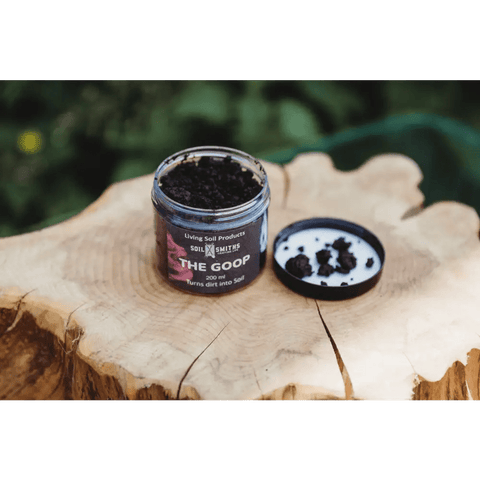
Soil Smiths The Goop | Microbial Inoculant
A microbial inoculant to build soil life.
from £21.00


