



Fertiliser
All Purpose Fertiliser 4-4-4
True all-purpose 4-4-4 for veg, fruit, flowers and containers.
from £12.00
Your basket is empty
Not sure where to start? These are our three best sellers.
 Organic All Purpose Fertiliser 4-4-4from £12.00
 Bloom Fertiliser 2-8-4from £12.00
 Mycorrhizal Fungi Powderfrom £6.99
Have an account?
Log in to check out faster.
Your basket
Customer highlight
Great product our plants are thriving with lots of flowers. Anyone who uses seaweed fertiliser would appreciate this.
Editorial highlight from marketplace and store reviews — separate from the full review list below.
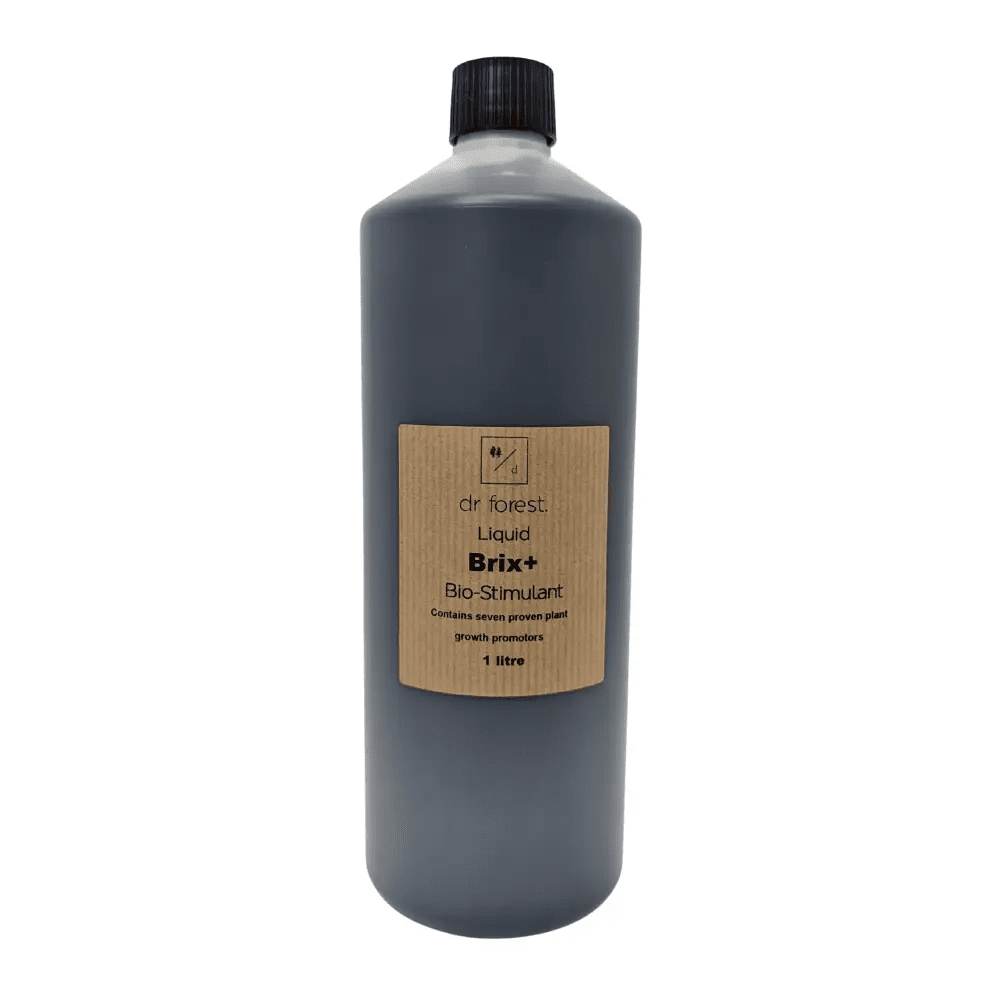
Liquid Seaweed Brix+ is a concentrated Ascophyllum seaweed biostimulant that carries triacontanol alongside cytokinins, gibberellins, auxins, betaines and mannitol. Used little and often as a foliar spray or root drench, it works on the plant's own growth signalling: more photosynthesis, more sugar in the sap and a buffer before frost, drought or heat. It is not a feed, so it goes alongside your usual fertiliser.
Part of our seaweed fertiliser range. For every seaweed format compared, read our seaweed fertiliser guide.
| Component | Value | Note |
|---|---|---|
| Natural acids, phenolics, amino acids, a wide range of ocean trace elements, cytokinins, gibberellins, auxins, betaines, mannitol | 17.5% | Declared as one combined figure |
| Total nitrogen (N) | 0.26% | Trace; not a nitrogen feed |
| Total potassium (K) | 1.65% | |
| Sulphur (S) | 0.37% | |
| Magnesium (Mg) | 0.15% | |
| pH | 5.0–5.8 | Mildly acidic; jar test before tank mixing |
| Conductivity | 30–50 mS/cm | Concentrate; falls to negligible at 2.5 ml/L |
| Specific gravity | 1.0 | 1 ml weighs 1 g, so ml and g are interchangeable |
| Appearance | Brown liquid | Can mark pale fruit if sprayed near harvest |
Specific gravity is 1.0, so 1 ml is 1 g. Half a 5 ml medicine spoon is 2.5 ml, the top of the foliar range for a litre; a 5 litre sprayer takes 10 to 12.5 ml.
Brix+ is designed to be used at low concentration and high frequency. It is preferable to increase the frequency of applications and keep the solution at the same concentration. The growth promoters work through signalling pathways that respond to repeated, regular stimulation. Stick to the dilution rates below and apply regularly through the growing season.
Shake well before use. Mix 2–2.5 ml of Brix+ per litre of water and apply as a fine spray to both upper and lower leaf surfaces, in early morning or late evening when stomata are open and evaporation is low. Foliar is the quickest route in. Suitable for all plants including lawns, shrubs, roses, tomatoes, vegetables and fruit.
Mix 5–12.5 ml of Brix+ per litre of water and apply around the root zone with a watering can. The organic acids and phenolics feed rhizosphere microbial activity while the trace minerals and growth promoters are taken up by the roots; a drench gives a longer-lasting, deeper effect than a spray. Use the lower rate (5 ml/L) for regular maintenance and the higher rate (12.5 ml/L) for plants under stress or during peak fruiting demand.
For growers running a two-part liquid feed, add Brix+ to the Part B solution before combining with Part A, or add it directly to the final working solution at 16 ml per 10 litres (1.6 ml/L). The Part B rate assumes roughly 50× dilution into the final reservoir, so do not put 0.4 L per 5 L into the finished tank. Do not pre-mix with concentrated feeds; always dilute into the working volume. The growth promoters and trace minerals supply the biostimulant and micronutrient side that synthetic liquid feeds usually lack.
Spray at the standard foliar rate immediately before a forecast frost, drought or heat event to prime the betaine and mannitol osmoprotection. If the event has already happened, spray as soon as conditions allow to support recovery: cytokinins delay senescence in damaged tissue, betaines steady the remaining cell membranes and triacontanol restarts photosynthesis.
Shake or stir well before every use. Do not mix with low-pH solutions; run a jar test to confirm compatibility with other products before tank mixing. Avoid spraying close to harvest on produce prone to staining, as the brown liquid can mark pale-skinned fruit. Do not pre-mix or store in diluted form. Use within 6 months of opening.
Brix+ delivers the signal; a base fertiliser delivers the building blocks. Use it alongside Organic All Purpose Fertiliser 4-4-4 during vegetative growth and switch to Organic Bloom Fertiliser 2-8-4 at flowering. Tank-mix with our soluble seaweed extract powder for a double seaweed pass, one for the hormone signal and one for mineral density. Apply our activated biochar condensate (wood vinegar) as a soil drench on alternate weeks for complementary karrikin signalling and microbial stimulation. Add humic acid flakes to soil drenches; the humic acid chelates the trace minerals in Brix+ for root uptake.
Store sealed in a cool, dry place out of direct sunlight. Crystallisation or sedimentation may occur below 5°C; this is normal and does not affect quality. Warm gently and shake to re-dissolve. Keep away from children and pets.
Brix is the refractometer reading of sugar in fruit juice: a tomato at 4°Bx tastes watery, at 8°Bx it is properly sweet. Brix+ aims to move that number.
Figures describe published research on seaweed products, not a trial of Brix+.
Which to choose: Brix+ is the ready liquid with triacontanol. Seaweed Extract Powder dissolves to make liquid seaweed at home: each gram makes 1.2 to 2 litres, so a 250 g pack makes 300 to 500 litres, and Scottish Kelp Meal is the granular version for soil.
True all-purpose 4-4-4 for veg, fruit, flowers and containers.
from £12.00
Flowering-stage 2-8-4 — more blooms without a jungle of leaves.
from £12.00