
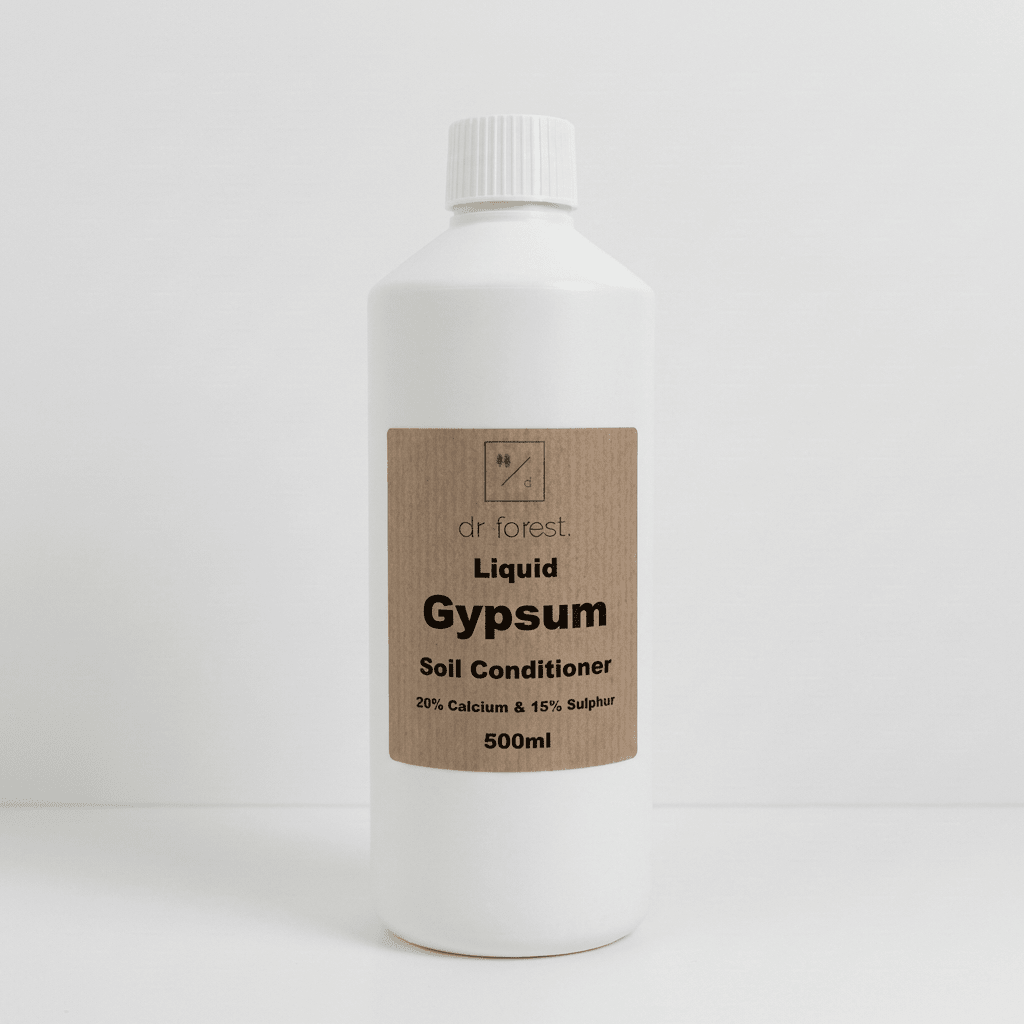
Liquid gypsum for clay soil and lawns
Liquid gypsum is micronised calcium sulphate held in suspension so you can water it onto clay soil and lawns without digging. As it dissolves it puts calcium into the surface water, which helps clay that disperses hold together instead of sealing — and it feeds calcium and sulphur without changing soil pH the way lime does. The Dr Forest version is mined mineral suspended in fulvic acid, with no synthetic dispersants. It is thick and settles on standing: shake hard before every use.
It will not fix waterlogging from compaction, a high water table, or missing drains. If water sits because it has nowhere to go, no bottle will change that. A crumb of dry soil in a glass of rainwater tells you in a day whether your clay disperses; the How to Use tab has that test plus screwdriver, hole and ribbon checks before you buy.
Root drench: 5 ml per litre (maintenance) or 10 ml per litre where a soil test shows calcium is genuinely low. Lawns: 10 ml per litre at 1 L/m², or 15 ml per litre fortnightly for three months on dispersive clay, ideally from early autumn. On heavy clay you are actively improving, expect to come back about every three years.
Treat as any garden concentrate: store out of reach, and keep pets and children off the area while you apply. Once a drench has soaked in or a spray has dried, we know of no reason to keep them off. We do not describe this product as certified organic.
What is liquid gypsum used for in the UK garden?
- Liquid gypsum for clay soil — on clay that disperses in water, dissolving gypsum holds the surface together so rain soaks in. Watered on, no digging in.
- Liquid gypsum for lawns — calcium and sulphur into the root zone of established turf, and one of the few ways to reach the clay underneath without lifting the grass.
- Calcium feed for fruiting crops — tomatoes, peppers, apples, pears, strawberries, courgettes and cucumbers, where a soil test shows calcium is genuinely low. Supplies calcium without raising pH the way lime does.
- Sulphur supply — sulphate-sulphur, available at once with no microbial conversion.
- Foliar calcium — the micronised suspension can be filtered and sprayed for calcium straight through the leaf.
Why liquid gypsum rather than lime for calcium?
Liquid gypsum (calcium sulphate)
- Supplies calcium without changing soil pH: Anderson and colleagues found no change in soil solution pH in a one-year and a ten-year trial [8]
- Supplies sulphate-sulphur at the same time
- Dissolving gypsum raises the salt concentration of the surface water, which holds dispersive clay together
- Micronised to a 5 micron average, so it dissolves quickly and can be watered on rather than dug in
Agricultural lime (calcium carbonate)
- Raises soil pH, which is only useful where acidity needs correcting
- Supplies no sulphur
- Can push an already-neutral soil above the range most vegetables want
- The right choice when a soil is both acid and short of calcium
Gypsum works on clay that disperses in water. It does nothing for waterlogging caused by mechanical compaction, a high water table, an impermeable subsoil pan, missing land drains or poor site grading. If water sits on your soil because it has nowhere to go, no liquid product will change that. The How to Use tab has four tests that tell you which problem you have before you spend anything.
Dr Forest is a small-batch business in Stockport, Greater Manchester. Other liquid gypsum questions are answered at liquid gypsum: your questions, answered, and the case for and against it on British clay is set out in liquid gypsum for clay soil, honestly assessed. Made by Growers. Backed by Science.
How does liquid gypsum work? Calcium, sulphate and the clay surface
What it is, and what it is not for
The science of gypsum on clay was originally worked out for salt-affected soils in Australia, the Mediterranean and the American west, where irrigation water has loaded the soil with sodium. UK gardens do not usually have a sodium problem, and that matters. On clay that does not disperse, the structural effect is modest and organic matter does the lasting work. Where clay genuinely disperses and caps, gypsum helps. No UK survey has measured how much British garden clay disperses, so the crumb-in-a-glass test in the How to Use tab is the honest answer.
Milling gypsum to a 5 micron average particle is what makes it dissolve quickly; Chen and Dick note that gypsum has to be finely ground before it goes readily into solution [4]. We do not put a clock on it; that depends on your soil and your rainfall. Why it is a suspension rather than a solution is explained in why liquid gypsum is a suspension, not a solution.
Composition
| Component | Analysis | Form |
|---|---|---|
| Calcium (Ca) | 19.55% w/v (27.35% CaO) | Ca²⁺ from dissolving calcium sulphate |
| Sulphur (S) | 15.31% w/v (38.23% SO₃) | Sulphate, plant-available without microbial conversion |
| Average particle | 5 microns | Wet-milled natural gypsum |
| Carrier | Fulvic acid | The liquid the gypsum is suspended in; not a dispersant |
| Effect on soil pH | None measured | Neutral salt, not a liming material [4][8] |
The gypsum is quarried from natural rock rather than recovered as flue-gas or phosphogypsum by-product. We make no purity claim on the back of that: Kost and colleagues applied mined and flue-gas (FGD) gypsum at ten US field sites and found most response ratios, for yield and for elements in soil, crop tissue and water, sat close to 1.00 for both [7], and the Miller and Ben-Hur rainfall studies below both used phosphogypsum [2][3]. The difference is provenance and what else is in the bottle, which is covered in natural vs synthetic gypsum: does the source matter?
Why water pools on clay
When a clay garden floods and stays wet for days, the problem is usually a skin a millimetre or two thick at the very surface. Clay particles carry a negative charge and push each other apart unless a positive ion sits between them as a bridge. Calcium does that job well. Sodium does it badly. Rain is close to distilled water, so it dilutes the surface solution towards the concentration below which a given clay stops holding together; the plates separate, wash into the pores and seal the top. Oster, Shainberg and Wood measured that threshold: calcium-saturated montmorillonite flocculates at 0.25 molc m⁻³, rising to 12 at full sodium saturation [1].
Mechanisms of action
Holding the surface together
Dissolving gypsum releases calcium and sulphate into the water lying on the soil and keeps its salt concentration above the line at which the clay disperses, so water soaks in instead of standing. This route does not need sodium to be present. Miller measured it on three non-sodic Georgia soils: surface gypsum roughly doubled final infiltration on two of them and cut soil loss by 30 to 50% [2].
Calcium onto the exchange
Over a longer period calcium from the dissolved gypsum swaps onto the clay in place of sodium, which lowers the concentration the clay needs to stay together. This half is conditional: it needs something worth displacing, so on a soil already dominated by calcium it changes little. The RHS advises against long-term watering with artificially softened water: softeners swap calcium and magnesium for sodium, and sodium can build up in the soil and affect its structure [10].
Stronger on dispersive soils
Ben-Hur and colleagues found surface gypsum cut soil loss "sharply from the dispersive soils and moderately from the nondispersive soils" [3]. Franzen, Rehm and Gerwing put the limit plainly: if soils are not dispersive, gypsum applications do not help infiltration, though it has reduced crusting in laboratory work on both sodic and non-sodic soil [5].
Why it needs repeating
The displaced sodium leaves as soluble sodium sulphate, and the same solubility that makes gypsum useful is why it does not stay put. Chen and Dick: gypsum "may need to be reapplied every couple of years in wet climates or on irrigated fields as the gypsum will leach out of the soil profile" [4]. In Ohio trials, annual or two-yearly applications did more good than one large dose, which lowered maize yield in one of four years [9].
Calcium and sulphur in the plant
Calcium is immobile in the plant: it moves up in the transpiration stream and cannot be pulled out of old leaves to supply new growth, so shortfalls show first in the fastest-growing tissue. Sulphur goes into cysteine, methionine and the proteins built from them. Fleuridor and colleagues measured gypsum raising sulphur in soil and crop tissue within five months of each application on fourteen organic dairy fields, with no short-term yield gain [6]. We hold no trial data on the fulvic acid carrier, so we claim nothing for it.
Scientific references
- Oster, J.D., Shainberg, I. & Wood, J.D. (1980). Flocculation value and gel structure of sodium/calcium montmorillonite and illite suspensions. Soil Science Society of America Journal, 44(5), 955–959.
- Miller, W.P. (1987). Infiltration and soil loss of three gypsum-amended Ultisols under simulated rainfall. Soil Science Society of America Journal, 51(5), 1314–1320.
- Ben-Hur, M., Shainberg, I., Stern, R. & van der Merwe, A.J. (1992). Slope and gypsum effects on infiltration and erodibility of dispersive and nondispersive soils. Soil Science Society of America Journal, 56(5), 1571–1576.
- Chen, L. & Dick, W.A. (2011). Gypsum as an agricultural amendment: general use guidelines. Ohio State University Extension, Bulletin 945.
- Franzen, D., Rehm, G. & Gerwing, J. (2006). Effectiveness of gypsum in the north-central region of the U.S. NDSU Extension Service, SF-1321.
- Fleuridor, L., Herms, C., Culman, S., Dick, W.A., Paul, P.A. & Doohan, D. (2021). Short-term responses of soils and crops to gypsum application on organic farms. Agronomy Journal, 113(5), 4220–4230.
- Kost, D., Ladwig, K.J., Chen, L. et al. (2018). Meta-analysis of gypsum effects on crop yields and chemistry of soils, plant tissues, and vadose water at various research sites in the USA. Journal of Environmental Quality, 47(5), 1284–1292.
- Anderson, G.C., Pathan, S., Hall, D.J.M., Sharma, R. & Easton, J. (2021). Short- and long-term effects of lime and gypsum applications on acid soils in a water-limited environment: 3. Soil solution chemistry. Agronomy, 11(5), 826.
- Rakkar, M. & LaBarge, G. (2024). Response of soils and crops to gypsum application in Ohio. Ohio State University Extension, ANR-0153.
- Royal Horticultural Society. Collecting, storing and reusing water (guidance on softened water).
Figures describe the published literature on gypsum and are not product-specific guarantees.
How to apply liquid gypsum: rates for plants, lawns and clay soil
This is a thick mineral suspension, not a clear solution, and the micronised gypsum settles on standing. Shake or stir vigorously for at least 30 seconds before measuring. If the bottle has been sitting for an extended period, invert and shake several times before use. The thick, creamy texture when shaken is normal. Do not store in a pre-diluted form; always dilute fresh for each application. 1 tsp is 5 ml.
Frequencies sit alongside the rates below where one applies. The short version on timing: September to November is the main window, March to April the second, and between May and August use the feeding rates only. On heavy clay you are actively improving, expect to come back to it about every three years. Avoid frozen, snow-covered or saturated ground, where surface-applied material is more likely to run off than soak in. For the liquid-specific frequency question, see how often and when should you apply liquid gypsum?
Application rates: plants and beds
Root drench: general maintenance
Standard rate for all plants during the growing season. Apply around the root zone, not over the crown, and water in well afterwards. Compatible with all Dr Forest fertilisers.
Root drench: active deficiency or high demand
The corrective rate, where a soil test shows calcium is genuinely low, or for calcium-hungry crops such as tomatoes, peppers and apples during rapid fruit fill. Return to the standard rate afterwards.
Foliar spray: rapid correction
Delivers calcium directly through the leaf and fruit surface. Apply in early morning or evening and avoid full sun; the suspension may leave a white residue at higher rates. Filter through 200 micron mesh before use in fine spray nozzles.
Spot treatment: individual plants
For a single plant you want to feed calcium, apply directly around the root zone at the higher volume. The lawn clay-conditioning rate is specified for lawns, so we do not carry it across to borders and beds.
Application rates: lawns and turf
Liquid gypsum puts calcium and sulphur into the root zone of established turf without digging, disruption or a change in soil pH. For a lawn sitting on clay that disperses, it is one of the few ways to reach that clay at all. More on the lawn case at is liquid gypsum good for lawns? It also comes paired with our wetting agent as the Waterlogged Lawn Kit.
Lawn: general maintenance
Standard lawn rate for ongoing calcium and sulphur supply. Apply with a watering can fitted with a rose, or through a knapsack sprayer. Water in lightly after application. Calcium is a structural component of grass cell walls; the sulphur deepens green colour and supports protein synthesis in the leaf.
Lawn: clay soil improvement
Higher rate for lawns on clay that disperses, so the surface sits wet and puddles after rain. Dissolving gypsum holds the salt concentration in the surface water above the line at which the clay comes apart, and deeper down calcium swaps onto the clay in place of sodium, without disturbing the turf. Start the programme in early autumn where you can, so the gypsum is dissolving in the surface water before the winter rain that does the capping.
Lawn: after aeration or scarifying
Apply immediately after hollow-tine aeration, slit aeration or scarifying, while the open channels let the liquid reach the clay beneath the turf. To be straight about it: no trial compares gypsum applied through core holes with gypsum applied to the surface, and the surface-sealing mechanism arguably favours leaving it on top. Aerate because compaction needs aerating. Gypsum does not relieve compaction; a two-year Ohio study found no change in penetration resistance [9].
Start it in early autumn. Gypsum stops the surface sealing by holding dissolved calcium and sulphate in the water lying on the soil while rain is falling, so it needs to be down before the rain that does the damage rather than after it. In the north-west that means having it on from September. A spring start in March or April is the next best thing if autumn gets away from you. One caveat, because it is repeated everywhere as though settled: there is no field trial comparing autumn application with spring. The autumn case is reasoning from the mechanism, not a measured result.
Rate table
| Situation | Rate | When / how |
|---|---|---|
| Root drench, maintenance | 1 tsp (5 ml) per litre | Growing season |
| Root drench, deficiency or high demand | 2 tsp (10 ml) per litre | Where a soil test shows calcium is genuinely low, or for calcium-hungry crops during rapid fruit fill; then back to standard |
| Foliar spray | 5 ml per litre, 200 micron mesh | Early morning or evening |
| Spot treatment, single plant | 5 ml per litre at 200–500 ml per plant | Around the root zone, at the higher volume |
| Lawn, maintenance | 10 ml per litre at 1 L/m² | Ongoing |
| Lawn, clay improvement | 15 ml per litre at 1 L/m² | Fortnightly for three months; start in early autumn where you can |
| Lawn, after aeration | 10–15 ml per litre at 1 L/m² | Immediately after aeration |
Step-by-step preparation
- Shake the bottle thoroughly. Invert and shake vigorously for 30 seconds. The product is thick and creamy, which is normal for a mineral suspension. Never measure from an unshaken bottle.
- Measure into a splash of warm water first. Measure the required amount into a small jug or cup holding a little warm water and stir until the suspension is fully dispersed. The warm water lifts the mineral paste cleanly off the spoon and the jug.
- Add the concentrate to the rest of your water. Pour it into your watering can or spray container filled with the remaining volume and stir briefly. The suspension stays stable during normal use.
- Apply to the root zone or foliage. For root drenches, apply evenly around the base and water in. For foliar, filter through fine mesh and apply in early morning or evening.
- Use fresh. Do not store diluted. Prepare only what you need for each application and use it immediately.
Will it help your drainage? Four tests before you buy
There are three causes of a waterlogged garden and gypsum addresses one of them. Clay that disperses: yes. Mechanical compaction from foot traffic, machinery or building work: no, that needs deep forking, broadfork aeration, hollow-tine aeration or double-digging with organic matter, after which gypsum can help hold the clay against re-dispersing. No drainage outlet, whether a high water table, an impermeable subsoil pan, missing land drains or poor grading: no, that needs land drains, a French drain, a soakaway, regrading or raised beds to lift the growing zone above the water table. Applying liquid gypsum to soil that is wet because water has nowhere to go is a waste of product.
- The screwdriver test (compaction). Push a long screwdriver into moist soil. In our experience, uncompacted soil lets it in 15 to 20 cm under moderate hand pressure. A hard, resistant layer within 5–10 cm is a compaction pan. This is a mechanical problem and gypsum will not fix it: fork, broadfork or hollow-tine aerate it first.
- The dispersion test (clay that comes apart). Drop an air-dried crumb of soil from about 10 cm down into a glass of rainwater and read it at ten minutes and again at two hours. A milky halo spreading from the crumb is dispersion, and gypsum has a job to do. Full protocol: does liquid gypsum work on clay soil?
- The hole test (drainage outlet). Dig a hole 30 cm deep and 30 cm wide in the problem area, fill it with water and time it. Water still sitting there after 24 hours means a high water table, a subsoil pan or no gradient. No liquid product will fix that; you need physical drainage.
- The ribbon test (clay at all). Squeeze a lump of moist soil between thumb and forefinger into a flat ribbon. True clay forms a smooth, shiny ribbon 5 cm or longer. If you cannot form one, your drainage problem is unlikely to be clay-related. Look at subsoil panning, water table or surface grading instead.
Blossom end rot is mainly a calcium transport and water-relations problem rather than a shortage of calcium in the soil, so steady watering matters more than any calcium product. Bitter pit is associated with low calcium in the fruit rather than in the soil, and the evidence for soil-applied calcium is thin. Gypsum is worth using where a soil test shows calcium is genuinely low. More in blossom end rot in tomatoes: what causes it, and how I stopped it.
Granulated Gypsum for digging into beds and borders by the square metre before planting, with the liquid for lawns and established plants; Natural Wetting Agent where a clay lawn has dried into a crust that sheds water and the liquid is sitting on top; and Amino Chelated Calcium when you want a fully soluble calcium feed for fruiting crops without the sulphur. The two gypsum formats are compared at liquid gypsum vs granular gypsum.
Store in a cool, dry place out of direct sunlight and above 5°C. Below that, sedimentation may occur; it is reversible on warming and shaking. Do not allow to freeze. Keep in the original container, not pre-diluted, and shake well before each use. Best used within 12 months of purchase. Keep away from children and pets.


