
Soil Conditioner
Humic Acid Flakes | 70% Humic, 100% Water-Soluble
70% humic acid to improve soil structure and uptake.
from £7.99
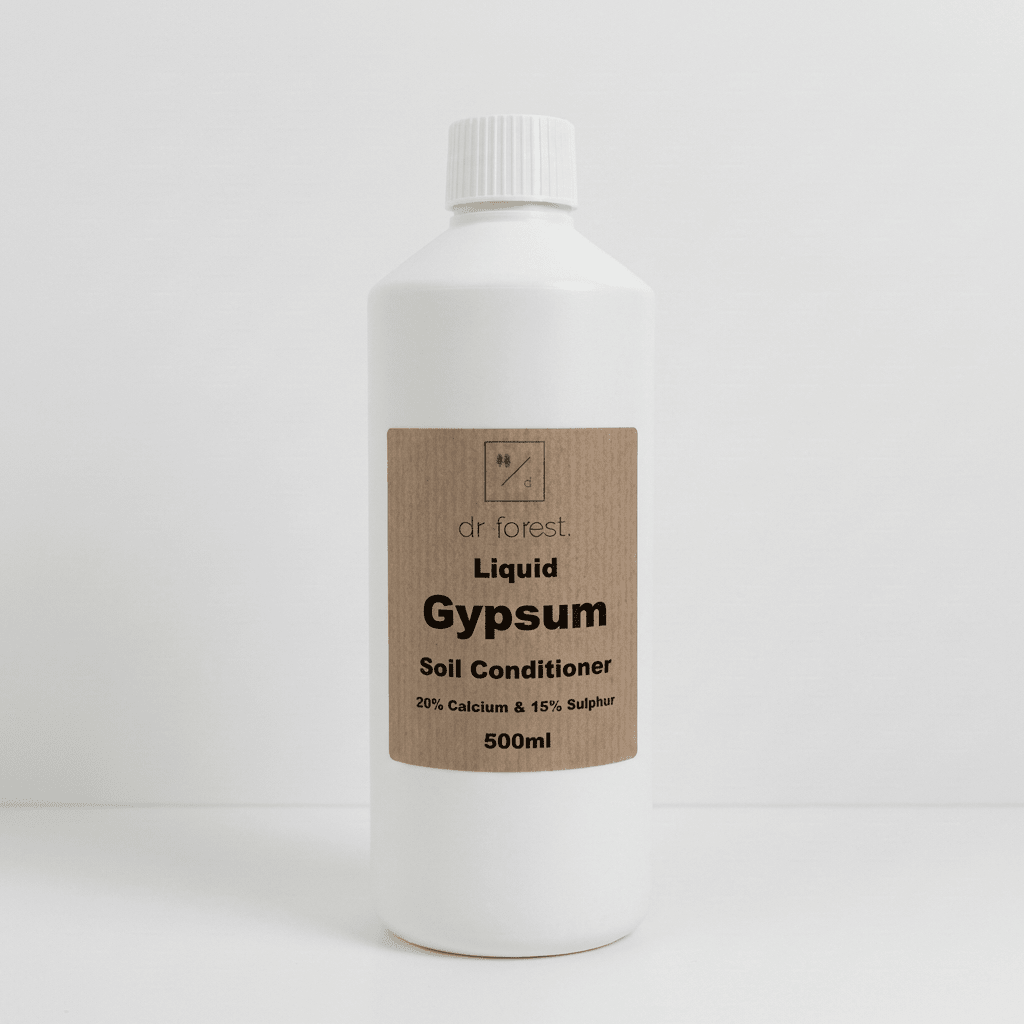
Liquid gypsum earns its place by doing two jobs at once: feeding calcium and sulphur, and helping dispersive clay drain. One product does four jobs that usually need four: it is a calcium fertiliser for tomatoes, peppers and apples prone to blossom end rot and bitter pit; a liquid gypsum clay breaker that helps dispersive clay soils drain without surface disturbance; a lawn feed that supplies calcium and sulphur to turf and reaches the clay beneath it without digging; and a general source of plant-available calcium and sulphur for any fruiting crop, leafy vegetable, perennial border or container plant. One of the few liquid products that can reach clay under a lawn or border without digging it in.
This is a thick, creamy mineral suspension, not a thin liquid, not a manufactured solution. It is made by wet-milling natural gypsum (calcium sulphate) down to an average particle size of just 5 microns and suspending those micronised mineral particles in water with fulvic acid. When you open the bottle, the product is dense, opaque, and settles on standing, because it is real, physical mineral held in suspension. Milling the mineral fine is what makes it dissolve quickly. Bolan and colleagues measured powdered gypsum dissolving two to ten times faster than pelletised discs, and three to eight times faster again in the presence of soil. We do not put a clock on it, because how fast it reaches your soil depends on your soil and your rainfall. It does not change how much calcium a dose contains.
Two ingredients: mined calcium sulphate, suspended in fulvic acid. No synthetic dispersants. The mineral is suspended in fulvic acid, which is the carrier. Mined mineral, not an industrial by-product. Not all liquid gypsum is the same: for the difference between a mined mineral suspension and a synthetic manufactured one, see the Mined vs Synthetic tab.
Liquid gypsum acts on clay that disperses in water, where the plates come apart, block the pores beneath and seal the surface. It does not fix drainage problems caused by mechanical compaction (foot traffic, machinery, building work) or by a lack of physical drainage (high water table, impermeable subsoil pan, missing land drains, poor site grading). If water sits on your soil because it has nowhere to drain to, no liquid product will resolve that. You need physical drainage infrastructure. See the How to Use tab for diagnostic tests.
Not all liquid gypsum is the same. The words "liquid gypsum" on a label tell you the product contains calcium sulphate in liquid form, but they tell you nothing about where that calcium sulphate came from, how it was processed, or what else is in the bottle. There are two fundamentally different types of liquid gypsum on the market, and the distinction matters.
| Feature | Mined Mineral Gypsum (This Product) | Synthetic Liquid Gypsum |
|---|---|---|
| Gypsum source | Naturally mined mineral gypsum | Industrial byproduct (FGD or phosphogypsum) |
| Processing | Mechanical micronisation only, no chemical processing | Chemical dissolution with synthetic dispersants and surfactants |
| Particle size | 5 microns average, extremely high surface area for fast dissolution | Variable, often coarser or chemically dissolved rather than micronised |
| Fulvic acid | Included as the carrier | Not included |
| Synthetic additives | None | Surfactants, dispersants, stabilisers, sometimes polyacrylamide |
| Naturally mined | Yes, naturally mined | No |
| Calcium & sulphur | 19.55% Ca, 15.31% S | Variable, depends on manufacturing process and dilution |
| Residual benefit | Mineral particles continue dissolving after application | Often pre-dissolved before it reaches the soil |
Most manufactured liquid gypsum is made from industrial byproduct gypsum, calcium sulphate produced as a waste product from other industrial processes, not mined from the ground. The two most common sources are:
Produced in coal-fired power stations when sulphur dioxide is scrubbed from the exhaust gas using limestone. The resulting calcium sulphate is recovered from an industrial process rather than mined. Kost and colleagues compared trace elements in soil, crop tissue and water under mined and FGD gypsum and reported that "most R values varied only slightly from 1.00".
Produced during the manufacture of phosphoric acid from phosphate rock. It is cheaper than mined gypsum, which is why it is used in manufactured liquid gypsum products where cost is the primary consideration. It is worth being straight about this: much of the field evidence for gypsum on clay, including Miller 1987 and Ben-Hur 1992, was run on phosphogypsum, so we make no efficacy claim against it.
Synthetic liquid gypsum requires chemical dispersants and surfactants to stay in suspension and pour smoothly. These are industrial chemicals designed to prevent particle settling. They are not there for the benefit of your soil or plants. In a mined mineral suspension, the product settles naturally because it is real mineral in water with no synthetic stabilisers. You shake it before use, and that is the trade-off. The fulvic acid in this product is not a dispersant. The mineral is suspended in fulvic acid, which is the carrier.
Check the label for the gypsum source. If it does not state "natural gypsum" or "mined gypsum", the calcium sulphate is likely an industrial byproduct. If the ingredient list includes surfactants, dispersants, polyacrylamide, or other synthetic additives, the product is manufactured rather than a mined mineral suspension. If the liquid does not settle or separate on standing, it almost certainly contains synthetic dispersants. A genuine mineral suspension will always settle. Ours is quarried from natural rock rather than recovered as an industrial by-product, and the only additive is fulvic acid.
The calcium sulphate itself is the same molecule regardless of source. What differs is provenance and what else is in the bottle. Ours is mined mineral rather than recovered as an industrial by-product, and the only other ingredient is the fulvic acid it is suspended in. We do not claim a purity advantage we cannot show: Kost and colleagues measured trace elements in soil, crop tissue and vadose water under both mined and FGD gypsum and found most values varied only slightly from 1.00. Anything we say about contaminants would need a certificate of analysis behind it, and we do not publish one yet.
This is a thick mineral suspension, not a clear solution. The micronised gypsum particles settle on standing. Shake or stir vigorously for at least 30 seconds before measuring. If the bottle has been sitting for an extended period, invert and shake several times before use. The thick, creamy consistency when shaken is normal: it is what genuine micronised mineral looks like in liquid form. Do not store in a pre-diluted form. Always dilute fresh for each application.
We attach a frequency to one rate only, lawn clay conditioning at 15 ml/L fortnightly for three months. For everything else, repeat on the symptom rather than the diary: water standing after rain, and a thin crust you can peel back with a knife.
Standard rate for all plants during the growing season. Apply around the root zone, not over the crown. Water in well after application. Compatible with all Dr Forest fertilisers.
The corrective rate, for use where a soil test shows calcium is genuinely low, or for calcium-hungry crops such as tomatoes, peppers and apples during rapid fruit fill. Return to the standard rate afterwards.
Delivers calcium directly through the leaf and fruit surface. Apply in early morning or evening. Avoid full sun: the suspension may leave a white residue at higher rates. Filter through 200 micron mesh before use in fine spray nozzles.
Liquid gypsum delivers calcium and sulphur into the root zone of established turf without digging, disruption, or a change in soil pH in the short term. For lawns sitting on clay that disperses, it is one of the few ways to reach that clay at all.
Standard lawn rate for ongoing calcium and sulphur supply. Apply with a watering can fitted with a rose, or through a knapsack sprayer. Water in lightly after application. Calcium is a structural component of grass cell walls. The sulphur deepens green colour and supports protein synthesis in the leaf.
Higher rate for lawns on clay that disperses, so the surface sits wet and puddles after rain. Dissolving gypsum holds the salt concentration in the surface water above the line at which the clay comes apart, and deeper down calcium swaps onto the clay in place of sodium, without disturbing the lawn surface. This is one of the few ways to get calcium into clay under an established lawn. You cannot dig in amendments without destroying the turf. For best results, combine with hollow-tine aeration in autumn to physically open channels into the clay layer.
Apply immediately after hollow-tine aeration, slit aeration, or scarifying. The open channels and exposed soil allow the liquid gypsum to reach the clay layer beneath the turf. This is the timing that gets it deepest under lawns.
Most soil amendments require digging or incorporation, impossible on an established lawn without destroying it. Liquid gypsum is applied to the surface and washes into the root zone with rain or irrigation. It delivers calcium and sulphur directly where the grass roots are, improves clay structure beneath the turf without disturbance, and does not alter soil pH in the short term. It is one of the very few products that can meaningfully improve the soil under a lawn without lifting the turf.
For a single plant you want to feed calcium, apply directly around the root zone at the higher volume. The lawn clay conditioning rate is specified for lawns, so we do not carry it across to borders and beds.
Gypsum is a powerful tool for the right problem, but it is not a universal drainage fix. Before applying, you need to understand what is actually causing your waterlogging. There are three distinct causes of poor drainage, and gypsum only addresses one of them.
Push a long screwdriver into moist soil. In our experience, in uncompacted soil it should push in to 15 to 20 cm under moderate hand pressure. If it meets a hard, resistant layer within 5–10 cm, you have a compaction pan. This is a mechanical problem. Gypsum will not fix it. Fork it, broadfork it, or hollow-tine aerate it first.
Take a pea-sized crumb of soil from about 10 cm down and air-dry it indoors for a day or two. Half fill a clear jar with rainwater. Tap water carries enough calcium to skew the result. Lower the crumb in without stirring, and look at it after ten minutes, after two hours, and again next morning.
If the crumb falls apart but the water stays clear, that is slaking. Organic matter is the tool for that, not gypsum. If a milky halo spreads from the crumb and hangs in the water, that is dispersion, and gypsum has a job to do.
Dig a hole 30 cm deep and 30 cm wide in the problem area. Fill it with water and time how long it takes to drain. If the water is still sitting in the hole after 24 hours, you have a fundamental drainage problem: either a high water table, an impermeable subsoil pan, or no drainage gradient. This is not a chemistry problem. No liquid product will fix it. You need physical drainage: land drains, a French drain, a soakaway, or raised beds to lift the growing zone above the saturated layer.
Take a small lump of moist soil and squeeze it between thumb and forefinger to form a flat ribbon. True clay forms a smooth, shiny ribbon 5 cm or longer. If you cannot form a ribbon, your drainage problem is unlikely to be clay-related. Look at subsoil panning, water table, or surface grading instead.
Blossom end rot is mainly a calcium transport and water-relations problem rather than a shortage of calcium in the soil, so consistent watering matters more than any calcium product. Bitter pit is associated with low calcium in the fruit rather than in the soil, and the evidence for soil-applied calcium is thin. Gypsum is worth using where a soil test shows calcium is genuinely low.
The science that follows was originally worked out for salt-affected soils in Australia, the Mediterranean and the American west, where irrigation water has carried high levels of sodium into garden soils for decades. UK gardens do not usually have a sodium problem, and that matters. On clay that does not disperse the structural effect is modest, and organic matter does the lasting work. Where clay genuinely disperses and caps, gypsum helps. Gypsum works on clay that comes apart in water, and a crumb of your soil in a jar of rainwater tells you in a day whether yours does: see does liquid gypsum work on clay soil.
Clay is made of flat plates that need something positively charged between them to hold together in crumbs. Calcium does that job well and sodium does it badly. Every clay has a concentration of dissolved salt below which it stops holding together, and rain, being nearly distilled water, dilutes the surface solution towards that line. The top few millimetres disperse, block the pores beneath, and a seal forms. Dissolving gypsum puts calcium back into the surface water and holds the concentration above the line, which is why water soaks in instead of standing. Deeper down, calcium also swaps onto the clay in place of sodium, and that lowers the threshold durably. The first effect works on any clay that seals. The second depends on your particular soil.
The GRDC puts the two routes in that order: "In the short term, the Ca in gypsum increases the ionic strength (the salinity) of the soil solution, which suppresses dispersion... In the long-term, Ca in gypsum replaces Na on soil particles, which helps the soil form aggregates."
No UK survey has measured how much British garden clay disperses. That is exactly why the jar test is the answer: it costs nothing and it tells you about your soil rather than about the average.
Calcium is unusual among plant nutrients in that it is simultaneously critical to soil chemistry and plant biology. In the soil, calcium acts as the primary cation binding clay particles together into stable aggregates: the open, crumb structure that allows drainage, aeration, and root exploration. When the salt concentration in the soil water falls below the level a given clay needs, or when sodium takes calcium's place on the exchange sites, the plates separate and the structure collapses into a dense, impermeable layer. Oster and colleagues measured that threshold: calcium-saturated montmorillonite flocculates at 0.25 mol_c m⁻³, and putting sodium on one fifth of the exchange sites raises it to 6.
Inside the plant, calcium is an immobile structural nutrient: unlike nitrogen or potassium, it cannot be remobilised from older tissue to supply new growth. Every new cell wall requires a fresh supply of calcium delivered by the transpiration stream from the roots. When the rate of new cell production in developing fruit exceeds the rate of calcium delivery, typically during rapid fruit expansion in heat or after irregular watering, the newest cells are formed with deficient cell walls that collapse and die. This is the visible result of blossom end rot and bitter pit: not a shortage of calcium in the soil, but a failure of delivery to the fastest-growing tissue.
When a heavy clay garden floods and stays wet for days, the problem is almost always at the very surface: a hard skin only a millimetre or two thick that water can't get through. The soil below it might be perfectly capable of draining; it just can't be reached. That skin is the surface seal.
Here is how it forms. Clay is made of microscopic flat particles, far too small to see, smaller than a grain of pollen. In a healthy garden these particles stick to each other in small crumbs, and water flows freely between the crumbs through the gaps. When the first heavy rain of the season hits bare clay, raindrops strike with enough force to knock individual particles loose from those crumbs. The loose particles wash into the gaps and clog them. As the surface dries, the trapped particles glue themselves together as a continuous hard crust. The next rain has nowhere to go and pools on top. AHDB describe the first step of it plainly: "The energy of the droplets causes soil particles to detach and block the coarser surface pores."
What decides whether clay particles will stick together properly or fall apart on contact with rainwater is the chemistry sitting on their surfaces. Each clay particle carries a slight negative electrical charge, and just like two negative magnets, two clay particles will push each other apart unless something positively charged is in between to bridge them. Calcium does that bridging job better than anything else that naturally occurs in soil. It has the right charge and the right size to sit tightly between adjacent clay particles and hold them together. Sodium does that job badly, and when it takes calcium's place on the clay surfaces the bridges fail, the particles drift apart, and surface sealing begins. Magnesium is a weaker stabiliser than calcium, not a dispersant.
When gypsum dissolves it releases calcium and sulphate into the soil water. The level of dissolved salt in that water is what decides whether the clay plates drift apart or pull together, and rain, being nearly distilled water, drives it downwards. Dissolving gypsum holds the concentration above the line, which is why water soaks in instead of standing. This route works regardless of what is sitting on the exchange sites. Miller measured it on three non-sodic Georgia soils: surface-applied gypsum held the electrolyte level at 0.5 to 1.3 dS m⁻¹ and cut soil loss by 50% on two of them and 30% on the third. We do not put a clock on it.
Over a longer period the calcium from the dissolved gypsum swaps onto the clay in place of sodium, and that lowers the concentration at which the clay stops holding together. This is the conditional half of the story: it needs something worth displacing, so on a soil whose exchange sites are already dominated by calcium, adding more calcium changes little. The effect is durable rather than permanent, and it reverses with leaching, sodium input or acidification.
Sodium displaced from the clay surfaces combines with sulphate to make a soluble salt that washes down out of the root zone with rainfall. The same solubility that makes gypsum useful is why it does not stay put. Chen and Dick put it plainly: gypsum "may need to be reapplied every couple of years in wet climates or on irrigated fields as the gypsum will leach out of the soil profile". The exchange effect is durable rather than permanent.
Standard agricultural gypsum is sold as granules, and a granule dissolves from its outer surface inwards. Milling the mineral fine is what makes it dissolve quickly. Bolan and colleagues measured powdered gypsum dissolving two to ten times faster than pelletised discs, and three to eight times faster again in the presence of soil. We do not put a clock on it, because how fast it reaches your soil depends on your soil and your rainfall. This product is wet-milled down to particles averaging five thousandths of a millimetre across (5 microns) and supplied already mixed into water as a thick suspension, so it is delivered where the seal forms rather than sitting on top of it.
Dispersion. The surface effect does not need sodium. Rain is nearly electrolyte-free, so it dilutes the surface solution towards the concentration below which the clay comes apart, and the top few millimetres seal. Miller measured exactly that on non-sodic soils. Non-sodic does not mean non-dispersive, which is why the jar test matters more than a sodium figure. Ben-Hur and colleagues found surface-applied gypsum decreased soil loss "sharply from the dispersive soils and moderately from the nondispersive soils", so the benefit is graded rather than binary.
Compaction. Walking on wet ground, digging when the soil is too damp, the legacy of building work or trenching: anything that physically crushes the soil's natural crumb structure flat against the surface. The crushed clay at the surface is now exposed raw to every rainfall and disperses on contact, even when the chemistry beneath it is healthy. This is why a trampled lawn or path edge pools water more than an undisturbed border: it has lost its surface structure.
Both produce the same visible problem. Rainwater that should soak in instead sits on the surface for hours or days, then runs off into the lowest corner of the garden. The lawn squelches underfoot. The vegetable bed turns into a shallow pond after every heavy shower. The roots underneath sit in stagnant water with no oxygen.
Gypsum works on the dispersive version, and it is worth being clear about the limit. As Franzen and colleagues put it, "Generally, if soils are not dispersive, gypsum applications do not help water infiltration". Note the word: dispersive, not sodic, and infiltration rather than crusting. The same review records gypsum "effective in reducing soil crusting in laboratory experiments using both sodic and nonsodic soil". Where the surface simply sits wet because the soil is compacted, gypsum does much less, and aeration and organic matter do more.
Calcium is the primary component of the middle lamella, the layer between plant cells that determines cell wall integrity and firmness. Every rapidly dividing cell in a developing fruit, leaf, or root tip requires a continuous supply of calcium. Liquid gypsum delivers calcium sulphate directly into the root zone in immediately absorbable form, maintaining the rate of calcium supply needed to match fast cell division during fruit set and fill.
Clay particles carry a negative surface charge and need positively charged ions between them to hold together in crumbs. Every clay has a concentration of dissolved salt below which it stops doing so. Dissolving gypsum raises that concentration in the surface water and holds the plates together, which is the common route and does not depend on sodium. Sodium already on the exchange sites raises the concentration the clay needs, and calcium swapping in for it lowers that threshold durably.
The RHS advises against watering the garden with artificially softened water in the long term, because softeners replace calcium and magnesium with sodium, and sodium can build up in the soil. Where sodium has built up, calcium from gypsum swaps onto the exchange sites in its place, the sulphate carries the displaced sodium off as a soluble salt, and watering leaches it below the root zone. The effect is durable rather than permanent.
Sulphur is essential for the synthesis of cysteine, methionine, and other sulphur-containing amino acids that are the building blocks of plant proteins, enzymes, and glucosinolates. Gypsum supplies sulphur as sulphate. Fleuridor and colleagues measured gypsum "consistently increased S concentrations (P < .1) in soil and crop tissues as soon as 5 mo after each application" across fourteen Ohio dairy fields. Immediately available as sulphate-sulphur, with no microbial conversion required.
The mineral is suspended in fulvic acid, which is the carrier. We hold no trial data on chelation, mobility, membrane permeability or microbial effects, so we make no claim about them.
70% humic acid to improve soil structure and uptake.
from £7.99
70% fulvic acid to help roots take up nutrients.
from £6.49
A plant-based root inoculant, 18 endo and ecto species.
from £6.99