


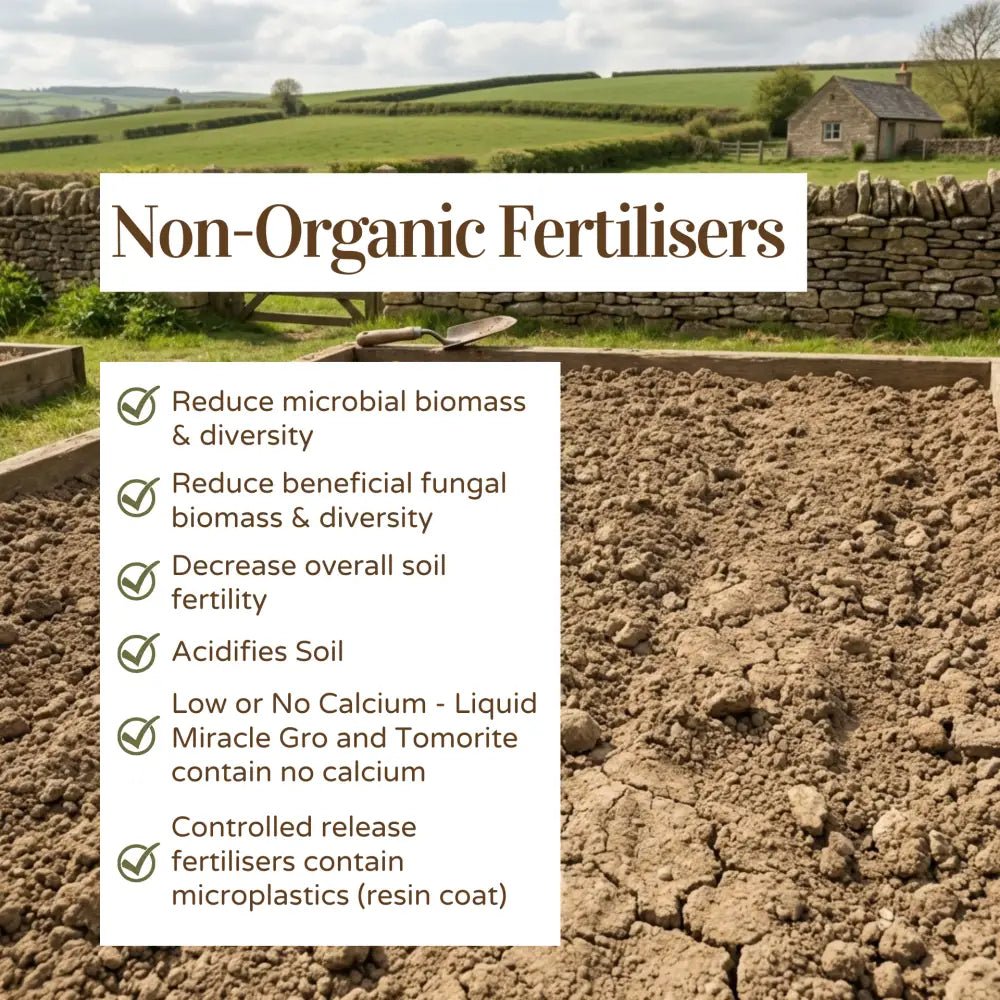
How Fruit & Vegetable Fertiliser (Veg Feed) 4-5-6 compares
Full guide and scienceDr Forest Fruit & Vegetable 4-5-6 — dry, slow-release blend
- 19 ingredients, every one named on this page
- Calcium, magnesium and sulphur alongside the NPK
- A top-dressing every 4–6 weeks for most crops
- Adds biochar, humic acid, clay and seaweed to the soil
Typical liquid tomato feed — soluble concentrate
- NPK, often with magnesium; calcium is rarely on the label
- Diluted in the can, usually weekly once fruit sets
- Available at once; what the roots miss drains away
- Adds nothing to the soil itself
Customer highlight
excellent product, well packed. my only gripe is the pack size, smallest size I could order was 1.5kgs yet they sent it as two 750g packs, would have liked the option to buy one 750g pack otherwise everything first rate.
Editorial highlight from marketplace and store reviews — separate from the full review list below.
Fruit and vegetable fertiliser 4-5-6 — 19 ingredients, potash-led for fruit, roots and pods
Dr Forest Fruit & Vegetable Fertiliser is a premium 4-5-6 slow-release organic fertiliser for the kitchen garden: tomatoes, peppers, courgettes, root crops, beans and soft fruit. Potassium leads the ratio for fruit quality, and nitrogen is kept moderate so plants crop rather than run to leaf. Made with organic ingredients and natural minerals, it is formulated and blended in small batches in Stockport, with all 19 ingredients listed.
It is an organic plant food for vegetables and fruit, made for people growing their own organic food on an allotment, in raised beds or in grow bags by the back door. The mineral fraction works within days of watering in, while the plant meals, polyhalite and rock phosphate release for weeks after. Of our organic fertilisers, this is the all-rounder for edible crops.
What it does across your kitchen garden
- Potash for fruit quality — chloride-free potassium from sulphate of potash and Yorkshire polyhalite, the nutrient most tied to sweetness and colour.
- Calcium all season — 6.2% calcium from five of the ingredients. Watering still decides whether it reaches the fruit.
- Phosphorus for roots and flowers — a quick-release phosphorus meal, with rock phosphate as the slow reserve.
- Magnesium for green leaves — three sources, fast to slow, for heavy croppers whose leaves yellow between the veins in midsummer.
- Nitrogen in proportion — enough for steady growth, not so much that tomatoes and beans run to leaf.
- Better soil each year — British biochar, humic and fulvic acid, clay and Scottish seaweed go in with every feed.
Dr Forest Fruit & Vegetable vs a liquid tomato feed
Dr Forest Fruit & Vegetable 4-5-6 — dry, slow-release blend
- 19 ingredients, every one named on this page
- Calcium, magnesium and sulphur alongside the NPK
- A top-dressing every 4–6 weeks for most crops
- Adds biochar, humic acid, clay and seaweed to the soil
Typical liquid tomato feed — soluble concentrate
- NPK, often with magnesium; calcium is rarely on the label
- Diluted in the can, usually weekly once fruit sets
- Available at once; what the roots miss drains away
- Adds nothing to the soil itself
For what goes into the best-known brands, see what is actually in Tomorite.
Blended in small batches in Stockport, and packed in compostable packaging. Dr Forest is named after Joe's grandfather, Dr Forrest, a GP in a Lancashire mining town near Preston who kept a back-garden plot for the runner beans he turned into piccalilli for family and friends. For the thinking behind feeding the soil as well as the plant, read what living soil is.
All 19 ingredients — what each one does for fruit and vegetables
A multi-input formula, with every input listed. The main plant meals come from Cambridgeshire, the polyhalite from North Yorkshire and the seaweed from Scotland; the biochar is British. Blend shares are shown where we publish them.
Nitrogen plant extract — Cambridgeshire, slow release
Plant protein concentrate at 12% N, 3% P₂O₅ and 4% K₂O: the main nitrogen source, released over six to eight weeks as microbes break it down.
Phosphorous rich plant meal — Cambridgeshire, fast release
A calcined plant meal at around 15% P₂O₅ and 9% CaO. The quicker phosphorus source, for rooting after transplanting and for flowering.
Yorkshire polyhalite — North Yorkshire, slow release
One mineral carrying 14% K₂O, 17% CaO, 6% MgO and 48% SO₃, mined 1,200 metres below the North Sea. It dissolves more slowly than sulphate of potash, extending supply by 50–60 days. See our polyhalite guide.
Sulphate of potash — mineral, immediate release
50% K₂O and chloride-free. The fast potassium, covering the crop until the slower polyhalite supply builds.
Gypsum (calcium sulphate) — mineral, fast release
23.3% calcium and 18.6% sulphur in soluble form. Calcium can't be moved from older leaves into fruit, so the soil has to supply it all through fruiting, and gypsum does so without raising pH.
Micronised rock phosphate — mineral, slow reserve
31% P₂O₅ and rich in calcium; it dissolves slowly, so it is still releasing phosphorus as the last fruit swells.
Rapeseed meal — British, slow release
A high-protein plant meal that microbes break down over six to eight weeks.
Clay minerals — British, permanent
Montmorillonite and illite clays hold potassium, calcium and magnesium against leaching and release them to roots, which matters most in pots and grow bags.
Mealworm frass — sustainably reared
Droppings and shed skins from mealworm rearing: a little slow-release nitrogen and phosphorus, plus chitin, which may stimulate beneficial soil microbes (Barragán-Fonseca et al., 2022).
Herbal mixture — comfrey, nettle, yarrow and chamomile
Dried herbs from the allotment tradition; comfrey is the classic British potash plant. Research on each herb alone is thin, so we claim no more than that.
Silica meal — mineral, structural
Plants take up silicon in amounts comparable to calcium and magnesium, and plants short of it are often structurally weaker (Epstein, 1999).
Seaweed extracts — British coastal, biostimulant
A concentrated extract, there for its growth-regulating compounds (cytokinins, auxins and betaines among them) rather than its nutrients (Khan et al., 2009).
EM microorganisms — living culture
A mixed culture of beneficial bacteria, yeasts, actinomycetes and lactic acid bacteria.
Alfalfa meal — plant meal, slow release
About 2.5% N and 1.4% Ca. The growth-promoting substance in alfalfa meal was identified as triacontanol, a natural plant growth regulator (Ries et al., 1977). More on alfalfa meal.
Micronised magnesium mineral — mineral, sustained release
20.9% Mg, the most concentrated magnesium source here, released slowly through the season.
Magnesium sulphate — mineral, immediate release
Water-soluble magnesium for the early growth spurt, until the slower sources take over.
Scottish seaweed — hand-harvested
Whole seaweed from Scottish coastal waters, breaking down over weeks and adding trace elements; results vary with crop and conditions (Craigie, 2011).
Fermented biochar — British, activated
Fermented before blending to charge it with microbes. Its pores hold water and nutrients; pooled trials show a 10% average rise in crop productivity (Jeffery et al., 2011).
Humic and fulvic acid — chelation and root growth
Humic substances make iron and zinc easier for roots to take up, and on average raised shoot and root growth by about a fifth, depending on source and rate (Rose et al., 2014).
How to use fruit and vegetable fertiliser: rates, timing and method
All g/m² rates assume even surface incorporation to 2–3cm depth. For new beds, borders or containers being set up for the first time, apply at double the standard rate as an initial base charge and work into the full soil depth before planting.
Step-by-step application
- Water first. Make sure the soil or compost is moist before applying. Never apply to bone-dry soil: the mineral fraction needs moisture to dissolve and reach the root zone. If it is very dry, water thoroughly and allow it to drain for 30 minutes.
- Sprinkle evenly over the root zone. Spread it across the full root area, not just at the stem base. For containers, sprinkle across the entire compost surface. Avoid direct contact with leaves, stems and developing fruit.
- Lightly fork in. Work it into the top 2–3cm of soil or compost: a finger or small hand fork in pots, a border fork or hoe in open ground (more in how to top dress). Avoid deep incorporation, because the soil biology is concentrated in the top layer.
- Water in thoroughly. Water within 24 hours of application. In containers, water until it runs freely from the base. In open ground, apply before rain when possible.
Rates by crop
Fruiting vegetables
| Plant | Rate per m² | Frequency & notes |
|---|---|---|
| Tomatoes | 80–120g | Better on Tomato Fertiliser 3-4-6. On this bag, from the first truss, every 4–5 weeks. Not every 2 weeks. |
| Peppers & chillies | 75–110g | Better on Chilli & Pepper Fertiliser. On this bag, every 4 weeks, and ease off as fruit ripens. |
| Courgettes & summer squash | 80–120g | Every 4–5 weeks. Heavy potassium feeders. |
| Winter squash & pumpkins | 80–110g | Every 5 weeks through to August, then stop to allow hardening and sugaring of the skin before harvest. |
| Cucumbers | 75–100g | Every 4 weeks. |
| Runner & French beans | 55–70g | Once, when you prepare the bed. They fix their own nitrogen. A top-dress only if growth is pale. |
| Peas | 30–45g | Once, when you prepare the bed. They fix their own nitrogen and rarely need a top-dress. |
| Sweetcorn | 80–110g | At planting then every 4 weeks until tassels appear. Reduces to every 6 weeks once silk has been pollinated. |
Root vegetables
| Plant | Rate per m² | Frequency & notes |
|---|---|---|
| Potatoes | 100–150g | Better on Potato Fertiliser 3-5-8. At planting, then the sprinkle when you earth up, which is the top-dress. One or two top-dresses for earlies, two or three for maincrops. |
| Carrots | 60–75g | Once at sowing, and one top-dress at most. Extra nitrogen forks the root. Potassium supports sweetness and colour. |
| Beetroot & turnips | 65–80g | Every 5 weeks. Potassium and phosphorus drive root swelling and sugar build-up. |
| Onions & garlic | 65–80g | Once at planting, and one top-dress at most. Stop once bulbs begin to swell. Extra feed makes bulbs that store badly. |
| Leeks | 70–110g | Every 4–5 weeks. A long-season crop with high nutrient demand. Moderate nitrogen keeps the plant building shank rather than excess leaf. |
On fruit trees and soft fruit
Soft fruit in the ground. Scatter the feed over the root area, along the row or under the bush, then hoe it in lightly and water.
- Strawberries: Strawberry Feed 3-2-7 suits them better. If you use this feed: summer-fruiting, 65–100 g per m² straight after picking (spring only for weak plants); everbearers, 50 g per m² in spring and again in midsummer. Don't go above 150 g per m² in a season.
- Summer raspberries: 70–110 g per m² in March as buds break, then 50–100 g per m² in May or June. No feeding after the end of July.
- Autumn raspberries: 70–110 g per m² in March, then 50–100 g per m² in June or July.
- Blackberries, tayberries, loganberries: 70–110 g per m² in March, then 50 g per m² in May or June if growth is weak.
- Blackcurrants: 100 g per m² in late winter and 100 g per m² in May. A further 50 g per m² after picking is optional.
- Redcurrants, whitecurrants, gooseberries: 80–120 g per m² in late winter, plus 50 g per m² in May if growth is weak.
- Blueberries: this isn't an ericaceous feed, and a dedicated ericaceous feed suits them better. If you do use it, don't mix it in at planting or potting. Feed lightly three times, in late April, mid-May and mid-June: 30–50 g per bush in the ground, spread under the branches, or 1–2 g per litre of compost in pots. Keep them in acid soil or ericaceous compost (pH 4.5–5.5) and water with rainwater. Check the pH each spring; if it's above 5.5, stop and switch to an ericaceous feed.
Raspberries, currants and gooseberries use a lot of potash. To top it up, add Sulphate of Potash in late winter: 10 g per m² on average soil, or up to 25 g per m² where a soil test shows low potash.
Fruit and nut trees in the ground. One feed in spring is usually enough (almonds can have a second). Scatter it under the branches out to the tips, keeping it at least 30 cm from the trunk, and water in.
- Apples: 50–100 g per m² under the branches, March to early April. Nothing after early July.
- Pears, plums, gages, damsons, cherries: 100 g per m² under the branches, March–April. If plums still look pale by early summer, give a nitrogen-only feed by June rather than more of this bag.
- Walnuts: 100 g per m² under the branches in April. Nothing after June. On good soil, walnuts need nothing in their first year.
- Almonds: 50–100 g per m² under the branches at flowering (February–March), with an optional second feed 4–6 weeks later. Nothing after June. Keep granules at least 45 cm from the trunk of young trees.
- A tree about 2 m across covers roughly 3 m², so it takes 150–300 g.
- Big established trees in mulched soil or grass often need no feeding. Feed them if growth is weak or crops are poor.
- Newly planted trees: don't put granules in the planting hole. Start feeding when growth begins the following spring.
- Apples: don't overfeed. It gives greener, softer fruit that keeps less well. Only add Sulphate of Potash or Polyhalite if a soil test shows low potash.
- Walnuts release natural compounds that affect neighbouring plants, such as tomatoes planted underneath. No fertiliser changes that.
Fruit in pots
- Patio apples, plums and figs: mix 4–6 g per litre of compost at potting. Then top-dress 2 g per litre of pot size in spring and again in late May. A 45 cm pot holds about 40 litres, so that's about 80 g each time.
- Figs: feed lightly and stop by midsummer. Kept a little hungry, they tend to make figs rather than leaves. A fig in the ground with its roots restricted (in a lined planting pit) can have one dressing of 40–50 g in March–April; one growing unrestricted in mulched soil needs nothing unless growth is weak (less than about 30 cm of new shoot a year). Give a fig only one spring feed, this or another fruit feed.
- Lemons and other citrus are hungry plants. Mix 5 g per litre at potting, then top-dress 2 g per litre every 4–6 weeks from late March to September. Go up to 3 g per litre if the leaves turn evenly pale. Water with rainwater where you can.
- Yellow young leaves with green veins on citrus usually point to hard tap water or high pH rather than hunger. This isn't an iron feed.
Soil mix: charging compost at planting
| Situation | Rate | Method | Notes |
|---|---|---|---|
| Containers & pots | 4–6g per litre | Mix evenly through the full volume before potting | 4g/L in compost already containing nutrients. 6g/L in plain or peat-free mixes. |
| Grow bags (40–50L) | 150–200g per bag | Mix thoroughly throughout the full bag before planting | 150g for bags with nutrients. 200g for plain bags. |
| Raised beds & borders | 100–120g per m² | Fork into the top 15–20cm before planting | Double the standard top-dress rate as a single pre-season application. |
| Single plant at transplanting | 15–25g per plant | Mix into the planting hole before placing the rootball | 15g for small transplants. 25g for larger rootballs or hungry crops like tomatoes. |
Top dressing: feeding through the season
| Situation | Rate | Frequency | Notes |
|---|---|---|---|
| Containers (per litre of pot volume) | 2–3g per litre | Every 4 weeks | Apply to compost surface, fork in lightly, water in thoroughly. |
| Grow bags (40–50L) | 60–90g per bag | Every 4 weeks from first truss | For tomatoes and peppers, start top-dressing when first truss sets. |
| Outdoor beds & raised beds | 80–100g per m² | Every 4–6 weeks | 4 weeks for heavy feeders. 5–6 weeks for root veg. Soft fruit: see the soft fruit section above. |
| Single plant top-dressing | 10–15g per plant | Every 4 weeks | Distribute around the full root zone, not at the stem. |
Mid-March to end of August for most crops. Soil must be above 8°C for organic N fractions to mineralise, typically mid-to-late March in most of the UK. The mineral K and Ca fractions activate as soon as the soil is moist. Stop when fruit begins ripening in earnest.
Water before you feed. Moisten the soil first and water in afterwards, as in steps 1 and 4.
Use Dr Forest Organic Seaweed Extract Powder as a fortnightly foliar or drench: it adds cytokinins without extra nitrogen load. Apply Amino Chelated Calcium as a targeted foliar spray if blossom end rot appears mid-season. Use the Dr Forest All Purpose 4-4-4 during the vegetative establishment phase before switching to this formula at first flower.
Kitchen garden growing guide — feeding roots, brassicas, legumes, fruiting veg and soft fruit
A UK kitchen garden runs on a short season: soil warm enough to feed from mid-to-late March, first frosts from October. Most problems come down to timing and water. For other allotment fertilisers and crop-specific feeds, see our vegetables and allotment range.
Feeding fruit crops and vegetables by group
Roots and onions — potatoes, carrots, beetroot, onions, leeks
- Too much nitrogen gives leaf at the root's expense; potatoes are the hungry exception
- UK varieties: potatoes 'Charlotte' and 'Maris Piper', carrot 'Nantes 2', beetroot 'Boltardy', onion 'Sturon', leek 'Musselburgh'
Brassicas — cabbage, kale, sprouts, broccoli
- Leaf and flower-head crops that stand for months in firm ground
- UK varieties: cabbage 'January King', kale 'Cavolo Nero', sprouting broccoli 'Claret', Brussels sprout 'Brigitte'
- No brassica row in the rate tables; a balanced feed such as our All Purpose 4-4-4 suits leaf crops better, though this formula won't harm them
Legumes — peas, runner beans, French beans, broad beans
- Root nodules fix their own nitrogen; potassium and phosphorus help pod fill
- UK varieties: runner bean 'Scarlet Emperor', French bean 'Cobra', peas 'Hurst Green Shaft' and 'Kelvedon Wonder', broad bean 'Aquadulce Claudia'
Fruiting veg — tomatoes, peppers, courgettes, squash, cucumbers, sweetcorn
- The hungriest group; potassium carries flavour, while calcium and even watering keep fruit sound
- UK varieties: tomatoes 'Gardener's Delight' and 'Sungold', courgette 'Defender', squash 'Crown Prince', cucumber 'Marketmore', sweetcorn 'Swift'
Soft fruit crops — strawberries, raspberries, currants, gooseberries, blueberries
- Permanent plantings fed by the calendar; blueberries need acid soil, which our Sulphur Soil Acidifier can provide
- UK varieties: strawberry 'Cambridge Favourite', raspberries 'Glen Ample' and 'Autumn Bliss', blackcurrant 'Ben Sarek', gooseberry 'Invicta', blueberry 'Bluecrop'
Feeding adjustments by crop
Tomatoes — cordon and bush types
Apply at planting, then top-dress every 4–5 weeks from when the first truss sets through to the end of harvest. Long-cropping cordons take more feeds than bush types.
Potatoes — earlies and maincrop
One or two top-dresses for earlies, two or three for maincrops such as 'Maris Piper'. Use the upper rate (130–150g) where tuber bulk is the aim.
Peas and beans — the light feeders
Legumes make their own nitrogen; what they take from this feed is potassium and phosphorus.
Greenhouse vs outdoor
Greenhouse and polytunnel
- Tomatoes and cucumbers go in from late April in the south, May elsewhere
- Most crops are in pots or grow bags, so use those rows
- Water daily in hot spells and ventilate on warm days
Outdoor beds and allotments
- Tender crops go out after the last frost: mid-May in the south, late May to early June further north
- The per-m² rates apply; feed before rain when you can
- Plant sweetcorn in blocks, not rows, so it pollinates
Watering — the make-or-break factor
Water carries fertiliser to the roots and calcium into fruit, so erratic watering undoes good feeding. A thorough soak less often beats a daily splash.
Containers and grow bags
Check daily in summer and water until it runs from the base, twice a day for a grow-bag tomato in a heatwave.
Greenhouse border
Water the soil, not the leaves, in the morning, and mulch to hold the moisture.
Outdoor beds and allotments
A weekly soak in dry spells, and never let peas and beans go dry at flowering or potatoes as the tubers form.
How much calcium reaches fruit depends heavily on water delivery (Hocking et al., 2016), so a plant that goes dry while its fruit swells can run short at the flower end even in calcium-rich soil. That is blossom end rot; more in our blossom end rot guide.
Crop rotation on a four-bed plot
- Bed one: potatoes. The hungriest crop, with outdoor tomatoes from the same family.
- Bed two: legumes and squash. Peas and beans, plus sweetcorn, courgettes and squash.
- Bed three: brassicas. They follow the legumes to use the nitrogen left behind.
- Bed four: roots and onions. None of them want freshly manured ground.
Each group moves on one bed a year.
UK seasonal timeline
| Month | Task | Feeding |
|---|---|---|
| January | Plan the rotation. Winter-prune currants and gooseberries. | None; feeding starts mid-to-late March |
| February | Chit seed potatoes. Cut autumn raspberries to the ground. | None |
| March | Plant onion sets and first early potatoes. Sow tomatoes under cover. | Soft fruit: first feed. Beds: 100–120g per m² before planting |
| April | Plant maincrop potatoes. Sow carrots, beetroot and peas outdoors. | Potatoes: 100–150g per m² at planting. Carrots: 60–75g per m² at sowing. Pots: 4–6g per litre |
| May | Plant greenhouse tomatoes. Plant out tender crops after the last frost. Earth up potatoes. | Transplants: 15–25g per plant. Grow bags: 150–200g per bag before planting |
| June | Plant leeks. Pinch out tomato side shoots. Lift first earlies. | Tomatoes: top-dressing starts as the first truss sets. Raspberries and blueberries: June feed |
| July | Keep watering steady. Harvest garlic, onions, courgettes and beans. | Heavy feeders: every 4 weeks. Summer-fruiting strawberries: straight after picking |
| August | Harvest tomatoes, sweetcorn and summer raspberries. Plant new strawberries. | Winter squash: last feed. Summer raspberries: none after the end of July |
| September | Lift maincrop potatoes. Leave squash in the sun to harden their skins. | None |
| October | Plant garlic and sow broad beans. Clear spent crops to the compost heap. | None for most crops |
| November | Plant bare-root fruit bushes and canes. Mulch empty beds. | None |
| December | Check stored crops. Order seed. | None |
Common problems
Blossom end rot on tomatoes and peppers
A sunken, leathery patch at the flower end. Water deeply and evenly, and if it appears mid-season apply Amino Chelated Calcium as a targeted foliar spray.
Yellowing between the veins of older leaves
Potassium suppresses magnesium uptake more than the reverse, and potassium-induced magnesium deficiency is widespread (Xie et al., 2021). This blend carries three magnesium sources alongside its potash. See magnesium deficiency in tomato plants.
All leaf and few flowers
Fresh manure or a high-nitrogen feed keeps plants in leaf; switch to this formula at first flower. Runner beans that flower without setting are often dry at the roots.
Split tomatoes and cracked roots
The inside swells faster than the skin can stretch. Water evenly and mulch.
Onions that won't keep
Stop feeding once bulbs begin to swell visibly. Let the tops fall, then lift on a dry day and dry them off before storing.
Why a potash-led organic fertiliser grows better fruit and veg
A 4-5-6 ratio follows what cropping plants take from the soil once established: steady phosphorus, moderate nitrogen and more potassium than a leaf crop would want.
Why the 4-5-6 ratio works
Once a plant turns from leaf to fruit, its main job is moving sugars into the part you'll eat, and potassium is central to that. Of all the mineral nutrients, potassium has the strongest influence on fruit quality, from sugars and firmness to vitamin C (Lester et al., 2010). Nitrogen stays moderate because a plant given plenty at flowering keeps making leaf.
What each nutrient does in the crop
| Nutrient | What it does | Carried by, in this blend |
|---|---|---|
| Nitrogen | Leaf and stem growth | Nitrogen plant extract, rapeseed meal, alfalfa meal, mealworm frass |
| Phosphorus | Roots, flowering, pod and seed set | Phosphorous rich plant meal, rock phosphate, nitrogen plant extract, frass |
| Potassium | Sugar movement into fruit; sweetness and colour | Sulphate of potash, polyhalite, nitrogen plant extract, herbal mixture (comfrey) |
| Calcium | Cell walls; a shortage at the flower end is blossom end rot | Gypsum, polyhalite, rock phosphate, phosphorous rich plant meal, alfalfa meal |
| Magnesium | The centre of every chlorophyll molecule | Micronised magnesium mineral, magnesium sulphate, polyhalite |
| Sulphur | Proteins, and the flavour of onions, garlic and brassicas | Polyhalite, sulphate of potash, gypsum, magnesium sulphate |
| Silicon | Structural strength in stems and leaves | Silica meal |
The 3:1:3 calcium, magnesium and potassium target
These three compete at the root, and potassium suppresses magnesium uptake more than the reverse (Xie et al., 2021), so the blend is designed around a 3:1:3 Ca:Mg:K target. We don't treat the ratio as magic: within normal soil ranges, cation ratios make little difference to fertility (Kopittke & Menzies, 2007). Having enough of each is what counts.
Fast minerals, slow meals: an organic-mineral fertiliser
Immediate mineral fraction — days 1–14
- Sulphate of potash — 50% K₂O, soluble at once
- Gypsum — 23.3% Ca and 18.6% S in sulphate form
- Magnesium sulphate — immediately available magnesium
- Phosphorous rich plant meal — the quick phosphorus
Slow-release fraction — weeks 3–10 and beyond
- Nitrogen plant extract — nitrogen over 6–8 weeks
- Yorkshire polyhalite — K, Ca, Mg and S over 50–60 days
- Rapeseed meal — slow nitrogen as microbes break it down
- Micronised rock phosphate and magnesium mineral — reserves lasting months
What the organic fraction adds: the evidence
Better tomatoes at a similar yield
Against chemical fertiliser alone, organic fertiliser moved tomato quality (nitrate, sugar, lycopene) far more than it moved yield (Fan et al., 2023).
More soil life
Organic inputs were among the drivers of bigger, busier soil microbial communities in organically managed ground (Lori et al., 2017).
More soil carbon
Organic systems hold more topsoil carbon (Gattinger et al., 2012), and soil carbon is what gives a bed its crumb and its hold on water.
Biochar holds water and nutrients
The likeliest reasons for its gains, the authors suggest, are a liming effect and better water holding, along with better nutrient availability (Jeffery et al., 2011).
Humic substances grow more root
More shoot and more root on average, though the response depends mainly on source and rate (Rose et al., 2014).
Seaweed works as a biostimulant
Its value lies in growth-regulating compounds such as cytokinins and auxins (Khan et al., 2009); the idea that seaweed works mainly through its nutrients is "no longer tenable" (Craigie, 2011).
Study data
| Study | Scope | Finding |
|---|---|---|
| Fan et al. (2023) | 124 studies, 2,041 data sets | Ordinary organic fertiliser vs chemical fertiliser alone: tomato nitrate −13%, sugar +10.7%, lycopene +10.8%. All organic types: yield +3.5% |
| Lori et al. (2017) | 56 papers, 149 comparisons | Microbial biomass and enzyme activity +32–84% under organic management |
| Gattinger et al. (2012) | 74 studies | Topsoil carbon +3.5 t per hectare in organic systems |
| Jeffery et al. (2011) | Meta-analysis, biochar | Crop productivity +10% on average |
| Rose et al. (2014) | Meta-analysis, humic substances | Shoot dry weight +22%, root dry weight +21% |
Scientific references
- Barragán-Fonseca, K.Y. et al. (2022). Insect frass and exuviae to promote plant growth and health. Trends in Plant Science, 27(7), 646–654.
- Craigie, J.S. (2011). Seaweed extract stimuli in plant science and agriculture. Journal of Applied Phycology, 23(3), 371–393.
- Epstein, E. (1999). Silicon. Annual Review of Plant Physiology and Plant Molecular Biology, 50, 641–664.
- Fan, H. et al. (2023). Effects of organic fertilizer supply on soil properties, tomato yield, and fruit quality: a global meta-analysis. Sustainability, 15(3), 2556.
- Gattinger, A. et al. (2012). Enhanced top soil carbon stocks under organic farming. Proceedings of the National Academy of Sciences, 109(44), 18226–18231.
- Ho, L.C. & White, P.J. (2005). A cellular hypothesis for the induction of blossom-end rot in tomato fruit. Annals of Botany, 95(4), 571–581.
- Hocking, B. et al. (2016). Fruit calcium: transport and physiology. Frontiers in Plant Science, 7, 569.
- Jeffery, S. et al. (2011). A quantitative review of the effects of biochar application to soils on crop productivity using meta-analysis. Agriculture, Ecosystems & Environment, 144(1), 175–187.
- Khan, W. et al. (2009). Seaweed extracts as biostimulants of plant growth and development. Journal of Plant Growth Regulation, 28(4), 386–399.
- Kopittke, P.M. & Menzies, N.W. (2007). A review of the use of the basic cation saturation ratio and the "ideal" soil. Soil Science Society of America Journal, 71(2), 259–265.
- Lester, G.E. et al. (2010). Impact of potassium nutrition on postharvest fruit quality: melon (Cucumis melo L) case study. Plant and Soil, 335, 117–131.
- Lori, M. et al. (2017). Organic farming enhances soil microbial abundance and activity: a meta-analysis and meta-regression. PLOS ONE, 12(7), e0180442.
- Ries, S.K. et al. (1977). Triacontanol: a new naturally occurring plant growth regulator. Science, 195(4284), 1339–1341.
- Rose, M.T. et al. (2014). A meta-analysis and review of plant-growth response to humic substances: practical implications for agriculture. Advances in Agronomy, 124, 37–89.
- Xie, K. et al. (2021). Synergistic and antagonistic interactions between potassium and magnesium in higher plants. The Crop Journal, 9(2), 249–256.
Figures describe the published literature on these ingredient classes and are not product-specific yield guarantees.
Frequently asked questions about fruit and vegetable fertiliser
Peas and broad, runner and French beans fix their own nitrogen, so they need one light dressing when you prepare the bed (30–45 g per m² for peas, 55–70 g for beans) and rarely anything after. Carrots and parsnips want soil that wasn't freshly manured, or they fork; a light base dressing is plenty. Leafy crops such as cabbage, kale and lettuce aren't harmed by this feed, but they want a nitrogen-led one. The hungry ones are tomatoes, courgettes, squash, potatoes and soft fruit, which is what this 4-5-6 is built for.
One that mixes fast and slow inputs, so plants get something in the first fortnight and something still arriving in week six. This 4-5-6 does that with 19 named ingredients, chloride-free potash from sulphate of potash and Yorkshire polyhalite, plus calcium, magnesium and sulphur, and British biochar, humic acid, clay and Scottish seaweed for the soil. One top-dressing at around 80–100 g per m² feeds for six to eight weeks. Slow release depends on soil life, so expect little in a cold March. More on how it works: organic slow-release fertiliser.
It depends what you're eating. For fruit, roots, pods and tubers (tomatoes, courgettes, potatoes, beans, soft fruit), a potash-led ratio with moderate nitrogen, such as this 4-5-6, keeps plants cropping rather than running to leaf. For leaf crops (cabbage, kale, spinach, salads), you want nitrogen in the lead. For a mixed plot where you only buy one bag, a balanced 4-4-4 is the compromise. The numbers are percentages of nitrogen, phosphate and potash by weight; our guide to NPK explains how to read them.
Customers also bought
15% of buyers here also chose Organic Tomato Fertiliser

Rose Feed 5-3-5 | Organic Rose Fertiliser & Rose Food
A slow-release 5-3-5 feed for roses.
from £11.50
Mycorrhizal Fungi Powder | 18 Species, Endo + Ecto, Dated Pouch
A root inoculant, 18 endo and ecto species.
from £6.99


