Liquid gypsum · FAQ
Your liquid gypsum questions, answered
Seventeen questions, each answered in full on its own page. Start with whichever one is yours.
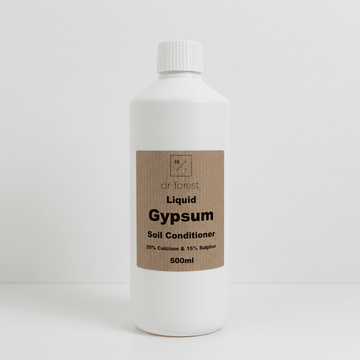
Mined natural mineral
Liquid Gypsum
Micronised natural calcium sulphate with fulvic acid, for clay soil and calcium feeding. 500ml · 1 litre
Shop Liquid GypsumThis page is an index, not the product. Below are seventeen questions gardeners actually ask, each answered in full on its own page, with sources: what it is, how it works on clay, the rates and timings, the safety, and the places where the evidence runs out.
For the product itself, its full analysis and how to use it, see Dr Forest Liquid Gypsum, which comes in 500ml and 1 litre alongside the rest of the liquid range.
Not sure where to start?
If your question is whether it will do anything in your particular garden, begin with a crumb of your own soil in a jar of rainwater. Nobody has surveyed how much British garden clay actually disperses, which is why that test is worth more to you than any average: it costs nothing and it tells you about your own soil.
Every question, answered
Start here if you have clay
Start with a crumb of your own soil in a jar of rainwater, because no average tells you what your clay actually does. The full dispersion test →
Ready to buy?
Liquid Gypsum
19.55% calcium and 15.31% sulphur (27.35% CaO, 38.23% SO₃), milled to a 5 micron average and suspended in fulvic acid.
Zero neutralising value, not a liming material · No digging in · Mined mineral · No synthetic dispersants · 500ml and 1 litre
Shop Liquid GypsumSources
- Oster, J.D., Shainberg, I. and Wood, J.D. (1980). Flocculation value and gel structure of sodium/calcium montmorillonite and illite suspensions. Soil Science Society of America Journal 44(5), 955–959.
- GRDC (2020). Dealing with dispersive soils. Western region fact sheet.
- Anderson, G.C. et al. (2021). Agronomy 11(5), 826.
- Lingenfelter, D. and Beegle, D.B. Soil acidity and aglime. Penn State Extension.
- Fleuridor, L. et al. (2021). Agronomy Journal 113(5), 4220–4230.
- Chen, L. and Dick, W.A. (2011). Gypsum as an agricultural amendment, Bulletin 945. Ohio State University Extension.
- Royal Horticultural Society. Clay soils. rhs.org.uk
Soil notes
Get the evidence, not the marketing
Occasional notes from Stockport on feeding, soil structure and what the research actually supports, including the things that turn out not to work.
No spam. Unsubscribe in one click. See our privacy notice.