
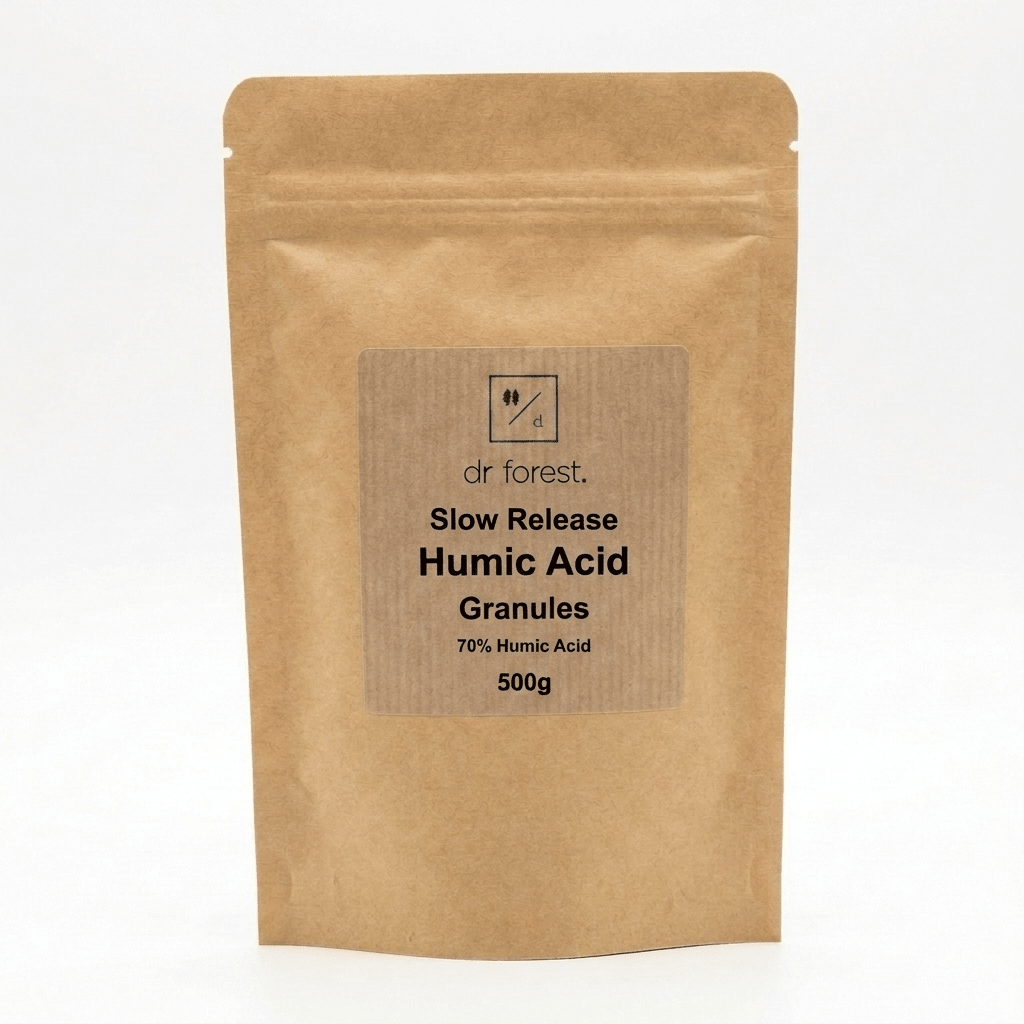
Slow release humic acid granules for lawns, beds and borders
Slow release humic acid is a granulated leonardite humate, 70% humic acid, that does not dissolve in water. It sits in the soil and breaks down gradually as soil biology works on it, feeding humic substances into the root zone across months rather than hours. This is the soil-building form of humic acid, not the drenching form.
The distinction matters. A soluble humic flake goes into solution, does its work over days to weeks, and is largely consumed. A granule that will not dissolve stays where you put it. Rain does not carry it off, irrigation does not flush it through, and each watering releases a little more. On a lawn or a bed you intend to keep improving season after season, that is the behaviour you want.
Concentration is the number to check on any humate, and it is the number most often left off the bag. Granular humates sold for lawns range from single figures up to the seventies, with the difference made up by carrier and filler. At 70% humic acid this is at the concentrated end, so the rates on this page are lower than you may be used to. If you are comparing products, compare the guaranteed analysis rather than the bag weight.
What the humate does once released is the same chemistry either way. It raises cation exchange capacity so minerals are held rather than leached, it feeds bacterial and fungal activity in the rhizosphere, and it carries auxin-like activity associated with root elongation and lateral root branching.
Do not try to use these granules in a foliar spray, a fertigation reservoir, a seed soak or a compost tea. They are made not to dissolve. For those jobs you want Humic Acid Flakes, which go into solution completely within minutes.
What it is for
- Lawns and turf — spreads through a standard fertiliser spreader, needs no watering in to disperse, and suits compacted or sandy lawns where a soluble input would be gone before it did much.
- Long-term soil building — raised beds, allotment plots and borders you are improving over years, not weeks.
- No-dig systems — surface-applied and left to work down, in keeping with a no-dig approach.
- Blending into a dry feed — the granule matches most granular fertilisers, so it distributes evenly rather than sifting to the bottom of the bag.
- Fruit, roses and shrubs — a single autumn or early spring application over the root spread, left on the surface under the mulch.
Slow release humic acid (this product)
Granular, insoluble, releases over months. Broadcast by hand or spreader, or blend into a dry feed. Best for lawns and for building soil organic matter and cation exchange capacity over successive seasons.
Humic Acid Flakes (soluble)
Dissolves fully in minutes. Drench, foliar spray, seed soak, compost tea, fertigation. Fast acting, shorter-lived. Best when you need humic activity in the root zone this week.
Made by Growers. Backed by Science.
What humic acid does, and why release rate matters
Humic acid supplies almost no plant nutrients directly. Its value is in changing the conditions nutrients operate under: how tightly the soil holds cations, how much microbial activity there is around the roots, how readily phosphate stays available. Those are cumulative effects, which is an argument for a form that persists.
The growth response is real, and it is variable
Rose and colleagues (2014, Advances in Agronomy 124:37–89) pooled the published trial literature on humic substances and ran a random-effects meta-analysis. Shoot dry weight came out 22 ± 4% higher and root dry weight 21 ± 6% higher. The authors are explicit that actual responses varied considerably, and were driven mainly by the source of the humic substance and the application rate.
Auxin-like activity on root cells
Nardi and colleagues (2002, Soil Biology & Biochemistry 34:1527–1536) reviewed the direct hormone-like effects of humic substances on higher plants. Their conclusion is worth stating precisely: the low molecular size fraction, below roughly 3,500 Da, reaches the root cell membrane and is partly taken up, while the high molecular size fraction interacts only with the cell wall. It is the smaller fraction that does most of the growth promotion. Canellas and Olivares (2014, Chemical and Biological Technologies in Agriculture 1:3) traced the same response to auxin-like activity within the humic pool.
Microbial and rhizosphere response
Nardi and colleagues (2009, in Biophysico-Chemical Processes Involving Natural Nonliving Organic Matter in Environmental Systems, Wiley) review the biological activity of humic substances across plants and soil organisms. Humic material acts as a carbon source and a conditioning agent at the same time. Effect sizes on microbial biomass differ widely between soils, so we do not publish a single figure for it.
Cation exchange and nutrient retention
Humic substances carry a high density of carboxyl and phenolic groups, which is what gives leonardite humates their exchange capacity. In practice that means potassium, calcium and magnesium are held on the exchange complex and released to roots rather than washing through. On a sandy soil or a free-draining lawn, that is the single most useful change you can make.
Soil carbon builds on a multi-season clock
Allam and colleagues (2022, Agriculture 12:464) found soil organic carbon 12.9% higher on average under organic amendment than mineral-only fertilisation, rising to 20.6% under no-till management. Shi and colleagues (2024, Nature Communications 15:3411), pooling 537 fertilisation experiments, found organic fertilisation raised grassland soil organic carbon by 19% and aboveground biomass by 56% relative to unfertilised controls. Those are multi-season figures, and a granule that persists is matched to that timescale in a way a soluble input is not.
Where the evidence is thinner
The same Rose meta-analysis that found a 22% mean shoot response also found that humic substances from compost sources significantly outperformed lignite and peat-derived humates for growth promotion. Leonardite is a lignite. We sell this product for what it reliably does, which is soil conditioning and cation exchange over seasons, rather than as a growth stimulant. Response size also varies with soil type and starting organic matter, and the largest gains in the literature come from degraded or low-carbon soils. On an already well-managed bed, expect less.
References
- Rose, M.T., Patti, A.F., Little, K.R., Brown, A.L., Jackson, W.R. & Cavagnaro, T.R. (2014). A meta-analysis and review of plant-growth response to humic substances: practical implications for agriculture. Advances in Agronomy 124:37–89.
- Nardi, S., Pizzeghello, D., Muscolo, A. & Vianello, A. (2002). Physiological effects of humic substances on higher plants. Soil Biology & Biochemistry 34:1527–1536.
- Canellas, L.P. & Olivares, F.L. (2014). Physiological responses to humic substances as plant growth promoter. Chemical and Biological Technologies in Agriculture 1:3.
- Nardi, S., Carletti, P., Pizzeghello, D. & Muscolo, A. (2009). Biological activities of humic substances. In: Senesi, N., Xing, B. & Huang, P.M. (eds), Biophysico-Chemical Processes Involving Natural Nonliving Organic Matter in Environmental Systems, Vol. 2 Part 1. Wiley, pp. 305–339.
- Allam, M., Radicetti, E., Quintarelli, V., Petroselli, V., Marinari, S. & Mancinelli, R. (2022). Influence of organic and mineral fertilizers on soil organic carbon and crop productivity under different tillage systems: a meta-analysis. Agriculture 12(4):464.
- Shi, T.-S., Collins, S.L., Yu, K., Peñuelas, J., Sardans, J., Li, H. & Ye, J.-S. (2024). A global meta-analysis on the effects of organic and inorganic fertilization on grasslands and croplands. Nature Communications 15:3411.
How to use slow release humic acid
The granules are broadcast dry. They do not need dissolving, mixing or pre-soaking, and they will not disperse if you try. A rounded tablespoon holds roughly 15 g. For anything above a few square metres, weigh the dose for the area and spread it rather than eyeballing it.
Humic acid for lawns
A lawn is the use case this format suits best. Turf is a permanent planting on shallow soil that gets walked on, mown, and rarely fed anything but nitrogen. Compaction, thinning and dry patch on a lawn are usually soil problems rather than grass problems. A granule that spreads through an ordinary fertiliser spreader, needs no watering in to disperse, and keeps releasing across the season fits that job better than a drench.
Established lawns
Early spring as the soil warms and growth starts, then again in early autumn. Use the upper end on sandy, compacted or heavily used lawns and the lower end on a lawn already in good order. Spread with a broadcast or drop spreader, then either brush in or leave for the next rain.
New lawns, turf laying and overseeding
Rake into the top 50 mm of the prepared seedbed before sowing or laying. This is the one moment you can get humate down into the rooting zone rather than onto the surface, so it is worth the higher rate. For overseeding, apply after scarifying and before the seed goes down.
Lawn top dressing
Blend into a sand and loam top dressing and apply as normal after scarifying and aerating. The 2–4 mm granule mixes evenly through a sandy dressing and works down the aeration holes.
Colour and density respond to nitrogen. Humate does not supply nitrogen and will not green a lawn up in a fortnight. What it changes is the soil the grass is rooting into: better cation exchange means the feed you do apply is held rather than washed through, and more soil biology means organic matter at the surface breaks down rather than sitting there. Judge it over two seasons, not two weeks.
Beds, borders and crops
Raised beds, allotments and vegetable plots
Apply at bed preparation in late winter or early spring. On an empty bed, rake lightly into the top 50 to 100 mm. On a no-dig bed or an established planting, leave it on the surface under the compost mulch and let rain and worms take it down.
Fruit trees, bushes and canes
Late winter or early spring. Scatter over the full root spread, which for a tree means roughly out to the canopy edge rather than in a ring at the trunk. Apply under the mulch, not on top of it.
Roses, shrubs and ornamental borders
Early spring alongside the first feed of the season. Work into the surface with a hand fork where the soil is bare, or apply and mulch over.
Containers, tubs and large pots
Mix through the compost when potting up rather than top-dressing, so it is distributed through the rootball. Because release runs over months, one addition covers a full season in a container.
Blending into a granular feed
The 2–4 mm granule size matches most granular fertilisers, so it can be mixed into a dry feed and spread in one pass without the two components separating in the bag or the spreader.
Method
- Weigh the dose for the area being treated.
- Broadcast evenly by hand for small beds, or with a standard fertiliser spreader for lawns and larger plots.
- Rake lightly into the top 50 to 100 mm on an empty bed or seedbed. On a lawn, a no-dig bed or an established planting, leave it on the surface.
- Water in, or apply before expected rain. Moisture starts the biological breakdown that releases the humates.
- Repeat at the interval given above. Because release is gradual, there is no benefit to applying more frequently.
These rates are being finalised against the current supplier specification. If anything on your bag label differs from this page, follow the bag.
Use with Humic Acid Flakes where you want both a persistent soil reserve and a fast soluble humic input for drenches and foliar work. Fulvic Acid Powder is the smaller, more mobile fraction and the one to reach for when the job is chelating nutrients for uptake. Volcanic Rock Dust pairs well, since the humates hold and exchange the minerals the rock dust releases. On a heavy clay lawn, pair with Liquid Gypsum for the calcium side of soil structure.
If you want humic acid for a foliar spray, a seed soak, a compost tea brew or a fertigation reservoir, this is the wrong product. Those all need the soluble form. Our guide to applying humic acid covers which format suits which job.
Questions
What is humic acid? · Benefits of humic acid for plants · How to apply humic acid · Humic vs fulvic acid · No-dig: reuse and recharge your soil


