


Customer highlight
Perfect product everytime
Everything I needed for a coots mix in one place. The only place I could find niche gardening supplies all in one place. I will happily use Dr forest forever
Editorial highlight from marketplace and store reviews — separate from the full review list below.
Mineral Mix for Plants: a six-mineral soil conditioner that works in weeks and keeps working for years
Mineral Mix for Plants is a six-mineral soil conditioner of volcanic basalt, gypsum, clay minerals and sea shell meal. Compost adds organic matter; this adds the mineral side: calcium and sulphur that release within weeks, a slow reserve of silicon, magnesium and trace elements that weathers out over years, and clay that helps light or peat-free soil hold nutrients between waterings. I blend it in Stockport.
- Holds nutrients in light soil. Clay minerals add cation exchange capacity, so feed stays in sandy and peat-free mixes instead of washing through.
- Calcium and sulphur within weeks. Micronised gypsum releases quickly without changing pH.
- A mineral reserve for years. Basalt weathers slowly, releasing silicon, magnesium and trace elements.
- Fast and slow in one bag. Each mineral comes in a fine and a granular grade, so release is staggered.
- Safe and simple. Pet and child safe; rake it in or mix it into compost.
Part of our soil improver range.
What's in Mineral Mix for Plants
How to use Mineral Mix for Plants: soil mixes, beds and top dressing
The mix weighs roughly 1.2 g per ml, so a level tablespoon is about 15 to 18 g and a 250 ml cup about 300 g. Soil-mix rates are given by volume (ml per litre of compost) because that is how people make up a mix; bed and lawn rates are by weight per square metre. Wear gloves and avoid breathing the dust, as with any fine mineral powder.
Application rates
Making up a soil mix (pots, containers, raised beds)
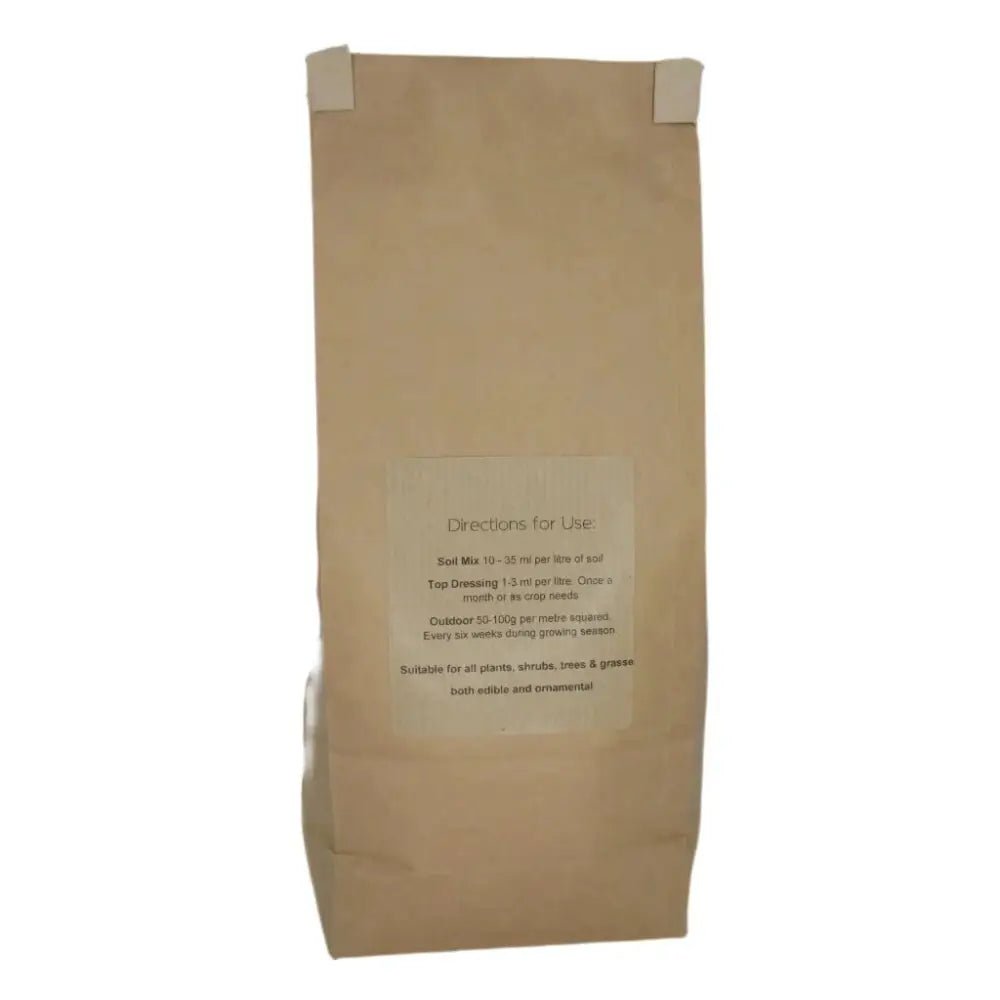
Mix in thoroughly before planting. Use 10 to 15 ml per litre for loam-based or home-made composts that already carry some mineral content, 15 to 20 ml for a standard multipurpose, and up to 30 ml for very mineral-poor peat-free mixes. Building the minerals into the medium at the start does more than any later top-dressing can.
Top-dressing established pots and containers
Scatter over the surface and water in. For a 20 litre pot that is 20 to 40 ml, about two tablespoons. The fine fractions wash in with the first watering; the granules and clay follow over the weeks after.
Beds, borders and vegetable plots
Scatter and rake into the top few centimetres, then water. Use the top of the range for a first application on ground that has never had a mineral amendment, and 50 g per m² for maintenance once the soil has been mineralised. A 1.5 kg bag covers 10 to 30 m² at a time.
Lawns
Broadcast evenly and water in. On sandy lawns the clay minerals and gypsum help the root zone hold water and calcium. Pair it with a lawn feed for nitrogen; the mix supplies none.
Planting trees, shrubs, roses and hedging
Mix through the soil that goes back around the roots. The gypsum gives readily available calcium to new roots; the granules and clay stay in the root zone for years.
Rates at a glance
| Situation | Rate | Frequency |
|---|---|---|
| Soil mix, loam-based | 10–15 ml/L | Once |
| Soil mix, multipurpose | 15–20 ml/L | Once |
| Soil mix, mineral-poor peat-free | up to 30 ml/L | Once |
| Top-dress pots | 1–2 ml/L | Once per season |
| Beds, first application | 100–150 g/m² | — |
| Beds, maintenance | 50 g/m² | Every 6 weeks |
| Lawns | 50–100 g/m² | 1–2 per season |
| Planting backfill | 50–75 g | Once |
Step by step
- Weigh or measure it. 10 to 30 ml per litre for a soil mix; 50 to 150 g per m² on beds. A level tablespoon is about 15 to 18 g.
- Mix in or scatter. For a soil mix, turn it through until the pale flecks are evenly spread. On beds and lawns, scatter and rake lightly. On pots, sprinkle around the base of the plant.
- Water in. Moisture starts the gypsum dissolving and washes the fine fractions off the surface.
- Feed as normal. The mix carries no NPK. Keep your usual fertiliser going alongside it.
- Store it dry. The clay is hygroscopic and will clump in a damp shed. Clumps still work; break them up and use as normal.
The 5% shell will lift pH a little over years; the gypsum will not lift it at all. If a soil test says your ground is acid and needs correcting, that is a job for Garden Calcium Carbonate at a proper liming rate, not for this.
Under a feeding programme it pairs with All Purpose 4-4-4 for growth and Bloom 2-8-4 for flowering and fruiting. For the organic-matter half of soil improvement, compost or leafmould does the job; if you want a bagged option, Alfalfa Meal Pellets add organic matter and some nitrogen at the same time.
Read more on what a soil improver is and which kind you need, and on how to top-dress.
How Mineral Mix for Plants works
- Exchange capacity stops nutrients washing through. Clay surfaces hold calcium, magnesium and potassium and release them to roots.
- Basalt has field evidence. In a four-year US trial led by the University of Sheffield, crushed basalt raised maize yields by 12% and soybean by 16% (Beerling et al., 2024). Results on temperate garden soils are slower and more mixed.
- Gypsum adds calcium and sulphur without moving pH. Sulphur is a nutrient many UK soils now run short of.
Read how to apply mineral amendments in How to top dress.
References
- Beerling, D.J., Epihov, D.Z., Kantola, I.B., Masters, M.D., et al. (2024). Enhanced weathering in the US Corn Belt delivers carbon removal with agronomic benefits. Proceedings of the National Academy of Sciences, 121(9), e2319436121.
Figures from published research are not a trial of this product.
Use Mineral Mix for Plants with
- Organic All Purpose Fertiliser 4-4-4: the organic NPK feed this mix doesn't carry.
- Humic Acid Granules: humus to pair with the clay for a stronger nutrient-holding complex.
- All Purpose, Bloom & Mineral Mix Trio: a full season of feed and minerals in one order.
Which to choose: this is the all-in-one mix. For a single job, choose Micronised Volcanic Rock Dust for trace minerals, Montmorillonite Clay for sandy soil, or Granulated Gypsum for Clay Soil for heavy clay.