
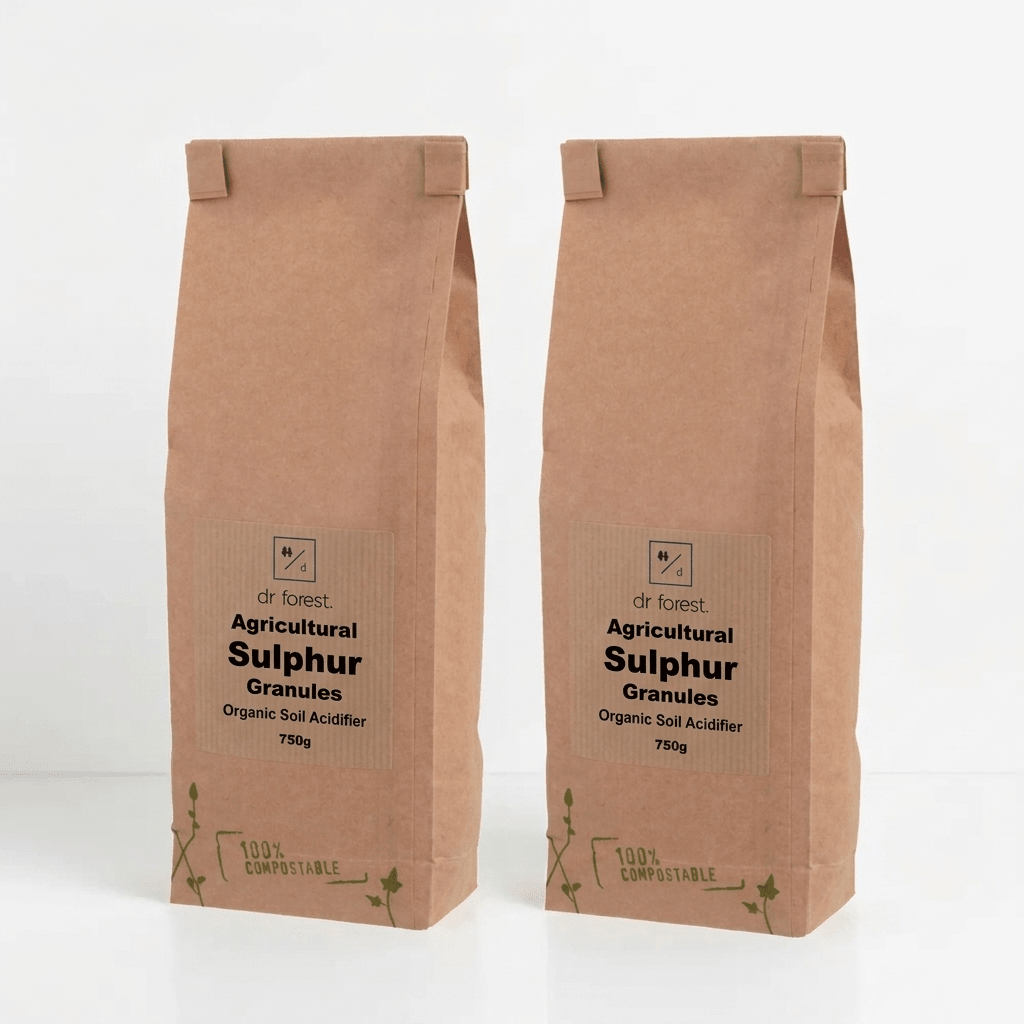
Sulphur soil acidifier — lower your soil pH the natural way
Soil acidifier in these pastilles is 90% elemental sulphur with 10% bentonite: soil bacteria oxidise it to sulphuric acid and the pH falls. Ours is a sulphur-bentonite pastille — 90% elemental sulphur with 10% bentonite clay . Spread it dry with no dust, then the moment it gets wet the bentonite swells and bursts the pastille apart into fine sulphur particles, giving the bacteria the surface area they need. It's the standard way to bring neutral or alkaline ground down towards pH 5.0–6.0 for blueberries, rhododendrons, azaleas, camellias and blue hydrangeas.
You'll also see elemental sulphur sold as garden sulphur, yellow sulphur, sulphur chips or pastilles. Plain chips and granules have to weather down before much happens; the bentonite does that job for you in a few days. Because the acid is still made by soil biology it isn't instant — it works from spring to autumn when soils are warm, and rewards re-testing rather than guessing. Once you reach your target it holds the pH down for years.
What it's for
- Blueberries & cranberries — the most acid-hungry, pH 4.5–5.5
- Rhododendrons, azaleas & camellias — classic ericaceous shrubs, pH 4.5–6.0
- Acers, pieris & summer heathers — acid-loving structure and foliage. Winter heathers (Erica carnea, E. × darleyensis) tolerate lime and do not need this
- Blue hydrangeas — keep the flowers blue (below about pH 5.5)
- Neutral or alkaline beds — nudge them down for acid-lovers
- Raised beds & containers — mix in before planting
Sulphur vs the quick fixes
Sulphur-bentonite pastilles
Gentlest on plants and the cheapest per pH unit. Handles like a granule, then breaks down to fine sulphur once wet, so it acts far quicker than plain chips. Still needs warm, moist soil and a few weeks to a few months, but the effect lasts 5+ years.
Iron or aluminium sulphate
Act faster, but you need roughly 7–8× as much for the same drop, they can lock up phosphorus, and aluminium can build up in the soil. Better for a quick nudge than a lasting change (RHS).
Weighed and packed by hand in small batches at our workshop in Stockport, Greater Manchester. The pastilles themselves are made by co-melting sulphur with the bentonite — nothing we blend, and nothing we add to.
The science: how sulphur acidifies soil
Elemental sulphur doesn't acidify soil on its own. Sulphur-oxidising bacteria — mainly Thiobacillus and Acidithiobacillus — use it as an energy source and convert it to sulphate, releasing hydrogen ions as they go. It's those H⁺ ions that lower pH.
CO₂ + S⁰ + ½O₂ + 2H₂O → CH₂O + SO₄²⁻ + 2H⁺ — two hydrogen ions for every sulphur atom oxidised (Havlin et al., 1999; Ohio State Extension). The sulphate left behind is also a plant nutrient.
Warmth and moisture set the speed
Why the bentonite is there
How far, how fast
The mechanism, in short
Two protons per atom
The acidity is biological: each sulphur atom oxidised releases 2 H⁺ (Havlin et al., 1999). No bacteria, no acid.
Temperature leads
Temperature, moisture and aeration are the three primary constraints on oxidation. Almost nothing happens below about 5 °C, and the rate peaks between 30 and 40 °C (Germida & Janzen, 1993; Yang et al., 2010).
Bentonite makes the surface area
The clay imbibes soil moisture and swells, bursting each pastille into finely divided sulphur that oxidises far faster than an intact granule (The Sulphur Institute). It has to wet where it lands to do that — see How to Use.
Buffering sets the dose
Clay and organic matter resist pH change, so they need far more sulphur than sand (RHS; Michigan State University Extension).
Long residual
Once acidified, soil pH typically stays low for 5+ years — but keep testing (Ohio State Extension, AGF-507).
Keep it aerobic
In waterlogged soil, sulphur turns to hydrogen sulphide instead of sulphate, which harms roots. Damp, not saturated (Michigan State University Extension).
- Mullen R, Lentz E, Watson M (2016). Soil Acidification: How to Lower Soil pH. Ohio State University Extension, AGF-507.
- Royal Horticultural Society. Acidifying soil. RHS Advice.
- Germida JJ, Janzen HH (1993). Factors affecting the oxidation of elemental sulfur in soils. Fertilizer Research 35(1–2): 101–114. doi:10.1007/BF00750224. (This journal is now published as Nutrient Cycling in Agroecosystems.)
- Watkinson JH, Blair GJ (1993). Modelling the oxidation of elemental sulfur in soils. Fertilizer Research 35: 115–126. doi:10.1007/BF00750225
- Lee A, Boswell CC, Watkinson JH (1988). Effect of particle size on the oxidation of elemental sulphur, thiobacilli numbers, soil sulphate, and its availability to pasture. New Zealand Journal of Agricultural Research 31(2): 179–186. doi:10.1080/00288233.1988.10417943
- Yang Z-H, Stöven K, Haneklaus S, Singh BR, Schnug E (2010). Elemental sulfur oxidation by Thiobacillus spp. and aerobic heterotrophic sulfur-oxidizing bacteria. Pedosphere 20(1): 71–79.
- Havlin JL, Beaton JD, Tisdale SL, Nelson WL (1999). Soil Fertility and Fertilizers: An Introduction to Nutrient Management, 6th ed. Upper Saddle River, NJ: Prentice Hall.
- Longstroth M (n.d.). Lowering the Soil pH with Sulfur. Michigan State University Extension.
- The Sulphur Institute. Elemental Sulphur (sulphur fertilizer types).
- Incitec Pivot Fertilisers. Agritopic: Sulphur.
- University of Georgia CAES. Backyard blueberry leaves can tell the tale of soil deficiencies and pH problems.
- Cornell University. Berry Diagnostic Tool — blueberries: iron deficiency.
How to use sulphur to lower soil pH
Only acidify if your soil is neutral or alkaline — check with a pH kit. Drop a little vinegar on the soil first: if it fizzes, there's free lime or chalk and it can't realistically be acidified (RHS). Wear gloves, work in still air, and err on the side of too little — you can always add more.
How much to use
| Soil type | Drop ~0.5 pH | Drop ~1.0 pH |
|---|---|---|
| Sandy | ~75 g/m² | ~150 g/m² |
| Loam | ~110 g/m² | ~220 g/m² |
| Clay / high organic | ~150 g/m² | ~300 g/m² |
These are weights of product, which is what you actually scoop. Because the pastilles are 90% sulphur they deliver the RHS elemental-sulphur figures for the top 15 cm — 70, 100 and 135 g/m² for the smaller shift, 135, 200 and 270 g/m² for the larger. One honest caveat: RHS quotes those rates for sulphur powder. The bentonite is there to break these pastilles down to fine sulphur in the soil, which gets you close, though the particles it releases stay a little coarser than a mill would give. Test and repeat rather than over-dose — over-acidified soil has to be limed back.
What you're aiming for
Application rates
Open ground & beds
Broadcast evenly on the surface and water it. Leave it a few days for the pastilles to swell and break down, then fork into the top 15 cm. Burying them intact concentrates the sulphur into a small volume and slows everything down. Sandy soils take the lower rate, clay the higher. Re-test after 8–12 weeks and top up if needed.
Containers & raised beds
For pots, it's safer to acidify peat-free ericaceous compost before planting than to dose a planted pot. Reckon on about 1.0 g per litre of mix on sandy blends, 1.5 g/L on loam and 2.0 g/L on compost-rich ones, for one pH point. Wet the mix so the pastilles break down, turn it through, then leave it a few weeks before testing. Avoid heavy doses around established roots.
Established ericaceous plants
For blueberries, rhododendrons and camellias already in the ground, scatter a light surface dressing in spring and water it in — no digging needed, since the pastilles break down where they land and the acid moves down with the rain. Re-test before repeating. Small and often beats one big dose.
Which bag size do you need?
Sulphur is dosed by area, so the sum is simple: your area in m² × the rate for your soil = grams of product needed. A 6 m² border on loam wanting a full pH point needs 6 × 220 = 1,320 g, so the 1.5kg bag. The chart and tables below do that arithmetic for every bag size.
Area each bag treats
| Bag | Sandy | Loam | Clay / high organic |
|---|---|---|---|
| 500g | 3.3 m² | 2.3 m² | 1.7 m² |
| 1.5kg | 10 m² | 6.8 m² | 5.0 m² |
| 4kg | 27 m² | 18 m² | 13 m² |
| 9kg | 60 m² | 41 m² | 30 m² |
| 18kg | 120 m² | 82 m² | 60 m² |
| 36kg | 240 m² | 164 m² | 120 m² |
One full pH unit in the top 15 cm. For a half-point drop, every figure doubles — a 4kg bag covers 36 m² of loam instead of 18.
Buying for a full year
Most people need more than the initial dose. Even with the bentonite doing the grinding for you, oxidation is biological and the first season is variable, so the honest planning assumption is one full application in spring, a re-test at 8–12 weeks, and a half-rate top-up in late summer if you are not there yet. That is 1.5× the initial figure across the first year.
| Bag | Sandy | Loam | Clay / high organic |
|---|---|---|---|
| 500g | 2.2 m² | 1.5 m² | 1.1 m² |
| 1.5kg | 6.7 m² | 4.5 m² | 3.3 m² |
| 4kg | 18 m² | 12 m² | 8.9 m² |
| 9kg | 40 m² | 27 m² | 20 m² |
| 18kg | 80 m² | 55 m² | 40 m² |
| 36kg | 160 m² | 109 m² | 80 m² |
Year one, including the likely top-up. After that the pH holds for years and you are only maintaining, so a bag lasts far longer.
Typical projects
| What you are doing | Year one, loam | Bag |
|---|---|---|
| One blueberry in a 45 cm pot (~40 L) | ~80 g | 500g does 6 pots |
| Three blueberries, 2 m × 1 m bed | 660 g | 1.5kg |
| Rhododendron border, 5 m × 1.5 m | 2,475 g | 4kg |
| New ericaceous bed, 10 m² | 3,300 g | 4kg |
| Acid border or small blueberry patch, 25 m² | 8,250 g | 9kg |
| Large planting, 100 m² | 33,000 g | 36kg |
On clay, add about a third. On sand, take about a quarter off.
The rates above cover the top 15 cm, which is 150 litres of soil per square metre. Divide through and you get roughly 1.0 g per litre on sandy mixes, 1.5 g/L on loam and 2.0 g/L on compost-rich or clay mixes, for one pH point. A 40 L pot is therefore about 60–80 g. Wet the mix so the pastilles break down, turn it through before planting, and leave it a few weeks before testing — dosing a pot that already has a plant in it is much easier to overdo.
Step by step
- Test your soil. Take a pH reading and do the vinegar-fizz check for free lime.
- Work out the rate. Use your soil type and how far you need to drop (table above).
- Weigh it out. A level tablespoon of granules is roughly 15–18 g — measure rather than guess.
- Broadcast on the surface. Scatter evenly across the area. Do not bury the pastilles yet.
- Water, and give it a few days. The bentonite swells and breaks each pastille into fine sulphur — you will see them slump and spread.
- Now fork it in. Work the dispersed sulphur into the top 15 cm and keep the soil damp. The bacteria need moisture and air, never waterlogged.
- Re-test after 8–12 weeks. Top up cautiously if you're not there yet; it's easy to overshoot.
Once the pH is right, feed acid-lovers gently. Our Sulphate of Potash gives fruiting blueberries chloride-free potash, and Seaweed Plant Food is a mild, pH-safe biostimulant. If you want sulphur and calcium without lowering pH, that's a job for gypsum — not this.


