


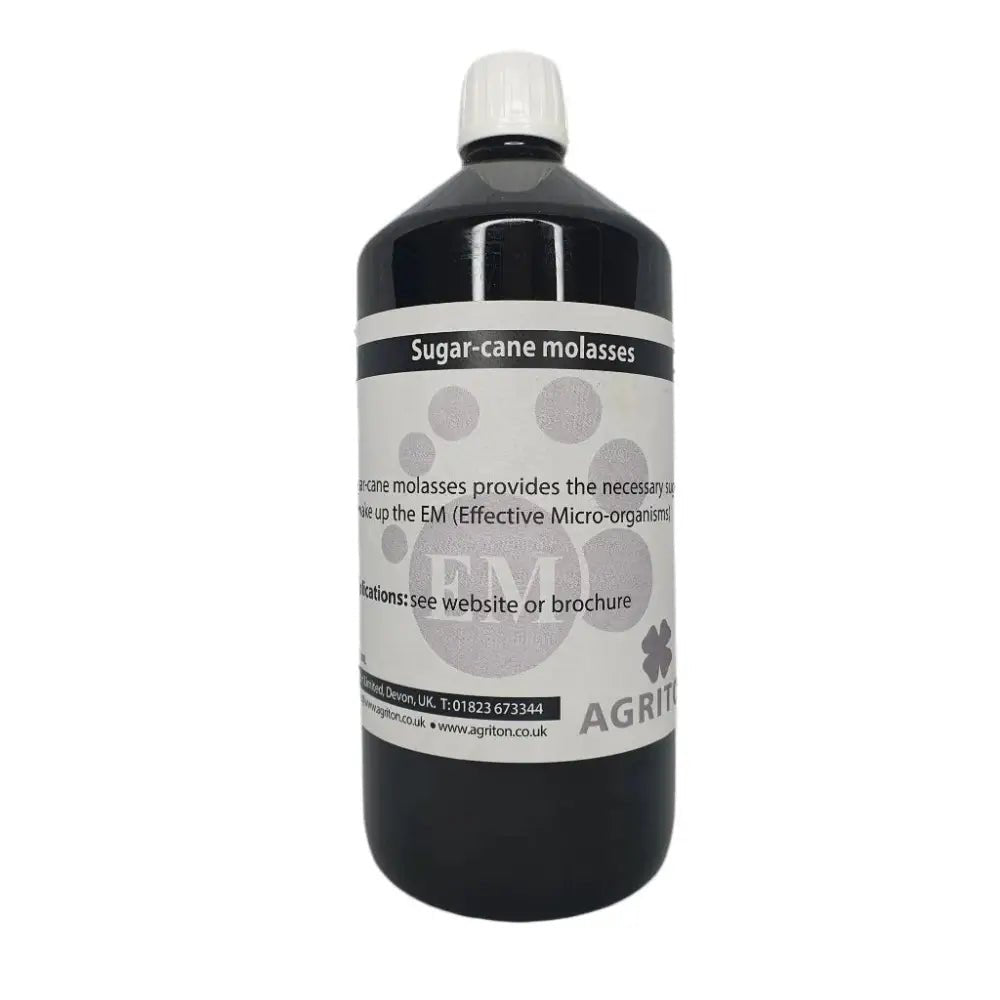


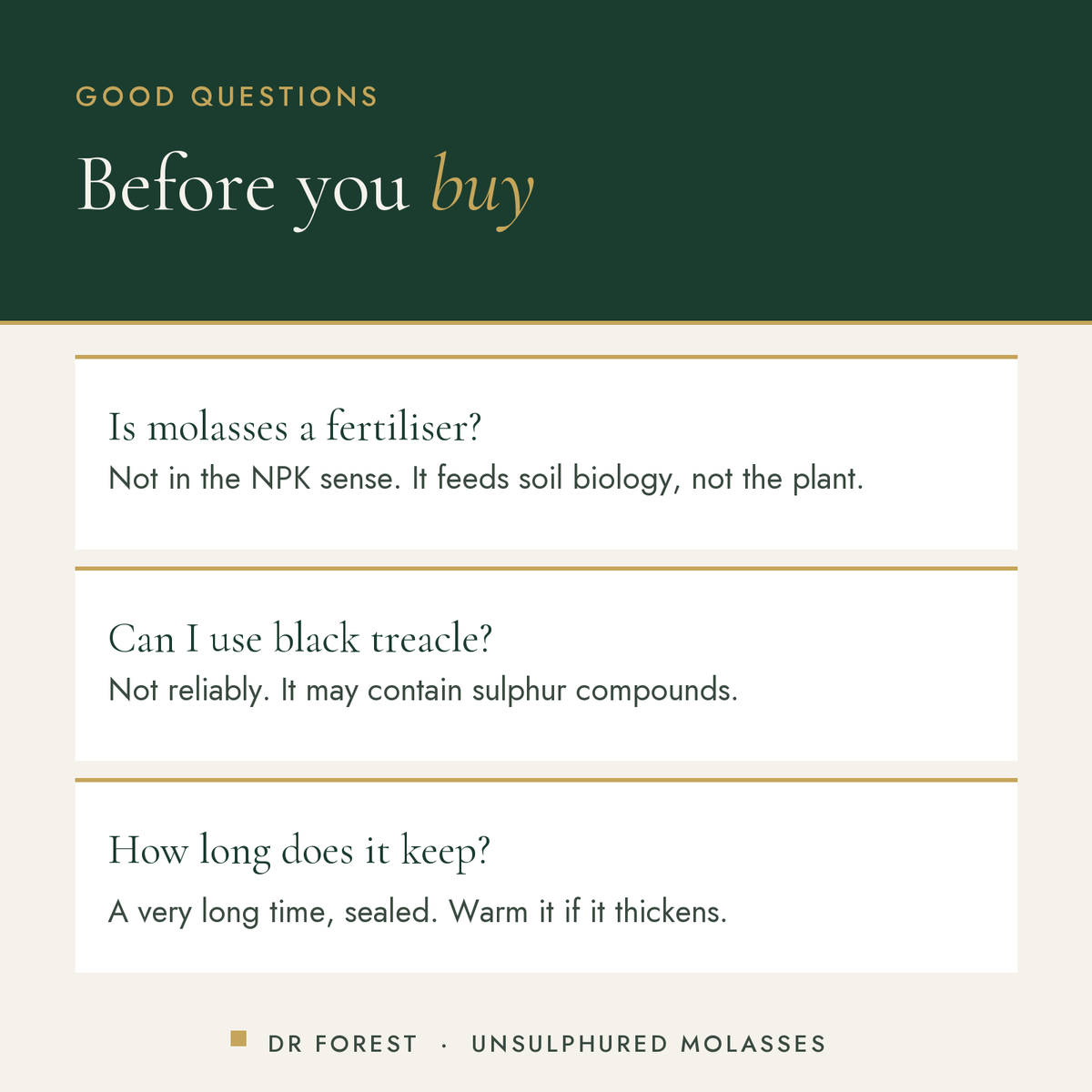
How Unsulphured Molasses compares
Full guide and scienceDr Forest Unsulphured Molasses
- No sulphur dioxide, so nothing in the bottle works against yeasts or bacteria
- Single ingredient: 100% sugar cane molasses
- Suitable for compost tea, EM activation, bokashi, JADAM and soil drenches
- 100% sugar cane molasses — nothing added
Sulphured molasses
- Sulphur dioxide added during processing as a preservative
- That preservative inhibits the organisms a compost tea or EM ferment depends on
- Brews tend to come out weak or fail outright
- Fine as a food ingredient; the wrong choice for anything microbial
Customer highlight
Happy customer
Fermenting my own probiotics using this excellent un-sulphured molasses.
Editorial highlight from marketplace and store reviews — separate from the full review list below.
Unsulphured sugar cane molasses: the food that feeds your soil biology
Unsulphured molasses is sugar cane molasses with no sulphur dioxide added, which makes it the right food source for compost tea, EM-1 activation and soil drenches. Sulphur dioxide is a preservative that inhibits yeasts and bacteria, so sulphured molasses works against the very organisms you are trying to multiply. This is 100% unsulphured sugar cane molasses from Dr Forest in Stockport, Greater Manchester, in 1 litre and 10 litre packs.
Molasses is what is left once sugar has been crystallised out of cane juice: roughly 62% sugars on a dry basis, with the rest water, minerals and organic compounds. Micro-organisms treat those sugars as fast fuel. It is a companion ingredient rather than a fertiliser. Buy it to brew actively aerated compost tea, to turn a litre of EM-1 concentrate into a much larger batch of activated culture, or to give the soil biology a carbon pulse a few days after a granular feed.
What unsulphured molasses is used for in the garden
- Actively aerated compost tea (AACT) — the standard food source for a 24–36 hour brew; the sugars feed the bacteria, fungi and protozoa you are multiplying from worm castings or compost
- EM-1 activation — the fermentation substrate that turns EM-1 concentrate into activated EM (EM-A) over 7–10 days
- Direct soil drench — 1 tablespoon per 5 litres, every 2–4 weeks, to feed the existing soil biology; most useful 2–3 days after an organic fertiliser goes on
- Bokashi, JADAM and KNF preparations — the sugar source in home-made ferments such as JADAM Microbial Solution and bokashi bran
- Compost heap accelerator — diluted molasses over a slow heap gives the decomposers an immediate energy source for the high-carbon material
- Foliar spray additive — a small amount in a foliar mix helps the spray stick to the leaf and feeds leaf-surface micro-organisms
Unsulphured molasses versus sulphured molasses
Dr Forest Unsulphured Molasses
- No sulphur dioxide, so nothing in the bottle works against yeasts or bacteria
- Single ingredient: 100% sugar cane molasses
- Suitable for compost tea, EM activation, bokashi, JADAM and soil drenches
- 100% sugar cane molasses — nothing added
Sulphured molasses
- Sulphur dioxide added during processing as a preservative
- That preservative inhibits the organisms a compost tea or EM ferment depends on
- Brews tend to come out weak or fail outright
- Fine as a food ingredient; the wrong choice for anything microbial
Dr Forest is a grower-run brand based in Stockport, Greater Manchester, making premium organic fertilisers and soil inputs in small batches. Molasses is one of the single-ingredient products in the range, and one of the cheapest ways to keep a living soil fed between granular feeds. If the idea of feeding soil rather than plants is new to you, start with What is living soil? Made by Growers. Backed by Science.
The science of molasses: why sugar moves soil biology, and where the evidence is thin
What molasses actually is
Cane molasses is the syrup left behind after sucrose has been crystallised out of sugar cane juice, after repeated boiling. Each round pulls more sugar out and concentrates what remains, so the final molasses is dense and dark. Palmonari and colleagues at the University of Bologna analysed 16 commercial cane samples and found them to average 62% total sugars on a dry-matter basis, mostly sucrose, with wide variation between batches [1]. Molasses is an agricultural by-product and varies from batch to batch. The figures below are literature values, not a batch analysis of this product.
Composition of cane molasses (literature values)
| Component | Average | Range across 16 samples |
|---|---|---|
| Dry matter | 76.8% | 75.7–79.6% |
| Total sugars (dry basis) | 62.3% | 57.0–71.0% |
| Sucrose (dry basis) | 48.8% | 39.2–67.3% |
| Fructose (dry basis) | 8.1% | 2.3–14.3% |
| Glucose (dry basis) | 5.3% | 1.3–12.1% |
| Ash (minerals, dry basis) | 13.1% | 10.2–16.3% |
| Crude protein (dry basis) | 6.7% | 2.2–9.3% |
| Potassium (dry basis) | 1.8% | 0.3–8.0% |
Sugars are the story: nearly two thirds of the dry matter is sucrose, glucose and fructose, all of which bacteria and yeasts can use within hours. The mineral fraction is real but modest, and potassium, the largest single mineral, varies more than twenty-fold between samples. Treat it as a bonus. If you need potassium, buy a potassium fertiliser.
Why sulphured molasses fails the microbes
Sulphur dioxide is a broad-spectrum antimicrobial preservative. In solution it forms sulphite and bisulphite, which consume oxygen, disrupt DNA replication and energy metabolism, and push microbial cells into oxidative stress [2]. Molecular sulphur dioxide, the most active form, dominates at low pH, which is exactly the acidic environment an EM ferment creates, so a sulphured molasses gets more hostile as the ferment progresses. Unsulphured molasses has none of this. The organisms get the sugar and nothing that fights them.
Mechanisms of action
Bacterial multiplication in aerated compost tea
Palese and colleagues (2021, Applied Sciences) brewed aerated compost teas with increasing doses of sugar beet molasses or whey. Total bacterial populations were significantly higher with either additive than in tea brewed with water alone [3]. That is the point of adding molasses: a modest inoculant becomes a far larger population. The highest doses did not always give the best tea, which is why the recipes on this page are measured in tablespoons.
Substrate for EM fermentation, and an honest note on EM
Activating EM-1 is a lactic fermentation: the lactic acid bacteria convert molasses sugars to lactic acid, the pH drops below about 3.5 and the culture stabilises. The molasses is what the organisms eat. The best temperate field trial of EM, a four-year Swiss study by Mayer and colleagues (2010, Applied Soil Ecology), compared living EM against sterilised EM and found no difference in yield or soil microbiology on any measure; the small effects they did see came from the nutrients in the Bokashi substrate the EM was applied with, and EM sprayed on its own did nothing [4]. Our reading is that the food does more of the work than the marketing admits, so it is worth getting the sugar right.
A carbon pulse, and why small doses beat large ones
Adding easily available carbon to soil sets off a priming effect: microbes wake up and multiply. Blagodatskaya and Kuzyakov (2008, Biology and Fertility of Soils) found the response is linear only when the added carbon is small relative to the existing microbial biomass, up to about 15% of it; above roughly 50% the effect flattens or reverses [5]. That is why the drench rate is a tablespoon in 5 litres rather than a cupful. A light, regular carbon pulse works with the soil biology; a heavy one overwhelms it.
Nitrogen tie-up: molasses feeds microbes, not plants
Molasses is mostly sugar and carries very little nitrogen; crude protein in the Bologna samples averaged under 7% of dry matter [1]. Microbes given a sugar hit grow, and growing microbes take nitrogen from the soil solution. Szili-Kovács and colleagues (2007, Biology and Fertility of Soils) used sucrose additions deliberately to immobilise soil nitrogen: microbial biomass rose and extractable inorganic nitrogen fell [6]. In a vegetable bed that is a caution. Use molasses alongside a nitrogen-containing feed, timed two or three days after the fertiliser goes on. On its own, at high rates, it can leave plants short of nitrogen for a while.
Soil enzyme activity goes up; plant growth may not
Nugroho and colleagues (2023, Journal of Environmental Geography) watered maize with molasses solutions for eight weeks. Beta-glucosidase activity rose by 11–57% and dehydrogenase by 30–81% depending on dose and tillage history, though only the beta-glucosidase rise in ploughed soil reached statistical significance [7]. Plant height and dry biomass did not differ between doses. The biology responded; the crop, over eight weeks, did not measurably. That fits how we position this product: a soil input that supports the biology breaking down your fertiliser.
A caution on compost tea and edible leaves
Compost tea brewed with nutrient additives is a growth medium, and it does not discriminate. Ingram and Millner (2007, Journal of Food Protection) found that trace E. coli or Salmonella in a compost inoculant only multiplied when supplements were added, and aerated teas held higher numbers than still ones [8]. They advised against supplemented tea on fresh produce. Our version: use clean, well-matured compost or worm castings, put supplemented tea on the soil rather than the leaves of salad crops, and keep it off anything eaten raw as harvest approaches.
Scientific references
- Palmonari, A., Cavallini, D., Sniffen, C.J., Fernandes, L., Holder, P., Fagioli, L., Fusaro, I., Biagi, G., Formigoni, A. & Mammi, L. (2020). Short communication: Characterization of molasses chemical composition. Journal of Dairy Science, 103(7), 6244–6249.
- Ren, J., Peng, X., Li, H., Chen, C. & Yan, R. (2026). Sulfur dioxide in food: A review of its preservative mechanisms, safety concerns, and the rise of smart detection systems. Comprehensive Reviews in Food Science and Food Safety, 25(4), e70580.
- Palese, A.M., Pane, C., Villecco, D., Zaccardelli, M., Altieri, G. & Celano, G. (2021). Effects of organic additives on chemical, microbiological and plant pathogen suppressive properties of aerated municipal waste compost teas. Applied Sciences, 11(16), 7402.
- Mayer, J., Scheid, S., Widmer, F., Fließbach, A. & Oberholzer, H.-R. (2010). How effective are 'Effective microorganisms (EM)'? Results from a field study in temperate climate. Applied Soil Ecology, 46(2), 230–239.
- Blagodatskaya, E. & Kuzyakov, Y. (2008). Mechanisms of real and apparent priming effects and their dependence on soil microbial biomass and community structure: critical review. Biology and Fertility of Soils, 45(2), 115–131.
- Szili-Kovács, T., Török, K., Tilston, E.L. & Hopkins, D.W. (2007). Promoting microbial immobilization of soil nitrogen during restoration of abandoned agricultural fields by organic additions. Biology and Fertility of Soils, 43(6), 823–828.
- Nugroho, P.A., Prettl, N., Kotroczó, Z. & Juhos, K. (2023). The effect of molasses application on soil biological indicators and maize growth of different tillage soil: a pot experiment. Journal of Environmental Geography, 16(1–4), 119–124.
- Ingram, D.T. & Millner, P.D. (2007). Factors affecting compost tea as a potential source of Escherichia coli and Salmonella on fresh produce. Journal of Food Protection, 70(4), 828–834.
Composition figures describe cane molasses in the published literature and are not a batch analysis of this product.
How to use molasses: compost tea recipes, EM activation and soil drench guide
Sulphured molasses contains sulphur dioxide, which is antimicrobial and will inhibit the organisms you are trying to grow. This product is unsulphured, so it is safe for compost tea, EM activation and all microbial applications. If using molasses from another source, check the label carefully for "unsulphured" or "no sulphur dioxide". Measuring: 1 tablespoon is 15 ml, 1 dessertspoon is 10 ml, 1 teaspoon is 5 ml. Warm water dissolves molasses faster, so pre-dissolve in a small jug before adding to the bucket.
Use the tea within 2–4 hours of switching off the air pump. Once aeration stops, the dissolved oxygen in the tea is consumed rapidly by the billions of organisms you have just multiplied. Within hours the tea becomes anaerobic: the beneficial aerobic organisms die and are replaced by anaerobic bacteria that can harm plants and soil. There is no way to "save" a tea for later. Brew it, use it, clean your equipment. This is a living product with a shelf life measured in hours, not days.
Actively aerated compost tea (AACT) recipes
Actively aerated compost tea is made by bubbling air through water containing compost or worm castings and a food source (molasses). The aeration fuels aerobic microbial multiplication, producing a living inoculant that can be applied to soil or foliage. The key to success is sufficient aeration: you need an air pump powerful enough to maintain dissolved oxygen above 6 ppm throughout the brew. A small aquarium pump is marginal for a 20-litre bucket; a dual-outlet pump or purpose-built brewer is better.
Recipe 1: simple AACT (20 litres)
Ingredients: 20 litres dechlorinated water (leave tap water standing 24 hours, or use rainwater) · 2 large handfuls (approx. 400 ml) worm castings or quality compost, placed in a mesh bag or old stocking · 2 tablespoons (30 ml) unsulphured molasses.
Method: Fill the bucket with dechlorinated water. Add the molasses and stir to dissolve. Suspend the mesh bag of worm castings in the water. Place the air stone or bubble snake on the bottom of the bucket and switch on the pump. Brew for 24–36 hours at room temperature. The tea is ready when it smells earthy and sweet, not sour or rotten. Remove the bag, switch off the pump, and use within 2–4 hours. Apply undiluted as a soil drench or foliar spray.
Recipe 2: enhanced AACT with seaweed and humic acid (20 litres)
Ingredients: 20 litres dechlorinated water · 2 large handfuls worm castings or compost in a mesh bag · 2 tablespoons (30 ml) unsulphured molasses · 1 teaspoon Dr Forest Seaweed Powder · 1 teaspoon Dr Forest Humic Acid Flakes (dissolved in warm water first).
Method: Dissolve the molasses, seaweed powder, and pre-dissolved humic acid into the water. Suspend the compost bag, add the air stone, and brew for 24–36 hours. The seaweed provides trace minerals and growth hormones; the humic acid chelates minerals and stimulates fungal growth. This produces a more diverse, mineral-rich tea than molasses alone. Apply undiluted.
Recipe 3: fungal-dominant AACT (20 litres)
Ingredients: 20 litres dechlorinated water · 2 large handfuls worm castings or forest-floor leaf litter compost in a mesh bag · 1 tablespoon (15 ml) unsulphured molasses (reduced from the standard 2 tbsp) · 2 tablespoons Dr Forest Seaweed Powder · 1 tablespoon oat flour or ground oats · 1 teaspoon Dr Forest Humic Acid Flakes.
Method: Reducing the molasses and adding complex foods (seaweed, oats, humic acid) shifts the brew toward fungal dominance rather than bacterial. Fungi need longer to multiply, so brew for 36–48 hours. Use forest-floor leaf mould or mature compost as the inoculant for the richest fungal diversity. Ideal for perennial beds, fruit trees, shrubs, and woodland plantings. Apply undiluted as a soil drench.
Recipe 4: small-batch AACT (5 litres)
Ingredients: 5 litres dechlorinated water · 1 handful (approx. 100 ml) worm castings in a mesh bag · 1 dessertspoon (10 ml) unsulphured molasses · ½ teaspoon Dr Forest Seaweed Powder (optional).
Method: A practical batch size for container gardeners and small plots. A single-outlet aquarium air pump with a decent air stone is usually sufficient for 5 litres. Brew for 24 hours. Apply undiluted to containers and small beds. This batch covers approximately 5–10 medium pots or 2–3 m² of bed space.
EM-1 activation (making activated EM / EM-A)
Activated EM recipe
Ratio (matches the EM-1 page): 1 part EM-1 : 1 part unsulphured molasses : 20 parts warm dechlorinated water — for example 50 ml EM-1 + 50 ml molasses + 1 litre water.
Method: Dissolve the molasses in the warm water, then add the EM-1 concentrate. Stir until fully dissolved. Pour into a clean plastic bottle, squeeze out as much air as possible, and seal tightly. Store at room temperature out of direct sunlight. The bottle will expand over the first few days as fermentation produces gas: release the pressure daily by loosening the cap briefly. Ferment for 7–10 days. It is ready when it smells sweet and sour (like cider vinegar) and the pH has dropped below about 3.5. Dilute approximately 1:100 with water for soil drenches or foliar sprays. Use within about 30 days of activation (sooner if kept warm).
Direct soil drench
Molasses soil drench: feeding soil biology
Dissolve the molasses in warm water, then dilute to the full volume with cool water. Apply as a soil drench to beds, borders, containers, and lawns. This provides an immediate carbon pulse for rhizosphere biology, particularly useful 2–3 days after applying organic fertiliser to accelerate nutrient mineralisation. The potassium, calcium, and iron in the molasses supplement the mineral supply simultaneously. Avoid applying in very hot weather or to dry soil: water the soil first, then apply the drench.
Step-by-step AACT brewing
- Dechlorinate your water. Fill your bucket with tap water and leave it standing for 24 hours with the lid off; the chlorine will dissipate. Alternatively, use collected rainwater. Chlorine and chloramine are toxic to micro-organisms and will ruin your brew. If your water supply uses chloramine (which does not dissipate by standing), aerate with the air pump for 1–2 hours before adding ingredients, or use a carbon filter.
- Add the molasses and dissolve. Measure the molasses and stir into the water until fully dissolved. Warm water dissolves molasses faster: you can pre-dissolve in a small jug of warm water before adding to the bucket.
- Add the compost or worm castings in a mesh bag. Place the compost, worm castings, or a mixture of both into a mesh bag, old stocking, or paint strainer. Suspend in the water, ideally hanging from the rim above the air stone so it does not sit on the bubbler and block airflow.
- Add any additional ingredients. Seaweed powder, humic acid, oat flour, or other complex foods can be added directly to the water (not in the bag). Stir briefly.
- Switch on the air pump and brew for 24–36 hours. The air stone or bubble snake should be producing vigorous, continuous bubbling. Do not turn the pump off during the brew; even a brief interruption allows dissolved oxygen to drop and the tea to turn anaerobic. Brew at room temperature (15–25°C). You may see foam forming on the surface. This is normal and indicates biological activity.
- Check the smell and use immediately. A good AACT smells earthy, sweet, and clean, like forest floor or mushroom compost. If it smells sour, rotten, or like sulphur, the brew has gone anaerobic: discard it (pour it on the compost heap, not on plants). Use the finished tea within 2–4 hours of switching off the pump. Apply undiluted as a soil drench or foliar spray using a watering can or coarse spray nozzle.
Molasses is a companion ingredient, not a standalone product. For AACT brewing, combine with worm castings or quality compost as the microbial inoculant, and add Seaweed Powder and water-soluble Humic Acid Flakes (the humic acid in the recipes above) for mineral content and fungal diversity. For EM activation, use it with EM-1 concentrate. For soil drenches, apply alongside your regular Dr Forest granular fertiliser programme; the molasses feeds the biology that breaks the fertiliser down. Use Grow-Kashi as a dry soil inoculant between liquid compost tea applications, and Bokashi Bran for kitchen waste.
Keep the lid sealed and store in a cool, dry place. Molasses keeps for a very long time; the sugar concentration is its own preservative. It thickens or crystallises in cold weather, which does not affect quality: stand the container in warm water to restore pourability. Do not refrigerate. Keep out of reach of children and pets, as you would any concentrated garden input.
Frequently asked questions about unsulphured molasses for the garden
Not directly, and be wary of anyone who says it does. Molasses feeds the bacteria and fungi in the soil or in a compost tea; it isn't an NPK fertiliser and it doesn't feed the plant in any meaningful amount. A busier soil can help a plant along over a season, so you can keep using it through flowering, but there's no good evidence that molasses on its own makes bigger flowers or fruit. Use 1 tablespoon (15 ml) per 5 litres of water as a soil drench every two to four weeks, or 30 ml in a 20-litre compost tea.
The pros: it's a cheap, simple sugar source that wakes up soil microbes and gets a compost tea going, and a little potassium, calcium, magnesium and iron come along with it. The cons: it doesn't feed the plant, too much at once can make a sour, sticky soil surface or a tea that turns anaerobic and smells, and on leaves of crops eaten raw a sugary tea is best avoided. Use unsulphured molasses, keep to the rates (15 ml per 5 litres as a drench), and treat it as a helper for a soil that already has organic matter in it.
Customers also bought
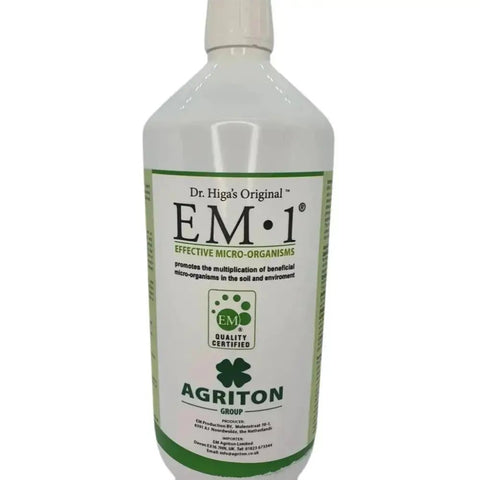
18% of buyers here also chose EM-1 Effective Microorganisms
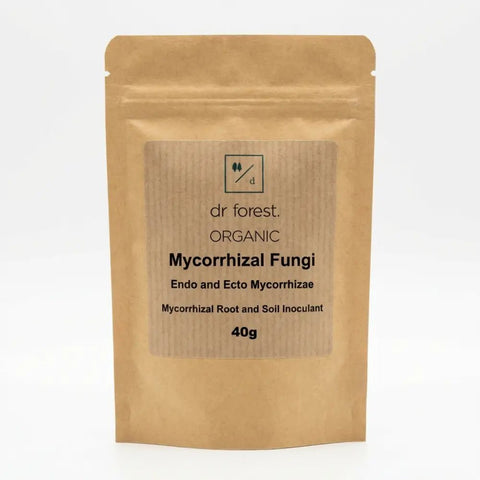
Mycorrhizal Fungi Powder | 18 Species, Endo + Ecto
A root inoculant, 18 endo and ecto species.
from £6.99


