
Microbial inoculant
Unsulphured Molasses | Organic Microbe Food
Unsulphured molasses to feed soil microbes.
from £13.00
Dr Forest EM-1 concentrate
Pre-diluted microbial sprays
Customer highlight
Extremely fast delivery and very well packaged. Top quality product, as expected from Dr Forest. Heard great things about Dr Forest EM-1 Blend. I will be purchasing more Organic Nutrients for my Urban Farming supplies. What can I say top Seller, will be using again. This gentleman has got you covered Looking forward to seeing the results.
Editorial highlight from marketplace and store reviews — separate from the full review list below.
This is a soil and compost biostimulant for plants. It is not a food, drink or human supplement, and is not tested to food-grade or supplement standards. Keep it for the garden.
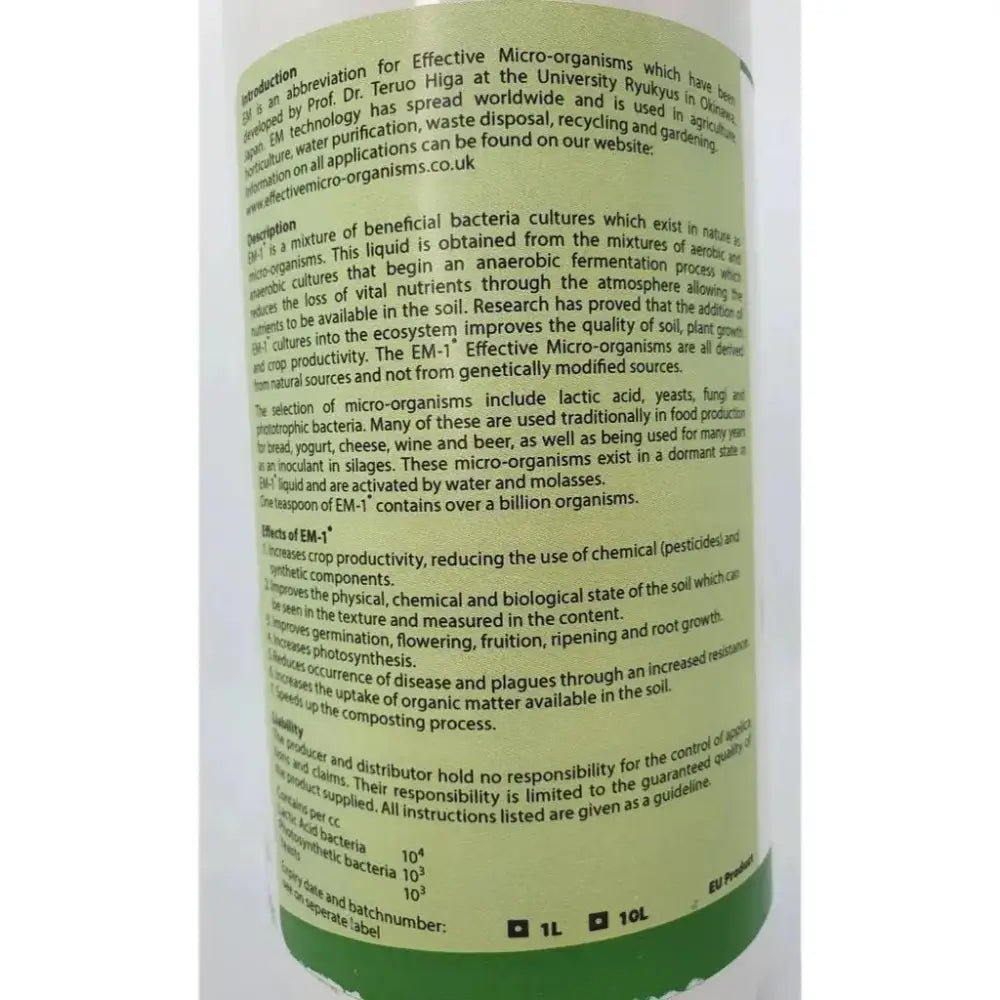
Effective microorganisms (EM) are a live culture of lactic acid bacteria, yeasts and phototrophic bacteria, kept dormant in a mildly acidic liquid and woken with molasses and water. Add them to soil, compost or a kitchen caddy and you are topping up the working microbial life that drives decomposition, nutrient cycling and a healthy root zone. Dr Forest EM-1 is a 1-litre concentrate, brewed in small batches in Stockport.
One bottle is a concentrate, not a ready-to-use spray. Mix it with Dr Forest Unsulphured Molasses and water, ferment it for a week or so, and a single litre becomes 20 litres or more of activated culture. You control the freshness, you control the cost per litre, and there is nothing in it derived from animals.
From Dr Forest — a grower-run brand based in Stockport.
The effective microorganisms approach was developed by Professor Teruo Higa at the University of the Ryukyus, Okinawa, in the 1980s. The idea is simple: rather than one isolated strain, you culture a stable community of compatible microbes that get along in the same acidic, low-oxygen liquid. The three groups in EM-1 are lactic acid bacteria, yeasts and phototrophic (photosynthetic) bacteria.
They sit dormant until molasses gives them a sugar source and water rouses them. Once active, they ferment rather than rot, which is why an EM-treated heap or caddy smells sweet and sour instead of putrid.
The literature on EM is genuinely mixed, and it is worth being straight about that. A review of vegetable trials found a positive effect on growth in roughly 70% of published studies, with no significant effect in the rest (Olle & Williams, 2013). Long-term field work in China recorded higher wheat yields and better nutrition where EM was applied alongside compost over many seasons (Hu & Qi, 2013). Against that, a careful four-year temperate field study found no reliable effect on yield or soil quality, and concluded that much of any benefit tends to come from the organic matter EM is carried in rather than the microbes alone (Mayer et al., 2010).
The practical reading: EM is most dependable as a fermentation and composting aid, and as part of a soil programme built around organic matter — not as a stand-alone yield booster. Treat it as one input in a living-soil approach, not a silver bullet.
Ferment sugars into lactic acid, dropping the pH. That acidic, fermentative environment is what keeps spoilage and putrefaction in check in a compost heap or bokashi bin, and is the basis of the same lactic fermentation used in silage and food preservation.
Produce enzymes, organic acids and growth substrates as they work through sugars. These by-products feed the other microbes in the culture and contribute to the breakdown of organic matter.
Use organic compounds and root exudates and release amino acids and other simple compounds. Reviews describe these substrates supporting other beneficial soil organisms, including mycorrhizal associations in the root zone (Olle & Williams, 2013).
By steering organic matter down an anaerobic fermentation route, EM reduces the odorous compounds produced when material simply rots. This is why it is widely used in bokashi composting and for odour in animal housing.
Trials consistently show EM performing better with compost, manure or molasses than on its own — controlled work in beans found EM maintained leaf photosynthetic efficiency and lifted seed yield when applied to organically amended substrates (Iriti et al., 2019). Feed the soil and the microbes together.
Chlorine in mains tap water kills the cultures. Use rainwater, or stand tap water uncovered for 24 hours so the chlorine gasses off, before activating or diluting.
EM-1 is a concentrate. To get the most from it, brew a batch of activated culture first. The molasses is the food source that wakes and multiplies the microbes.
Activation needs Dr Forest Unsulphured Molasses. Use unsulphured only — the sulphur dioxide in sulphured molasses inhibits the microbes. (See your basket cross-sells, or search "Dr Forest Unsulphured Molasses" in our shop.)
The dilutions below follow the product's standard guidance. EM is forgiving — err toward weaker rather than stronger, and apply little and often.
Water or spray a 1% solution onto the soil 2–3 weeks ahead of sowing, repeat just before planting out, and continue roughly every two weeks. Suits beds, borders, vegetables, soft fruit and ornamentals.
Apply as a soil drench or a well-diluted leaf mist as part of a regular microbial routine. Best on a dull day or in the evening, not in strong sun.
Spray a 2% solution in runs, sheds, stables and on bedding to help manage odour, and onto slurry or muck heaps.
At land scale, apply 1–10 litres of EM per hectare depending on the crop and the condition of the soil, diluted into your watering volume.
Dr Forest Unsulphured Molasses for activation; Dr Forest Bokashi Bran for fermenting kitchen food waste; and our Liquid Veg & Bloom Boosters, which are already EM-fermented feeds if you would rather skip the brewing. New to fermenting soil microbes? Read our guide, what effective microorganisms are and how to use them, on the Dr Forest journal.
Keep the concentrate sealed, cool and out of direct sunlight; it stays viable for around a year. Do not freeze. Use activated batches within about 30 days, sooner if kept warm.
No. It carries no meaningful nitrogen, phosphorus or potassium. It is a live microbial culture that you add to soil, compost and food waste to support the microbes that break down organic matter and cycle nutrients. Use it alongside a feed, not instead of one. The evidence is mixed: some vegetable trials show a growth response and others show none, and where benefits appear they often sit alongside the organic matter EM was used with rather than from the culture alone.
Activate it with molasses first, then use it at around a 1% solution, which is 10 ml per litre of water. On soil and seedbeds, water it on two to three weeks before sowing, again just before planting out, then roughly every two weeks. In the growing season, use the same strength as a soil drench or a fine leaf mist every one to two weeks, on a dull day or in the evening, not in strong sun. Weaker and more often beats stronger and occasional. Don't mix it with fungicides or pesticides in the same can.
Activate it first with unsulphured molasses and water, as the label describes, then dilute to around a 1% solution and water it over each new layer as you build or turn the heap. Keep the heap damp rather than wet. The lactic acid bacteria and yeasts get to work on fresh material and help keep the heap sweeter-smelling; most people notice the smell change within days to a couple of weeks. It works best with plenty of mixed green and brown material. EM speeds a heap along; it doesn't replace the turning and the browns.
25% of buyers here also chose Unsulphured Molasses UK
Unsulphured molasses to feed soil microbes.
from £13.00
A root inoculant, 18 endo and ecto species.
from £6.99