What are the advantages and disadvantages of organic fertiliser?
Advantages: steady feeding, little scorch risk, less leaching, and soil that improves over time. Disadvantages: slower to act, a lower and more variable analysis, more bulk to carry, and almost no use in cold ground.
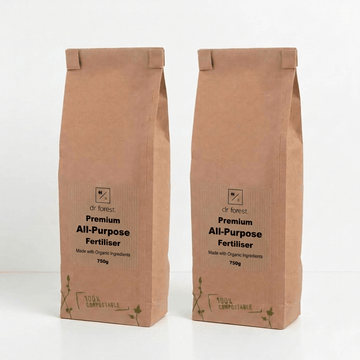
Handcrafted in Stockport
Premium Organic Fertilisers
Multi-input blends, with the analysis printed on every bag. From £6.25
Shop organic fertilisersThe advantages, in order of how much they matter
It feeds steadily. Because release depends on soil organisms breaking material down, the nutrient arrives over weeks rather than in a single flush. Plants grow at an even rate instead of surging and stalling.
Scorch is uncommon. There is no concentrated salt dissolving around the roots, so at normal garden rates the risk of burning a plant is low. This is the advantage that matters most to anyone who has killed something with a liquid feed.
Less washes away. Nutrients held in solid materials do not leach out of the root zone in the first heavy downpour the way a dissolved salt can.
The soil improves. Organic materials leave carbon behind, and that is what builds crumb structure and water holding over several seasons. This is the only one of the four that compounds.
The disadvantages, stated plainly
It is slow. Two to six weeks before a granular feed shows, and that is in warm, moist soil. If a plant is short of something now, this is the wrong tool.
The analysis is lower and less exact. A bagged blend might be 4-4-4 where a manufactured feed is 20-20-20, so you apply considerably more by weight to deliver the same nutrient. Compost is lower again and varies from heap to heap.
It costs more per unit of nutrient. That is simply true, and worth saying. What you are buying alongside the nutrient is the organic matter and the trace elements.
Cold soil stops it. Below roughly 4°C mineralisation nearly halts, so an early spring feed sits there doing very little until the ground warms.
| Organic | Soluble synthetic | |
|---|---|---|
| Time to show | 2 to 6 weeks | Days |
| How long it feeds | 6 to 8 weeks | 1 to 2 weeks |
| Typical analysis | Lower, more variable | Higher, exact |
| Scorch risk | Low at normal rates | Higher if over-applied |
| Effect on soil structure | Builds over seasons | Little to none |
| In cold soil | Nearly stops | Still works |
The honest summary. If you want a result this week, a soluble feed will give you one and an organic feed will not. If you want ground that grows better in three years than it does now, that is the other way round. Plenty of gardeners use both.
From the Dr Forest range
Premium Organic Fertilisers
Multi-input blends carrying six nutrients rather than three, with the full ingredient list and the rate printed on every bag.
Six nutrients, not three · Published rates · Blended in Stockport
Browse the organic fertiliser rangeMore organic fertiliser questions
Is organic fertiliser better for plants?How long does organic fertiliser take to work?Which is the best organic fertiliser company?Sources
- Royal Horticultural Society. Fertilisers: types and uses. rhs.org.uk
- Cassity-Duffey, K. et al. (2020). Nitrogen mineralization from organic materials and fertilizers: predicting N release. Soil Science Society of America Journal 84(2), 522–533. doi.org
- Geisseler, D. et al. (2021). Nitrogen mineralization from organic fertilizers and composts: literature survey and model fitting. Journal of Environmental Quality 50(6), 1325–1338. doi.org
Soil notes
Get the evidence, not the marketing
Occasional notes from Stockport on feeding, soil structure and what the research actually supports, including the things that turn out not to work.
No spam. Unsubscribe in one click. See our privacy notice.