Wetting agents · FAQ
Wetting agents: your questions, answered
Straight answers on what a wetting agent does, how to tell whether your garden actually needs one, how much to use, and what it will not fix.
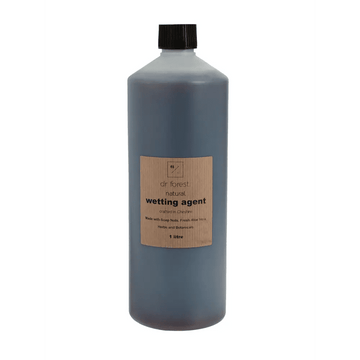
Handcrafted in Stockport
Natural Wetting Agent
A soap nut and aloe vera concentrate for dry soil, compost, pots and lawns. 500ml · 1 litre · 5 litre
Shop Natural Wetting AgentA wetting agent is a surfactant. It lowers the surface tension of water so that water spreads and soaks in rather than beading and running off, on a waxy leaf and in ground that has turned water-repellent. That is the whole of what it does. It is not a feed, it does not hold water in the soil, and it will not green up a lawn that is brown for any other reason. The pages below say so plainly. If you already know what you need, Dr Forest Natural Wetting Agent comes in 500ml, 1 litre and 5 litre, alongside the rest of the range.
How it works
Soil turns water-repellent when waxy organic residues build up as a coating on the soil particles. Dry peat-based compost, sandy soil and the thatch layer in a lawn are the common cases in a garden. Water applied to repellent ground does not wet it: it channels down cracks, runs along the walls of a pot, and leaves the middle of the root zone dry however long you stand there with the hose. Lowering the surface tension of the water lets it make contact with those coated surfaces and move down through the profile instead of around it.
The same property is what makes a wetting agent useful in a sprayer. A droplet that beads and rolls off a waxy leaf has almost no contact time, and whatever it was carrying ends up on the ground. Spread as a film, the same volume stays put for longer. In Dr Forest Natural Wetting Agent the surfactant is saponin from organic soap nuts, Sapindus mukorossi, whose pericarp carries 10–11.5% triterpenoid saponins.
Does your garden actually need one?
Most gardens do not, most of the time. The test costs nothing: put a droplet of water on the dry surface and watch it. Soaks in within a few seconds, and the ground is not repellent, so a wetting agent will not do much. Sits there as a bead for a minute or more, and it is. Do that before you spend anything.
It is worth being equally clear about the other half. A wetting agent gets water into ground that is refusing to accept it. It does not store water there, and it will not extend the gap between waterings. Those are two separate jobs, and products sold as doing both are usually a surfactant blended with a polymer. If your soil wets easily but dries out too fast, what helps is organic matter and the soil's own moisture-holding capacity, not a surfactant.
How much, and how long it takes
One level teaspoon, which is five millilitres, per litre of water for a soil or lawn drench, applied at one litre of solution per square metre. For a foliar spray, one to two teaspoons, five to ten millilitres, per litre. A nine litre watering can takes 45 ml and covers nine square metres. The calculator will do the arithmetic for your area.
On a lawn, one application rarely finishes the job: the RHS advises repeating monthly for three to four months, alongside spiking and thorough watering. Judge the result on water, not on colour. The morning after treating, watch what the water does: if it now sinks in where it previously beaded and ran to the edges, the wetting agent has done its job. Green-up is separate and slower. It follows over the following week or two as the root zone rewets, and only where the grass crowns are still alive. Where the grass has died off, the patch will need reseeding once the ground is accepting water again.
What is in it
Six ingredients: organic soap nut extract, aloe vera grown in-house in Stockport, vegetable glycerine, citric acid, potassium sorbate and reverse osmosis water. The soap nut extract is the working ingredient. The glycerine slows how fast a sprayed film dries on the leaf. The citric acid holds the pH down so that the potassium sorbate, a food-grade preservative, can keep the concentrate stable for twelve months. There are no petroleum or silicone surfactants, no fragrance and no colourants. We would rather name the preservative than imply there is nothing in the bottle but soap nuts.
Every question, answered
Start here, before you buy anything
A droplet of water on the dry surface. In within a few seconds and you do not need this. Still sitting there as a bead after a minute and you do. The full test, and what else causes brown patches →
Ready to buy?
Natural Wetting Agent
Organic soap nut saponins with aloe vera grown in-house, for foliar sprays, dry compost, containers and lawn dry patch.
Six named ingredients · No petroleum or silicone surfactants · No fragrance or colourants · Handcrafted in Stockport · 500ml, 1 litre and 5 litre
Shop Natural Wetting AgentSources
- Sochacki, M. and Vogt, O. (2022). Triterpenoid saponins from washnut (Sapindus mukorossi Gaertn.): a source of natural surfactants and other active components. Plants 11(18), 2355.
- Balcerek, M. et al. (2021). Surface activity of natural surfactants extracted from Sapindus mukorossi and Sapindus trifoliatus soapnuts. Colloids and Interfaces 5(1), 7.
- Böttger, S. et al. (2012). Saponins can perturb biologic membranes and reduce the surface tension of aqueous solutions: a correlation? Bioorganic & Medicinal Chemistry 20(9), 2822–2828.
Soil notes
Get the evidence, not the marketing
Occasional notes from Stockport on feeding, soil structure and what the research actually supports, including the things that turn out not to work.
No spam. Unsubscribe in one click. See our privacy notice.