Skip to product information
1 of 7

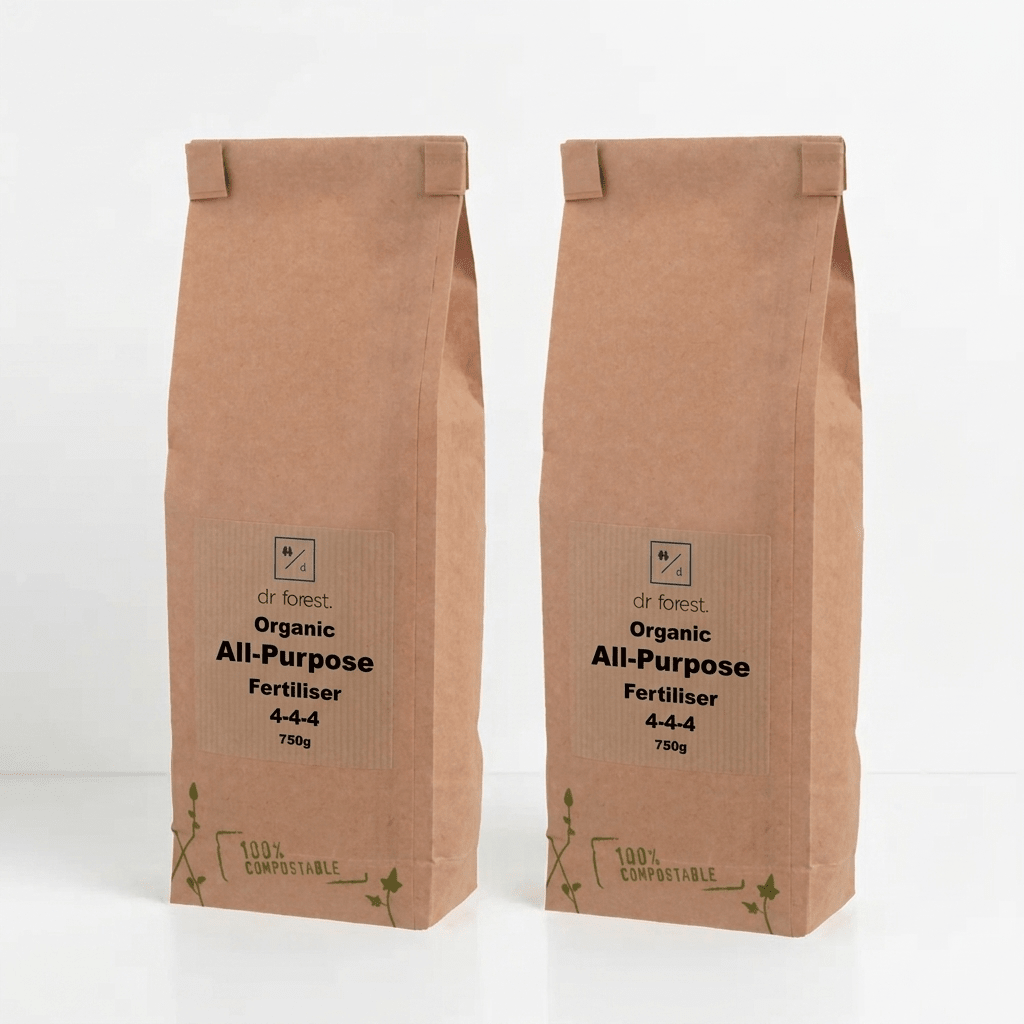
Organic All Purpose Fertiliser 4-4-4

Regular price £12.00
Regular price Sale price £12.00
Sale
£8.00 per kg
  • Even 4-4-4 for veg and flowers
  • Alfalfa, bone meal and seaweed
  • Calcium and magnesium too
Size

£28.00 more for free UK delivery

Quantity

In stock. Free UK delivery over £40, dispatched in 1 to 2 days.

£12.00 of £40 — £28.00 more for free shipping

Often bought with this

Optional — off by default. Toggle on to add with your main product.

View full details

Organic All Purpose Fertiliser 4-4-4: one balanced feed for the whole garden

Organic All Purpose Fertiliser 4-4-4 is a slow-release granular plant food that feeds vegetables, fruit, flowers, herbs, shrubs and pots from a single bag. Equal nitrogen, phosphorus and potash cover leaf, root and flower together, and soil life releases them over weeks, so there is no salt spike and no scorched roots. We formulate and blend it in small batches in Stockport from ten organic inputs.

  • One bag for the whole garden. A balanced 4-4-4 suits most of what UK gardeners grow; you change the rate, not the product. Growing notes for 194 plants are in the How to Grow Plants guides.
  • Steady feeding with no scorch. Nutrients come from organic meals that soil microbes release as roots need them.
  • Calcium, magnesium and sulphur built in. Gypsum, kieserite and bone meal fill the gap that most all purpose plant food leaves.
  • Better soil every season. Alfalfa, seaweed, humic acid and biochar feed soil biology and build organic matter.
  • Simple to use. Sprinkle, water in, done: no mixing and no weekly liquid feeding.
NPK 4-4-4 10 organic inputs Feeds for up to 8 weeks Granular Contains bone meal (not vegan) Compostable bag

Part of our organic fertilisers range. Stage feeding? Switch to Bloom Fertiliser 2-8-4 when the first flower opens.

What's in Organic All Purpose Fertiliser 4-4-4

Ten organic inputs, with several sources per nutrient so release stays even.

Alfalfa meal
A third of the mix: organic matter for soil microbes, plus natural triacontanol.
Bone meal
Slow phosphorus (around 18% P₂O₅) and calcium for roots and flowering.
Nitrogen plant extract
13% amino-acid nitrogen from molasses for the early push.
Flaxseed meal
A second slow nitrogen source and food for soil life.
Gypsum
pH-neutral calcium and sulphur.
Sulphate of potash
Chloride-free potassium for flower and fruit quality.
Kieserite
Magnesium and sulphur to keep leaves green.
Scottish seaweed
Ascophyllum biostimulant and trace elements.
Humic and fulvic acid
Stronger roots and better micronutrient uptake.
Fermented biochar
A home for microbes that holds nutrients in the root zone.

How to use Organic All Purpose Fertiliser 4-4-4: light, medium and heavy feeders

Two ways to apply

Soil mix (when potting): 5 g per litre of compost, worked in thoroughly. Heavy feeders: up to 10 g per litre. Top dress (during growth): 2 g per litre of pot volume every 4 weeks, starting 6 weeks after potting, scattered on the surface and watered in. Heavy feeders: 2 to 3 g per litre every 2 to 3 weeks. Water in after every application. As a guide, a level tablespoon holds roughly 12 to 15 g. The three groups below show which plants are heavy feeders. For exact doses by pot size, use the feeding schedule and calculator.

Plants are grouped by how much feeding they need. Light feeders (legumes, root crops and Mediterranean herbs) grow best in leaner soil and can run to leaf or fork if overfed. Brassicas, hanging baskets and patio containers draw nutrients down fast and take the heavy-feeder rate. Light and medium feeders take the standard rate.

Light feeders: lean and steady

Soil mix: 5 g/L | Top dress: 2 g/L | Frequency: every 4 weeks, starting 6 weeks after potting

Fix their own nitrogen or store food in their roots, so too much feed brings leafy tops, forked roots or fewer flowers.

  • Vegetables: peas, broad beans, runner beans, French beans, carrots, parsnips, beetroot, radishes, turnips, onions, garlic, shallots.
  • Herbs: rosemary, thyme, sage, oregano, bay, lavender.
  • Ornamentals & evergreens: established trees and shrubs, conifers and evergreens, hedging (box, yew, privet, laurel), topiary, acers, ferns, ornamental grasses, alpines, nasturtiums and wildflower areas.

Medium feeders: the everyday majority

Soil mix: 5 g/L | Top dress: 2 g/L | Frequency: every 4 weeks, starting 6 weeks after potting

Steady demand through the season, happy on a balanced feed.

  • Vegetables: potatoes, sweetcorn, salad leaves, lettuce, spinach, chard, rocket, kale, leeks.
  • Fruit: strawberries, raspberries, blackcurrants, redcurrants, gooseberries, blueberries. This is not an ericaceous feed: keep them in ericaceous compost or acid soil and stay at the standard rate.
  • Flowers & shrubs: hardy annuals, cosmos, sweet peas, sunflowers, geraniums, petunias, most herbaceous perennials and bedding, flowering shrubs (hydrangea, hebe, viburnum) and climbers (wisteria, honeysuckle, jasmine).

Heavy feeders: hungry and fast

Soil mix: up to 10 g/L | Top dress: 2 to 3 g/L | Frequency: every 2 to 3 weeks

High, sustained demand, especially in pots, grow bags and baskets where roots are confined and watering leaches nutrients away.

  • If this is the only bag: tomatoes, cucumbers, courgettes, marrows, pumpkins, squash, peppers, chillies and aubergines can use it. Their own packs suit them better.
  • Brassicas: cabbage, cauliflower, broccoli, Brussels sprouts.
  • Hungry crops & flowers: rhubarb, celery, dahlias, chrysanthemums, clematis, hanging baskets and patio containers. Roses do better on two dressings a season of Rose & Shrub 5-3-5.

Outdoor beds, borders and allotments

Rate: 100 g per m² | Frequency: every 6 weeks while growing, up to 3 times a season

Scatter evenly, work lightly into the top 5 to 10 cm and water in after every application. A handful is roughly 40 to 50 g.

Step by step

  1. Prepare the soil. When potting, mix All Purpose 4-4-4 into the compost at 5 g per litre, or up to 10 g per litre for heavy feeders. On beds and borders, scatter 100 g per m².
  2. Match the rate to the plant. Light and medium feeders take the standard rate; heavy feeders take the higher rates shown for their group above.
  3. Water in. After every application, water well: moisture activates the soil biology that releases the nutrients.
  4. Watch the plant. Lower leaves fading from deep green to pale, or growth slowing, show the last dressing is running down.
  5. Repeat through the season. Keep to the frequency for the feeder group; ease off as crops finish or plants go dormant.
Five common mistakes

1. Overfeeding light feeders: beans and carrots want lean soil. 2. Underfeeding pots: confined roots and frequent watering empty a container fast. 3. Expecting an overnight response: this feeds over weeks. 4. Applying to bone-dry soil: always water in. 5. Feeding dormant plants in winter: wait until growth restarts in spring.

Works well combined with…

Pair with Sulphate of Potash for a potash lift on tomatoes, roses and fruit as they flower and set, and with Seaweed Plant Food for extra biostimulant during heat or transplant stress, or mix Seaweed Extract Powder into water as a soluble foliar. In the vegetable garden, fruiting crops that want more phosphorus and potash later on can move to our Fruit & Vegetable Fertiliser 4-5-6, which carries them through to harvest.

Storage

Keep the bag sealed in a cool, dry place. As a natural product it may vary slightly in colour and texture between batches, and the odd seed may sprout if left damp. Neither affects performance. It contains bone meal, which some dogs find tempting, so store out of reach of children and pets.

Packs, delivery and returns

Sold in 1.5 kg, 4 kg, 9 kg, 15 kg, 30 kg and 60 kg packs. Delivery is free on UK orders of £40 and over. Unopened packs can be returned within 30 days of delivery; return postage is yours unless the pack arrived damaged or you were sent the wrong item, in which case we replace or refund it. Full terms are in our refund policy.

How Organic All Purpose Fertiliser 4-4-4 works

Nearly every plant needs nitrogen, phosphorus and potassium all season; what changes is how much. A balanced 4-4-4 supplies all three, and you set the rate to the plant.

  • Staggered release. Five nitrogen sources break down at different speeds through microbial mineralisation, giving steady growth rather than soft, pest-prone tissue (Cassity-Duffey et al., 2020).
  • The nutrients most feeds miss. Gypsum and kieserite add calcium, magnesium and sulphur; most liquid feeds carry no calcium at all.
  • Soil that improves. A global meta-analysis found organic fertilisation raised plant biomass by 56% while maintaining plant diversity (Shi et al., 2024).

Figures describe published research on these ingredient classes, not a trial of this product. For what the numbers on the bag mean, read What is 4-4-4 fertiliser?

References

  • Cassity-Duffey, K. et al. (2020). Nitrogen mineralisation from organic materials and fertilisers. Soil Science Society of America Journal, 84, 522-533.
  • Shi, T.-S. et al. (2024). A global meta-analysis on the effects of organic and inorganic fertilization on grasslands and croplands. Nature Communications, 15, 3411.

Use All Purpose 4-4-4 with

Which to choose: this granular bag is the base feed. All-Purpose Booster 5-5-5 is the fast release version for transplants and stalled plants, and Organic Liquid Fertiliser 5-2-5 is the watering-can option for pots.

Switching from Gaia Green, Ecothrive Soil Food or Dr Organics? Compare them on our Gaia Green alternative, Ecothrive alternative and Dr Organics alternative pages.

Organic All Purpose Fertiliser 4-4-4 FAQs

Mix 5 g per litre of compost at potting (up to 10 g for heavy feeders), top dress pots at 2 g per litre every 4 weeks, and use 100 g per m² on beds every 6 weeks, up to three times a season. Water in every time.

A potting-mix charge feeds most plants for about 8 weeks. The nitrogen extract and alfalfa get to work within days, while flaxseed meal, bone meal and gypsum break down more slowly, so nitrogen, phosphorus and calcium keep coming through the whole period. It works best in warm, moist soil.

No, not at the recommended rates. Soil microbes release the nutrients gradually, so there is no surge of soluble salts at the roots to scorch them. Keep granules off stems, water top dressings in, and don't add more because growth looks slow after a week.

It is blended from organic ingredients, and several of them, including the alfalfa meal and flaxseed meal, are certified organic by a UK certification body. The finished blend itself is not certified organic, because we have not paid for certification of the blend.

No. It contains bone meal for slow phosphorus and calcium. We have a wide range of vegan feeds in our vegan fertiliser collection.

Keep the bag sealed and out of reach. Dogs find bone meal tempting, so work it into the soil, keep dogs off freshly fed beds and call your vet if one eats a quantity. Avoid dust near hives on windy days.

4-5-6 carries extra phosphorus and potash for cropping edibles. 4-4-4 is fully balanced for the whole garden. Use 4-4-4 as your general feed and 4-5-6 to push a fruiting crop.

It is the successor, with a new recipe. We kept the balanced 4-4-4 ratio growers liked and reformulated it with ingredients chosen to suit the whole garden.

An all-purpose fertiliser, also called a general-purpose or multi-purpose feed, is a compound fertiliser with a balanced mix of the three primary nutrients: nitrogen (N), phosphorus (P) and potassium (K). Because it feeds leaf, root, flower and fruit together, one product covers most of the garden: veg, fruit, flowers, shrubs and pots. The better ones also carry the secondary nutrients calcium, magnesium and sulphur, plus trace elements. All Purpose 4-4-4 contains 4% each of nitrogen, phosphate and potash, with calcium, magnesium and sulphur from gypsum, kieserite and bone meal, and trace elements from Scottish seaweed.

Nitrogen (N) drives leaf and shoot growth and is part of chlorophyll and every protein; a shortage shows as pale older leaves and slow growth. Phosphorus (P) powers root development, flowering and fruit and seed set; a shortage shows as stunted plants, sometimes with a purple tint to the leaves. Potassium (K) controls water movement in the plant and improves flower and fruit quality and hardiness against drought and cold; a shortage shows as brown, scorched leaf edges. Calcium (Ca) builds cell walls, root tips and new growth; tomato blossom end rot is a calcium problem, though usually caused by irregular watering rather than too little calcium in the soil. Magnesium (Mg) sits at the centre of the chlorophyll molecule; a shortage shows as yellowing between the veins of older leaves. Sulphur (S) goes into proteins and the flavour compounds of onions, garlic and brassicas. Trace elements are needed in tiny amounts: iron for chlorophyll, manganese, zinc and copper for enzymes, boron for flowering and fruit set, and molybdenum for using nitrogen. Humic and fulvic acids are not nutrients themselves; they help hold nutrients in the root zone.

A balanced, slow-release one: equal nitrogen, phosphorus and potash to cover leaf, root and flower together, with calcium, magnesium and sulphur alongside. It should also carry trace minerals and, ideally, a high organic matter content to build soil health. That's why we recommend an organic fertiliser. Soluble chemical feeds such as Miracle-Gro also carry no calcium at all, because calcium reacts with phosphorus in a concentrated mix and drops out as an insoluble solid. Calcium builds plant cell walls, so a shortage can lead to deficiency problems.

Feeding everything that doesn't need a specialist feed: veg beds, fruit bushes, borders, shrubs, herbs, hanging baskets and pots. Equal nitrogen, phosphorus and potash cover leaf, root and flower together. You change the rate, not the product.

Yes. Scatter it on the surface of pots at 2 g per litre and water it in. On beds, scatter 100 g per m², work it lightly into the top 5 to 10 cm and water in. Mixing it first with an equal amount of compost speeds up the breakdown and release of the nutrients. Moisture is what starts the release, so never leave it on dry soil.

It is slower. Soil microbes release the nutrients over weeks, so don't expect an overnight response, and it works best in warm, moist soil. This blend also contains bone meal, which dogs find tempting, so work it in and store the bag out of reach.

Soluble chemical feeds act fast, but they feed the plant rather than the soil. They add no organic matter, so soil structure doesn't improve season on season. Too strong a dose can scorch roots. Soluble nitrogen also washes through quickly, especially in pots, so you need to feed more often, and what the plant doesn't take up can leach into drains, rivers and groundwater, where excess nutrients feed algal blooms and harm wildlife. Most all-purpose soluble feeds also carry no calcium.
From 4,172 real Dr Forest orders

Customers also bought

41% of buyers here also chose Organic Bloom Fertiliser 2-8-4