


Customer highlight
Very pleased to find a new source as polyhalite is not easily available in natural form. Have used for growing garlic last 3-4 years with great results. Many thanks.
Editorial highlight from marketplace and store reviews — separate from the full review list below.
Polyhalite Fertiliser: four nutrients in one Yorkshire-mined mineral
Polyhalite Fertiliser is one natural mineral, mined beneath the North Yorkshire coast, that supplies four nutrients as sulphates: 14% potash, 17% calcium, 6% magnesium and 48% sulphur (as K₂O, CaO, MgO and SO₃), with very little chloride. It is crushed and granulated with nothing added, and it dissolves slowly, so one dressing keeps releasing through the season. It is also the slow potash inside the Dr Forest crop feeds.
- Four nutrients in one granule. Potassium, calcium, magnesium and sulphur, the ones most often stripped out of containers, raised beds and lawns.
- Season-long release. Dissolves gradually, so beds need a dressing only every 6 to 12 weeks.
- Low chloride. Gentle on chloride-sensitive crops such as tomatoes, strawberries and potatoes. If you follow a crop rotation, it suits the potato and tomato beds wherever they move each year.
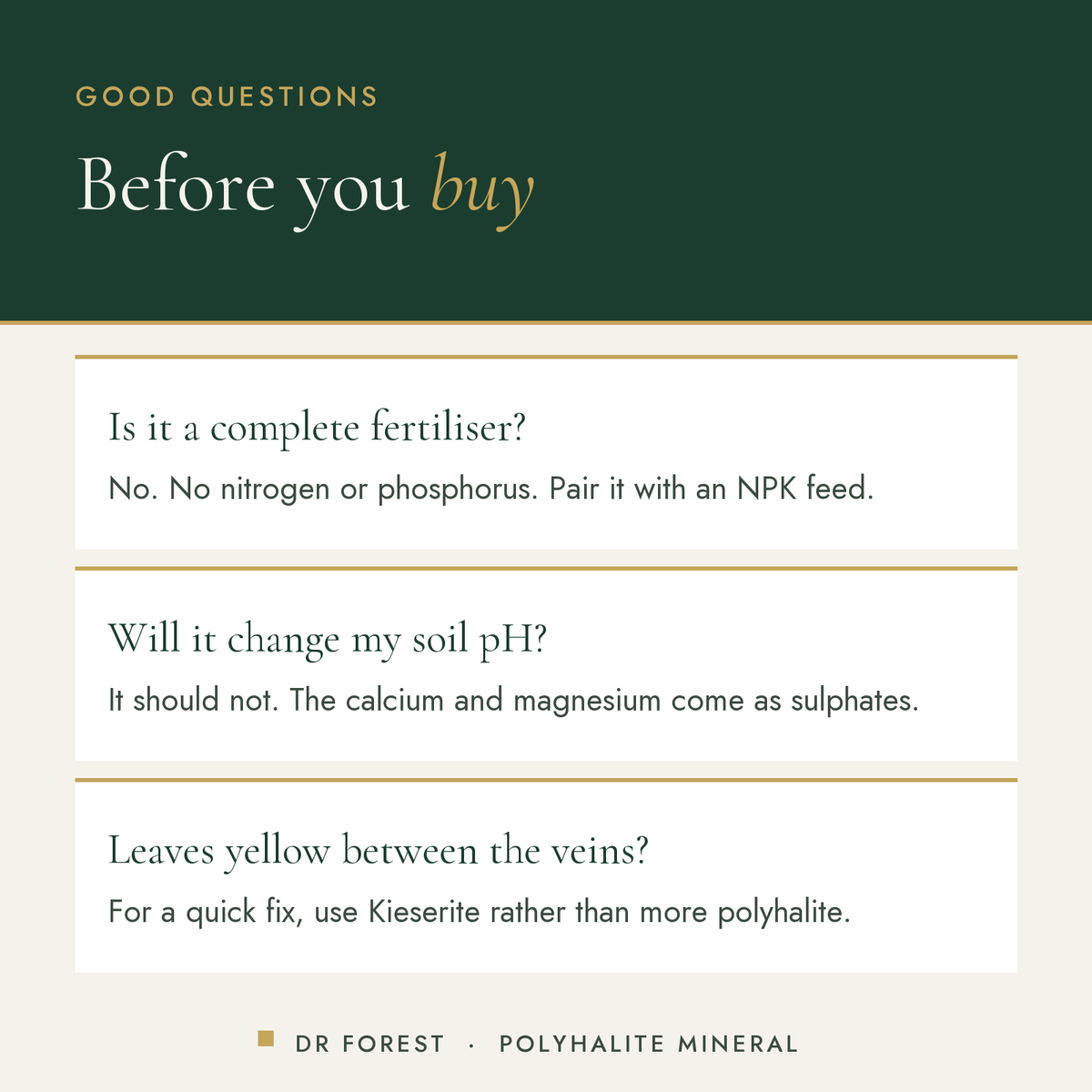
- Won't change your pH. Calcium and magnesium arrive as sulphates, not carbonates.
- Nothing added. A natural mineral, mined, crushed and granulated.
Part of our potash fertilisers range. Learn how it forms and how it compares in What is polyhalite?
What's in Polyhalite Fertiliser
How to use Polyhalite Fertiliser: rates for beds, pots, fruit and lawns
Polyhalite contains no nitrogen and no phosphorus. It supplies potassium, calcium, magnesium and sulphur. For a complete feeding programme, use it alongside a nitrogen and phosphorus source: a Dr Forest crop-specific blend (Tomato, Rose & Flower, Fruit & Veg) or an all-purpose NPK fertiliser.
Polyhalite fertiliser application rates
Soil mix: potting and container preparation
Mix thoroughly into compost or potting soil before planting. Because it dissolves gradually, it gives baseline calcium, magnesium, potassium and sulphur for the first 8–12 weeks. Ideal for all container crops.
Top-dressing: established containers
Scatter granules evenly across the surface and water in. Because it dissolves gradually, applications are less frequent than with soluble alternatives. Particularly valuable for tomatoes, peppers and other heavy-feeding fruiting crops.
Outdoor beds and borders
Broadcast evenly across the soil surface and water in well. Lower rate for general maintenance, higher rate for heavy feeders, new plantings or clay improvement. Apply at planting and as a mid-season top-up.
Lawns and turf
Apply and water in. Potassium hardens turf for winter, calcium improves soil structure, sulphur supports colour and density. Polyhalite is used as part of professional turf nutrition programmes at the highest level, including Wimbledon's (The Telegraph, 9 July 2023).
Sodic clay soil
Only where a soil test confirms too much sodium on the clay. There, the calcium in polyhalite can displace the sodium, improving structure and drainage, provided the soil drains well enough for the sodium to wash away. It doesn't alter pH. On ordinary heavy clay it won't change the structure. Work into the top 10–15 cm where you can.
Polyhalite on saline and sodic soils
These are two different problems. A sodic soil holds too much sodium on its clay, so the clay disperses and the soil slumps and drains poorly. A saline soil has too much dissolved salt in the soil water. On sodic soil, the calcium sulphate in polyhalite can displace sodium from the clay, as gypsum does, but only if the soil drains well enough for the released sodium to wash away. Polyhalite also adds potassium and magnesium salts, so it is not a substitute for gypsum where a soil needs a large calcium correction.
No fertiliser, polyhalite included, cures salinity: that needs leaching with good-quality water and better drainage. A low-chloride feed simply avoids adding to the problem. Have the soil tested for exchangeable sodium and electrical conductivity before treating either. If a test confirms a sodic soil that drains adequately, use the clay improvement rate of 100 to 150 g/m².
On fruit trees and soft fruit
Polyhalite gives fruit potash, magnesium, calcium and sulphur in one granule. It has no nitrogen or phosphorus, so it's a potash and magnesium top-up, not a complete feed. Keep using your usual fruit feed alongside it.
Before you start
- Once a year is enough for fruit in the ground. Fruit uses far less potash per square metre than vegetables, so don't follow the beds-and-borders schedule of every 6–12 weeks.
- Test your soil if you can. Soil that's already high in potash or magnesium doesn't need polyhalite, and too much potash does more harm than good, especially to apples.
- Spread it where the roots are: evenly over the ground under the branches, out to the branch tips, or along the row. Keep it 30 cm from tree trunks, and off the stems of bushes, canes and strawberries, then water it in or rake it in lightly.
- Measuring: a level tablespoon holds about 12–15 g.
Trees in the ground
- Apples: none without a soil test. Only use it if a test shows low potash: 125 g per m² under the branches at Index 0 (low), 100 g per m² at Index 1, and none at Index 2 or above. Once a year in February–March. Too much potash on apples can spoil storage and make bitter pit (brown spots in the flesh) more likely, and polyhalite's calcium is not a cure for bitter pit. If a test shows low magnesium but potash is fine, use Kieserite instead, because polyhalite always adds more potash than magnesium.
- Plums, gages and damsons: 50–100 g per m² under the branches, once a year in February–March. Use the lower rate on good garden soil and the higher rate on light, sandy or hungry soil.
- Figs planted in the ground: figs fruit best on lean soil. A fig with its roots restricted (in a lined planting pit) can have one light dressing of 20–40 g per tree over the pit in March–April. A fig growing unrestricted in mulched soil needs nothing unless growth is weak (less than about 30 cm of new shoot a year). Give a fig only one spring feed, this or a general fruit feed, and never feed after midsummer.
- Walnuts: 50–100 g per m² under the branches, once a year in early spring before the leaves open. On good soil, walnuts need nothing in their first year. For a large tree that isn't cropping well, get a soil test first. Walnuts release natural compounds that affect neighbouring plants; no fertiliser changes that.
- Almonds: 50–100 g per m² under the branches, once a year in February, before flowering. Otherwise as for walnuts. On young trees, keep granules at least 45 cm from the trunk.
Soft fruit in the ground
- Blackcurrants, redcurrants, gooseberries, raspberries: 85 g per m² with no soil test, once a year in February–March. Go up to 125 g per m² only if a soil test shows low potash.
- Strawberries: 60 g per m² with no soil test, once a year in March. Go up to 105 g per m² if a soil test shows low potash.
Planting a new fruit tree or bush: mix 35–70 g into the soil from the planting hole (roughly a 1 m² area), and mix it well so no granules touch the roots. Autumn planting is ideal.
Fruit in pots (lemons, figs, patio apples and plums)
Fruit stays in the same compost for years, so use the lower end of the container rate. Scatter the granules on the compost surface and water in well.
- Lemons and other citrus: 2.5 g per litre of compost at potting (about 1 level tablespoon per 5 litres). Top up with 10–20 g per 10 litres of compost in spring (March–April) and midsummer (July) only. Keep using a citrus feed through the year; polyhalite doesn't replace it. Water with rainwater where possible.
- Figs: 2.5 g per litre at potting. Top up with 10 g per 10 litres in April and again in late May, then nothing after midsummer.
- Patio apples and plums: 2.5 g per litre at potting. Top up with 10–20 g per 10 litres in spring and early summer.
Good to know
- Yellowing between the veins on older leaves usually means magnesium is short. For a quick fix, use a magnesium-only feed such as Kieserite rather than more polyhalite.
- Low in chloride: polyhalite is a sulphate mineral with far less chloride than muriate of potash. That makes it a good potash choice for fruit that's sensitive to chloride, such as strawberries, raspberries, redcurrants and gooseberries. Citrus growing advice also says to avoid potash in its chloride form (muriate of potash).
- It isn't lime, gypsum or Epsom salt. It always brings potash with it, so don't use it as a straight swap for any of them.
- It dissolves gradually, so water it in after spreading.
Step-by-step application
- Assess your soil. Polyhalite is most useful where calcium, magnesium, potassium or sulphur are running low: typically containers, raised beds, sandy soils and intensively cropped patches.
- Measure the rate. A level tablespoon of polyhalite is roughly 12–15g. Use the rates above as a starting point and adjust to crop demand.
- Apply evenly. Scatter across the surface for containers. Broadcast by hand or spreader for beds. Mix thoroughly with compost for soil mixes.
- Water in. Polyhalite needs soil moisture to begin dissolving and releasing nutrients. Water it in straight after application.
- Pair with a nitrogen source. Polyhalite carries no N or P. Use it with a Dr Forest blend or another NPK fertiliser for complete crop nutrition.
Polyhalite is the natural partner for any nitrogen-led feed. Pair with Dr Forest All Purpose 4-4-4 for general gardens, the crop-specific blends (Tomato, Rose & Flower, Potato) for targeted feeding, or Seaweed Powder for biostimulant activity. The calcium content also pairs well with Slow Release Humic Acid for long-term soil structure building.
How Polyhalite Fertiliser works
- Slow by structure. Nutrients release gradually from the crystal, which suits beds and turf that need a season-long base rather than a soluble hit.
- All sulphates. Every nutrient arrives as a sulphate, so there is virtually no chloride and no change to soil pH.
- Biggest gains on hungry crops. A meta-analysis of 921 field trials across 47 crops in 33 countries found yields 3.2% higher on average than standard NPK, with the largest responses in sugarcane, vegetables and potatoes (Agronomy Journal, 2026).
Polyhalite is part of professional turf nutrition programmes at the highest level, including Wimbledon's (The Telegraph, 9 July 2023).
References
- Meta-analysis of polyhalite's yield performance across diverse soil, crop, and environmental conditions (2026). Agronomy Journal. doi:10.1002/agj2.70259
Use Polyhalite Fertiliser with
- Organic Tomato Feed 3-4-6 or Potato Fertiliser 3-5-8: polyhalite carries no nitrogen or phosphorus, so pair it with a crop feed.
- Organic Lawn Fertiliser 10-3-3.5: the nitrogen feed for turf, with polyhalite for potash and sulphur.
- Autumn Lawn Feed for Clay Soil: polyhalite, alfalfa and gypsum in one autumn kit.
Which to choose: Sulphate of Potash is the concentrated option (50% K₂O) when potash is the only need. Potassium Rich Fertiliser is a micronised rock potash for sprays and drenches.