


Customer highlight
thanks got it to day. thanks fast postings thanks
Editorial highlight from marketplace and store reviews — separate from the full review list below.
a professional-grade, high-nitrogen lawn feed that greens fast and feeds for weeks
Dr Forest Organic Lawn Fertiliser is a professional-grade, high-nitrogen lawn feed for fast, thick green growth, packed in a size that suits your lawn. It comes as easy-to-spread granules that green the grass quickly, then keep feeding it for around six weeks — without the burnt patches or the quick fade you get from a cheap chemical lawn feed.
The three numbers on the bag — 10-3-3.5 — are simply the recipe. The first and biggest, 10, is nitrogen, the nutrient that makes grass grow thick and green. The other two feed the roots and toughen the grass against drought and wear. What makes this feed different is where the nitrogen comes from: instead of a harsh chemical salt, it is a natural protein made from fermented plant sugars (molasses — the dark syrup left over from making sugar). Grass takes it up fast for a quick green, but because it is a gentle, low-salt protein rather than a soluble salt, it won't scorch the lawn, and it feeds steadily instead of dissolving and rushing straight through after the first heavy rain.
Most lawn feeds only colour the grass. This one also feeds the living soil underneath, using natural conditioners drawn from a soft, ancient form of brown coal. They wake up the tiny life in the soil that does the real work of feeding your grass, so a tired lawn slowly comes back to health rather than just getting a quick coat of green. And it is a feed, not a weed-and-feed: there is no weedkiller in it, just food for the grass and the soil.
There's no weedkiller and no pesticide in the bag — just food for the grass and the soil. Made from natural ingredients, it's safe to use around children, pets, birds and bees: simply spread it evenly, water it in, and let the lawn dry before anyone plays on it.
A professional feed cannot just look good for a fortnight then fade. It has to give steady growth across a whole season, year after year, without harming the soil underneath. This is built to that standard — a proper agricultural-grade formula, not a brightly packaged product designed down to a price.
What people use it for
- Spring and summer feeding — a quick green that lasts, from a professional-grade, high-nitrogen formula.
- Tired, worn or patchy lawns — feeds the soil back to health, not just the surface.
- Sandy, hungry soils that dry out fast — the natural conditioners help hold food in the ground where the roots can reach it.
- New lawns and bare patches — gentle enough that it will not burn young, tender grass.
- Gardeners who would rather avoid chemicals — a natural, vegan lawn feed with no weedkiller, safe around children, pets, birds and bees once it's watered in.
- A hard-wearing family lawn — the kind of feeding that stands up to children, dogs and football.
This feed vs a typical cheap lawn feed
Dr Forest professional-grade feed
- Greens fast, then keeps feeding for about six weeks — no quick fade.
- Feeds the living soil under the lawn, so the ground gets better year on year.
- Natural, low-salt ingredients — will not burn the grass or build up in the soil.
A typical cheap lawn feed
- A burst of green from chemical salts that fades within a couple of weeks.
- Often mixed with weedkiller, and does nothing for the soil itself.
- The salts build up over time and can burn the lawn if you put a little too much down.
Made with organic ingredients.
what's in the bag
Four natural ingredients, each with a simple job. Two feed the grass, and two look after the soil it grows in. No fillers and no chemical salts.
The nitrogen — a natural plant protein
Nitrogen is the nutrient that drives green, leafy growth. Here it comes as a natural protein made from fermented plant sugars (molasses) — the very same nitrogen we use in our Nitrogen Fertiliser feed. Grass can take it up quickly for fast colour, and because it is a protein rather than a chemical salt, it is gentle and will not burn the lawn. Roughly half feeds the grass in the first two weeks, and the rest over the following month or so.
The phosphate — a natural ground rock
Phosphate feeds the roots and helps a lawn settle in and thicken up. Ours is a soft natural rock, finely ground, that releases its phosphate gently over a long time rather than all at once — so it keeps working for several seasons. It also brings a little natural calcium, which grass uses to build strong, healthy cells.
The soil conditioners — humic and fulvic
These are natural substances called humic and fulvic acids, drawn from leonardite — a soft, very old form of brown coal that is rich in decomposed plant matter. In plain terms, they are food and habitat for the tiny life in your soil: the microbes that quietly break nutrients down and pass them to the grass. They also help the grass take up its food more easily, and stop the phosphate getting locked away in the soil where roots cannot reach it.
The potassium — sulphate of potash, no chloride
Potassium is the nutrient that toughens grass, helping the lawn cope with drought, cold and heavy use. Ours is sulphate of potash — a natural, chloride-free form of potassium that cheaper feeds often avoid because it costs more. There is no chloride to build up in the soil, and it brings useful sulphur with it, which grass needs to make full use of its nitrogen.
What's in it, and what each part does
| Nutrient | Amount | What it does |
|---|---|---|
| Nitrogen | 10% | Green, leafy growth |
| Phosphate | 3% | Strong roots, settling in |
| Potash (potassium) | 3.5% | Toughness — drought, cold and wear |
| Sulphur | ~9% | Helps grass use its nitrogen |
| Calcium | ~5.5% | Strong cell structure |
| Magnesium | ~3% | Keeps grass deep green |
The first three — nitrogen, phosphate and potash — are the headline numbers (10-3-3.5) on the bag. The sulphur, calcium and magnesium come naturally with the ingredients; these are typical figures.
Every ingredient is plant or mineral in origin — the nitrogen comes from fermented plant sugars, the rest from natural minerals — so there are no animal products in it at all.
how to feed your lawn
Feed from mid-spring to the end of summer, every six to eight weeks, at 45–60 g per square metre — roughly a rounded to a generous handful. Start once the grass is growing again and the soil has warmed up; make the last feed by the end of August, then switch to a potassium feed for autumn. Two feeds a year is plenty for an easy life; three or four for a lush, hard-wearing lawn.
How much to put down
The amount is 45 to 60 g per square metre each time you feed. As a rough guide, a level handful of the granules is about 30–40 g and a generous, heaped handful about 55–60 g — but it is always more accurate to weigh the first few until your eye is in. Use the lighter end (around 45 g) for routine feeds and a fine, well-kept lawn, and the heavier end (up to 60 g) for the first feed of the year or a hungry, worn lawn. A 1 kg bag covers roughly 17 to 22 square metres, depending on the rate you choose.
The first feed of the year — spring
Put your strongest feed down once the grass is clearly growing again and you have mown once or twice. This kick-starts a thick, green lawn for the season. Hungry, sandy or worn lawns take the full 60 g; a fine or well-kept lawn is happy with 45–50 g.
Summer top-ups
Keep the colour and growth steady with a lighter feed every six to eight weeks — about how long one feed lasts. In a hot, dry spell, wait for cooler, moister weather rather than feeding stressed grass.
New lawns and bare patches
Rake it lightly into the surface before you sow or turf. Because the nitrogen is a gentle, low-salt protein, it will not burn young, tender grass the way a chemical feed can.
Tired or worn lawns
Works best if you first rake out the dead moss and matted old grass, and spike the lawn all over with a fork to let air in — that way the feed and the soil conditioners reach the roots. Over a season this rebuilds the soil under a worn lawn rather than just colouring the top.
What it costs to run
Because this is concentrated, professional-grade feed, a little goes a long way — around 50 g per square metre a feed. Spread across a season it works out cheaper per year than it looks on the shelf. Here is roughly how much you need, and what a year comes to.
At about 50 g per square metre, a 1 kg bag feeds roughly 20 square metres each feed. Fed three times through the year, a single 15 kg bag covers a 100 m² lawn for the whole season — around £67 a year, or about 67p per square metre.
How much you need
| Lawn size | Per feed (~50 g/m²) | A season (3 feeds) | Bag that covers it |
|---|---|---|---|
| Small — 25 m² | ~1.25 kg | ~3.75 kg | 4 kg |
| Medium — 50 m² | ~2.5 kg | ~7.5 kg | 9 kg |
| Large — 100 m² | ~5 kg | ~15 kg | 15 kg |
| Very large — 200 m² | ~10 kg | ~30 kg | 30 kg |
What a year costs
For a typical 100 m² lawn — feed more often for a lusher lawn, less for an easy one:
| How you feed | Product a year | Cost a year | Per m² |
|---|---|---|---|
| 2 feeds — easy, healthy lawn | ~10 kg | ~£44 | ~44p |
| 3 feeds — most lawns | ~15 kg | ~£67 | ~67p |
| 4 feeds — lush or hard-worn | ~20 kg | ~£89 | ~89p |
A guide at current prices. Costs are worked at the 15 kg bag price (about £4.40 per kilo); the bigger bags are cheaper per kilo again, so the cost per year drops further. Stick to the lighter 45 g rate throughout and you'll use a little less again than the figures above, which assume about 50 g.
When to feed through the year
| Time of year | What to do | Amount |
|---|---|---|
| Late March–April | First feed, once the grass is growing and the soil has warmed (about 8–10°C) | 50–60 g/m² |
| May–June | Second feed, about 6–8 weeks after the first | 45 g/m² |
| July | Optional top-up — only if the lawn is growing well and not under drought or heat stress | 45 g/m² |
| By end of August | Final feed of the year with this product | 45 g/m² |
| September–October | Stop using this feed — switch to a potassium autumn feed to toughen the lawn for winter | — |
| November–February | Do not feed — the grass is resting | — |
Two feeds — one in spring and one in late summer — is plenty for an easy, healthy lawn. Three suits most lawns. Four is for a showpiece, or a lawn that takes a lot of wear from children and pets. Whatever you choose, leave at least six weeks between feeds and never put down more than 60 g per square metre in one go.
When not to feed
the lawn is brown and dry in a drought and you cannot water it; there is frost about or the ground is frozen; the ground is waterlogged; or it is a heatwave above about 25°C. Feeding grass that is stressed or resting just wastes the feed and can scorch it. Wait for cool, moist weather when the grass is growing.
Step by step
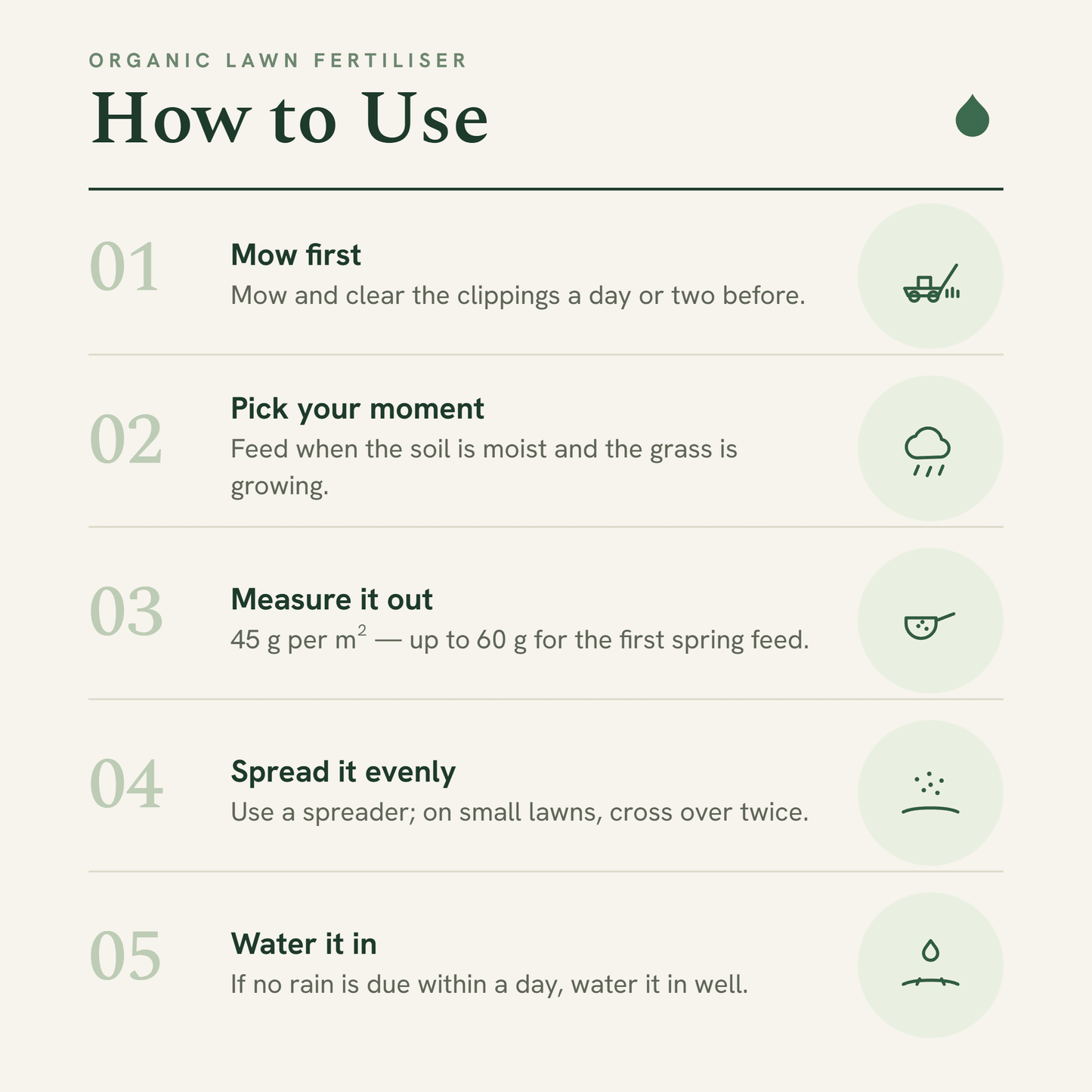
- Mow first. Cut the lawn a day or two before and clear the clippings, so the granules can reach the soil.
- Pick your moment. Feed when the soil is moist and the grass is growing, ideally with rain due in the next day or two — or plan to water it in yourself.
- Measure it out. A rounded handful (about 45 g) per square metre, up to a generous handful (60 g) for the spring feed. Weigh the first few until your eye is in.
- Spread it evenly. Use a spreader on a larger lawn. On a small one, use half the amount and go over the area twice — the second time at right angles to the first — so you do not get green stripes where it landed thickly.
- Water it in. If no rain falls within a day, water the lawn so the granules break down and the food reaches the roots.
Use Dr Forest Scottish Seaweed as a spring pick-me-up to help the grass root and shrug off stress, and Dr Forest Sulphate of Potash in autumn — once you stop feeding nitrogen — to toughen the lawn for winter. For a worn lawn on poor ground, Granulated Volcanic Rock Dust puts minerals back into the soil underneath.
Keep the bag closed and dry. The granules soak up damp and will clump together if left open. Store it somewhere cool and dry, out of reach of children and pets. Kept dry, it lasts for years.
More on feeding through the year in our high nitrogen lawn feed guide.
why it works
This is a professional-grade feed, built to a proper agricultural formula, so it keeps grass growing steadily across a whole season without wearing out the soil. Here is what each part is doing, in plain terms, with the research it rests on listed at the bottom.
The simple version
Fast colour, less waste
Because the nitrogen is a protein released gradually as soil life breaks it down — rather than a soluble salt dissolved all at once — the grass greens quickly but holds its colour for weeks instead of flushing and fading. Grass can even take up some of it as whole amino acids, without waiting for it all to turn to nitrate.1,2 And because less of it sits in the soil as loose nitrate at any moment, less of it washes away after heavy rain — a well-known loss route for nitrogen on turf.3
Feeding the soil beats feeding only the grass
When soil gets natural food alongside its minerals, the combination outperforms mineral feed alone. A large review of nearly 8,000 field comparisons found the mix gave the best results overall.4
Waking up the life in the soil
The natural conditioners — the humic and fulvic acids — act like a tonic for soil life and root growth. They support the soil biology and the fine roots that release food to the grass and pass it up into the leaf.5,6
Keeping the root food available
Phosphate, the root nutrient, easily gets locked up in soil into a form grass cannot use. The natural conditioners help keep it unlocked and available, so the ground rock keeps feeding the lawn instead of going to waste.6
Building better soil under the lawn
Feeding with natural ingredients slowly builds up the dark, spongy matter in soil that holds water and roots. In trials it rose by about an eighth compared with chemical feed — which in a lawn means turf that copes far better in a dry spell.7
Toughness and lasting colour
Potassium helps grass handle drought, cold and heavy use, and the little bit of sulphur helps it make full use of its nitrogen and hold a deep green. Both are often missing from cheap feeds.8,9
More growth, without wrecking the soil
Across hundreds of experiments, feeding with natural ingredients grew more — and, unlike chemical feed alone, did not thin out the diversity of life the ground supports.10
Scientific References
- Näsholm, T., Ekblad, A., Nordin, A., Giesler, R., Högberg, M. & Högberg, P. (1998). Boreal forest plants take up organic nitrogen. Nature, 392, 914–916.
- Näsholm, T., Kielland, K. & Ganeteg, U. (2009). Uptake of organic nitrogen by plants. New Phytologist, 182(1), 31–48.
- Cameron, K.C., Di, H.J. & Moir, J.L. (2013). Nitrogen losses from the soil/plant system: a review. Annals of Applied Biology, 162(2), 145–173.
- Ishfaq, M., Wang, Y., Xu, J., et al. (2023). Improvement of nutritional quality of food crops with fertiliser: a global meta-analysis (7,859 data pairs). Agronomy for Sustainable Development, 43, 80.
- Nardi, S., Pizzeghello, D., Muscolo, A. & Vianello, A. (2002). Physiological effects of humic substances on higher plants. Soil Biology & Biochemistry, 34, 1527–1536.
- Canellas, L.P., Olivares, F.L., Aguiar, N.O., et al. (2015). Humic and fulvic acids as biostimulants in horticulture. Scientia Horticulturae, 196, 15–27.
- Allam, M., Radicetti, E., Quintarelli, V., et al. (2022). Influence of organic and mineral fertilisers on soil organic carbon and crop productivity: a meta-analysis. Agriculture, 12(4), 464.
- Marschner, P. (Ed.) (2012). Marschner's Mineral Nutrition of Higher Plants, 3rd ed. Academic Press.
- Hawkesford, M.J. & De Kok, L.J. (2006). Managing sulphur metabolism in plants. Plant, Cell & Environment, 29(3), 382–395.
- Shi, T.-S., Collins, S.L., Yu, K., et al. (2024). A global meta-analysis on the effects of organic and inorganic fertilisation on grasslands and croplands (537 experiments). Nature Communications, 15, 3411.


