What does organic fertiliser do?
It does two jobs at once: it supplies the nutrients a plant needs, and it feeds the soil organisms that release them. The second job is the one that compounds from season to season.
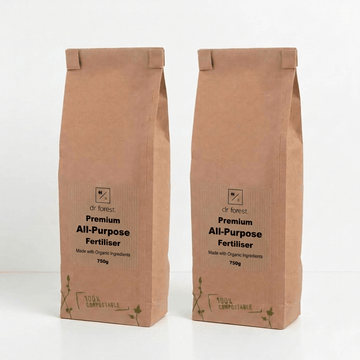
Handcrafted in Stockport
Premium Organic Fertilisers
Feeds the plant and the soil in the same application. From £6.25
Shop organic fertilisersThe nutrients, and what each one is for
Nitrogen builds leaves and stems. A shortage shows first in the older leaves, which go pale and undersized because the plant moves its nitrogen to the new growth. Phosphorus goes into roots, flowering and fruit set. Potassium governs flowering, fruiting, sugars and the plant's water regulation, which is why potassium-led feeds are the standard answer for tomatoes and soft fruit from midsummer onwards.
Then there are the three that general feeds usually omit. Calcium builds firm cell walls. Magnesium sits at the centre of the chlorophyll molecule, so a shortage reads as yellowing between the veins of older leaves while the veins stay green. Sulphur is needed to build proteins. A multi-input blend supplies all six.
What it does to the soil
This is the part that does not show up on the bag. Organic materials leave carbon behind when they break down, and that carbon is what soil bacteria, fungi and worms live on. Over several seasons that builds crumb structure, which lets water in and air through, and raises how much water the soil can hold before it dries out.
None of that happens in one application. It is a slow, cumulative effect, and it is the honest reason to feed this way rather than any claim about the nutrients themselves being superior.
What it does not do
It will not rescue a plant that is short of something this week. Mineralisation takes weeks and slows to almost nothing in cold soil, so a granular feed applied to a struggling plant in April does very little until the ground warms. That is what liquid feeds are for.
It also will not fix a problem that is not a nutrient problem. Yellow leaves are as often waterlogging, drought or root damage as a deficiency, and feeding a plant with sick roots makes nothing better.
Worth knowing. Because the nutrients are released gradually rather than dissolved on contact, scorch is uncommon at normal garden rates. That is a genuine advantage of feeding this way, but it is not a licence to over-apply: too much nitrogen still produces soft growth that flops and does not flower.
From the Dr Forest range
Premium Organic Fertilisers
Blends carrying nitrogen, phosphorus and potassium alongside calcium, magnesium, sulphur and trace elements, so one bag covers a crop for the season.
Six nutrients, not three · Feeds soil life · Rates published for beds and pots
Browse the organic fertiliser rangeMore organic fertiliser questions
What is organic fertiliser?Is organic fertiliser better for plants?How long does organic fertiliser take to work?Sources
- Royal Horticultural Society. How to feed plants. rhs.org.uk
- Royal Horticultural Society. Organic matter: how to use it in the garden. rhs.org.uk
- Cassity-Duffey, K. et al. (2020). Effect of soil texture on nitrogen mineralization from organic fertilizers in four common southeastern soils. Soil Science Society of America Journal 84(2), 534–542. doi.org
Soil notes
Get the evidence, not the marketing
Occasional notes from Stockport on feeding, soil structure and what the research actually supports, including the things that turn out not to work.
No spam. Unsubscribe in one click. See our privacy notice.