What is organic fertiliser?
Organic fertiliser holds its nutrients inside natural materials, and soil organisms have to break those materials down before roots can take anything up. That is the whole difference: the nutrient arrives on the soil's timetable rather than the moment you water.
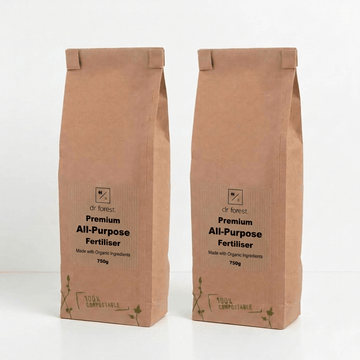
Handcrafted in Stockport
Premium Organic Fertilisers
Finished crop blends and single ingredients, every one named on the label. From £6.25
Shop organic fertilisersWhat counts as organic fertiliser
In gardening, organic fertiliser means a feed whose nutrients sit in natural materials rather than in manufactured soluble salts. That covers a wide family: single materials like seaweed meal, alfalfa or rock phosphate, and finished blends that draw on a dozen or more of them at once.
The word is doing two jobs at once, which is where most of the confusion starts. In chemistry, organic means carbon-based, so a nitrogen atom held in a protein counts and a mined mineral does not. In the garden centre it means something looser: not synthetic. Mined minerals such as rock phosphate and sulphate of potash are sold as organic fertiliser under that second meaning, and they are permitted in organic growing, even though they are not carbon-based at all.
Why the nutrients arrive slowly
That middle step is the one people underestimate. Mineralisation is a biological process, so its speed depends on soil temperature, moisture and texture rather than on how much you applied. Below roughly 4°C it very nearly stops, which is why an autumn feed does little until spring.
Organic and synthetic are not different nutrients
A root cannot tell where a nitrate ion came from. It absorbs the same ion whether it was mineralised out of a protein or dissolved out of a manufactured salt, and the plant builds the same tissue from it either way. Anyone claiming organic nutrients are inherently better for the plant is overstating it.
The real difference is what happens to the soil. An organic feed leaves carbon behind, which soil organisms live on, and that is what improves structure and water holding over several seasons. A soluble feed supplies the nutrient and nothing else.
How to tell a good one from a label
Look for the full ingredient list rather than a headline NPK. A bag that says "organic base" without naming what is in it is telling you less than it looks. Look for the application rate printed for beds and for pots, and for an analysis that includes calcium, magnesium and sulphur rather than the three headline numbers alone. Most plant problems that get blamed on nitrogen turn out to be one of the others.
A note on wording. A feed described as suitable for organic growing is not the same as a certified organic product. Certification means a body has audited it and issued a licence number. If a brand claims certification, ask which certifier.
From the Dr Forest range
Premium Organic Fertilisers
Finished crop blends alongside the single ingredients they are built from. Every input named on the label with its own analysis, hand-blended in small batches in Stockport.
Every ingredient named · Rates published for beds and pots · Compostable packaging
Browse the organic fertiliser rangeMore organic fertiliser questions
What is organic fertiliser made of?What does organic fertiliser do?What is slow-release organic fertiliser?Sources
- Royal Horticultural Society. Fertilisers: types and uses. rhs.org.uk
- Royal Horticultural Society. How plants absorb nutrients. rhs.org.uk
- Cassity-Duffey, K. et al. (2020). Nitrogen mineralization from organic materials and fertilizers: predicting N release. Soil Science Society of America Journal 84(2), 522–533. doi.org
Soil notes
Get the evidence, not the marketing
Occasional notes from Stockport on feeding, soil structure and what the research actually supports, including the things that turn out not to work.
No spam. Unsubscribe in one click. See our privacy notice.