Liquid Fertiliser
Brix+ Liquid Seaweed Biostimulant Booster
Concentrated seaweed biostimulant for steady, resilient growth.
from £12.99
Free UK Delivery on Orders Over £40

Dr Forest
Couldn't load pickup availability
Dr Forest customers rate us 4.96/5 · 3,543+ reviews & ratings across Shopify, Amazon, Google, Trustpilot and eBay
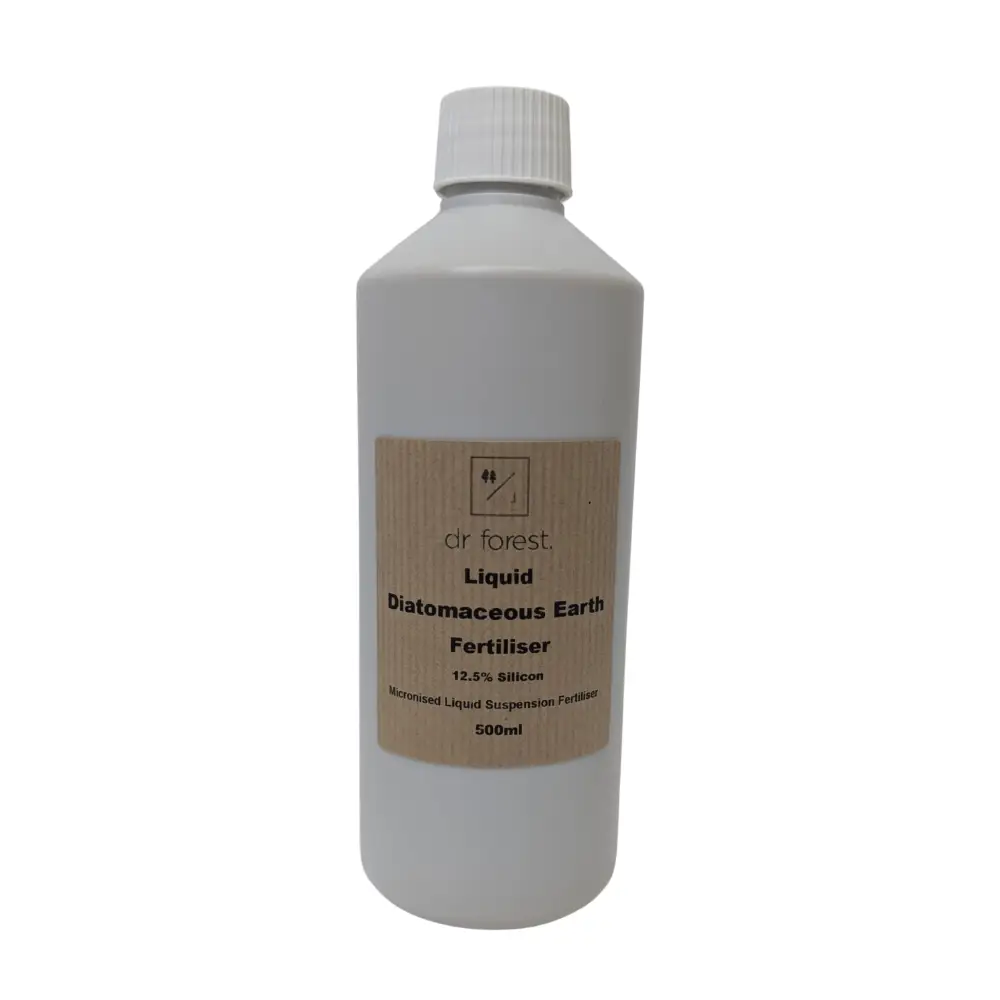
Silicon is the most abundant mineral element in the earth's crust after oxygen — and the most neglected in plant nutrition. It strengthens cell walls, improves drought tolerance, increases resistance to fungal disease and insect feeding, enhances flowering and fruit set, and acts as a general tonic for plant health. Yet almost no fertiliser programme includes it. This product solves that gap: a liquid suspension of micronised diatomaceous earth delivering 90% amorphous silica in plant-available form.
Diatomaceous earth (DE) is the fossilised remains of diatoms — single-celled aquatic organisms whose cell walls are made of silica. Micronising these fossils into ultra-fine particles and suspending them in liquid creates a form of silicon that can be applied as a foliar spray or fertigation input. The formula also includes 0.7% boron — a documented silica synergist that improves silicon uptake and supports reproductive development. ACO certified organic (456AI).
Every Dr Forest product is made by hand in small batches at our workshop in Stockport, Greater Manchester. We source ingredients for quality, not cost. Supplied in recycled plastic bottles.
Silicon is not classified as an essential plant nutrient under the strict Arnon and Stout criteria — plants can complete their life cycle without it. But this technical classification has led to a practical blind spot. Research over the past two decades has consistently demonstrated that silicon supplementation improves cell wall strength, disease resistance, drought tolerance, yield, and quality across a wide range of crops. It is now classified as a "beneficial element" and is included in many advanced nutrition programmes worldwide. The problem has always been delivery: how to get silicon into a plant-available form that is compatible with other inputs.
Silicon is absorbed by roots as monosilicic acid (Si(OH)₄) and transported to the shoot where it polymerises in the outer cell wall as amorphous silica (SiO₂·nH₂O). This creates a physical barrier — essentially a layer of biological glass — beneath the cuticle. Fungal hyphae must penetrate this barrier to infect the tissue. Insect mandibles and stylets encounter a hard, abrasive surface. Research consistently shows that silicon-supplemented plants have significantly lower rates of powdery mildew, botrytis, rice blast, and other foliar diseases.
The silica layer in cell walls reduces cuticular transpiration — the passive loss of water through the leaf surface. Silicon also improves root water uptake under osmotic stress and maintains cell turgor at lower water potentials. Published studies demonstrate that silicon-treated plants maintain photosynthesis and biomass production under drought conditions that significantly reduce performance in untreated controls. For container-grown crops where water stress cycles are common, this translates directly to improved resilience and reduced watering frequency.
Recent research has identified boron as a key synergist for silicon uptake and utilisation. Boron improves the deposition of silicon in cell walls and enhances the structural benefits. This formula includes 0.7% boron specifically for this synergistic effect. Boron also has its own critical role: it is required for pollen tube growth, sugar transport, and cell wall structure. However, boron has a narrow window between deficiency and toxicity — the 0.7% concentration is calibrated for synergistic benefit without accumulation risk at recommended application rates.
The silica in diatomaceous earth is amorphous — a non-crystalline form with no associated health risks. This is fundamentally different from crystalline silica (quartz), which is a documented respiratory hazard. Amorphous silica from diatomaceous earth is classified as safe for agricultural use and is approved under organic certification standards. The micronised particle size improves plant availability without creating any crystalline silica exposure.
Silicon supplementation has been shown to increase flowering intensity, improve fruit set rates, and enhance fruit quality across multiple crop species. The mechanisms include improved pollen viability (enhanced by the boron synergist), stronger peduncle and pedicel tissue, and firmer fruit cell walls. Silicon-treated fruit consistently shows improved firmness, colour, sugar content, and post-harvest shelf life — all traceable to the structural and metabolic benefits of silicon deposition in developing tissue.
Diatomaceous earth is not pure silica — it is the fossilised remains of aquatic organisms that accumulated a range of trace elements during their lifetime. The micronised DE in this product contains a broad spectrum of micronutrients alongside the dominant silica fraction. While silicon is the primary active ingredient, the micronutrient content provides additional nutritional value that pure silicon sources like potassium silicate cannot match.
This product contains 0.7% boron. Boron is beneficial at correct rates but toxic to plants at high levels. Do not exceed the application rates below. Monitor plant boron levels if applying regularly or at the upper end of the rate range. Some crops (particularly beans and peas) are more sensitive to boron than others — test-spray a small area first.
Apply every 2–4 weeks or as required during the growing season. Ensure thorough foliage coverage. Where higher water volumes are needed for canopy penetration, do not exceed the maximum product rate per hectare. Particularly effective from pre-flower through to fruit fill.
Adjust water volume depending on canopy closure. Apply at key growth stages based on crop monitoring. Silicon is particularly valuable at tillering in cereals and pre-flower in all crops.
Apply through drip systems or irrigation. Use the higher rate for initial soil loading; lower rates for maintenance. Maintain agitation in the mixing tank. Use a coarse inline filter (500 micron / 35 mesh).
Shake well before use. Dilute 45 ml into a 9-litre watering can. Apply as a foliar spray to both leaf surfaces, or pour over foliage and root zone as a combined drench. Repeat every 2–4 weeks during the growing season as required.
Micronised mineral suspensions leave a visible white residue on leaves and fruit after spraying. This is normal — it is mineral particles on the leaf surface. If produce appearance matters close to harvest, switch to soil drench application or spray earlier in the growing season.
Pair with Cal-Mino for chelated calcium during fruiting — calcium and silicon together produce the strongest cell walls. Use alongside Seaweed Powder for additional biostimulant activity. Compatible with most Dr Forest fertiliser inputs. Avoid mixing with strongly acidic solutions — perform a jar test before combining with any new product.

Concentrated seaweed biostimulant for steady, resilient growth.
from £12.99

A wood-vinegar biostimulant for soil and foliar use.
from £14.99

70% fulvic acid to help roots take up nutrients.
from £6.49