Dr Forest
Living Soil Refills UK
Couldn't load pickup availability
- ✓Free UK delivery on orders over £40
- ✓Handcrafted and dispatched from Stockport
- ✓Made with organic ingredients
- ✓No-quibble returns
Dr Forest customers rate us 4.96/5 · 3,543+ reviews & ratings across Shopify, Amazon, Google, Trustpilot and eBay
Living Soil Refills
Veg, Bloom, bone meal and micronised rock phosphate. Restock what you need.
Everything in the Dr Forest living soil programme, sold on its own. Restock the blend you have run out of, feed heavier for maximum yield, or re-charge a soil you are running for a second or third year. Choose your component and your size. New to the programme? Start with the complete Living Soil kit.
Reusing your soil? This is what you need
Veg and Bloom at full strength, and only a third of the phosphorus charge — last year's phosphorus is still banked in the soil. Top the organic matter back up with compost and you are away.
You bought the soil once. You do not need to buy it again.
★★★★★ 5-star across all platforms · 4,300+ reviews. Handcrafted in small batches in Stockport, Greater Manchester, in compostable packaging. Made with organic ingredients, and safe around children, pets and wildlife.
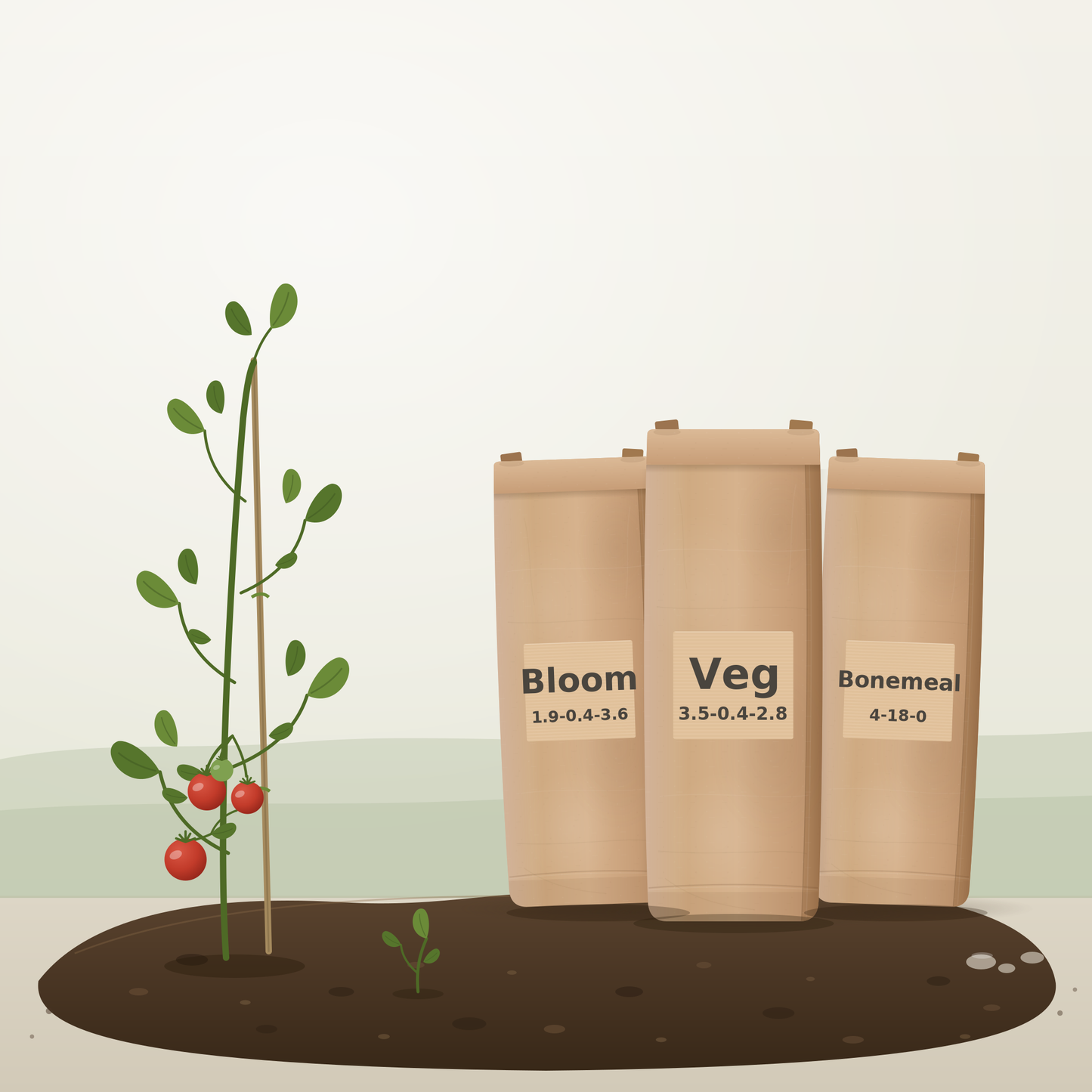
Veg — 3.5-0.4-2.8
Thirteen inputs, nitrogen-led, with a carbon backbone of organic alfalfa meal and bokashi-fermented bran. Calcium and magnesium available from day one. Humic and fulvic acid at 1% each.
Analysis
N 3.5% · P₂O₅ 0.4% · K₂O 2.8% · CaO 2.9% · MgO 1.9% · SO₃ 8.1%
Alfalfa meal 37.5% · amino-acid nitrogen from molasses extract 17% · bokashi bran 8.5% · gypsum 7% · seaweed meal 6.5% · kieserite 6.5% · zeolite 5.85% · malted barley 4.5% · sulphate of potash 3% · biochar 1.5% · humic acid 1% · fulvic acid 1% · boron complexed with humic acid 0.15%
Bloom — 1.9-0.4-3.6
Nitrogen drops back; potash and calcium rise. Magnesium sits on its optimum — enough for the job, and no more. Too much magnesium suppresses reproductive growth without buying any quality, so it is held level rather than pushed.
Analysis
N 1.9% · P₂O₅ 0.4% · K₂O 3.6% · CaO 3.7% · MgO 1.7% · SO₃ 10.0%
Alfalfa meal 31% · zeolite 17.15% · gypsum 10% · bokashi bran 8% · seaweed meal 6.5% · amino-acid nitrogen from molasses extract 5.5% · kieserite 5.5% · sulphate of potash 5.2% · malted barley 4.5% · biochar 4.5% · humic acid 1% · fulvic acid 1% · boron complexed with humic acid 0.15%
What the feed delivers — and what your plants need
Every level is set against peer-reviewed trials on flowering and fruiting crops, not tradition. Here is what a standard build puts into the soil solution, against what the plant actually wants — and the one that matters most is phosphorus.
| Nutrient | This feed delivers | Flowering plants need | Fruiting & root veg need |
|---|---|---|---|
| Nitrogen | high in veg, lean through flower | low in flower — lifts flavour | moderate and steady |
| Phosphorus | ~27 mg/L, from the charge | 25–30 mg/L | 35–50 mg/L — add extra P |
| Potassium | ~160 mg/L | 60–175 mg/L | ~300 mg/L — add extra K |
| Calcium | high, from day one | to sufficiency | high |
| Magnesium | ~55 mg/L | 35–70 mg/L | 35–70 mg/L |
"But don't flowers need a phosphorus spike?"
It is the most common belief in growing, and the peer-reviewed answer is no. A flowering plant's phosphorus demand is real but modest, and the same 25–30 mg/L in the soil solution covers every stage — bloom included. Raise it above that and flower number and weight do not move (Westmoreland & Bugbee 2022; Shiponi & Bernstein 2021). A "PK spike for bloom" sells feed; it does not grow more flower. Bloom boosters seem to work only because they also cut the nitrogen — and it is the lower nitrogen doing the work, not the phosphorus. Dr Forest gets that effect honestly: nitrogen steps down in the Bloom blend while the charge holds phosphorus flat at the level the flower actually uses.
How much phosphorus you feed — Dr Forest vs the rest
Every other living-soil feed bundles phosphorus into the amendment and re-adds it each grow. This is the phosphorus in the feed itself, from each product's own published analysis.
| Living-soil feed | P₂O₅ in the feed | How it is applied |
|---|---|---|
| Dr Forest Veg & Bloom | 0.4% | a separate one-time charge |
| Leading grow-stage feeds | 3% | in the feed, re-added every grow |
| Craft bloom blends | 5% | in the feed |
| High-phosphorus bloom feeds | 8% | in the feed, every grow |
Some of these use the same micronised rock phosphate Dr Forest does — they simply bundle it into a 3–8% feed and re-apply it every stage, every crop. Dr Forest works it in once as a separate charge and takes only a third on reused soil, so the soil never loads up.
Why re-amending a 3–8% phosphorus feed goes wrong
Rock phosphate and bone meal are slow-release — they weather over years, not weeks. A feed carrying 3–8% phosphorus doses that slow mineral at a rate that would only make sense for a fast inorganic salt the plant uses up each cycle. But slow phosphorus does not leave. Re-amend every grow and you add it far faster than the plant can take it up, so it climbs.
A plant draws about 25–30 mg/L of phosphorus from the soil solution and no more. Above that there is no gain in growth, flower or fruit (Westmoreland & Bugbee 2022) — everything past sufficiency simply accumulates.
Surplus phosphorus competes with zinc and iron for uptake — an effect set by the phosphorus-to-zinc balance rather than a single figure, and worst on soils already low in zinc. They are the two micronutrients behind a clean finish and behind aroma and flavour; the blends carry seaweed and a full micronutrient package to keep them available. The plant can look fed and still run short of them.
Slow phosphorus added early and topped up each cycle sits at its highest late in the grow and into the next — exactly when you want the feed easing off for a clean ripening. You cannot turn a banked mineral back down.
In controlled trials, raising phosphorus above sufficiency does not lift yield or quality. It raises tissue phosphorus, micronutrient antagonism and leaching instead (Westmoreland & Bugbee 2022; Shiponi & Bernstein 2021).
Why phosphorus does not belong in the feed
Put a slow phosphorus into the feed and top-dress it cycle after cycle, and it stacks in the soil far faster than the plant can draw it down.
Either way, you pay for it
In a living soil the phosphorus stays put. Bundled into an all-in-one feed, you cannot turn it down without starving the nitrogen and potash the plant still needs — so on a reused soil it only ever climbs, when all you actually needed to replace was nitrogen and potassium. The soil gets harder to run each year, not easier.
In a soluble mineral feed the phosphorus you do not need just washes out — expensive run-off, and a pollution problem, for no benefit to the plant.
Dr Forest keeps phosphorus in a one-time charge instead: top up nitrogen and potassium by the week, and the banked phosphorus holds steady at what the plant actually uses.
Dr Forest keeps it separate — so the soil lasts
Phosphorus lives in a one-time charge, worked in once and never fed again. On a second or third grow you take just a third of the charge — because last year's is still banked — while nitrogen, potash, calcium and magnesium carry on at full strength. Phosphorus stays flat at the ~27 mg/L the plant actually needs, the soil never loads up, and it finishes clean grow after grow. Our bloom feed carries 0.4% phosphate; a typical "bloom" amendment carries 5–8%.
Why the charge goes in a week before planting
Phosphorus is slow, so you add it before the plant needs it — not when it needs it. Worked into the soil at planting, it has the whole veg phase to weather, and it is ready and waiting the moment bloom demand climbs. Add the same slow phosphorus at the flip instead and it is barely started — still locked in the mineral through the weeks the plant wants it most, and only catching up long after flowering has peaked.
The phosphorus charge
Finely ground and steamed. A biological apatite, so soil acid and biology break it down readily. The more reliable of the two: faster, less fussy about pH, more forgiving if your soil drifts. It carries a little nitrogen of its own, which nudges a build gently towards yield.
The plant-based choice, and nitrogen-free — so it holds the flower at its leanest, the flavour build. Ground fine so soil biology and root acids can weather it. Slower than bone meal and far more dependent on an acidic soil, so keep the pH near 6.2 and take mycorrhizal fungi with it.
Rates
Phosphorus charge — bone meal
9g per litre of soil. Mixed through the soil a week before planting. Once per cycle.
Phosphorus charge — rock phosphate
12g per litre of soil. Higher than bone meal, because it releases more slowly and depends more on soil acid.
Reused soil
A third of the charge. Blends stay at full strength.
Veg
5.6g per litre across the growing phase (4.7g lean for flavour, 6.5g for maximum yield). Top-dressed weekly.
Bloom
8g per litre across flowering (6.7g lean for flavour, 8.5g for maximum yield, with a mid-flower nitrogen booster). Top-dressed weekly.
The finish
Plain water for the last two to three weeks.
How much for your soil
| Soil | Bone meal | or Rock phos | Veg | Bloom |
|---|---|---|---|---|
| 80 litres | 720g | 960g | 448g | 640g |
| 120 litres | 1,080g | 1,440g | 672g | 960g |
| 200 litres | 1,800g | 2,400g | 1,120g | 1,600g |
Standard (Balanced) build. On reused soil, take a third of the phosphorus charge and leave the blends as they are.
Get your pH right or none of it works
Aim for 6.2 to 6.5. Slightly acidic soil is what dissolves the phosphorus charge — above about 6.8 the release slows sharply, and no amount of extra phosphorus will fix a pH problem.
If you have chosen rock phosphate, aim for 6.2. It leans on soil acid far more than bone meal does, and it carries calcium and a little carbonate that gently nudge pH upward — the direction that slows its own release. Check your pH mid-cycle rather than assuming it has held.
Dr Forest — Made by Growers. Backed by Science.
Handcrafted in Stockport, Greater Manchester. Named after Joe's grandfather Dr Forrest, a GP near Preston who kept a back-garden plot for the runner beans he turned into piccalilli.
Everything you need to run the programme, step by step:
Feeding calculator · Feeding schedule · Phosphorus & flavour: the scienceShare