Dr Forest
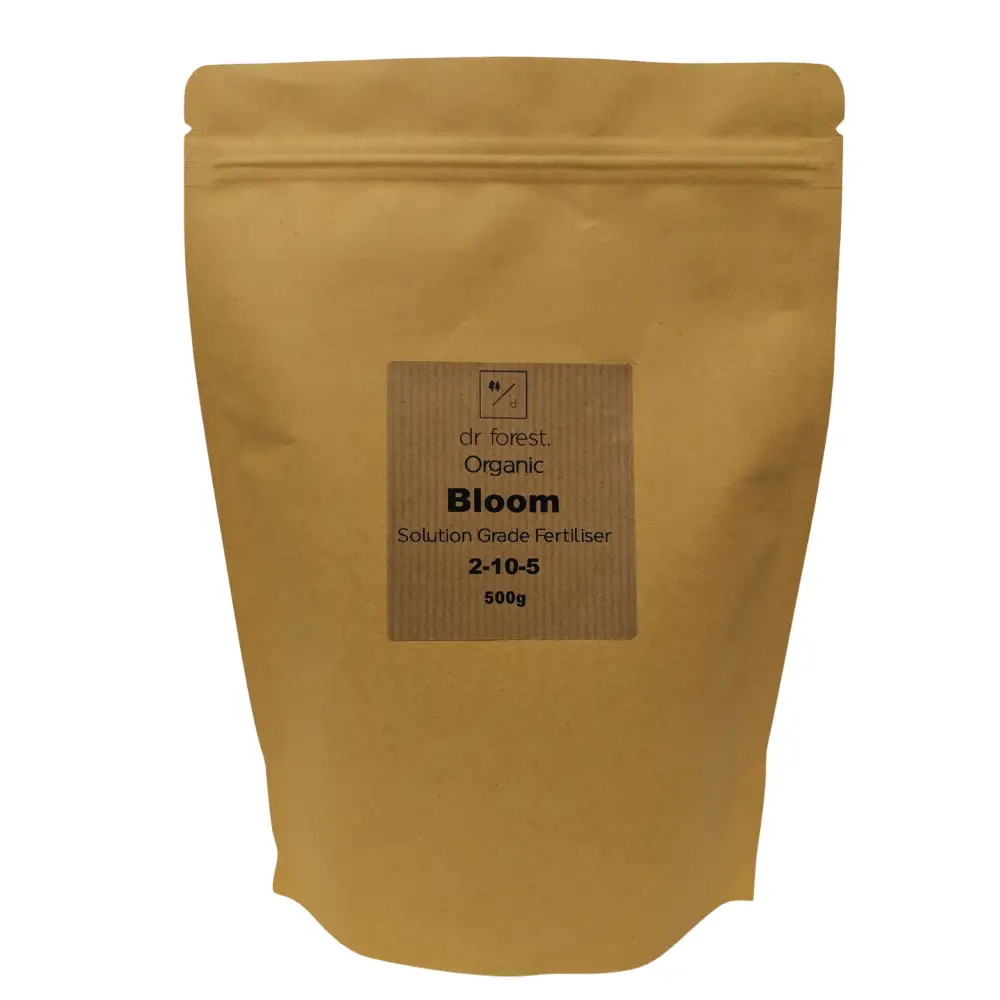
Bloom Booster 2-10-5
Couldn't load pickup availability
- ✓Free UK delivery on orders over £40
- ✓Handcrafted and dispatched from Stockport
- ✓Made with organic ingredients
- ✓No-quibble returns
Dr Forest customers rate us 4.96/5 · 3,543+ reviews & ratings across Shopify, Amazon, Google, Trustpilot and eBay
Organic Bloom Booster 2-10-5 — solution grade fast-release fertiliser for flowers, fruit & yield
The moment a plant begins to flower, its nutritional needs change fundamentally. During the vegetative phase, nitrogen drives leaf and stem growth. But once the first flowers open, phosphorus and potassium become the dominant requirements — phosphorus to fuel the energy-intensive processes of flower formation, pollination, and fruit set, and potassium to control water balance, sugar transport, and the flavour compounds that determine eating quality. Continuing to feed a high-nitrogen fertiliser during flowering produces more leaves at the expense of flowers and fruit. The correct move is to switch to a high-P, high-K feed — and this is that feed.
Bloom Booster is a solution grade organic fertiliser — a concentrated powder that you add to water to create a fast-acting nutrient drench. The 2-10-5 ratio is deliberately weighted toward phosphorus, with moderate potassium and low nitrogen to support the reproductive phase without promoting excess vegetative growth. The nitrogen and just under half the potassium are fully water-soluble, delivering nutrients into the root zone within hours. The phosphorus and remaining potassium are micronised to ultra-fine particle size for rapid breakdown even though they are not technically soluble.
The formulation includes amino acids enriched with humic and fulvic acid for enhanced nutrient uptake, soluble seaweed extract providing growth hormones and trace minerals, and micronised gypsum and magnesium mineral to keep calcium and magnesium balanced during the demanding flowering and fruiting phase. This is not a bottled liquid — you are not paying to ship water across the country. It is a concentrated, sustainable powder that delivers all the speed of a synthetic bloom feed with none of the downsides.
What Bloom Booster is used for in the garden
- Tomatoes, peppers & fruiting vegetables during flowering and fruit set — the high phosphorus content fuels the energy-demanding transition from vegetative growth to fruit production; potassium drives sugar transport into developing fruit for improved flavour and sweetness
- Roses and flowering shrubs for more abundant blooms — phosphorus triggers flower bud initiation and supports petal development; use from first bud swell through the flowering season for maximum bloom count and flower size
- Strawberries, soft fruit and fruit trees during fruiting — supports fruit set, berry development, and flavour compound synthesis in strawberries, raspberries, blackcurrants, gooseberries, apples, pears, and plums
- Annual flowers and bedding plants — extends the flowering display of petunias, marigolds, geraniums, dahlias, sweet peas, and all annual flowers by keeping phosphorus and potassium supply matched to reproductive demand
- Container and hanging basket flowers — plants in containers exhaust bloom nutrients fastest; Bloom Booster keeps flowering plants productive well beyond the point where an initial slow-release granular has run out
- Orchids and flowering houseplants — the solution format is clean, odourless, and ideal for indoor use; particularly effective for encouraging orchids, African violets, peace lilies, and Christmas cacti to re-bloom
- Courgettes, cucumbers, beans & peas during fruiting — all fruiting vegetables benefit from the phosphorus-potassium shift once flowering begins; improves pod set, fruit size, and harvest duration
- Bulbs after flowering — a drench after flowering helps bulbs replenish their energy stores for the following year's display; the phosphorus supports bulb rebuilding and next season's flower bud formation
Why solution grade rather than bottled liquid bloom feed?
Bloom Booster — Solution Grade Powder
- Concentrated powder — you add the water; no paying to ship water across the country
- Far less plastic waste per dose delivered than any bottled liquid
- Nitrogen and potassium fractions are fully water-soluble for immediate uptake
- Phosphorus and remaining potassium are micronised for rapid breakdown
- Includes amino acids, humic and fulvic acid, seaweed, calcium, and magnesium
- Longer shelf life — store dry and mix fresh for each application
- Lower carbon footprint per application than any bottled product
Bottled Liquid Bloom Feeds
- Typically 85–95% water by weight — you are paying for the water and the bottle
- Heavy plastic bottles generate significant packaging waste per dose
- Convenient but far less concentrated per gram of active nutrients
- Shorter shelf life once opened; some require refrigeration
- Often contain preservatives to prevent spoilage
- Higher carbon footprint from transport weight per dose delivered
- More expensive per unit of actual nutrition delivered to the plant
The science of flowering and fruiting: why phosphorus and potassium matter most after first flower
The reproductive switch — when nutrition must change
During vegetative growth, nitrogen is king — it builds the leaf and stem framework that captures light and produces energy. But the moment a plant initiates its first flower buds, the nutritional priority shifts dramatically. Flower formation, pollen production, pollination tube growth, fruit set, seed development, and sugar transport into ripening fruit are all processes that depend primarily on phosphorus (for ATP energy production and DNA replication in every dividing cell) and potassium (for enzyme activation, sugar translocation, and water balance in swelling fruit). Nitrogen is still needed, but in much smaller amounts — too much nitrogen during flowering pushes vegetative growth at the direct expense of reproductive development.
This is why the 2-10-5 ratio exists. The phosphorus content is five times the nitrogen — delivering the heavy energy supply that flower and fruit production demands. The potassium content is more than double the nitrogen — supporting the flavour, sweetness, and structural quality of the resulting crop. The low nitrogen maintains essential protein synthesis without diverting the plant back toward leaf growth when it should be making flowers and fruit.
Phosphorus in flowering — the energy driver
- Every flower bud, pollen grain, and developing seed requires massive ATP production — all phosphorus-dependent
- Pollen tube growth during fertilisation is one of the most phosphorus-intensive processes in plant biology
- Fruit set depends on successful pollination; phosphorus deficiency directly reduces fruit set rates
- DNA replication in every cell of a developing fruit requires phosphorus as a backbone component
- The micronised rock phosphate in Bloom Booster delivers phosphorus rapidly into the active root zone
Potassium in fruiting — flavour, sugar & quality
- Potassium activates over 60 enzymes involved in photosynthesis and sugar production
- Controls the translocation of sugars from leaves into developing fruit — the mechanism behind sweetness
- Regulates stomatal opening and water balance — critical in swelling fruit to prevent splitting and cracking
- Directly influences flavour compound synthesis: volatile aromatics, organic acids, and sugar-acid balance
- The soluble seaweed potassium fraction provides an immediately available K supply alongside the slower mineral fraction
Five mechanisms of action
Phosphorus-Driven Flower Initiation
The transition from leaf production to flower production is triggered by hormonal signals, but it is fuelled by phosphorus. Each flower bud that differentiates from a vegetative growing point requires an enormous surge of ATP — the phosphorus-dependent energy molecule — to power the rapid cell division and specialisation involved. Adequate phosphorus supply at bud initiation results in more flower buds, larger individual flowers, and a longer flowering period. The high 10% phosphorus content of Bloom Booster supplies this energy directly into the root zone in rapidly available form.
Potassium & Sugar Transport into Fruit
The sweetness, flavour, and eating quality of fruit are determined by how much sugar the plant moves from its leaves into the developing fruit. Potassium is the ion that controls the phloem loading mechanism — the biochemical pump that transports sugars. When potassium is adequate, sugar transport is efficient and fruit develops full sweetness, complex flavour, and dense texture. When potassium is deficient, fruit is watery, bland, and prone to splitting. The 5% potassium content of Bloom Booster — delivered in both soluble and micronised forms — maintains this transport system throughout the fruiting period.
Amino Acid & Fulvic Acid Uptake Enhancement
The amino acids in Bloom Booster serve a dual purpose: they supply a small, immediately available nitrogen fraction for essential protein synthesis without excess, and they act as natural chelators that keep mineral nutrients in plant-available form in the root zone. Fulvic acid further amplifies this effect by increasing root cell membrane permeability, improving the rate at which phosphorus, potassium, calcium, and magnesium are transported into the plant. The combination makes every nutrient in the formulation more effective per gram applied.
Seaweed Hormones & Trace Minerals
The soluble seaweed extract provides cytokinins and auxins — natural plant hormones that delay flower senescence (keeping blooms open longer), improve fruit retention (reducing flower and fruitlet drop), and support balanced growth during the demanding reproductive phase. The trace mineral content — over 60 elements from the marine source — addresses potential micronutrient deficiencies that can limit flower quality, pollen viability, and fruit development even when NPK levels are adequate.
Calcium & Magnesium Balance During Fruiting
Developing fruit has extremely high calcium demand — calcium is a structural component of every new cell wall in the expanding fruit. Magnesium is required for continued chlorophyll production in the leaves that are photosynthesising the sugars being exported to the fruit. If either mineral falls behind during the fruiting phase, the result is blossom end rot (calcium) or interveinal chlorosis (magnesium). The micronised gypsum and magnesium mineral in Bloom Booster maintain both minerals in balance throughout the most demanding growth phase.
Scientific References
- Marschner, H. (2012). Mineral Nutrition of Higher Plants (3rd ed.). Academic Press. [Phosphorus and potassium in reproductive development]
- Havlin, J.L. et al. (2014). Soil Fertility and Fertilizers (8th ed.). Pearson. [Potassium in sugar transport and fruit quality]
- Vance, C.P. et al. (2003). Phosphorus acquisition and use: critical adaptations by plants. New Phytologist, 157(3), 423–447.
- Pettigrew, W.T. (2008). Potassium influences on yield and quality production for maize, wheat, soybean and cotton. Physiologia Plantarum, 133(4), 670–681.
- Canellas, L.P. & Olivares, F.L. (2014). Physiological responses to humic substances as plant growth promoters. Chemical and Biological Technologies in Agriculture, 1(1), 3.
How to use Bloom Booster: preparation, application rates & guide
Bloom Booster is a concentrated powder, not a liquid. Add the measured amount to water, stir briefly, and apply as a root drench. The soluble components dissolve completely; the micronised components form a fine suspension that stays stable during normal watering. No straining, no clogging, no sediment issues. Mix fresh for each application — do not store the diluted solution.
Application rates
Root drench — standard bloom feed
The standard application rate for all flowering and fruiting plants. Use the lower rate (¼ tsp/L) for regular maintenance during the bloom phase and the higher rate (½ tsp/L) for heavy-fruiting crops or plants in peak flower production. Begin when the first flower buds appear and continue throughout the flowering and fruiting period.
Tomatoes, peppers & fruiting vegetables
Use the full rate for heavy-fruiting crops. Tomatoes, peppers, aubergines, courgettes, cucumbers, and beans all have high phosphorus and potassium demand during fruiting. Apply as a root drench weekly. For tomatoes in particular, the calcium content helps prevent blossom end rot simultaneously.
Roses & flowering shrubs
Begin at first bud swell in spring. The phosphorus supports bud development and petal expansion; the potassium intensifies flower colour and fragrance. For repeat-flowering roses, continue through the summer flushes. Reduce or stop as flowering finishes in autumn.
Strawberries & soft fruit
Strawberries, raspberries, blackcurrants, gooseberries, and blueberries all respond strongly to increased phosphorus and potassium during their fruiting phase. The balanced calcium content supports fruit firmness — particularly important for strawberries where shelf life depends on cell wall integrity.
Annual flowers, bedding plants & hanging baskets
Keeps annual flowers producing blooms for longer by maintaining the phosphorus and potassium supply that drives continuous flower production. Particularly effective in hanging baskets and containers where nutrient reserves are quickly exhausted. Petunias, marigolds, geraniums, dahlias, lobelia, and sweet peas all respond well.
Orchids & flowering houseplants
The clean solution format is ideal for indoor use — no granules, no odour, no fungus gnat attraction. Use at the lower rate for orchids, African violets, peace lilies, and Christmas cacti. Increase frequency when plants are in active bud or flower development. Reduce to monthly during vegetative growth phases.
Fruit trees — apples, pears, plums & cherries
Apply as a root drench around the canopy drip line from petal fall (when fruit set is underway) through to midsummer. The phosphorus supports cell division in developing fruitlets; the potassium drives sugar accumulation as fruit matures. The calcium content helps prevent bitter pit in apples.
Step-by-step preparation
- Measure the powder. Use ¼ teaspoon (approx. 1g) per litre for standard bloom feeding, ½ teaspoon (approx. 2.5g) per litre for heavy-fruiting crops and peak flowering periods.
- Add to water and stir. Add the measured powder to water in a watering can, jug, or spray bottle. Stir briefly — the soluble components dissolve within seconds; the micronised components form a fine, stable suspension.
- Apply immediately as a root drench. Pour the solution around the base of the plant, saturating the root zone. For containers, apply until you see a small amount of run-through from drainage holes.
- Use fresh — do not store diluted solution. Mix only as much as you need for each application. The solution is most effective when applied immediately after mixing.
The transition point is first flower. During vegetative growth — when the plant is building leaves and stems — use Veg Booster 5-5-5 (or the granular Veg 4-4-4) for its balanced nitrogen content. The moment you see the first flower buds forming, switch to Bloom Booster 2-10-5. The reduced nitrogen and elevated phosphorus-potassium ratio shifts the plant's energy toward flower and fruit production rather than continued leaf growth. Many experienced growers use a 50:50 mix of Veg Booster and Bloom Booster for the first week of the transition, then move to straight Bloom Booster from the second week of flowering onwards.
Pair with Veg Booster 5-5-5 during the vegetative phase, then switch to Bloom Booster at first flower for the complete two-stage feeding programme. Use alongside the slow-release granular Bloom 2-8-4 as the base feed, with Bloom Booster as the fast-acting liquid top-up between granular applications. Add Liquid Gypsum root drenches for extra calcium delivery during rapid fruit fill — particularly for tomatoes and peppers where blossom end rot risk is highest. Combine with Seaweed Powder in the same watering can for an enhanced biostimulant and bloom drench.
Frequently asked questions about Bloom Booster
Share
Often bought with this
37% of buyers here also chose Organic Veg Booster 5-5-5